Launching Your SaaS Business on Your Own: A List of Tools You Need to Get Started
In this article, we present the ultimate operational stack for launching a SaaS startup on your own in 2026-from product development to billing, including customer acquisition and support-a proven, consistent approach designed to help you avoid costly mistakes from the start.
Why choosing a tech stack is often the first strategic decision an indie hacker makes.
Launching a SaaS startup on your own is an adventure that’s attracting more and more entrepreneurs. No VCs to convince, no co-founders to manage, no HR processes to build from day one. Just you, an idea, and the ability to execute quickly. This is precisely the model now referred to as a SaaS solopreneur orindie hacker, and it has been growing in popularity over the past few years.
According to a Stripe study published in 2023, more than 60% of new digital projects start with fewer than three people. It’s no coincidence that dozens of SaaS companies generating between €10,000 and €100,000 in MRR (monthly recurring revenue) are now the work of a single person. Technology has radically changed the game: where it used to take a full team to build, deploy, and market a product, a well-equipped solopreneur can now cover the entire value chain.
But here’s the catch: choosing the wrong tools from the start can be costly-not just in terms of money, but also in terms of time wasted on migration, data lost during transitions, and energy wasted on learning interfaces that didn’t really meet your needs.
This article does not claim to be an exhaustive list of everything available on the market. It is the actual, tested, and consistent operational stack of someone launching a SaaS startup on their own in 2025: from product creation to billing, including customer acquisition, support, and analytics.
#1 - Bubble: The no-code platform that proved you can launch a real SaaS.
Benefit from our free deal on Bubble.
Up to 20% off on annual plan
Find over 300 free deals as well as over 850 Premium deals right now with Bubble and save on your software subscriptions. Whether you're an entrepreneur, a startup or a solo freelancer, save hundreds of euros thanks to our discounts and promo codes.
Bubble has become an must-have tool must-have non-developer solopreneurs (and even for developers who want to get things done quickly). The idea is simple: build full-featured web applications using a visual interface, complete with an integrated database, user management, automated workflows, and advanced business logic.
Here's what Bubble actually lets you do:
Build applications with complex features (member areas, dynamic dashboards, search engines, marketplaces).
Seamlessly integrate third-party APIs.
Manage access rights and conditional logic just like in a real back-end.
Deploy directly to Bubble's infrastructure without having to manage a server.
Pricing:
Free Plan: Free (testing environment, ideal for prototyping).
Starter Plan: starting at ~$29/month (custom domain, basic features).
Growth Plan: starting at ~$119/month (enhanced performance, advanced logs).
Team Plan: starting at ~$349/month (multi-user collaboration, separate environments).
For a solopreneur launching their first SaaS product, Bubble is often the best balance between speed of development and functional robustness.
Benefit from a on Bubble.
$200 in credits during 3 months
Find our best discount right now with Bubble and save on your software subscriptions. We offer over 850 promo codes and discounts on the best software and SaaS on the market.
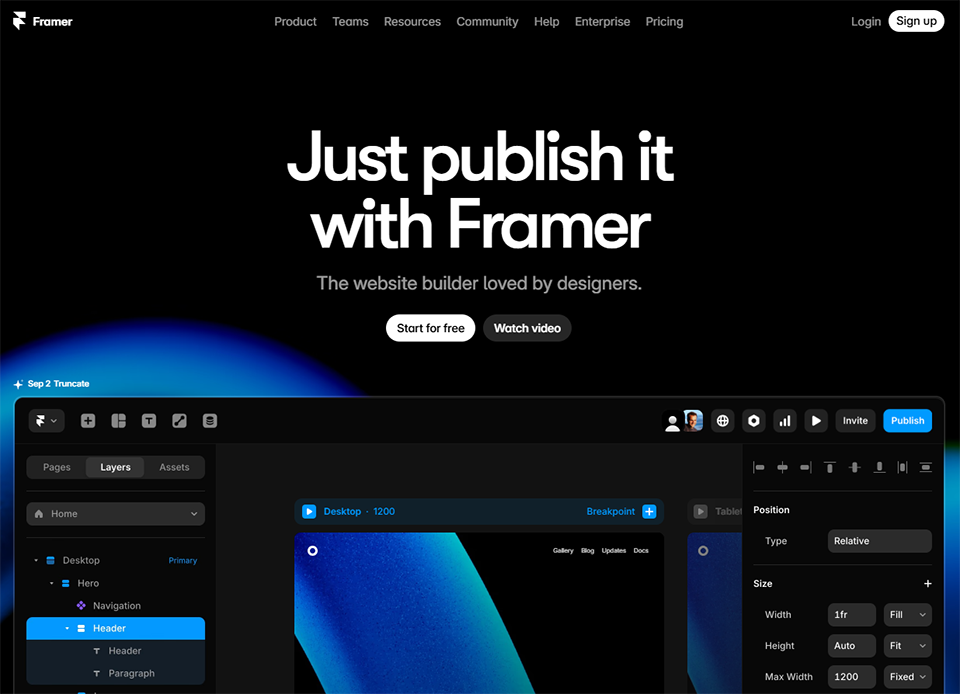
#2 - Framer: The best option for a marketing website that converts.
Benefit from our free deal on Framer.
30% off on annual plan
Find over 300 free deals as well as over 850 Premium deals right now with Framer and save on your software subscriptions. Whether you're an entrepreneur, a startup or a solo freelancer, save hundreds of euros thanks to our discounts and promo codes.
Framer is the tool you use when you want a landing page or a portfolio site that really stands out, without spending hours in Webflow or WordPress. The editor is smooth, the animations are native, and the final result far surpasses what most generic templates can produce.
Key features:
A visual editor powered by React components.
Animations and transitions directly within the interface.
Built-in CMS for blog or changelog pages.
Automatic SEO optimization and hosting included.
Pricing:
Free Plan: free (Framer subdomain, ideal for testing).
Mini Plan: starting at ~$5/month (custom domain, 1 page).
Basic Plan: starting at ~$15/month (unlimited pages, 1,000 visitors/month included).
Pro Plan: starting at ~$30/month (staging, advanced CMS, unlimited visitors).
Framer is particularly powerful for the initial versions of a SaaS site, where the goal is to validate that the product resonates with users before investing in a more robust infrastructure.
Benefit from a on Framer.
3 months free on annual “PRO” plan
Find our best discount right now with Framer and save on your software subscriptions. We offer over 850 promo codes and discounts on the best software and SaaS on the market.
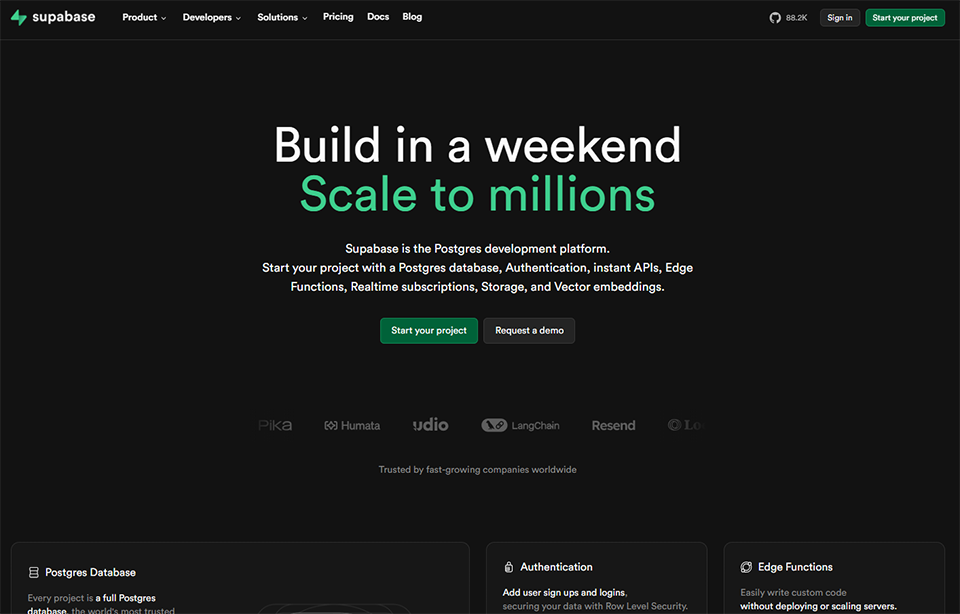
#3 - Supabase: The open-source database that’s on par with Firebase.
For solo developers, Supabase has become the go-to alternative to Firebase. It offers a managed PostgreSQL database, out-of-the-box authentication, automatically generated REST and GraphQL APIs, and native real-time capabilities.
Key features:
PostgreSQL database with a visual administration interface.
Pro Plan: starting at ~$25/month (8 GB of storage, daily backups, email support).
Team Plan: starting at ~$599/month (SLAs, SSO, advanced compliance).
Supabase is particularly well-suited for B2B SaaS applications, where PostgreSQL’s flexibility offers a real advantage over more rigid NoSQL databases.
Benefit from a on Supabase.
$50 in free credits
Find our best discount right now with Supabase and save on your software subscriptions. We offer over 850 promo codes and discounts on the best software and SaaS on the market.
#4 - Vercel: Continuous deployment for modern developers.
If you're developing with Next.js, React, or just about any modern JavaScript framework, Vercel is the go-to hosting provider. Deployment from GitHub takes just a few seconds, every pull request generates a preview environment, and performance is optimized out of the box.
Highlights:
Global CDN with integrated edge computing.
Automatic previews with every commit.
Native integration with Next.js (Vercel created it).
Built-in Analytics and Web Vitals.
Automatic SSL certificates.
Pricing:
Hobby Plan: Free (for personal use, unlimited deployments).
Pro Plan: starting at ~$20/month (commercial use, increased bandwidth, advanced analytics).
Enterprise Plan: Pricing available upon request.
For most SaaS companies in the launch phase, the Hobby or Pro plan is more than enough.
Benefit from a on Vercel.
No deals currently available
Find our best discount right now with Vercel and save on your software subscriptions. We offer over 850 promo codes and discounts on the best software and SaaS on the market.
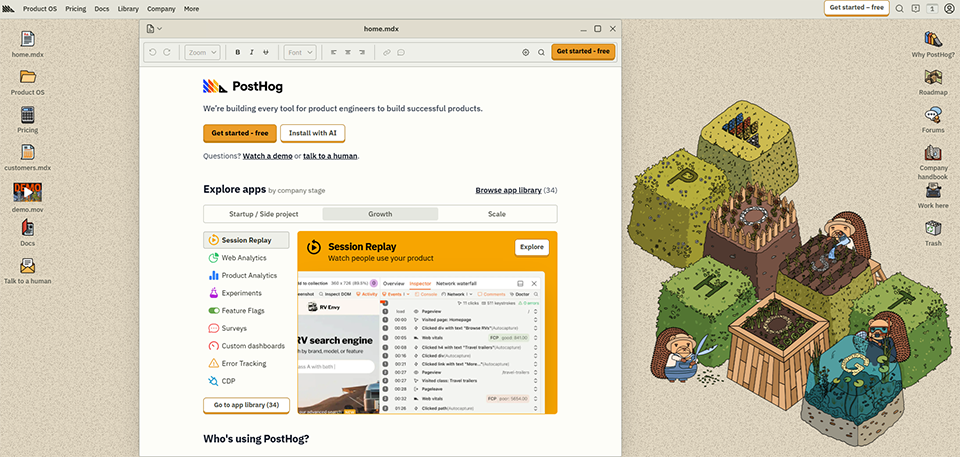
#5 - PostHog: The all-in-one product analytics suite.
PostHog combines into a single tool what would normally require Mixpanel + Hotjar + LaunchDarkly + a session replay solution. For a solopreneur, this is a huge advantage: one integration, one interface, one invoice.
What PostHog covers:
Tracking of custom events (such as Mixpanel).
Conversion and retention funnels.
User session recordings.
Feature flags and A/B tests.
Heatmaps.
Pricing:
Free Plan: 1 million events per month included, access to all features.
Paid Plan: Pay-as-you-go pricing for usage over one million, very affordable for the early stages.
It’s one of the few solutions on the market to offer such a generous free plan for such a comprehensive tool. It’s ideal for understanding how your early users actually interact with your product.
Benefit from a on PostHog.
$50,000 in credits
Find our best discount with PostHog and save on your software subscriptions. We offer over 850 promo codes and discounts on the best software and SaaS on the market.
#6 - Hotjar: See exactly what your users are doing.
Benefit from our free deal on Hotjar.
20% off on annual plan
Find over 300 free deals as well as over 850 Premium deals right now with Hotjar and save on your software subscriptions. Whether you're an entrepreneur, a startup or a solo freelancer, save hundreds of euros thanks to our discounts and promo codes.
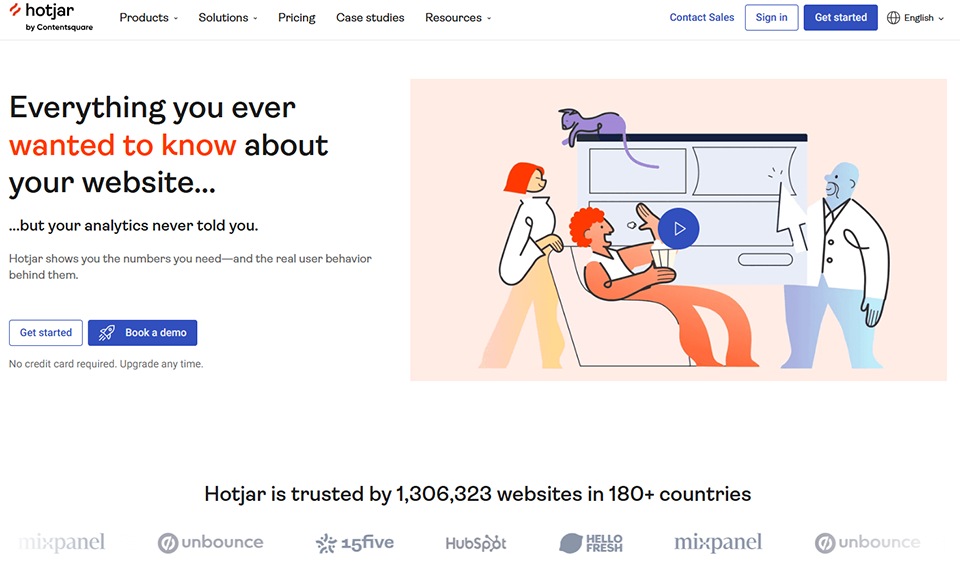
Hotjar helps you understand visitor behavior on your website or in your app through heatmaps, session recordings, and pop-up surveys. It’s a valuable complement to an event-based analytics solution.
Key features:
Click, scroll, and mouse movement heatmaps.
Video recordings of the sessions.
Built-in feedback widgets and NPS surveys.
Visual funnel analysis.
Pricing:
Basic Plan: Free (35 sessions per day, limited features).
Plus Plan: starting at ~$39/month (100 sessions/day, unlimited recordings).
Business Plan: starting at ~$99/month (increased volume, advanced filters).
For the launch phase, the free or Plus plan is usually sufficient to identify the initial UX pain points.
Benefit from a on Hotjar.
Additional 40% off on annual plan
Find our best discount right now with Hotjar and save on your software subscriptions. We offer over 850 promo codes and discounts on the best software and SaaS on the market.
#7 - Brevo: The most comprehensive email marketing tool.
Benefit from our free deal on Brevo.
10% off on annual plan
Find over 300 free deals as well as over 850 Premium deals right now with Brevo and save on your software subscriptions. Whether you're an entrepreneur, a startup or a solo freelancer, save hundreds of euros thanks to our discounts and promo codes.
Brevo (formerly Sendinblue) has become a go-to solution for entrepreneurs who want to take email marketing seriously without paying HubSpot's price tag. It covers standard email campaigns, automated sequences, SMS, live chat, and a basic CRM.
Transactional (emails triggered by product events).
Native A/B testing.
Pricing:
Free Plan: Free (300 emails per day, unlimited contacts).
Starter Plan: starting at ~$9/month (increased storage, Brevo logo removed).
Business Plan: starting at ~$18/month (advanced automation, A/B testing, detailed statistics).
For early-stage SaaS companies, Brevo often offers the best value for money on the market when it comes to email.
Benefit from a on Brevo.
75% off on annual plan
Find our best discount with Brevo and save on your software subscriptions. We offer over 850 promo codes and discounts on the best software and SaaS on the market.
#8 - Lemlist: Personalized outbound prospecting to help you find your first 100 B2B customers.
Benefit from our free deal on Lemlist.
20% off on annual plan
Find over 300 free deals as well as over 850 Premium deals right now with Lemlist and save on your software subscriptions. Whether you're an entrepreneur, a startup or a solo freelancer, save hundreds of euros thanks to our discounts and promo codes.
If your SaaS targets professionals, lemlist is the most popular cold outreach tool in France. It lets you send highly personalized email sequences (with dynamic variables, custom images, and LinkedIn integration) to reach out to prospects without sounding robotic.
Highlights:
Advanced customization with images and dynamic variables.
Email Outreach Plan: starting at ~$59/month (email sending, basic features).
Multichannel Expert Plan: starting at ~$99/month (LinkedIn, advanced sequences).
Outreach Scale Plan: starting at ~$159/month (unlimited volume).
When it comes to finding your first 50 to 100 B2B customers, Lemlist is often much more effective than traditional marketing automation solutions.
Benefit from a on Lemlist.
An additional 20% off on annual plan
Find our best discount right now with Lemlist and save on your software subscriptions. We offer over 850 promo codes and discounts on the best software and SaaS on the market.
#9 - Mangools: SEO made simple for those who don't want to spend their lives poring over complex dashboards.
For a solopreneur looking to drive organic traffic without spending 10 hours a week on SEO, Mangools is an excellent alternative to SEMrush or Ahrefs. The interface is user-friendly, it includes all the essential features, and the price is significantly more affordable.
Included tools:
KWFinder: Keyword research with clear difficulty levels.
SERPChecker: Competitor Analysis on a SERP.
SERPWatcher: tracking rankings over time.
LinkMiner: Backlink Analysis.
SiteProfiler: Domain Overview.
Pricing:
Basic Plan: starting at ~$29.90/month (100 searches/day, 200 SERP lookups).
Premium Plan: starting at ~$39.90/month (500 searches/day, expanded features).
Plan Agency: starting at ~$79.90/month (for teams and agencies).
The learning curve is much more accessible than that of the competition.
#10 - Stripe: The de facto standard for processing online payments-and much more.
Stripe is the payment infrastructure used by virtually all modern SaaS companies. Its documentation is exemplary, its integration is seamless, and its capabilities go far beyond simple payment processing: subscription management, automated billing, free trial management, a self-service customer portal, and even tax tools for VAT compliance.
What Stripe covers:
Online payments (credit cards, SEPA, Apple Pay, Google Pay, etc.).
Stripe Billing for managing recurring subscriptions.
Stripe Tax for automatic tax compliance.
Stripe Radar for fraud prevention.
Integrated customer portal (subscription management on the user side).
Pricing:
Transaction fees: 1.5% + €0.25 per transaction (European cards).
Stripe Billing: included with the account (additional fees apply for certain advanced features).
Monthly subscription: no upfront fees.
It’s one of the few tools on this list whose cost is directly tied to your income, which is ideal for a startup phase when revenue is still low.
#11 - Pennylane: Real-time accounting for founders.
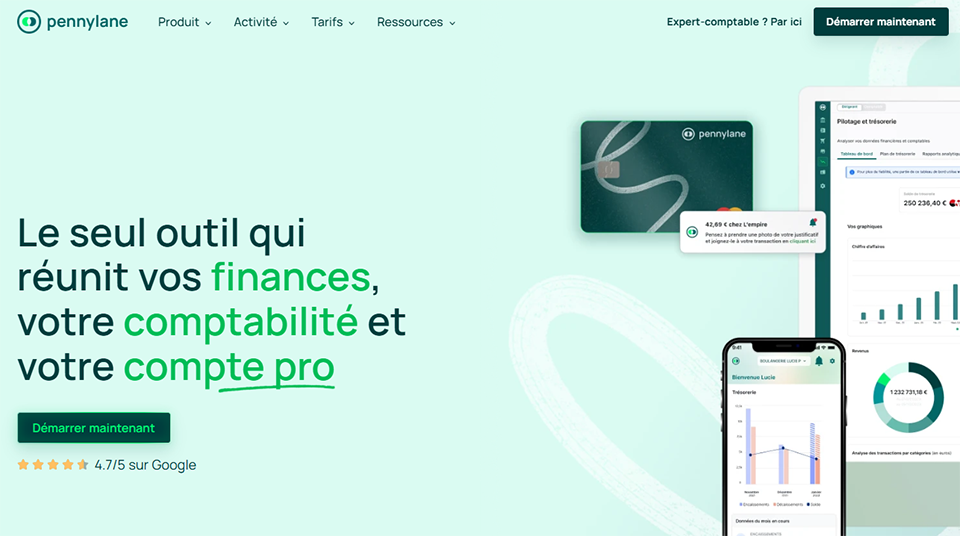
Pennylane is the most comprehensive accounting and invoicing solution for French solopreneurs and small businesses. It syncs with your bank, generates your invoices, tracks your cash flow in real time, and can be connected directly to your accountant if you have one.
Key features:
Automatic bank synchronization.
Creating and sending customer invoices.
Tracking expenses and expense reports.
Cash flow dashboards.
Working with your accountant.
Pricing:
Essential Plan: starting at ~€39/month (basic features, ideal for solopreneurs).
Business Plan: starting at ~€79/month (advanced features, multi-user).
To round out the financial side of things, Qonto remains the go-to choice for business bank accounts among French startups and freelancers, and integrates natively with Pennylane.
#13 - HubSpot: The most powerful free CRM on the market for the early stages of a SaaS business.
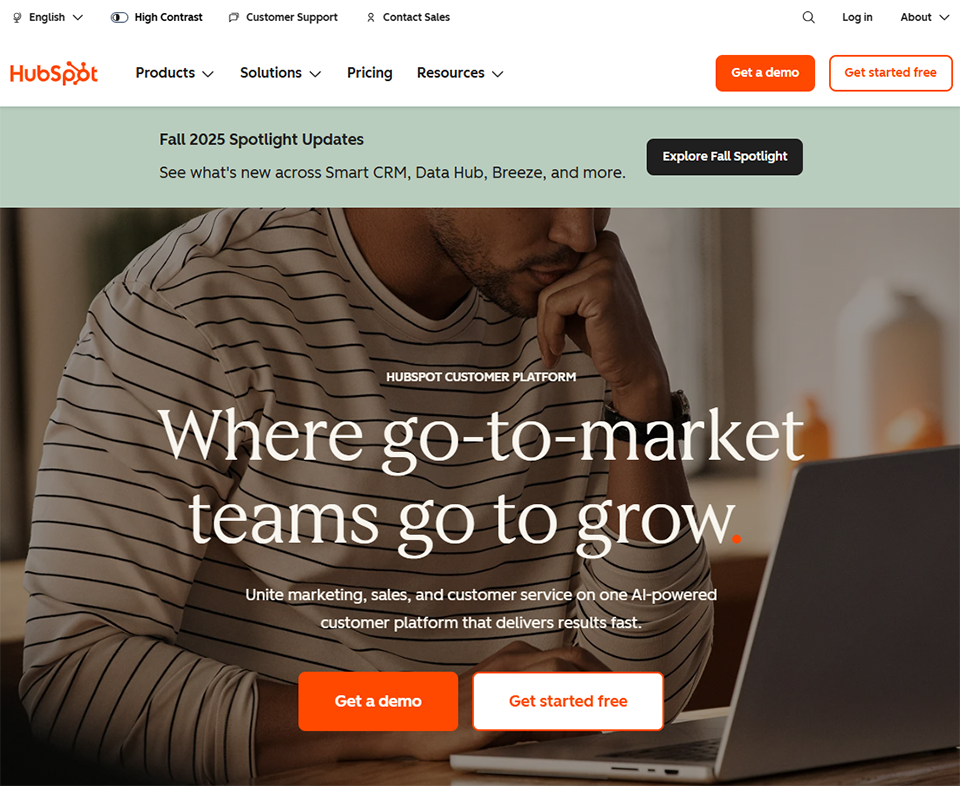
HubSpot offers a free version of its CRM, which is, objectively speaking, one of the best options on the market for a solopreneur in the traction phase. Contact management, sales pipeline, tracked emails, email sequences, and meeting bookings: all of these features are available without spending a single euro upfront.
Free Plan: Free (full CRM features, no time limit).
Starter Plan: starting at ~$20/month (basic automation, HubSpot branding removed).
Professional Plan: starting at ~$800/month (advanced automation, reporting).
For the first 50 to 100 customers of a SaaS platform, the free version of HubSpot is more than enough. If you're looking for an alternative that's more sales-focused, Pipedrive is also a strong option.
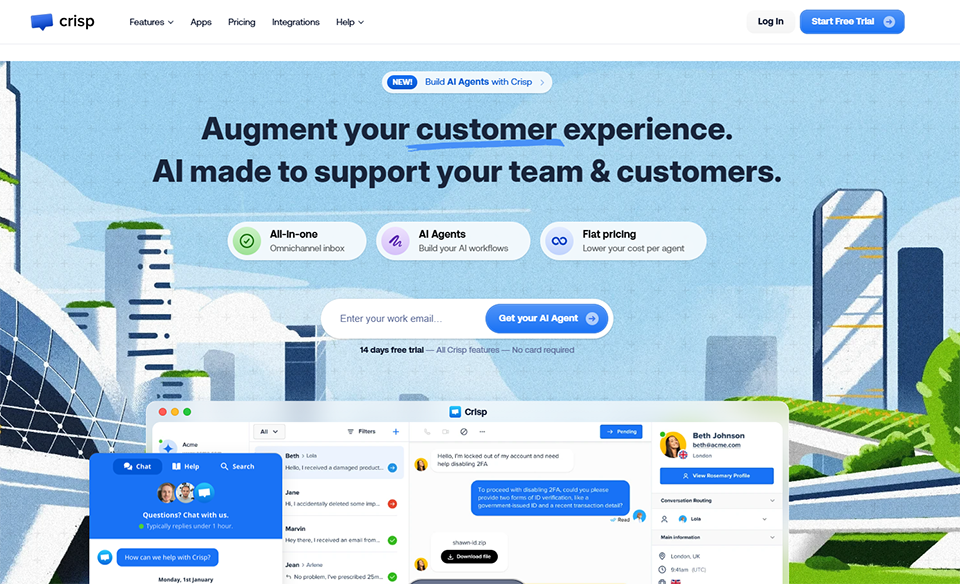
Crisp is the most widely used chat and customer support solution among early-stage startups in Europe. It allows you to embed a chat widget on your website, manage conversations from a unified inbox, and automate responses to frequently asked questions using chatbots.
Key features:
Chat with a customizable widget.
Unified inbox (email, chat, social media).
Chatbots for automating customer support.
Integrated knowledge base.
In-app onboarding campaigns.
Pricing:
Free Plan: Free (2 agents, basic features).
Pro Plan: starting at ~€25/month (unlimited agents, bots, advanced integrations).
Unlimited Plan: starting at ~€95/month (all-inclusive, for growing teams).
Crisp is often the first support tool that solo founders set up, precisely because it allows them to stay in close contact with users even when resources are limited.
#15 - Make: Visual automation to connect your tools without coding.
Make (formerly Integromat) is the go-to automation platform for many solopreneurs. Its visual "scenario" interface is more intuitive than Zapier for complex workflows, and its pricing is generally more cost-effective as the volume of operations increases.
Highlights:
Advanced conditional logic in workflows.
Error handling and automatic retries.
Modules available for over 1,500 applications.
Ability to process data (parsing, transformation).
Scheduled scenarios or scenarios triggered by a webhook.
Pricing:
Free Plan: Free (1,000 transactions/month, 2 active scenarios).
Core Plan: starting at ~$10.59/month (10,000 transactions/month, unlimited scenarios).
Pro Plan: starting at ~$18.82/month (40,000 transactions/month, advanced features).
For more technical use cases or for solopreneurs looking for a self-hosted solution, n8n is a powerful open-source alternative worth exploring.
#16 - Notion: The operational brain of your SaaS: roadmap, documentation, notes-all in one.
Notion has become the go-to workspace for nearly all indie hackers and solopreneurs. More than just a notepad, it lets you structure your product roadmap, document your code and processes, manage your backlog, and even create public pages for your changelog.
Free Plan: Free (unlimited blocks, unlimited pages for personal use).
Plan Plus: starting at ~$10/month (advanced collaboration, unlimited history).
Business Plan: starting at ~$18/month (SAML SSO, advanced analytics).
For solopreneurs, the Free or Plus plan covers most operational needs.
For tasks that are more focused on team-based project management or for more structured sprint tracking, Linear is a very clean alternative that is particularly popular among developers.
Comprehensive Comparison Chart 📋
The prices listed are for the plans most commonly used by solopreneurs in the launch phase. These prices are subject to change; we encourage you to check them directly on the official websites.
Tool
Category
Departure plan
Recommended startup plan
Available for free
Bubble
No-code / Dev
Free
Starter ($29/month)
✅
Framer
Marketing website
Free
Basic ($15/month)
✅
Supabase
Database
Free
Pro ($25/month)
✅
Vercel
Accommodation
Free
Pro ($20/month)
✅
PostHog
Product Analytics
Free
Usage-based
✅
Hotjar
UX / Heatmaps
Basic (Free)
Plus ($39/month)
✅
Brevo
Email marketing
Free
Starter (~$9/month)
✅
Lemlist
Cold outreach
59 $/month
Email Outreach
❌
Mangools
SEO
29,90 $/month
Basic
❌
Stripe
Payments
% per transaction
Standard
✅
Pennylane
Accounting
39 €/month
Essential
❌
HubSpot
CRM
Free
Free (then Starter)
✅
Crisp Chat
Customer Support
Free
Pro (€25/month)
✅
Make
Automation
Free
Core ($10.59/month)
✅
Notion
Workspace
Free
Plus ($10/month)
✅
🎯 Which user profile uses which tool?
Depending on your background and stage of development, the most important tools will vary. Here’s how to build your ideal tech stack.
👨💻 The technical founder (developer):
If you know how to code, your tech stack will naturally differ from that of a non-developer. You probably don’t need Bubble, but Supabase and Vercel will become your best allies. Add PostHog from day one so you don’t start out in the dark, Stripe for monetization, and Crisp to stay connected with your early users.
The key here is not to over-engineer things at the outset. Many developers spend weeks choosing their tech stack instead of verifying that anyone is willing to pay for their product.
🧑💼 The no-code founder / non-developer:
Bubble and Framer make a powerful combination for building and launching a fully functional product in just a few weeks. Brevo handles your onboarding emails, HubSpot manages your initial sales outreach, and Make automates repetitive tasks. You can launch a fully functional, revenue-generating product without writing a single line of code.
🧑🎨 The marketing/content-focused founder:
Your strength lies in your ability to attract customers. Focus on Framer for your landing page, Brevo for your email list, Lemlist for your B2B outreach, and Mangools to identify the keywords you’re ranking for. PostHog will then tell you whether visitors are converting as you’d hoped.
🚀 The founder in the rapid scaling phase:
Once you start generating your first recurring revenue, you’ll need to monitor your product more closely: Hotjar for UX, PostHog for conversion funnels, Pennylane for cash flow management, and HubSpot (paid version) for structuring your sales pipeline.
Advantages and disadvantages of each tool.
An honest look at the strengths and limitations of each tool, so you can make the right choice without any unpleasant surprises.
Bubble:
✅ Quick setup, advanced features without needing a developer, and a very active community.
👎 Limited performance at high volumes, platform dependency, and a steep learning curve for complex logic.
Framer:
✅ Professional-quality design, quick to set up, SEO-friendly.
👎 Less suitable for sites with a large number of pages; limited CMS features on lower-tier plans.
Answers to the most frequently asked questions to help you avoid common mistakes and confidently move toward your first euro in MRR.
1️⃣ What is the minimum budget needed for a tool stack during the launch phase?
By using the free plans available (PostHog, HubSpot, Crisp, Notion, Brevo, Supabase, Vercel, and Bubble-currently in testing), you can keep your tech stack under $50/month for the first few months. Once you have your first recurring revenue streams in place, a budget of $200 to $400/month will unlock most of the paid features that accelerate growth.
2️⃣ Bubble or coding from scratch: which should you choose to launch your SaaS?
If you know how to code, coding offers more flexibility in the long run and greater control over performance. But if your goal is to quickly validate a market, Bubble often lets you build a revenue-generating MVP 3 to 5 times faster. Many tech founders choose Bubble for their MVP and then rewrite the code themselves once they’ve validated product-market fit.
3️⃣ How can a SaaS company that collects data ensure GDPR compliance?
This is an issue that is often overlooked during the launch phase. Tools like PostHog offer self-hosting options that simplify compliance. Brevo, Crisp, and Stripe are GDPR-compliant providers with data processing agreements (DPAs) available. For your privacy policy and legal notices, dedicated compliance solutions are available on Freelance Stack the Compliance & GDPR category.
4️⃣ Should you start a company before launching your SaaS?
No, technically you can start as a sole proprietorship. But as soon as your revenue reaches a significant level (around €3,000 to €5,000 in MRR), it often makes sense to set up a more suitable legal structure (such as an SASU or SAS). Stripe Atlas also lets you set up a Delaware C-Corp directly online if you’re targeting an international market.
5️⃣ What is the difference between an email marketing tool and a cold outreach tool?
These are two distinct approaches. Email marketing (Brevo, Mailchimp) targets people who have agreed to hear from you, typically by signing up. Cold outreach (Lemlist, Woodpecker) targets prospects who don’t know you yet. Both have a place in an acquisition strategy, but they don’t use the same lists or follow the same legal guidelines.
6️⃣ How do you choose between Make and Zapier for automation?
Make is generally more cost-effective and more powerful for complex workflows involving conditional logic. Zapier is easier to get started with for basic automations and offers a slightly wider range of integrations. For a solopreneur with some technical curiosity, Make is almost always the better choice.
7️⃣ Are there any tools on this list that work particularly well together?
Several combinations are particularly effective: Framer + Brevo for the website and email marketing, Supabase + Vercel for the backend and deployment, HubSpot + Lemlist for CRM and outreach, and PostHog + Hotjar for product analytics and UX. And Make can serve as the glue that ties most of them together.
Launching a SaaS startup on your own has never been more technically accessible. The real challenge today is no longer access to tools, but the ability to choose the right ones, avoid spreading yourself too thin, and stay focused on what really matters in the first few weeks: understanding your market, building what people actually want, and bringing in your first revenue.
The tools featured here were selected because they are accessible from the start (often free), scalable as your business grows, and recognized by the startup community. You’ll find promo codes and discounts for all of these solutions at Freelance Stack, the SaaS deals platform for entrepreneurs and freelancers.