The 7 Best Tools for Managing Your Entire Customer Relationship Without Juggling a Dozen Apps
This article reviews seven solutions that cover most of the customer relationship spectrum, from pure sales CRM to conversational support. Each has its own strengths, positioning, and ideal user profile. The goal: to help you see the big picture and make an informed choice.
Why Customer Relations Have Become a Major Operational Challenge?
Just a few years ago, “managing customer relationships” often meant using an Excel spreadsheet, a shared email inbox, and a lot of good will. For a small business or a freelancer with about ten active clients, this was manageable. As the business grows, however, this makeshift approach ends up costing a lot in lost time, missed opportunities, and sometimes even lost customers.
Today, customer relations encompass a much broader scope than is often realized. It’s not just about “responding to support requests.” It also involves tracking the sales pipeline, following up at the right time, centralizing multichannel interactions, automating recurring communications, and maintaining a consistent view of each contact, regardless of which team member handled the last message.
The problem is that the proliferation of tools has had the opposite effect of what was intended. An email system here, a CRM there, a chat tool on top of that, a ticketing platform running in parallel... Information becomes fragmented, teams get lost, and customers notice inconsistencies. Having too many poorly integrated tools is often worse than having too few.
That is precisely why choosing a solution that fits your organization and your needs is worth taking the time to consider. It’s not about finding “the best tool on the market” in absolute terms, but about identifying the one that fits your specific situation: team size, volume of contacts, types of interactions, and available budget.
This article reviews seven solutions that cover most of the customer relationship spectrum, from pure sales CRM to conversational support. Each has its own strengths, positioning, and ideal user profile. The goal: to help you see the big picture and make an informed choice.
#1 - HubSpot: The Swiss Army knife of customer relations.
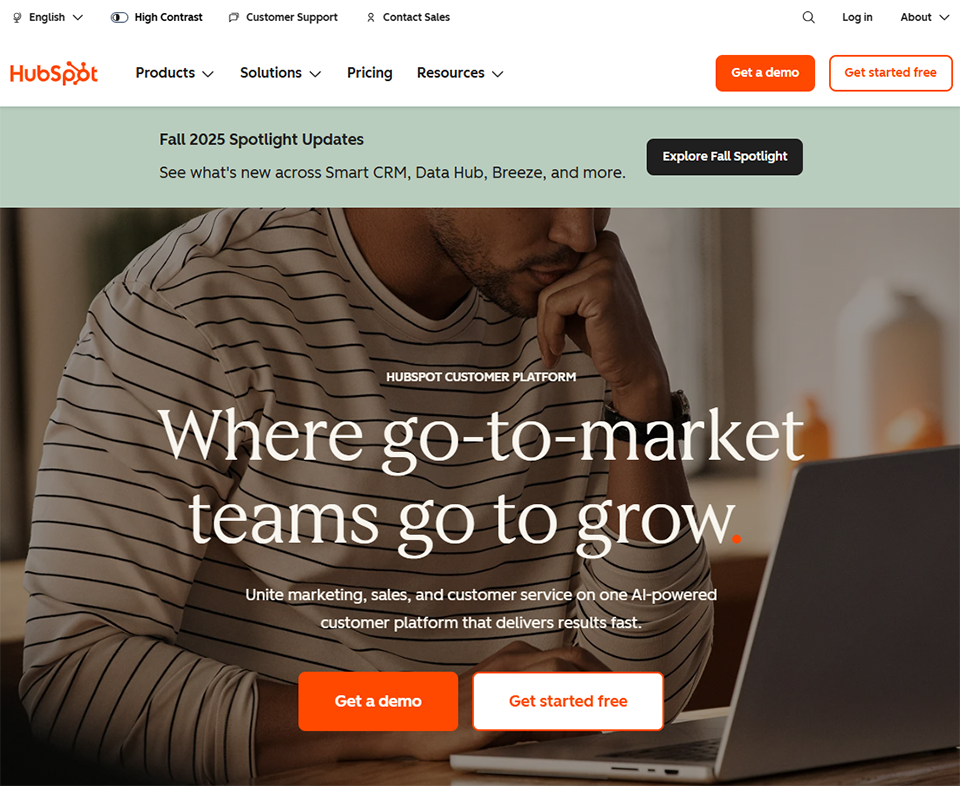
HubSpot is probably the name that comes up most often when discussing CRM solutions for startups and small and medium-sized businesses. And for good reason: it’s one of the few platforms to offer a comprehensive ecosystem encompassing CRM, marketing, sales, customer service, and a CMS-all within a single, cohesive interface.
HubSpot’s promise is to break down silos between teams. When a contact is added to your database, every interaction-whether it’s an opened email, a completed form, a sales call, or a support ticket-is automatically added to their profile. Everyone on the team sees the same information, at the same time.
Here's what HubSpot actually offers:
A completely free basic CRM with unlimited contacts and a visual sales pipeline.
Specialized hubs (Marketing, Sales, Service, CMS, Ops) that can be activated on an as-needed basis.
Tools for email automation, lead nurturing, and lead scoring.
A ticketing system for customer support, with a shared inbox and a knowledge base.
Advanced, customizable analytical dashboards.
Native integrations with Gmail, Outlook, Slack, Salesforce, and hundreds of other apps.
Pricing:
Free CRM plan (unlimited contacts, basic pipeline).
Starter Plan: starting at €15/month/user.
Professional Plan: starting at €90 per month per user.
Enterprise Plan: Price upon request.
👍 The advantages:
A comprehensive ecosystem with true integration between modules.
A generous and feature-rich free version.
A gradual learning curve.
A wide range of native integrations.
High-quality training resources (HubSpot Academy).
👎 The disadvantages:
Prices rise quickly as soon as you move up to a higher-end model or add multiple hubs.
Some advanced features (automations, reporting) are available only on higher-tier paid plans.
It can become cumbersome for very small organizations that don't need all that complexity.
Benefit from a on HubSpot.
90% off during 1 year
Find our best discount right now with HubSpot and save on your software subscriptions. We offer over 850 promo codes and discounts on the best software and SaaS on the market.
Pipedrive starts with a simple observation: most CRMs were designed for managers who want reports, not for salespeople who need to act quickly. As a result, sales teams don’t update their tools, information gets lost, and the CRM becomes a ghost system.
Pipedrive was designed with the user in mind: first and foremost for those who manage sales opportunities on a daily basis. The interface features a highly visual pipeline view where deals move from one stage to the next via drag-and-drop. Simple, intuitive, and effective.
What Pipedrive actually offers:
A visual, customizable drag-and-drop sales pipeline.
Track activities (calls, emails, meetings) with smart reminders.
Automations for repetitive tasks (sending emails, updating statuses).
A built-in AI assistant that suggests actions and identifies risky opportunities.
Web forms to capture leads directly into the pipeline.
A robust mobile app for field sales reps.
Over 400 integrations available.
Pricing:
Essential Plan: €14/month/user.
Advanced Plan: €34/month/user.
Professional Plan: €49/month/user.
Power Plan: €64 per month per user.
Enterprise Plan: €99 per month per user.
14-day free trial.
👍 The advantages:
Very intuitive interface, quickly adopted by teams.
A clear and customizable visual pipeline.
Good value for money on the mid-tier plans.
Automation solutions that require no technical expertise.
Successful mobile app.
👎 The disadvantages:
Less suitable for customer support management or marketing automation.
Limited reporting on lower-end models.
Advanced automation requires higher-level plans.
Benefit from a on Pipedrive.
30% off on any plan during 12 months
Find our best discount right now with Pipedrive and save on your software subscriptions. We offer over 850 promo codes and discounts on the best software and SaaS on the market.
Find over 300 free deals as well as over 850 Premium deals right now with Folk and save on your software subscriptions. Whether you're an entrepreneur, a startup or a solo freelancer, save hundreds of euros thanks to our discounts and promo codes.
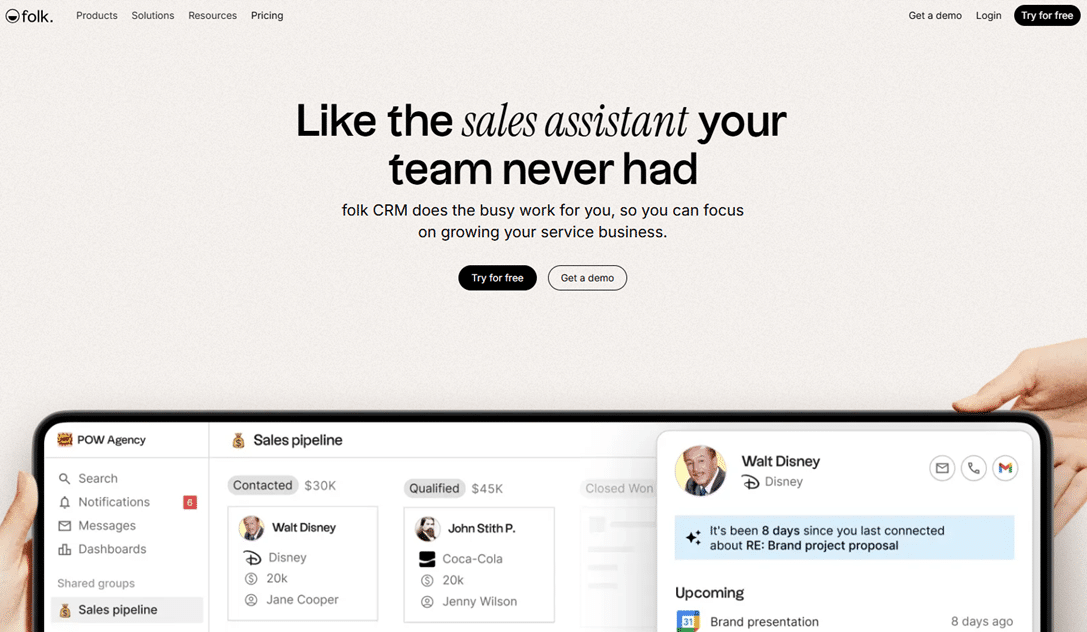
Folk stands out clearly from its competitors thanks to its philosophy. While HubSpot and Pipedrive are designed for formalized sales processes, Folk is built to manage relationships, not just deals. This is an important distinction that makes all the difference in practice.
The tool is particularly popular among freelancers, consultants, content creators, recruiters, and anyone whose work relies on a dense and active network. Folk is a bit like a very powerful version of Notion combined with a CRM, with an interface that’s easy to use.
What Folk actually offers:
Ultra-flexible contact management with fully customizable features.
A Chrome extension for importing contacts from LinkedIn with a single click.
Dynamic groups for segmenting contacts based on specific criteria.
Personalized email sequences sent directly from Folk.
An AI assistant that drafts personalized messages based on contact information.
A streamlined sales pipeline for those who want a little structure in their sales process.
Multiple views: table, list, kanban.
Pricing:
Free limited plan (1 user, up to 100 contacts).
Standard Plan: $20/month/user.
Premium Plan: $40/month/user.
Custom Plan: Price upon request.
👍 The advantages:
A modern, user-friendly interface that's easy to pick up.
Highly effective native LinkedIn import.
A great deal of flexibility in scheduling appointments.
Contextual AI for personalizing messages.
Well-suited for non-commercial social interactions.
👎 The disadvantages:
Less suitable for complex sales cycles or structured sales teams.
No built-in customer support module.
Automation features that are less advanced than those of HubSpot or ActiveCampaign.
Benefit from a on Folk.
Find our best discount right now with Folk and save on your software subscriptions. We offer over 850 promo codes and discounts on the best software and SaaS on the market.
#4 - Zendesk: The Gold Standard for Large-Scale Customer Support
Zendesk stands out in this comparison. It isn’t a CRM in the traditional sense: it’s primarily a customer support platform. Tickets, live chat, emails, social media, phone calls… Zendesk centralizes all the channels through which your customers can contact you and turns them into tickets that your team can manage.
For a company that receives a significant volume of customer inquiries and needs to prioritize, assign, track, and measure their resolution, Zendesk is often the go-to solution.
Here's what Zendesk actually offers:
A multi-channel ticketing system (email, chat, phone, social media, web form).
Queues, prioritization rules, and automatic assignment workflows.
A knowledge base to help customers find answers on their own.
Macros and template responses to help agents work more efficiently.
Detailed performance reports (response time, CSAT, SLA).
Built-in generative AI to suggest responses and summarize tickets.
A sales CRM (Zendesk Sell) is available as an option.
Pricing:
Team Plan: €55/month/agent.
Growth Plan: €89/month/agent.
Professional Plan: €115 per month per agent.
Enterprise Plan: Price upon request.
14-day free trial.
👍 The advantages:
The gold standard for multichannel ticket management.
Comprehensive reporting and analytics.
Scalable from a small team to hundreds of agents.
A vast ecosystem of integrations (over 1,500 apps in the marketplace).
Increasingly powerful integrated AI.
👎 The disadvantages:
High costs, especially for small businesses.
Significant learning curve for the initial setup.
It may seem excessive for a company with fewer than 10 employees.
Benefit from a on Zendesk.
6 months free + 15% off
Find our best discount right now with Zendesk and save on your software subscriptions. We offer over 850 promo codes and discounts on the best software and SaaS on the market.
#5 - Intercom: The ultimate in conversational customer support
Benefit from our free deal on Intercom .
15% off on annual plan
Find over 300 free deals as well as over 850 Premium deals right now with Intercom and save on your software subscriptions. Whether you're an entrepreneur, a startup or a solo freelancer, save hundreds of euros thanks to our discounts and promo codes.
Intercom popularized the concept of real-time customer support through chat features built directly into products and websites. But since then, the tool has evolved significantly: today, it is a comprehensive platform that covers support, product marketing, and customer engagement.
Intercom's greatest strength is its ability to provide context. When a customer messages you, you instantly see who they are, what they're doing in your product, and their previous interactions. No more guessing.
Here's what Intercom actually offers:
A real-time chat widget that can be integrated into your website or app.
A shared email inbox to centralize all incoming messages.
Customizable chatbots to automatically screen and route inquiries.
A help center with a knowledge base accessible via chat.
Campaigns featuring messages tailored to user behavior (onboarding, reactivation).
Fin AI, their AI agent that resolves some tickets without human intervention.
CRM integrations (HubSpot, Salesforce) to connect support and sales.
Pricing:
Essential Plan: $29/month/agent.
Advanced Plan: $85/month/agent.
Expert Plan: $132/month/agent.
14-day free trial.
👍 The advantages:
A polished user experience, both for users and for the team.
In-depth contextual analysis of conversations.
One of the most advanced AI agents on the market.
A good balance between support and product engagement.
Seamless integration with common SaaS platforms.
👎 The disadvantages:
Prices that might come as a surprise, especially with AI-based billing.
Less suitable for phone support or highly formalized processes.
This system requires configuration to take full advantage of all its features.
Benefit from a on Intercom .
$100 in credits
Find our best discount with Intercom and save on your software subscriptions. We offer over 850 promo codes and discounts on the best software and SaaS on the market.
#6 - Crisp Chat: The affordable solution for small teams
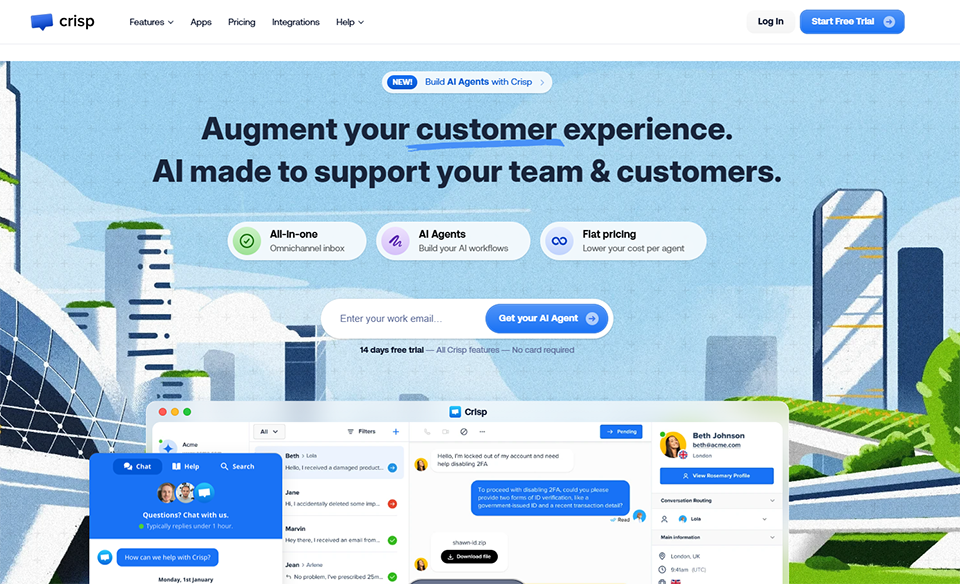
Crisp may be less well-known than its American competitors, but it clearly deserves a spot in this comparison. It’s a French solution (based in Nantes) that offers an all-in-one approach to customer support, with pricing that’s much more affordable than Zendesk or Intercom.
The tool brings together the following features in a single interface: live chat, email, a chatbot, a lightweight CRM, a knowledge base, and even a co-browsing module. For a small team looking to professionalize its customer service without breaking the bank, it’s a solid choice.
Here's what Crisp actually offers:
A live chat feature that can be integrated into any website in just a few minutes.
A shared inbox for all channels (email, chat, Instagram, WhatsApp).
A CRM system with a complete history of communications for each contact.
A no-code chatbot builder for automating first-line responses.
A knowledge base for self-service.
Co-browsing: View the customer's screen in real time to assist them.
Advanced features (co-browsing, chatbot) are available even on basic plans.
A French solution with responsive support.
Quick to deploy.
👎 The disadvantages:
Less suitable for teams with more than 20 agents.
Reporting capabilities are less advanced than Zendesk's.
Complex automations are still less powerful than Intercom.
Benefit from a on Crisp Chat.
20% off on "Essentials" and "Plus" plan
Find our best discount right now with Crisp Chat and save on your software subscriptions. We offer over 850 promo codes and discounts on the best software and SaaS on the market.
#7 - Brevo: The cornerstone of your customer relationship strategy
Benefit from a on Crisp Chat.
20% off on "Essentials" and "Plus" plan
Find our best discount right now with Crisp Chat and save on your software subscriptions. We offer over 850 promo codes and discounts on the best software and SaaS on the market.
Brevo (formerly Sendinblue) takes a different approach to customer relations than the other tools on this list. It is not a CRM in the strict sense, nor is it a customer support platform. It is primarily a marketing automation and email marketing platform, with CRM features that allow it to handle a significant portion of customer management.
For companies whose customer relationships rely heavily on proactive communication (newsletters, transactional emails, follow-up campaigns, text messages), Brevo is often the most logical tool to implement first.
What Brevo actually offers:
An email marketing tool with a drag-and-drop editor and professional templates.
A French solution (Brevo is based in Paris), with native GDPR compliance.
Robust e-commerce integrations.
👎 The disadvantages:
Less suitable for managing complex support tickets.
A CRM system that is less advanced than HubSpot or Pipedrive when it comes to sales management.
Advanced automations require the Business plan.
Benefit from a on Brevo .
75% off on annual plan
Find our best discount with Brevo and save on your software subscriptions. We offer over 850 promo codes and discounts on the best software and SaaS on the market.
⚠️ The prices listed below are for reference only. They are subject to change at any time depending on publishers' offers. Please check the official websites for current prices.
Tool
Type
Admission price
Free
Ideal for
HubSpot
CRM + Marketing + Support
€15 per month per user
✅ Yes (CRM)
Startups and Growing SMEs
Pipedrive
Sales CRM
€14 per month per user
❌ (14-day trial)
B2B Sales Teams
Folk
Relationship Management CRM
20 $/month/user
✅ Limited
Freelancers and active networks
Zendesk
Customer Support & Tickets
€55 per month per agent
❌ (14-day trial)
Small and medium-sized business with a dedicated support team
Intercom
Conversational support
$29/month/agent
❌ (14-day trial)
SaaS and app publishers
Crisp Chat
Chat multichannel support
Free / 25 €/month
✅ Yes (2 agents)
Small Businesses and Startups on a Tight Budget
Brevo
Email Marketing + CRM
8 €/month
✅ Very generous
E-commerce and marketing automation
Which tool suits your profile? 🎯
Each tool has its own strengths; it all depends on your business, the size of your team, and your priorities.
HubSpot:
🚀 Growing startups and SMEs looking to centralize everything:
HubSpot is particularly well-suited for organizations that want to avoid fragmentation from the start. If you have marketing, sales, and support teams that need to share customer data, HubSpot helps you avoid using multiple incompatible tools.
💰Organizations starting out with a limited budget:
The free CRM is fully functional-it’s not a stripped-down version. For a small team just starting to organize its sales management, it’s a solid starting point with no financial commitment.
Pipedrive:
🧑💻Freelancers and consultants with a steady stream of leads:
Even when working alone, Pipedrive helps you stay on track. Automatic follow-ups, activity reminders, and conversation tracking: everything you need to make sure no opportunities slip through the cracks.
⚡Small and medium-sized businesses that find HubSpot too complex:
Pipedrive is more focused and easier to get started with. If your main need is sales management (rather than marketing automation or comprehensive customer support), Pipedrive covers the essentials with less hassle.
Folk:
🌐Freelancers and entrepreneurs rely on their network:
Folk is perhaps the CRM best suited for entrepreneurs don’t want a complex tool but need to keep track of hundreds of contacts. Its LinkedIn import feature, customizable settings, and AI-powered messages make it an incredibly effective tool for this type of user.
🎨Small teams without a rigid sales process:
No rigid processes, no pointless required fields. Folk adapts to the way you work-not the other way around. Perfect for agencies, creative studios, or consulting firms that want to centralize their operations without losing flexibility.
Zendesk:
🏢Small and medium-sized businesses (SMEs) and mid-sized companies with a dedicated support team:
Once you have multiple agents handling customer requests simultaneously, Zendesk provides a system that saves a significant amount of time. Automatic assignment, SLAs, and performance dashboards are major advantages.
🛍️E-commerce and businesses with high order volumes:
Black Friday, which generates 500 tickets in 48 hours? Handling product returns? Zendesk is designed to handle spikes in activity and maintain consistent service quality.
Intercom:
💻Software and SaaS app publishers:
Intercom was born in the world of SaaS and remains its undisputed leader. The ability to send context-driven messages based on in-app behavior (onboarding, upsells, feature announcements) is a real competitive advantage for digital products.
📈Startups in the rapid growth phase:
The combination of real-time support, onboarding messages, and behavioral analytics makes it a tool that is particularly well-suited for product and support teams working together.
Crisp Chat:
💸Small businesses and early-stage startups on a tight budget:
Crisp's free plan is a great way to get started, and the Pro plan-at €25/month for four agents-offers one of the best values on the market. For a small business looking for a robust tool without breaking the bank, it's hard to beat.
🛒E-commerce businesses and websites that require responsive customer service:
Live chat with mobile notifications, targeted messaging campaigns, and co-browsing make it an ideal tool for online stores or services that need to be easily reachable.
Brevo:
🌱Small businesses and entrepreneurs want to get started with email marketing without breaking the bank:
Brevo's free plan is one of the most generous on the market: unlimited contacts and up to 300 emails per day. For someone just starting to build a list and send out a newsletter, it's an ideal starting point with no commitment required.
🛍️E-commerce businesses and online stores:
The combination of transactional emails, abandoned cart automations, and SMS marketing makes it a very comprehensive tool for e-commerce businesses. Brevo integrates natively with Shopify, WooCommerce, PrestaShop, and most e-commerce CMS platforms.
See all the software of this category: Clients
Check out all the other software and discount we offer in this category. Explore other tools and choose the perfect solution to grow your business.
FAQ: Everything You Need to Know About Customer Relationship Management 💬
Here are a few frequently asked questions to help you think things through before making your decision.
1️⃣ Is customer relationship management only for large companies?
Not at all. An entrepreneur 50 active clients has just as much to gain from organizing their communications as an 80-person small business. The tools presented here cater to a wide range of needs, and many offer free or very affordable plans. The question isn’t “Do I need this?” but rather “What level of organization fits my current situation?”
2️⃣ What is the difference between a CRM and a customer support tool?
A CRM (Customer Relationship Management) system is primarily used to manage the sales lifecycle of a contact: from prospecting to closing the deal, including follow-ups and ongoing support. A customer support tool handles incoming requests after the sale: tickets, questions, complaints, and after-sales service. Some tools, such as HubSpot, combine both functions, while others, such as Zendesk or Crisp, specialize in support.
3️⃣ Can multiple tools be used simultaneously?
Yes, and that’s actually what more advanced teams often do: a CRM for sales, a support tool for customer service, and an email platform for marketing. The key is to ensure these tools are well integrated to avoid duplication. HubSpot is particularly well-suited for those who want to avoid this kind of piecemeal setup.
4️⃣ Will AI replace my support team?
Not entirely, but it’s already changing the way things are done. AI agents like Intercom’s Fin or those integrated into Zendesk can independently resolve simple, repetitive requests. This frees up time for complex cases that require empathy and human judgment. AI is a tool for improving efficiency, not a replacement.
5️⃣ How do you choose between Zendesk and Intercom?
Zendesk is generally better suited for organizations with formalized processes, SLAs, a high volume of tickets, and a need for advanced reporting. Intercom is a better fit if you’re a software company or app developer looking to combine responsive support with proactive product communication. Both are excellent tools: the choice depends on your specific situation.
6️⃣ Is Folk really a CRM?
Folk is often described as a "relationship-based CRM" rather than a sales CRM in the strict sense. It doesn't offer a sophisticated sales pipeline or quota management. However, when it comes to managing a network, tracking contacts, sending personalized messages at scale, and never losing track of a relationship, it's one of the most effective tools on the market.
7️⃣ Is Brevo a good CRM?
Brevo is first and foremost a marketing automation platform. It does have a CRM module, but it remains relatively basic compared to HubSpot or Pipedrive. On the other hand, if your main priority is proactive communication with your customers (email marketing, automated campaigns, SMS), Brevo is hard to beat in terms of value for money.
8️⃣ Which tool should you choose to get started on a budget?
Three options stand out for offering a truly usable free plan: HubSpot for basic CRM, Crisp for chat-based customer support, and Brevo for email marketing. Depending on your priorities, one of these three tools can help you get started at no cost and upgrade to a paid plan when your business needs it.