





Guide: How to Choose Data Management and Analysis Software
This guide is based on six of the most widely used tools in the entrepreneurial and startup ecosystem: Airtable,…
Read more


Just five years ago, integrating a chatbot into a website often required a substantial budget and a dedicated technical team. Today, the situation is radically different. The tools have become widely available, the interfaces can be used without writing a single line of code, and artificial intelligence has profoundly transformed what these systems are capable of doing.
For freelancers, startups, or small and medium-sized businesses, the question is no longer whether you should automate some of your customer interactions. The real question is: which tool best fits your operational needs, your budget, and your goals?
The market for chatbots and live chat solutions has been growing steadily for several years. The acceleration in the use of generative AI since 2023 has further amplified this trend: chatbots no longer simply answer pre-programmed questions. They analyze the context of a conversation, qualify leads, route users to the right human agent, or generate coherent responses based on your knowledge base.
For entrepreneurs small teams, this presents a real opportunity: to maintain a 24/7 presence, manage a growing volume of incoming requests, and focus human attention where it truly matters.
In this comparison, we’ve selected six solutions that are representative of the market in 2026: Tidio, Crisp Chat, Intercom, Landbot, ManyChat, and Chatbase. Each addresses distinct needs, and that’s exactly what we’ll be breaking down.
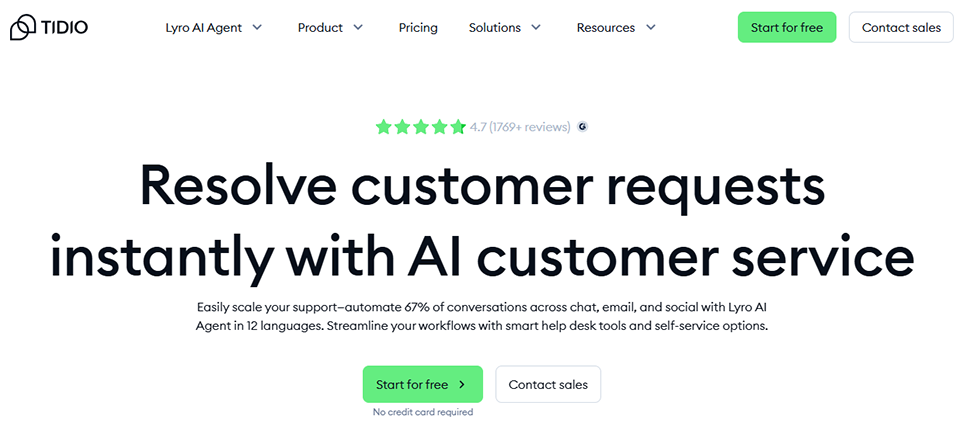

Tidio has established itself as a market leader for e-commerce businesses and small organizations looking to combine live chat, chatbots, and AI-powered support into a single interface. The tool is designed so that even someone without a technical background can set it up in less than an hour. Its visual chatbot editor uses a drag-and-drop interface, making it accessible even to teams without developers.
The solution is built on three distinct pillars. The first is traditional live chat, featuring a centralized inbox that allows you to manage multiple conversations simultaneously. The second is a visual chatbot builder, offering dozens of ready-to-use templates for qualifying leads, collecting email addresses, answering frequently asked questions, or triggering specific workflows. The third-and this is where Tidio has taken a significant turn since 2023-is its AI engine called Lyro. Lyro is capable of automatically answering a very large volume of customer questions by drawing on your existing content (FAQs, website pages, conversation history).
Tidio integrates natively with Shopify, WooCommerce, Wix, WordPress, Squarespace, and several CRMs such as HubSpot and Klaviyo.
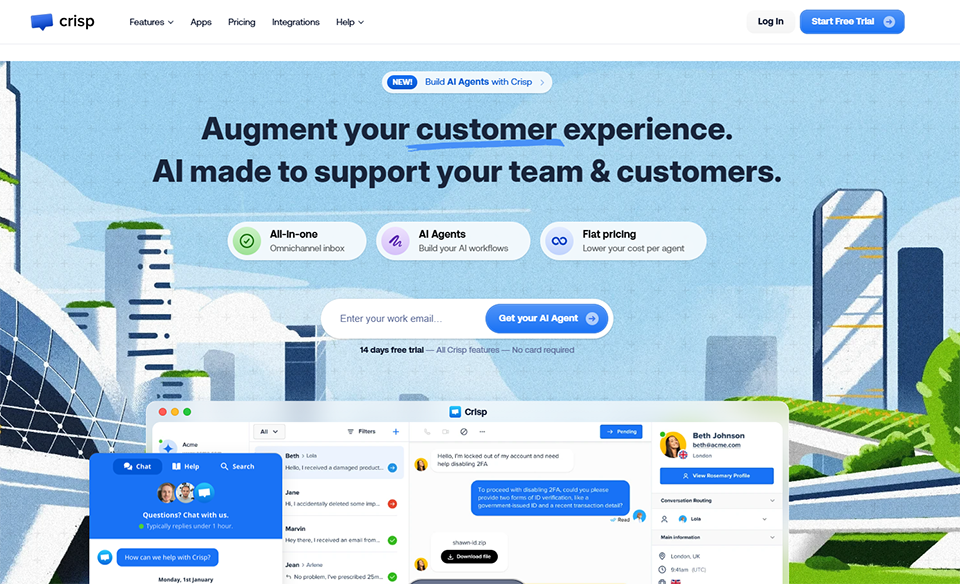
Crisp is a French tool (based in Nantes) that has built a solid reputation among startups and product teams. What sets it apart at first glance is its centralized inbox, which aggregates all communication channels: website, email, Messenger, Instagram, WhatsApp, and Telegram. Rather than using multiple tools to manage each channel, Crisp centralizes everything in a unified interface.
In addition to live chat, Crisp offers a campaign engine that allows you to send automated messages based on visitor behavior (time spent on a page, number of visits, user segment). Its built-in CRM automatically stores contact data and the complete history of each conversation.
Its chatbot system allows users to create workflows for lead qualification, appointment scheduling, or automated routing without requiring any special technical skills. Crisp also includes a public knowledge base (similar to a help center) and, more recently, an AI engine that suggests responses to agents in real time based on this knowledge base.
One feature that’s particularly popular is the availability of a native mobile app and browser extensions, which allow a small team to stay responsive even when on the go.


Intercom is often touted as the industry leader, and for good reason. Founded in 2011, the tool has gradually evolved from a simple chat widget into a comprehensive customer support and engagement platform. Its current vision centers on the concept of a "customer service platform": a single hub for managing support, onboarding, retention, and engagement.
In 2023 and 2024, Intercom placed a strong emphasis on AI with the launch of Fin, its AI agent capable of independently resolving complex issues by drawing on your documentation. The tool is primarily aimed at SaaS companies, structured support teams, and fast-growing businesses.
The platform covers a wide range of features. It includes live chat, a ticketing system, outbound messaging (in-app, email, push notifications), conditional and AI-powered chatbots, advanced reporting, and a basic CRM. The Fin AI agent can handle entire conversations without human intervention recurring topics and automatically escalates complex cases to an agent.
Team management is particularly robust: intelligent conversation routing, SLA management, automatic assignment based on skills, and performance reports by agent. For a startup in the scaling phase, this is a major selling point.
Native integrations cover more than 400 tools, including Salesforce, Stripe, Jira, Slack, GitHub, Zendesk, and the entire mainstream SaaS ecosystem.

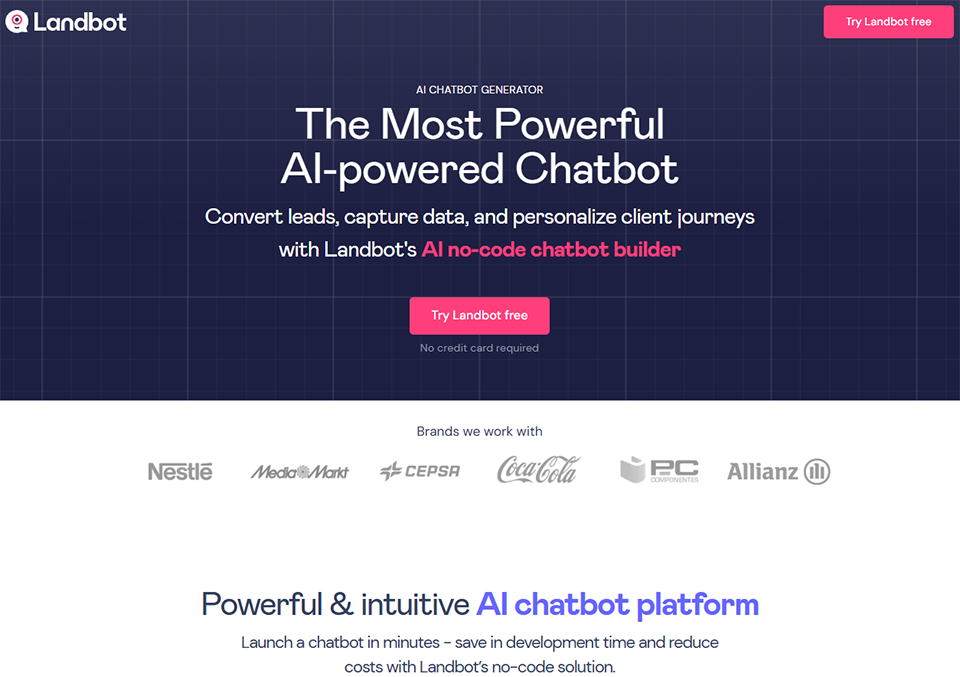
Landbot occupies a rather unique niche in this comparison: it’s a no-code conversational chatbot builder designed primarily for marketing and sales teams. Whereas other tools place chat at the center and add automation as an afterthought, Landbot operates on the principle that the chatbot is the primary interface, and that the conversation itself should be a complete experience in its own right.
The result: interfaces that feel more like immersive conversational forms than traditional support widgets. You can create landing pages built entirely around a chatbot, or integrate these flows directly into a website.
Landbot's visual editor is undoubtedly one of the most intuitive on the market. You build your workflows using blocks, including conditions, variables, calculations, and integrations with external tools (Google Sheets, HubSpot, Slack, Zapier, Make, Webhooks). Each step can be customized: text, images, buttons, dropdown menus, files, and appointment calendars.
In 2025, Landbot introduced AI features that allow you to insert "AI blocks" into your flows, enabling natural language responses at specific stages while maintaining the conditional structure of the rest of the journey.
Landbot operates across three main channels: website (widget or dedicated page), WhatsApp Business, and an API for custom integrations.

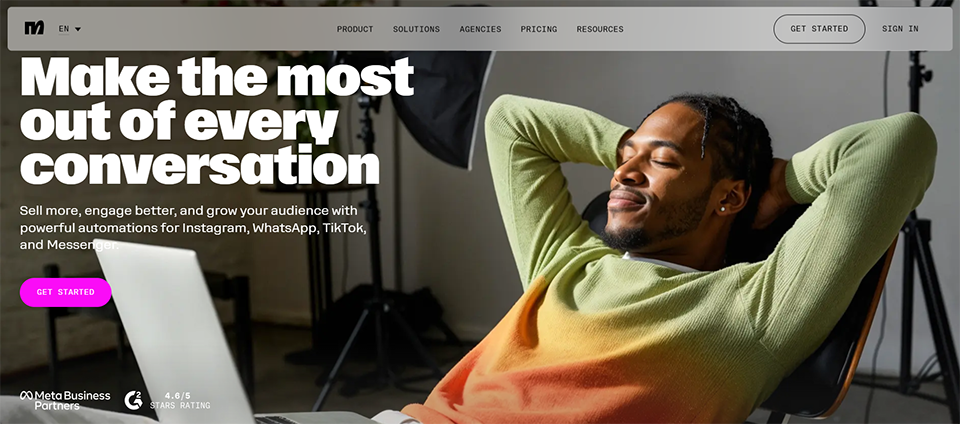
If your business revolves around social media and instant messaging, ManyChat is likely the best option to consider. The tool specializes inautomating conversations on social media platforms such as Instagram, WhatsApp Business, Facebook Messenger, SMS, and Telegram. It’s a very specific niche, but that specialization is precisely what makes it so effective.
For content creators, e-commerce stores with a strong Instagram presence, or businesses that generate a lot of engagement on social media, ManyChat helps turn comments and direct messages into structured conversations and sales opportunities.
The core principle of ManyChat is based on triggers: a user comments on your post with a keyword, replies to a story, clicks on a link, or sends a DM. From there, an automated sequence begins. You can qualify the request, ask questions, offer content, send a link to a payment page, or redirect the user to a live agent.
The tool also includes broadcast features (sending bulk messages to your opt-in subscribers), tag-based segmentation, and native integrations with Shopify, MailChimp, HubSpot, ActiveCampaign, and Zapier.
The interface is user-friendly for non-technical users, with templates for common use cases: lead generation, promotions, automated customer service, and onboarding new subscribers.
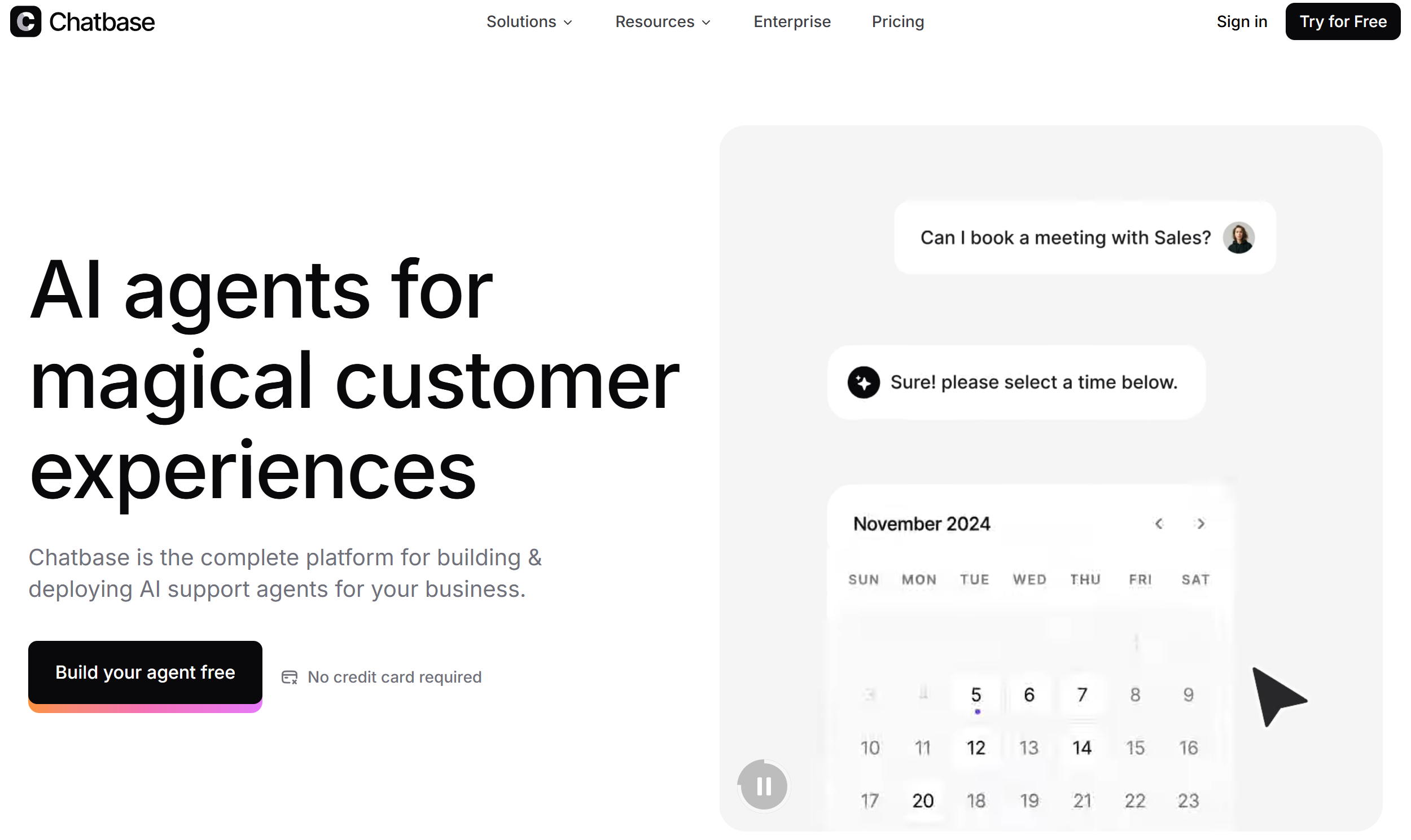
Chatbase stands apart in this comparison: it’s an AI chatbot trained on your own data. The idea is simple yet powerful: you import your content (documentation, FAQs, PDF files, website URLs, knowledge base), and Chatbase creates a conversational agent capable of providing precise answers to questions about that content, in natural language.
This is a radically different approach from traditional workflow builders. No conditional blocks to configure, no scenarios to design: you feed the model, and it responds.
The initial setup takes just a few minutes: import the source files, choose an AI model (GPT-4, Claude, or others depending on your plan), and customize the chatbot’s appearance and behavior. You can set the agent’s tone, give it a name, a description, and specific instructions.
Once deployed, the chatbot can be integrated into your website using a simple script, shared via a direct link, or connected to other tools via the API. Chatbase also offers native integrations with Slack, WhatsApp, and Zapier.
Built-in analytics allow you to track conversations, identify unanswered questions, and gradually improve the chatbot's performance by expanding the data sources.
For someone who works alone or in a small team, the priority is often to stay reachable without sacrificing focus or work hours. In this context, Crisp Chat is a particularly solid option: its free plan is fully functional, its interface is easy to get the hang of, and the centralized channels help you avoid spreading your attention across multiple tools. Chatbase can also provide real value if you want an AI agent to answer basic questions from your prospects or customers while you’re away, without having to manually configure dozens of scenarios.
A startup that is beginning to build out its customer support needs a tool that can scale with it. Intercom is the gold standard in this category: it covers support, in-app onboarding, and customer engagement all in one. The cost is higher, but the platform is designed for growing teams. For those who want to start with a more modest budget, Tidio offers good value for money with its Lyro AI engine.
E-commerce generates a predictable volume of inquiries: order tracking, return policies, product availability, and shipping costs. Tidio is designed for this use case, with its native Shopify and WooCommerce integrations and conversion-optimized templates. Gorgias (also available on Freelance Stack) is also worth mentioning here as a highly e-commerce-focused alternative.
While Instagram, WhatsApp, or Facebook Messenger may be your primary channels for customer acquisition or support, ManyChat doesn’t really have a direct equivalent. Its focus on these platforms and the depth of its automation features make it a natural choice for content creators, DTC brands, or agencies that manage active communities.
For lead generation campaigns or automated qualification processes, Landbot stands out for the quality of the conversational experience it enables. The ability to create landing pages entirely based on a chatbot, or to integrate flows into contact forms, makes it a particularly effective tool for maximizing conversion rates.
If your company already has structured documentation (FAQs, guides, procedures) and you’re looking to automate first-level responses without having to reconfigure everything, Chatbase offers the quickest solution. In just a few hours, you can have an AI agent up and running that provides accurate responses based on your existing resources.
Note: The rates listed are estimates based on data available in 2026 and are subject to change. Please check the official websites for the exact terms and conditions.
| Criterion | Tidio | Crisp Chat | Intercom | Landbot | ManyChat | Chatbase |
|---|---|---|---|---|---|---|
| Live chat | ✅ | ✅ | ✅ | ❌ | ❌ | ❌ |
| No-code chatbot | ✅ | ✅ | ✅ | ✅ | ✅ | ✅ (AI) |
| Autonomous AI agent | ✅ (Lyro) | ✅ (partial) | ✅ (End) | ⚠️ (partial) | ❌ | ✅ |
| Social media channels | ⚠️ | ✅ | ⚠️ | ✅ (WhatsApp) | ✅ | ⚠️ |
| E-commerce integration | ✅✅ | ✅ | ✅ | ✅ | ✅ | ⚠️ |
| Free map available | ✅ | ✅ | ❌ | ✅ | ✅ | ✅ |
| Admission fee (paid) | ~$29/month | ~€25/month | ~$29 per agent | ~€45/month | ~$15/month | ~$19/month |
| Ideal Profile | E-commerce, SMEs | Startup, SaaS | SaaS, scale-up | Marketing, leads | Social media | Documentation, FAQ |
| Learning curve | Low | Low/Medium | High | Low | Low | Very low |
| Value for money | ⭐⭐⭐⭐ | ⭐⭐⭐⭐ | ⭐⭐⭐ | ⭐⭐⭐ | ⭐⭐⭐⭐ | ⭐⭐⭐⭐ |
Below are the most frequently asked questions on this topic, along with detailed answers to help you better understand the issue.
Partially, yes. Next-generation AI agents like Fin (Intercom) or Lyro (Tidio) are capable of autonomously handling a significant portion of incoming requests, particularly recurring questions, basic information requests, or follow-up inquiries. However, complex situations, disputes, or interactions with high emotional stakes still require human intervention. The best approach remains the hybrid model: AI handles the volume, while humans manage the complexity.
A traditional chatbot operates based on predefined rules and scenarios: if the user says X, the bot responds with Y. An AI agent, on the other hand, is capable of understanding the meaning of a question-even if it’s phrased differently than expected-and generating a context-aware response. This distinction is important: a poorly configured chatbot can frustrate users who don’t fit the expected scenarios, whereas an AI agent will be more flexible when faced with unexpected phrasing.
Yes, the vast majority of the solutions presented here support French, both for the configuration interface and for conversations with end users. Crisp Chat, being a French company, offers particularly robust support for French. Intercom, Tidio, and Chatbase work very well in multiple languages, including French.
It depends heavily on the tool and your goals. With Chatbase, you can have a chatbot up and running in less than an hour if you already have existing documentation. With Tidio or Crisp, expect to spend a few hours setting up relevant scenarios and testing workflows. Intercom requires more time to learn, but in return offers a much higher level of customization.
All the solutions featured in this comparison are GDPR-compliant. As a French tool, Crisp pays particular attention to this issue. That said, compliance also depends on how you configure the tool: storage of conversation data, retention periods, and management of user consent. It is always recommended to verify the data processing terms with the provider and adapt your privacy policy accordingly.
Yes, and that’s actually one of the key differences between the solutions. Intercom offers over 400 native integrations. Tidio, Crisp, and Landbot rely on Zapier or Make to expand their connectivity. ManyChat natively integrates with the leading marketing CRMs. Integration capabilities are an important factor if you want data collected via the chatbot to automatically feed into your management or lead generation tools.
Start by asking yourself three simple questions: Where are your customers (on your website, on social media, via email)? What resources do you have available to set up and maintain the tool? What is your estimated monthly volume of conversations? These three factors will naturally guide you toward the solution that best fits your situation. If you’re still unsure, most of the tools listed here offer a free plan or a trial period so you can test them out before committing.
Among the tools available on Freelance Stack, you can also explore LiveChat, Freshchat, or JivoChat, which offer solid core features at competitive prices. Help Scout is also a good option if you’re looking for something more focused on support and tickets.