Recruitment, onboarding, payroll, engagement: the HR tools found in SMEs with well-structured processes
In this article, we’ve outlined the ideal HR stack based on its four pillars: recruitment, onboarding, payroll, and engagement. From putting an end to the chaos of Excel to adopting tools like Lucca or PayFit, we break down concrete solutions for transforming your HR department into a driver of growth, regardless of your team’s size.
Recruit, onboard, pay, retain. These four words alone sum up a reality that thousands of teams in France face every day. And yet, in many SMEs (small and medium-sized businesses) or startups in their growth phase, human resources management still relies on shared Excel spreadsheets, rough processes, and a significant amount of luck.
The problem isn’t a lack of willingness. Rather, it’s that the HR function has long been viewed as the exclusive domain of large companies, which have dedicated departments and substantial budgets. Today, that paradigm is crumbling. SaaS tools have made solutions—once reserved for mid-sized companies or multinationals—accessible at reasonable prices.
SMEs that have taken the lead in this area share one thing in common: they have structured their HR stack in successive layers, covering the four fundamental pillars of an employee’s lifecycle. Recruitment, onboarding, payroll, and engagement. These are precisely the four areas we’ll explore here, along with a selection of practical tools that have been tested and adopted by teams ranging in size from 5 to 150 people.
#1 - Taleez: The French ATS that simplifies without sacrificing power.
Taleez is a recruitment software (ATS, or Applicant Tracking System) designed for teams that don’t have a full-time recruiter but still need to manage a steady stream of applications. The tool lets you create job postings in just a few minutes, post them to major job boards from a single interface, and centralize all received applications in a visual pipeline.
What sets Taleez apart is how easy it is to get started. Managers and founders don’t need any technical training to understand where each candidate is in the process. Teams particularly appreciate the internal collaboration feature: they can leave comments on each profile, assign ratings, and coordinate feedback from multiple stakeholders without having to rely on endless email chains.
Key features:
Multi-posting of job ads on Indeed, LinkedIn, Welcome to the Jungle, and more.
Team collaboration with comments and profile ratings.
Integration of a custom application form on your website.
Reporting dashboard on application sources.
Estimated rates:
Team Plan: starting at €99/month (adjusted based on hiring volume).
👨💼 Who is this for?
🚀 A startup in the midst of an intensive hiring drive:
When you hire 5 or 10 people in a quarter, managing applications through email quickly becomes overwhelming. Taleez provides a streamlined solution: candidate profiles are tracked, follow-ups are automated, and decisions are made collectively.
🏢 The SME with several hiring managers:
In an organization with 20 to 80 employees where each department head is involved in hiring, Taleez makes it possible to centralize the process without losing control. Everyone works within their own scope, while HR maintains an overview.
✅ The benefits:
An intuitive and well-designed interface in French.
Built-in job-board multi-posting.
Great value for money for small teams.
Responsive support.
👎The downsides:
Less suitable for very large volumes (several hundred simultaneous openings).
Integrations with other HR tools remain limited compared to international solutions.
Benefit from a on Taleez.
€300 in credits
Find our best discount right now with Taleez and save on your software subscriptions. We offer over 850 promo codes and discounts on the best software and SaaS on the market.
#2 - Flatchr: Multi-posting job ads without breaking the bank on job board subscriptions.
Flatchr positions its ATS around a key selling point: the time and money saved by posting job listings simultaneously on dozens of job boards from a single platform. The tool is designed for teams that have a steady enough volume of job openings to justify a subscription but want to avoid juggling multiple job board contracts.
The interface is clean, the application workflow is clear, and the management of job pipelines is well-designed. Flatchr also includes employee referral features (to leverage the network of current employees) and employer branding tools, with the ability to create a branded careers page directly from within the tool.
Key features:
Posting to more than 80 job sources.
Personalized career page (employer brand).
Kanban-based application management.
Internal employee referral tool.
Recruitment reporting and analytics.
Estimated rates:
Standard Plan: starting at ~€149/month (depending on the options selected).
👩💼 Who is this for?
🏗️ The SME with recurring needs across several roles:
An engineering firm that regularly recruits technical professionals, a chain of stores that operates on a just-in-time basis for field positions: Flatchr is designed for this type of organization, where recruitment is an ongoing process rather than a one-time event.
🎯 Companies looking to build their employer brand:
The built-in career page and employee referral tools make Flatchr a valuable ally for SMEs looking to attract candidates more organically, without relying solely on paid job boards.
✅ The benefits:
Very broad multi-posting (80+ sources).
Employer branding and career page included.
Built-in employee referrals, rare at this price point.
An interface that can be used without training.
👎The downsides:
Fewer workflow customization options than some international ATSs.
Reporting could be more granular to support advanced analytical needs.
Benefit from a on Flatchr.
10% off on "BASIC" and "PRO" plan
Find our best discount right now with Flatchr and save on your software subscriptions. We offer over 850 promo codes and discounts on the best software and SaaS on the market.
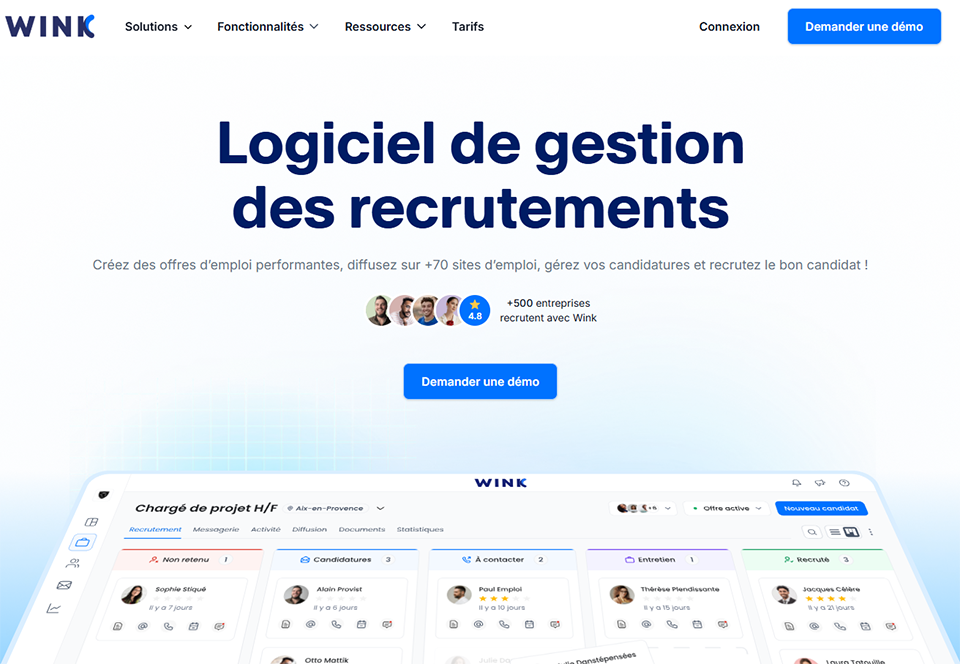
#3 - Wink: The ATS designed for recruiters who want to get things done quickly.
Wink is a newer solution on the market that focuses on a streamlined user experience and quick setup. The tool is particularly popular with recruitment agencies and HR teams looking for an ATS without the usual complexity of enterprise-level solutions. The workflow is simple: a job posting, a pipeline, and candidates who move forward or are rejected.
Key features:
A visual, customizable recruitment pipeline.
Send forms and tests directly from the tool.
Collaboration among recruiters.
History of interactions with each candidate.
Estimated rates:
A freemium plan is available, with paid plans within reach for SMEs. Check the Wink website for details.
✅ The benefits:
Easy to get started, very short learning curve.
Affordable pricing for small businesses.
Modern design and user-friendly interface.
👎The downsides:
Integration ecosystem still under development.
More limited reporting features than Taleez or Flatchr.
Benefit from a on Wink.
30% off on any plan
Find our best discount right now with Wink and save on your software subscriptions. We offer over 850 promo codes and discounts on the best software and SaaS on the market.
#4 - Freshteam: The all-in-one HR suite for SMEs just getting started.
Freshteam is the HR product from the Freshworks ecosystem, a well-established Indian software provider in the SMB segment. The solution covers recruitment, onboarding, employee information management, and time off in a unified interface. It’s the ideal tool for a team starting from scratch that wants to avoid piling up multiple subscriptions right from the start.
When it comes to onboarding, Freshteam lets you create customized onboarding checklists by role or department, assign tasks to various stakeholders (IT, managers, HR, finance), and track progress in real time. New employees are given access to a dedicated portal where they can complete their personal information, sign documents, and access the resources made available to them.
Key features:
Integrated ATS for recruitment.
Structured onboarding with checklists and assigned tasks.
Centralized employee database.
Leave and absence management.
Self-service employee portal.
Offboarding is also covered.
Estimated rates:
Free Plan: free for up to 50 employees (limited features).
Paid Plan: starting at $71/month for approximately 50 employees (price varies depending on team size and activated modules).
👨💼 Who is this for?
🌱 The SME of 10 to 50 people setting up its HR function for the first time:
Freshteam is an excellent starting point for an organization that doesn’t yet have an HRIS and is looking for a tool that can grow with it. Its range of features is broad enough to avoid having to use multiple tools in the early years.
🔄 The team that wants a single tool from sourcing to offboarding:
Recruitment, onboarding, HR tracking, time off, offboarding: all in one place. For HR professionals who wear many hats, this saves a significant amount of time.
✅ The benefits:
Broad functional coverage with a single subscription.
A generous free plan for very small teams.
Structured onboarding with task assignments involving multiple stakeholders.
Integrations with the Freshworks ecosystem (if you use Freshdesk, Freshsales, etc.).
👎The downsides:
Less powerful than specialized ATSs focused solely on recruitment.
The interface is sometimes less intuitive than that of newer competitors.
Benefit from a on Freshteam.
No deals currently available
Find our best discount right now with Freshteam and save on your software subscriptions. We offer over 850 promo codes and discounts on the best software and SaaS on the market.
#5 - Willo: Asynchronous video interviews to speed up the process.
Benefit from our free deal on Willo.
25% off on annual plan
Find over 300 free deals as well as over 850 Premium deals right now with Willo and save on your software subscriptions. Whether you're an entrepreneur, a startup or a solo freelancer, save hundreds of euros thanks to our discounts and promo codes.
Willo bridges the gap between recruitment and onboarding. Originally designed for pre-recorded video interviews (where candidates answer video questions at their own pace), the tool is also used for onboarding sessions: team introductions, personalized welcome messages, and orientation quizzes.
In the context of remote hiring or remote onboarding, Willo adds a human touch that simple emails or documents cannot replicate. Managers can record welcome messages, HR can create video onboarding sequences, and new hires feel less alone in front of their screens on their first day.
Key features:
Asynchronous video interviews (predefined questions, responses recorded at a later time).
Library of customizable questions.
Collaborative evaluation of candidates.
Can be used for video onboarding.
Integration with leading ATS platforms.
Estimated rates:
Free Plan: free (limited number of interviews per month).
Paid Plan: starting at approximately $83/month (full access; pricing varies based on needs).
👩💼 Who is this for?
🌍 Distributed or fully remote teams:
When candidates or new hires are located in different cities or countries, asynchronous video interviews eliminate the constraints of time zones and the need for everyone to be available at the same time.
⚡ The recruiter who handles a high volume of applications:
Shortlisting 50 candidates over the phone takes weeks. With Willo, every candidate answers the same questions in a standardized format, and the team reviews the videos at their convenience.
✅ The benefits:
Significant time savings during the pre-selection process.
A video format that offers more than just a resume or a phone call.
Integrated team collaboration for evaluation.
A simple interface for applicants.
👎The downsides:
Not all candidates are comfortable with the video format.
True onboarding features remain secondary.
Less suitable for processes that require real-time human interaction.
Benefit from a on Willo.
An additional 50% off on any plan during 6 months
Find our best discount with Willo and save on your software subscriptions. We offer over 850 promo codes and discounts on the best software and SaaS on the market.
#6 - PayFit: Automated payroll, designed for the French market.
PayFit is now one of the leading providers in the French payroll market for SMEs. The solution automates the generation of pay stubs by incorporating collective bargaining agreements, legal changes, and company-specific rules. Its stated goal: to enable an HR team to handle payroll in just a few hours each month, without needing to be an expert in labor law.
The tool supports the management of absences, paid time off, expense reports, and benefits in kind. It generates social security reports (DSN) and interfaces with pension and benefits providers. An employee portal allows employees to access their pay stubs, enter their absences, and track their vacation balances without having to contact the HR department.
Key features:
Automated generation of pay stubs.
Integration of more than 200 French collective bargaining agreements.
Management of vacation, absences, and RTT.
Automated nominative social declaration (DSN).
Self-service employee portal.
Expense reports and benefits in kind.
Accounting integrations (Pennylane, Sage, etc.).
Estimated rates:
Standard Plan: €4 to €7 per employee per month (depending on the plan, with a minimum subscription period).
Team Plan: tiered pricing based on team size.
👨💼 Who is this for?
🧑💼 The French SME with 5 to 100 employees:
PayFit was designed specifically for this segment. The solution is automated enough for a small team without a full-time HR staff, and robust enough for a mid-sized organization with a variety of employment situations (managers, non-managers, part-time employees, fixed-term contracts, etc.).
🔗 The company that wants to integrate payroll and accounting:
Native integrations with tools like Pennylane and the ability to export data to other accounting software make PayFit a natural fit within a cohesive financial stack.
✅ The benefits:
Advanced automation, tailored to the French legal framework.
Automatic updates in response to changes in the law.
A useful employee portal for reducing back-and-forth communication.
Customer support well regarded as you scale up.
👎The downsides:
Pricing that can weigh on very small organizations (fewer than 5 employees).
The initial setup requires some time.
Less suitable for highly complex HR situations (multiple locations, multiple employment statuses).
Benefit from a on Payfit.
4 months free
Find our best discount right now with Payfit and save on your software subscriptions. We offer over 850 promo codes and discounts on the best software and SaaS on the market.
#7 - Gusto: U.S. payroll, but accessible to international teams.
Gusto is the undisputed leader in payroll for SMEs in the United States. If your team or company operates in the U.S. market, or if you have employees based across the Atlantic, Gusto is the go-to solution. The tool goes beyond basic payroll by integrating features for employee benefits (health insurance, 401(k)), onboarding, and compliance.
For a French startup with employees in the United States, or an international team that pays some employees in dollars, Gusto greatly simplifies the management of these complexities.
Key features:
Automated payroll for U.S. employees and contractors.
Management of employee benefits (health insurance, retirement plans, etc.).
Digital onboarding for new employees.
Tax and social security compliance (automatic tax filings).
Integrations with leading accounting and HR tools.
Estimated rates:
Basic plan: starting at $40/month + $6/employee/month.
✅ The benefits:
The undisputed leader in the U.S. market.
Built-in employee benefits, rare at this price point.
A very polished and user-friendly interface.
Onboarding and offboarding are covered.
👎The downsides:
Limited to the U.S. market (and sometimes Canada).
Less relevant for teams that are 100% French.
Benefit from a on Gusto.
3 months free
Find our best discount with Gusto and save on your software subscriptions. We offer over 850 promo codes and discounts on the best software and SaaS on the market.
#8 - Rippling: The HR platform that connects everything else.
Rippling is a solution of a different kind. It doesn’t just handle payroll—it manages the entire employee lifecycle by incorporating an IT dimension. When an employee is hired, Rippling can automatically create their email account, assign them software licenses, enroll them in health insurance, and generate their first pay stub. When they leave, the reverse process is triggered.
This “unified platform” approach is particularly powerful for fast-growing companies, where manual processes quickly become bottlenecks.
Key features:
International payroll (more than 50 countries).
Benefits administration.
IT management (app provisioning, MDM).
Automated onboarding and offboarding.
Performance management and training.
Estimated rates:
Standard Plan: starting at $8 per employee per month (final price varies depending on the additional modules activated).
✅ The benefits:
End-to-end automation of the employee lifecycle.
International coverage (ideal for companies with teams in multiple countries).
Native connection between HR and IT.
Extensive integration ecosystem.
👎The downsides:
The price can quickly go up depending on the modules you choose.
Greater configuration complexity than a specialized tool.
Less suitable for small organizations (ideal for groups of 20–30 people or more).
Benefit from a on Rippling.
6 months free
Find our best discount right now with Rippling and save on your software subscriptions. We offer over 850 promo codes and discounts on the best software and SaaS on the market.
#9 - Swile: The employee benefits card that replaces paper meal vouchers.
In just a few years, Swile has become one of the leading platforms for employee benefits in France. Originally focused on digital meal vouchers, the solution has expanded to include CSE benefits (social and cultural activities), gift cards, and other reward programs.
The Swile card works like a debit card, with a balance funded by employer contributions. Employees can use it directly at restaurants or online. For HR teams, administration is centralized: no more paper checkbooks, no more manual reconciliation.
Key features:
Digital meal vouchers (Swile card).
CSE benefits and gift cards.
Mobile app for employees.
Simplified administration interface.
Consumption tracking dashboard.
Estimated rates:
Pay-as-you-go billing model, with an employer portion and an employee contribution. Rates are based on a quote depending on the size of the team.
👨💼 Who is this for?
🍽️ The SME looking to replace paper meal vouchers:
The shift to digital meal vouchers is now unavoidable. Swile makes this transition simple and popular with employees thanks to its mobile app and sleek design.
🎁 The team looking to promote its CSE benefits:
For companies that want to offer benefits beyond just meal vouchers, Swile’s CSE platform opens up interesting opportunities for customization.
✅ The benefits:
A very polished user experience (well-designed mobile app).
Fully digital, paperless.
Accepted by a wide network of partners.
Simplified HR administration.
👎The downsides:
Pricing is slightly higher than that of some long-standing competitors.
Network coverage should be verified based on employees’ geographic locations.
#10 - Jibble: Time tracking made simple, for field teams and office teams alike.
Jibble is a clock-in and working-time management tool. It allows employees to clock in via a mobile app, a web interface, or even a shared tablet, and enables managers to monitor attendance in real time. The solution is particularly useful for companies with employees in the field, in stores, in warehouses, or on construction sites.
Beyond simple time tracking, Jibble includes geolocation features (to confirm that employees are clocking in at the correct location), automatic overtime calculation, and the ability to export data to payroll software.
Key features:
Clock in via mobile, web, or tablet (kiosk).
Optional geolocation.
Automatic calculation of hours worked and overtime.
Attendance and absence reports.
Export to payroll software.
Free map available.
Estimated rates:
Free Plan: free (for teams of up to 5 people).
Paid Plan: starting at approximately $2.49 per user per month.
👩💼 Who is this for?
🏪 The SME with field teams:
A retail chain, a personal services company, a construction contractor: whenever employees work outside a fixed office, Jibble provides a clear framework for tracking attendance.
⏱️ The team that must account for its billable hours:
For agencies or consulting firms that bill by the hour, Jibble can serve as a platform for tracking project hours, which can then be exported for billing purposes.
✅ The benefits:
Generous free plan.
Easy for employees to get started.
Geolocation is useful for mobile teams.
Very affordable price.
👎The downsides:
Reporting features that are less advanced than those of enterprise solutions.
Payroll integrations may need improvement depending on the software used.
#11 - Connecteam: The all-in-one platform for deskless teams.
Connecteam addresses a need that is often overlooked by traditional HR tools: that of employees who do not have a desktop computer. Delivery drivers, technicians, field workers, retail sales associates... These employees have specific needs when it comes to communication, time management, and access to internal information.
The solution combines the following features into a single mobile app: time tracking, team communication, scheduling, internal training, satisfaction surveys, and document management. It’s essentially an intranet and HR system combined into a mobile-friendly app.
Team Plan: starting at $29/month (for small teams).
✅ The benefits:
Very broad functional coverage for field teams.
Mobile app at the heart of the product.
Free plan available for small businesses.
Communication and HR in a single tool.
👎The downsides:
This may seem redundant if the company already uses Slack or Monday.com for communication.
Requires a higher pricing tier to unlock all features.
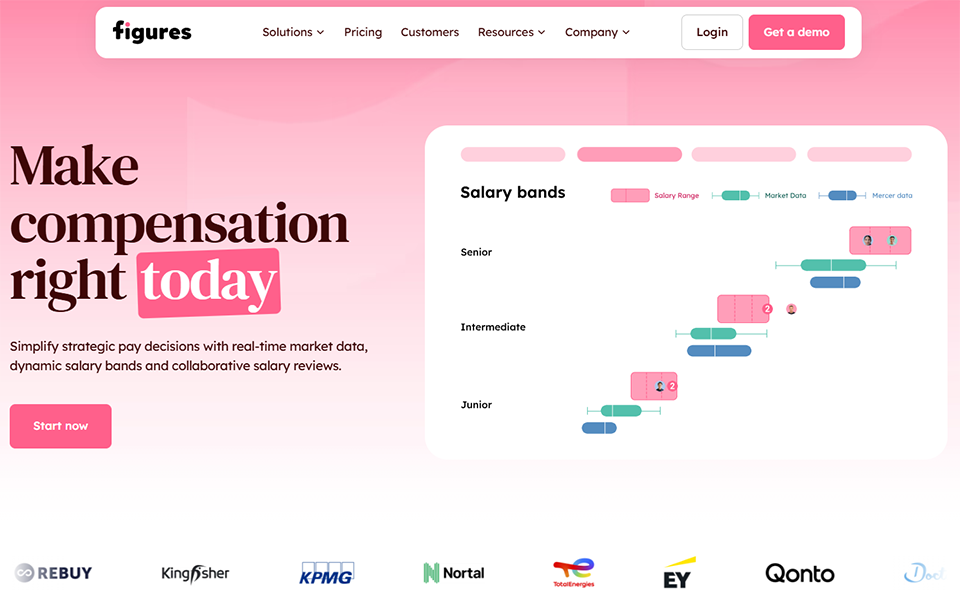
#12 - Figures HR: The salary benchmark for making informed compensation decisions.
Figures HR fills a particularly useful niche: market data on salaries. The platform aggregates salary data from thousands of European tech companies and startups, enabling HR teams and executives to benchmark their compensation packages against the market.
Knowing whether you’re paying your senior developer at, below, or above the market average is valuable information, both for attracting candidates and for retaining current employees. Figures HR provides a structured answer to this question.
Key features:
Salary data by position, level of experience, and geographic region.
Market comparison (percentile).
Assistance with developing salary scales.
Exportable reports for executive committees.
Estimated rates:
Subscription-based access; pricing is based on a quote depending on the size of the company and the modules selected.
✅ The benefits:
Relevant data on the European tech and startup ecosystem.
A strategic decision-making tool for HR teams.
Clear and actionable visualization.
👎The downsides:
Less suitable for sectors far removed from technology.
Data focused primarily on Europe; less relevant for other markets.
Comparison table of HR tools.📊
Before consulting this table, here’s a helpful note: The prices listed are approximate figures based on publicly available information. They may have changed since this article was written. Always check prices directly on each publisher’s website before making a purchase decision.
1️⃣ What is the difference between an ATS and an HRIS?
An ATS (Applicant Tracking System) is a recruitment-focused tool: it manages job postings, applications, and the selection process. An HRIS (Human Resources Information System) has a broader scope: it covers the entire employee lifecycle, from hiring to separation, including payroll, time off, training, and administrative management. Tools like Freshteam and Rippling are closer to the definition of an HRIS, while Taleez and Flatchr remain specialized ATSs.
2️⃣ Where do you start when setting up your HR department for the first time?
The priority depends on your current situation. If you’re actively hiring, an ATS is the first investment you should make. If you already have a team and payroll is handled manually or by an outside accountant, software like PayFit is often the next step. Onboarding and employee benefits come next, once the groundwork has been laid.
3️⃣ Does it make sense to use a single tool to manage everything?
The temptation is real, but the reality is more nuanced. All-in-one tools like Rippling or Freshteam offer valuable consistency, but they aren’t always the best in every category. A fast-growing SME will often prefer to combine a specialized ATS (Taleez, Flatchr) with dedicated payroll software (PayFit) rather than centralizing everything in a single tool that does everything adequately but excels in no single area. There is no one-size-fits-all answer.
4️⃣ How do you choose between PayFit and an accounting firm for payroll?
The two are not necessarily mutually exclusive. PayFit automates the generation of pay stubs, but it does not replace legal advice or the handling of complex situations (labor disputes, restructuring, etc.). Some SMEs use PayFit independently for routine matters and retain a firm for specific issues. Others delegate payroll entirely to their accountant. The SaaS tool offers greater visibility and responsiveness, while the firm provides the advisory aspect.
5️⃣ What tools are available for managing teams spread across multiple countries?
Rippling is likely the most advanced solution for international management, with coverage in more than 50 countries. Deel and Oyster HR (both available at Freelance Stack) are also leading providers in this niche, particularly for teams that rely on contractors or Employers of Record in different jurisdictions.
6️⃣ Are SaaS HR tools GDPR-compliant?
Regulations impose strict safeguards on the processing of employees’ personal data. The major software providers mentioned in this article offer GDPR compliance measures (hosting in Europe, available Data Processing Agreements, pseudonymization, etc.). That said, responsibility for data processing remains with the user company. It is recommended that you review the Data Processing Agreement provided by each software provider and ensure that your DPO or legal counsel has approved the terms of use.
7️⃣ My team consists of 3 to 5 people. Are these tools really useful at this stage?
When it comes to recruitment, an ATS remains valuable right from the very first hires, if only to organize the tracking of applications. For payroll, software like PayFit for 5 employees may seem expensive: some very small companies still outsource this to their accountant at this stage, which is perfectly reasonable. On the other hand, Jibble (with its free plan) or Freshteam (free plan for up to 50 employees) can add value right from the start, without a significant impact on the budget.
This comparison is intended for microbusinesses, small and medium-sized businesses, startups, founders, and HR managers who want to take back control of their payroll, or…