





Our Selection of AI Tools for Content Creators in 2026
We reviewed the most robust solutions on the market in 2026, focusing on those that…
Read more


Recruitment is one of the most time-consuming processes in a company. Between drafting job postings, screening applications, scheduling interviews, and following up on interactions, a single hire can take dozens of hours for HR. And often, despite all that time invested, the results are disappointing: well-qualified candidates slip through the cracks, decisions are made too quickly without enough perspective, and the candidate experience falls short.
Artificial intelligence is starting to make a real difference. Not by replacing humans in decision-making, but by automating what can be automated, structuring what isn’t always structured, and helping teams focus on what matters most: meaningful conversations with the right candidates.
In 2024, 67% of HR professionals reported using or testing AI tools in their recruitment processes (source: LinkedIn Talent Trends). This trend is gaining momentum, particularly among startups and small and medium-sized businesses that do not always have the resources of a structured HR department.
This article reviews the most relevant tools on the market, organized by process stage, with a focus on those accessible to agile organizations. Each solution featured has an exclusive deal on Freelance Stack.

Taleez is a recruitment software (ATS) developed in France, designed to centralize the entire process from job posting to the final decision. Its positioning is clear: to make recruitment smoother for human-sized organizations, without imposing the complexity of an enterprise tool.
Taleez’s logic is based on a step-by-step visual pipeline. Each application enters a workflow that the team can move through based on its own criteria: pre-screening, phone interview, technical interview, and job offer. The tool natively supports posting to multiple job boards (Indeed, LinkedIn, Welcome to the Jungle, etc.), team-based application management, and a dedicated space for communicating with candidates.
What sets it apart is its gradual integration of AI features: automatic resume scoring based on the desired profile, suggestions for rewriting job postings, and detection of duplicate entries in the candidate database.
Startups in the scaling phase:
Taleez is particularly well-suited for startups that hire between 5 and 30 people per year. The visual pipeline allows a CEO or COO to stay in control of the hiring process without having to devote all their time to it.
SMEs without a dedicated HR manager:
For a small business or SME with 10 to 80 employees that hires a few new employees each year, Taleez is a reliable entry-level ATS without the complexity of enterprise-level solutions.
Boutique recruitment firms:
The collaborative workspace and multi-position tracking make it possible to manage several assignments in parallel with small teams.

Flatchr is another French player in the ATS market, with a focus that is slightly more centered on automating the applicant workflow. The tool stands out for its automatic screening capabilities and its built-in candidate communication features.
The Flatchr approach is built on reducing the time spent on low-value tasks: automatic acknowledgments, scheduled follow-ups, and pre-screening questions that can be configured per position. The recruiter then ends up with an already qualified shortlist rather than an inbox of 200 resumes to sort through manually.
Flatchr’s AI analyzes incoming applications to score them based on predefined criteria (required skills, experience, location, etc.) and automatically rank them by relevance.
In-house recruiters who manage many positions:
Flatchr is designed for teams where a single person manages dozens of applications at the same time. Automating communications saves several hours a week.
Companies with high employee turnover:
Retail, food service, logistics... Industries that hire in large numbers would be well advised to automate the initial screening process rather than conduct systematic interviews.
Executives who want to regain control:
The dashboard centralizes everything, making it ideal for a CEO or general manager who wants to monitor hiring without getting bogged down in operational details.

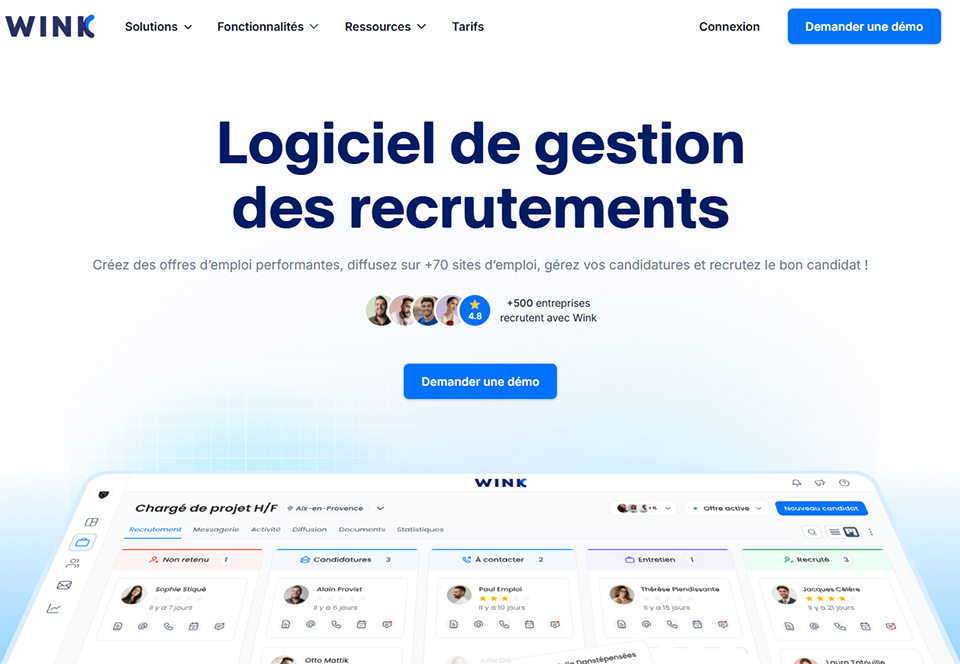
Wink is an ATS with a deliberately minimalist approach. The idea behind the tool is to simplify the recruiting process as much as possible for organizations that don’t need 50 features but want a clean, collaborative, and efficient way to track candidates.
Wink focuses on clarity: a simple workflow, clear candidate profiles, and streamlined communication among team members involved in the decision-making process. The tool doesn’t aim to automate everything, but rather to eliminate day-to-day friction: emails that get lost, poorly maintained Excel spreadsheets, and informal feedback that isn’t tracked.
Wink offers affordable pricing suited to small teams. Prices should be checked directly on the vendor’s website.
Small businesses and early-stage startups:
Wink is ideal for organizations that hire 5 to 20 people per year and are simply looking for a tool that’s more reliable than a spreadsheet.
Managers involved in hiring:
The collaborative aspect makes it easy to involve operational managers without requiring them to undergo training on a complex tool.


Willo solves a real-world problem: How can you quickly evaluate a large number of candidates without spending hours on video calls? The answer is the asynchronous video interview. Candidates answer pre-recorded questions at a time that’s convenient for them, and recruiters review the responses at their own pace.
The recruiter creates a customized video questionnaire for each position: 3 to 8 questions, with a set response time for each question. The link is sent to shortlisted candidates, who record their answers using their phone or computer. The videos are then accessible in a centralized location, with the option to share the top candidates internally to gather feedback.
Willo’s AI rounds out the system with automatic transcription of responses, summaries generated by LLM, and scoring based on keywords and the structure of the responses.
Companies with a large number of candidates to pre-screen:
For a position that receives 100+ applications, Willo lets you interview 30 candidates in 2 hours instead of scheduling 30 phone calls.
Recruiters who want to reduce no-shows:
Asynchronous communication eliminates scheduling constraints for both parties, which reduces last-minute cancellations.
Startups hiring remotely:
Willo is particularly well-suited for distributed teams or international hiring, where time zones make scheduling difficult.

Intervia is a tool specifically designed to improve the quality of recruitment interviews using AI. While other tools focus on sourcing or pipeline management, Intervia addresses the interview phase itself: structuring questions, analyzing responses, and aiding decision-making.
The tool generates customized interview guides based on the position and the skills sought. During or after the interview, the AI analyzes the answers (via transcription if the interview is recorded) to identify key signals and suggest a structured assessment. This helps reduce cognitive biases and standardize decisions across different recruiters.
Pricing is available directly on the Intervia website.
Managers who conduct interviews without HR training:
Intervia provides a structure and framework that enables even a tech lead or sales manager to conduct a meaningful and fair interview.
Companies that want to reduce recruitment bias:
Standardizing evaluation rubrics is one of the most effective ways to ensure that decisions are made objectively.


Fireflies.ai is an AI-powered meeting transcription and analysis tool. In the context of recruitment, it plays a valuable role: it records, transcribes, and summarizes all your interviews, automatically extracting key moments, questions asked, important answers, and action items.
Fireflies connects to your video conferencing tool (Google Meet, Zoom, Teams, etc.) and automatically joins calls as a virtual participant. It records the audio, generates a near-real-time transcript, and then produces a structured summary highlighting the key points. For recruitment, this means the recruiter can stay fully focused on the conversation rather than on taking notes.
Recruiters who conduct many interviews:
When you spend your day on calls, it’s nearly impossible to take comprehensive notes while staying focused. Fireflies solves this problem at its core.
Teams that conduct interviews simultaneously:
Centralizing all transcripts in a shared space makes it easier to compare them and reach a collective decision.
Hyper-growth startups:
When hiring picks up, keeping a structured record of each interview makes it easier to onboard new recruiters more quickly.


Tl;dv (short for “Too Long; Didn’t View”) is an alternative to Fireflies.ai with a slightly different positioning: the emphasis is on how easily key moments of a meeting or an interview can be shared, as short video clips. Very popular for remote recruitment interviews.
Tl;dv records your meetings on Google Meet or Zoom, transcribes them automatically and lets you tag specific moments during or after the call. These moments can be shared as video clips of a few seconds or minutes, which makes debriefing with the team easier without forcing them to watch the whole interview.
Recruiters working as a team who want to share excerpts quickly:
With Tl;dv, it takes just 10 seconds to send a 30-second clip of a candidate’s response to a manager. It’s much more efficient than a long summary email.
Organizations seeking improved traceability:
In the event of a dispute or questions regarding an HR decision, having a time-stamped transcript is an asset.
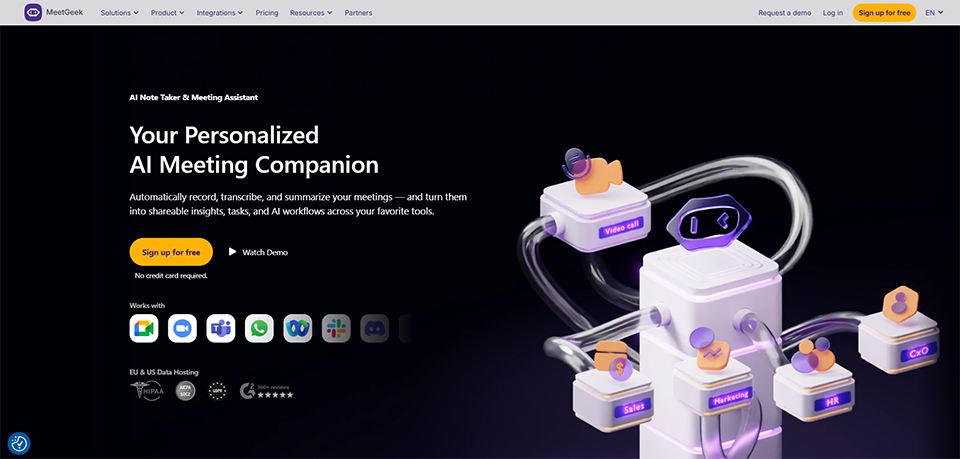
MeetGeek is a third player in the AI meeting assistant category. It stands out for its highly “action-oriented” approach: beyond transcription, MeetGeek identifies decisions made and next steps, making it a valuable tool for teams seeking a more structured post-meeting follow-up process.
MeetGeek integrates with your calendar, automatically joins scheduled meetings and, after each call, produces a summary sheet including: summary, decisions, action items, and each participant’s speaking time. For recruitment, this translates into a post-interview sheet ready to share.
Teams that hold frequent debriefing meetings:
If there is a 15-minute call after each interview to sync up, MeetGeek structures that debrief automatically.
Recruiters who care about following up on commitments:
“We’ll send them an answer before Friday” is the kind of commitment that MeetGeek captures and surfaces.
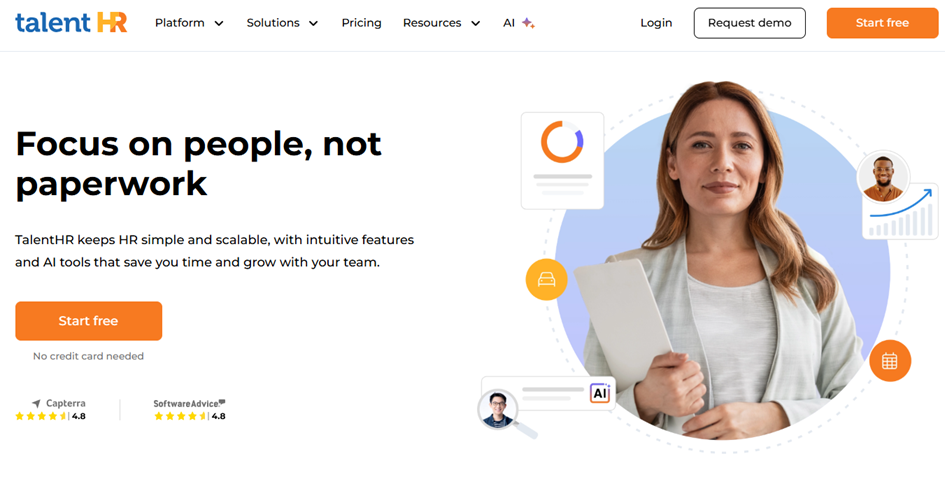
TalentHR is an all-in-one HR software solution designed for small and medium-sized businesses: recruitment, employee management, onboarding, time off, and absences. It is not intended for organizations that need a highly specialized ATS, but rather for those that want to consolidate their HR tools into a single platform.
TalentHR’s recruitment module lets you create job postings, manage applications, and onboard new hires directly within the tool. The transition from accepted candidate to onboarded employee is seamless, with automated workflows for documents, access rights, and initial tasks.
SMEs that want to consolidate everything:
If you use a spreadsheet for recruitment and a different tool for time off, TalentHR can streamline the entire process at a reasonable cost.
Companies currently hiring:
A seamless transition from recruitment to onboarding is a real advantage in maintaining momentum between accepting a job offer and the first day on the job.

Lindy AI is an AI agent automation tool. In practice, you create “Lindies” (autonomous agents) that carry out sequences of tasks on your behalf. In the context of recruitment, the possibilities are numerous: sorting incoming applications, sending reply emails, qualifying profiles against your criteria, scheduling interviews...
Unlike specialized recruitment tools, Lindy AI is a general-purpose automation platform that you can configure to suit your needs. The approach is more technical but much more flexible: you define the rules, conditions, and actions, and the agent executes them autonomously. This is particularly useful for connecting tools to one another without any development work.
Ops managers and tech-savvy founders:
Lindy AI is designed for people who can describe a workflow in natural language and want to automate it without involving a developer.
Startups with a high volume of applications:
Automating responses to rejected candidates or scheduling interviews results in significant time savings at scale.
The prices mentioned are indicative and may change. We recommend checking them directly on the vendors’ websites before making any decision.
| Tool | Category | Ideal for | Starting price | Free map | Native AI |
|---|---|---|---|---|---|
| Taleez | ATS | French SMEs & startups | ~89 s per month | No | Yes (scoring) |
| Flatchr | ATS | High-volume recruitment | ~99 s per month | No | Yes (scoring + offers) |
| Wink | Lightweight ATS | Small teams | Accessible | No | Limited |
| Willo | Video interviews | Asynchronous pre-screening | ~39 $/month | Yes | Yes (transcription + scoring) |
| Intervia | Interviews | Interview structuring | Check website | To be confirmed | Yes (analysis) |
| Fireflies.ai | Transcription | Teams doing intensive interviewing | ~$18/user/month | Yes | Yes (transcription + summaries) |
| Tl;dv | Transcription + clips | Team sharing and debriefing | ~20 $/month | Yes (generous) | Yes |
| MeetGeek | Transcription + follow-up | Post-interview decision tracking | ~15 $/month | Yes | Yes |
| TalentHR | HRIS + recruitment | SMEs that want to centralize everything | Free / Paid | Yes | Limited |
| Lindy AI | Automation | Custom workflows | ~49 $/month | Yes | Yes (agents) |
No, and that’s not the goal. Today’s AI tools excel at repetitive tasks: sorting resumes, transcribing interviews, following up with candidates, and generating reports. But assessing personality, potential, cultural fit, or leadership remains a fundamentally human endeavor. AI is a productivity booster, not a replacement.
In France and the European Union, the GDPR requires transparency regarding the processing of personal data. If you use AI tools that process resumes, interview recordings, or behavioral data, you must disclose this in your legal notices and privacy policy. For interviews recorded using Fireflies, Tl;dv, or MeetGeek, the candidate’s explicit consent is required.
Start with an ATS: it’s the foundation. If you’re hiring just a few people a year, Wink or Taleez are two excellent, affordable options. Then add a transcription tool like MeetGeek to make your interviews more professional. These two tools already cover 80% of a small company’s needs.
This is a serious issue. Scoring algorithms learn from historical data that may reflect existing biases (such as favoring certain degrees or career paths). Several studies have shown that unintentional discrimination can occur in automated scoring systems. Best practice is to never use the AI score as the sole selection criterion and to regularly audit the results to detect problematic patterns.
Generally speaking, yes. ATS platforms like Taleez, Flatchr, and TalentHR are designed for HR professionals and executives without a technical background. Transcription tools (Fireflies, Tl;dv, MeetGeek) are even simpler: they can be set up in just a few clicks and run in the background. Only Lindy AI requires a bit more initial effort to set up the automations.
For a startup or SME, a complete stack (ATS + video interview tool + transcription) generally comes to between €150 and €300 per month, depending on volumes and the plans chosen. With the deals available on Freelance Stack, it is possible to significantly reduce this cost, in particular by combining discounts across several complementary tools.
Most of the tools featured are available in English and natively support multi-country processes. Remote and Deel, for example, are industry leaders in everything related to international hiring and legal compliance in various countries. For transcription, Fireflies.ai supports more than 30 languages, making it a robust tool for distributed teams.