





Why automate repetitive tasks? The best software to get started
This article reviews the best automation platforms available today: those that have proven themselves, that are adaptable…
Read more


There was a time when automating marketing campaigns was a luxury reserved for large companies with six-figure budgets and entire dedicated teams. Those days are gone. In 2026, a five-person startup can run personalized email sequences, score its leads, segment its contacts, and trigger behavioral workflows—all without writing a single line of code.
However, the abundance of tools creates a new problem: which one should you choose? On the surface, the options may seem similar, but there are real differences in their underlying philosophy, target audience, and technical complexity. A tool designed for an e-commerce store with 10,000 contacts will not be suitable at all for a growing B2B startup—and vice versa.
This article reviews the most relevant solutions available on the market in 2026 for French-speaking SMEs and startups. The goal: to help you identify the one that truly fits your situation, your stage of development, and your budget constraints.
What this article covers: ActiveCampaign, Brevo, HubSpot, GetResponse, Omnisend, Encharge, and Plezi One. All of these tools are available with discount on Freelance Stack.
Before we get into the heart of the matter, let’s set the stage. Marketing automation refers to the set of processes that enable you to send the right message to the right person at the right time, automatically. This includes:
According to Salesforce, marketing teams that use automation see their productivity increase by an average of 14.5% and their customer acquisition costs decrease by 12.2%. These figures explain why this category of software has exploded in recent years.
So the real question isn't "Should we automate?" but "With what tool, and to what extent?"

ActiveCampaign positions itself as an automation and CRM platform geared toward small and medium-sized businesses. What sets it apart right from the start is the depth of its automation engine: its visual workflow editor is one of the most flexible on the market, with over 900 native integrations and particularly advanced conditional logic.
The platform was designed for teams that already have some experience with this topic. It’s not the tool you start using on day one, but rather the one you migrate to when entry-level solutions become too limiting.
ActiveCampaign covers a very broad range:
Growing B2B Startups:
The integrated CRM and lead scoring make it a natural choice for sales teams that want to align marketing and sales without adding more tools.
SMEs with long sales cycles:
The ability to create complex nurturing sequences, with branches based on the contact's behavior, is a major advantage.
Marketing teams with technical resources:
There is a real learning curve. Without someone to set up and maintain the automations, the potential remains untapped.

Brevo (formerly Sendinblue) is the French solution that has established itself as a serious alternative to the big American names. What makes Brevo particularly attractive to European SMEs is its native GDPR compliance, its servers hosted in Europe, and a price-to-feature ratio that’s hard to beat.
The platform has significantly expanded its scope in recent years: email, SMS, WhatsApp, live chat, basic CRM, landing pages, and automation are now available through a unified interface.
SMEs and microbusinesses new to marketing automation:
It's easy to get started, there are plenty of templates, and the free plan lets you give it a thorough try before committing.
Companies concerned about GDPR compliance:
Brevo's European presence is a real selling point, particularly for regulated sectors.
Organizations with multichannel needs:
If you want to manage email, text messages, and chat all from a single tool without having to sign up for multiple subscriptions, Brevo effectively checks that box.
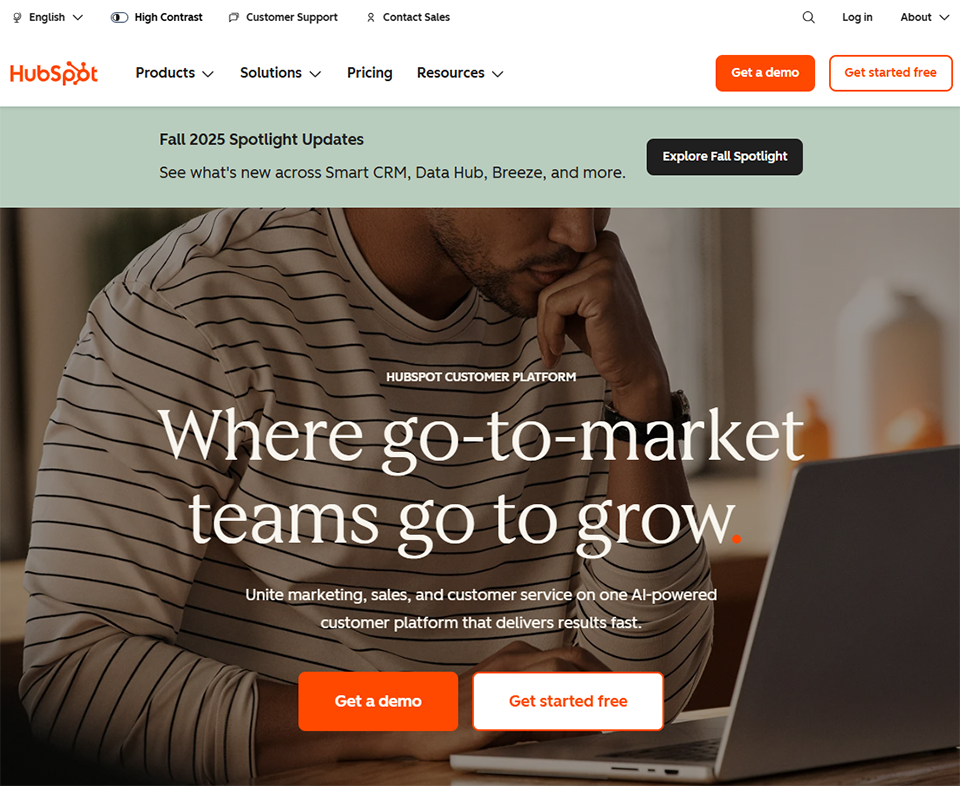
HubSpot is less a tool than an ecosystem. The platform brings together a CRM, marketing, sales, service, CMS, and operations hubs, all interconnected around a shared contact database. This is its main strength, but it’s also what can make it too ambitious a choice for some organizations.
What makes HubSpot a good fit for small and medium-sized businesses in 2026 is the quality of its free CRM (truly free, with no contact limits) combined with basic marketing features available without a subscription. The platform scales gradually, allowing users to start simple and enable advanced features as needed.
Startups looking for a comprehensive growth tool:
If the goal is to align marketing, sales, and customer service on a single platform, HubSpot is hard to beat.
Teams making their debut:
The quality of the educational resources (HubSpot Academy), templates, and onboarding make it an easy way to get started in the world of automation.
Small and medium-sized enterprise (SME) with a sales team:
Native synchronization between marketing automation and sales CRM is a real value-add for B2B sales cycles.

GetResponse is often underestimated in comparisons, likely because it occupies a middle ground between entry-level tools and premium platforms. Yet it is one of the most comprehensive solutions in this price range, with one notable feature: a genuine focus on conversion tools (landing pages, webinars, funnels).
The platform is primarily designed for marketing teams looking to cover the entire cycle—from lead generation to conversion—without having to sign up for multiple subscriptions.
Content creators and trainers:
The combination of landing pages, webinars, and automation makes it a top choice for selling training courses or digital products.
E-commerce retailers:
E-commerce integrations and behavioral automation (abandoned carts, upsells) are well managed.
Marketing teams that want to centralize everything:
If the goal is to avoid using separate tools for landing pages, webinars, and email marketing, GetResponse meets that need.
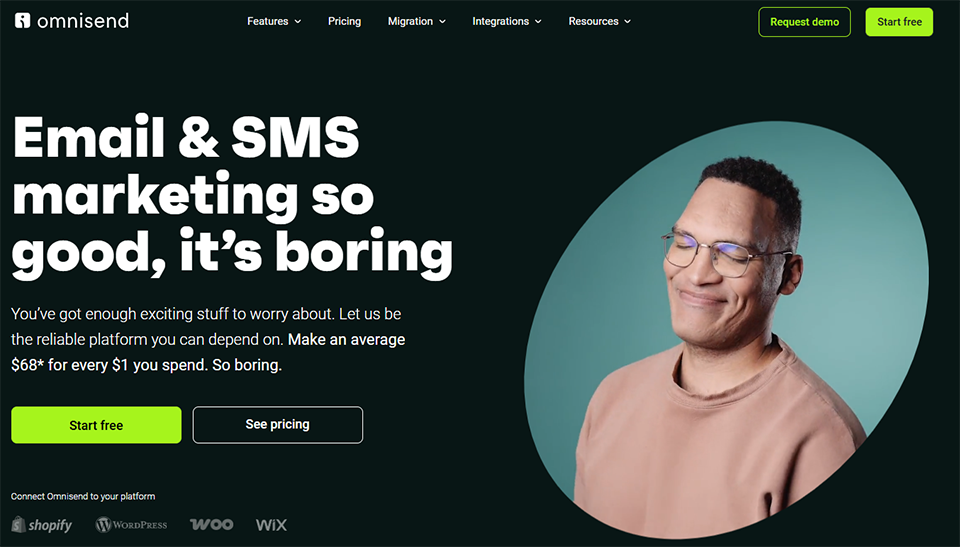
Omnisend doesn't try to be a one-size-fits-all solution. Its target audience is clearly defined: online stores and e-commerce teams that need marketing automation capable of meeting the challenges of their industry. This focus translates into highly specific and well-executed features, particularly in the areas of abandoned cart recovery, post-purchase sequences, and segmentation based on purchasing behavior.
If you have a Shopify, WooCommerce, or BigCommerce store, Omnisend is definitely worth considering.
Online stores on Shopify, WooCommerce, and BigCommerce:
This is the use case Omnisend was designed for, and it shows in the depth of its integrations.
DTC (direct-to-consumer) brands:
The management of customer segments based on purchasing behavior and lifetime value lifetime handled particularly well.
E-commerce businesses looking for turnkey automation:
Preconfigured workflows allow you to quickly establish a solid foundation without having to start from scratch.
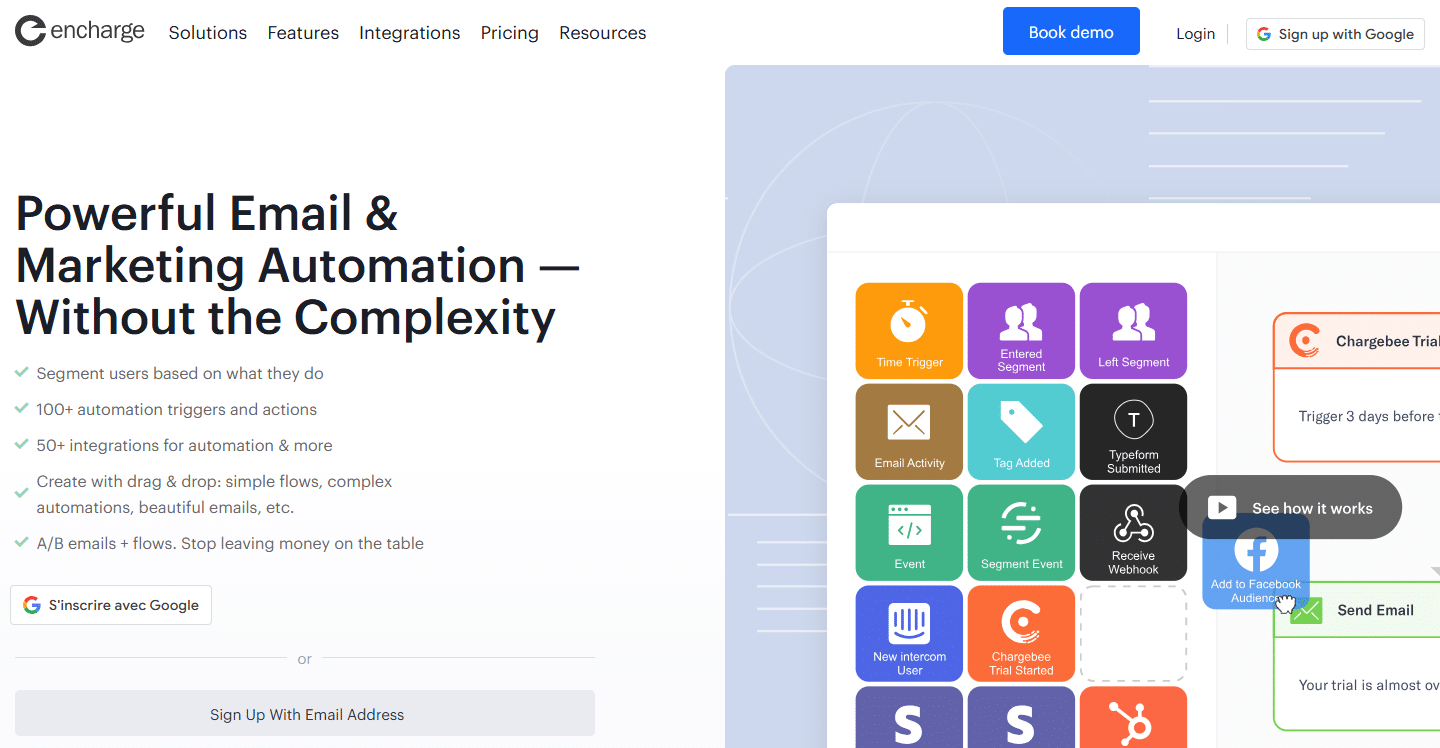

Encharge is a marketing automation platform designed specifically for SaaS startups and digital products. Its philosophy is based on behavior-based email: rather than relying solely on lists and tags, Encharge connects to your product or app to trigger automations based on real-world events (first login, feature used, plan limit reached, etc.).
This approach is fundamentally different from that of general-purpose tools, and that is what makes it particularly well-suited for product-led teams.
SaaS Startups:
This is the reference use case. Integrations with Stripe and Segment enable automations based on actual in-product behavior.
Teams with a product-led growth approach:
Onboarding, feature adoption, retention, and expansion can all be managed through Encharge.
Organizations that already use Segment or Stripe:
Encharge's value increases tenfold when it is connected to these tools.
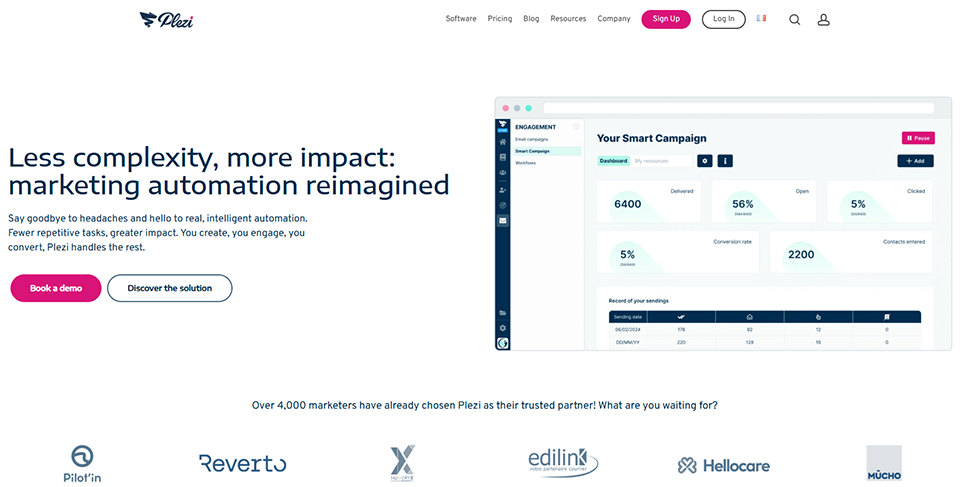
Plezi is a marketing automation platform founded in France, specifically targeting the B2B market for small and medium-sized businesses. Plezi One is the entry-level version, designed for marketing teams that are new to automation and want a guided, accessible solution that complies with European regulations.
What sets Plezi apart is its editorial approach: the platform actively helps you structure your inbound strategy, not just send emails. Features like the Smart Campaign (which automatically sends the right content to the right contact based on their interests) are unique in the market.
French-speaking B2B marketing teams:
The French-language interface, French-speaking support, and GDPR compliance are concrete selling points.
SMEs that use inbound marketing:
Smart campaign logic is particularly well-suited to showcasing an existing content catalog.
Organizations seeking support:
Plezi offers high-quality educational resources and support, which helps users develop their skills.

Before we get to the comparison chart, here’s a quick guide based on your situation:
If you're a growing SaaS startup with a product-led approach, Encharge is the perfect fit for you—as long as you have Stripe or Segment in your tech stack.
If you run a B2B small or medium-sized business that uses inbound marketing and wants a French solution that’s GDPR-compliant and offers high-quality support, consider Plezi One or Brevo, depending on your budget.
If you have an online store on Shopify or WooCommerce and want to automate the e-commerce customer journey, Omnisend is clearly the best choice.
If you're looking for the most powerful tool for pure automation, with a robust built-in CRM, for a team with experience in this area: ActiveCampaign.
If you want to get started on a limited budget while still having access to a comprehensive ecosystem that includes CRM, email, and automation, try HubSpot (free plan) or Brevo.
If you have multichannel needs (email, webinars, funnels, landing pages) but don't want to use multiple tools: GetResponse.
The prices listed are for reference only and are based on 1,000 contacts on plan with automation. Please check the pricing terms directly on the official websites.
| Tool | Primary target | Entrance Map (for reference) | Automation | Integrated CRM | Multi-channel | EU GDPR | Key strengths |
|---|---|---|---|---|---|---|---|
| ActiveCampaign | B2B/B2C SMEs | ~€49/month | ⭐⭐⭐⭐⭐ | ✅ Yes | Email, Text Message | ⚠️ US | Highly Flexible Workflows |
| Brevo | All profiles | Free / ~€25/month | ⭐⭐⭐⭐ | ✅ Basic | Email, Text Message, WhatsApp, Chat | ✅ EU | Value for money, GDPR |
| HubSpot | Startups, SMEs | Free / ~20 €/month | ⭐⭐⭐⭐ | ✅ Excellent | Email, Chat | ⚠️ US | Free CRM, comprehensive ecosystem |
| GetResponse | Designers, e-commerce | ~€15/month | ⭐⭐⭐ | ❌ Limited | Email, Text Messages, Webinars | ⚠️ Partial EU | Native webinars, funnels |
| Omnisend | E-commerce | ~€16/month | ⭐⭐⭐⭐ | ❌ No | Email, SMS, Push Notifications | ✅ EU | E-commerce Specialist |
| Encharge | SaaS, PLG | ~$99/month | ⭐⭐⭐⭐ | ❌ No | ⚠️ US | Product events, Stripe integration | |
| Plezi One | B2B SMEs in France | ~200 €/month | ⭐⭐⭐⭐ | ✅ Via integration | ✅ EU | Smart Campaign, French Support |
Answers to the key questions you need to ask to choose the right tool and avoid common mistakes when getting started with automation.
A basic email marketing tool lets you send newsletters or campaigns to a list. Marketing automation goes far beyond that: it triggers actions (not just emails) based on your contacts’ behavior. A visitor who views your pricing page can automatically be added to a nurturing sequence. A customer who has been inactive for 90 days can receive a personalized reactivation email. It is this conditional and behavioral logic that lies at the heart of automation.
If you're looking for simpler email marketing tools, Freelance Stack also Freelance Stack Mailchimp, Mailjet, and Kit (formerly ConvertKit).
Brevo or HubSpot are generally the most natural starting points. Brevo because its free plan is truly functional and easy to get started with. HubSpot because its free CRM and basic marketing features let you build your system gradually, with high-quality educational resources. In both cases, there’s no need to try to use 100% of the features right from the start: begin with one or two simple automations (welcome email, post-signup sequence) and gradually increase the complexity.
Yes, as long as you choose the right tool and don't get overwhelmed by complexity. For a solo entrepreneur, the most relevant tools are those that offer a good balance between accessibility and features: Brevo (free for up to 300 emails per day), Kit (designed for content creators), or GetResponse. The idea is to set up a few high-impact automations (welcome sequence, follow-up after a lead magnet download) rather than building a complex infrastructure.
All-in-one tools (HubSpot, Brevo, ActiveCampaign) offer the advantage of consistency: all data is centralized, there are no synchronization issues between tools, and you receive a single invoice. Specialized stacks (for example, Encharge for automation + a dedicated CRM like Pipedrive or HubSpot) offer more depth for each component but introduce integration complexity. As a general rule, for a team of fewer than 10 people, an all-in-one solution is more practical. A specialized stack becomes relevant when you have very specific needs in a particular area.
This is very important—and often underestimated. Even the best automation in the world is useless if your emails end up in the spam folder. Tools like Brevo, ActiveCampaign, and HubSpot have a good reputation in this regard, with robust sending infrastructures. To maximize your deliverability, be sure to configure SPF, DKIM, and DMARC on your sending domain, maintain a clean contact list, and monitor your bounce rates. These best practices apply regardless of which tool you choose.
Migration is always possible, but it’s rarely painless. Contacts can usually be exported to CSV, but automations, tags, templates, and behavior histories aren’t transferred automatically. The more complexity you’ve built into a tool, the more time-consuming the migration will be. This is yet another reason to choose wisely from the start, thinking about where you’ll be in 18–24 months rather than just your immediate needs.
Most of the tools mentioned in this article offer hundreds of native integrations and are compatible with automation platforms like Make or Zapier, allowing you to connect to just about any tool. However, be sure to check for native integrations with your critical tools (CRM, e-commerce, analytics) before committing. An integration via Zapier will always perform less well than a native integration in terms of reliability and the richness of the data exchanged.