Web Hosting 2026: The Top 5 European Solutions for Keeping Control of Your Data.
In this comparison, we’ve selected five 100% European hosting providers available on Freelance Stack, designed for professionals who want to take control of their infrastructure without sacrificing simplicity or performance.
The issue of web hosting is no longer the sole concern of technical teams. By 2026, it had become a full-fledged governance issue for entrepreneurs, freelancers, and small and medium-sized businesses. And for good reason: where your data is hosted largely determines who can access it, under what conditions, and under which jurisdiction.
The GDPR has provided a clear framework since 2018, but the reality of the market remains complex. The majority of global cloud infrastructures remain dominated by U.S. providers (AWS, Azure, Google Cloud) subject to the Cloud Act, a U.S. law that authorizes U.S. authorities to access data hosted by U.S. companies, even if that data is stored in Europe. This is not a matter of mistrust toward these giants: it is simply a legal reality that any serious professional must incorporate into their strategy.
In response to this situation, a new generation of European hosting providers has emerged. With features such as data sovereignty, native GDPR compliance, infrastructure located in Europe, and support in French, these solutions have matured and now pose a serious challenge to the American giants in terms of both performance and reliability.
In this comparison, we’ve selected five 100% European hosting providers available on Freelance Stack, designed for professionals who want to take control of their infrastructure without sacrificing simplicity or performance.
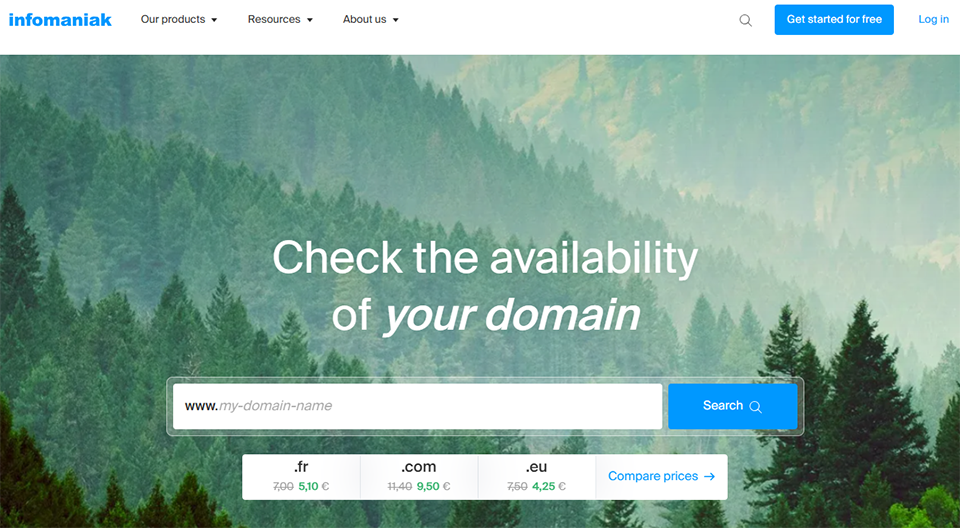
#1 - Infomaniak: The Swiss web hosting provider that combines ethics, performance, and affordability.
Benefit from our free deal on Infomaniak.
10% off on annual plan
Find over 300 free deals as well as over 850 Premium deals right now with Infomaniak and save on your software subscriptions. Whether you're an entrepreneur, a startup or a solo freelancer, save hundreds of euros thanks to our discounts and promo codes.
Founded in 1994 in Geneva, Infomaniak is one of the most established players in the European tech ecosystem. The company is independent, self-financed, and committed to a rigorous environmental policy: its data centers are powered entirely by renewable energy, and it is regularly cited as one of the web hosting providers most dedicated to environmental issues.
What sets Infomaniak apart in the hosting industry is the consistency of its offerings. No vague marketing promises: transparent pricing, data hosted exclusively in Switzerland (meaning outside the European Union but under Swiss law, one of the most protective in the world), and French-speaking customer support renowned for its responsiveness.
Here's what Infomaniak actually offers:
With standard web hosting, the plans are designed for WordPress sites, e-commerce stores, and web applications. The in-house control panel (iKonek) is well-designed, intuitive, and includes tools for managing domains, SSL certificates, databases, and email accounts. Everything is centralized, which is a big plus for entrepreneurs multiple projects.
The kDrive solution (Infomaniak’s proprietary cloud storage) and Swiss Backup round out the offering for those seeking a European alternative to Google Drive or Dropbox. The kDrive office suite and collaboration tools (calendar, contacts, video conferencing via kMeet) even make it possible for teams deeply concerned about their digital sovereignty to consider completely moving away from GAFAM.
Pricing:
Starter Web Hosting Plan: starting at ~€5.75/month, ideal for showcase websites and blogs.
Creator Web Hosting Plan: around €8.75/month, for projects with higher traffic.
Cloud Server (VPS) Plans: starting at ~€14/month with scalable configurations.
kDrive plans: starting at €4.17/month for 15 GB, up to team plans.
Who is this for?
Freelancers and small businesses looking for turnkey, stable, French-language, and ethical hosting without having to manage a complex infrastructure. It’s also an excellent choice for professionals subject to strict compliance requirements in sectors such as healthcare, law, or finance.
Benefit from a on Infomaniak .
Additional 20% off on any plan
Find our best discount right now with Infomaniak and save on your software subscriptions. We offer over 850 promo codes and discounts on the best software and SaaS on the market.
#2 - OVH Public Cloud: French-style cloud infrastructure, designed for technical projects.
OVHcloud is Europe's leading hosting provider by volume and one of the few capable of competing with major U.S. players in the field of pure infrastructure. The group, founded in Roubaix in 1999 by Octave Klaba, now operates more than 40 data centers around the world, the vast majority of which are in Europe. Its physical “bare metal” servers are even assembled in-house, giving it a level of independence that is rare in the industry.
The OVH Public Cloud offering is designed for users with more technical expertise than those using traditional shared hosting solutions. This is an IaaS (Infrastructure as a Service) cloud solution: you can provision virtual servers, managed databases, object storage volumes, Kubernetes solutions, and more. Everything is on-demand, with billing by the hour or by the month based on the resources used.
What the offer actually includes:
The OVH Public Cloud catalog is very comprehensive. Among the features most commonly used by technical teams and developers are:
Compute instances (General Purpose, CPU-Optimized, RAM-Optimized) allow you to precisely scale resources to meet your needs. Object storage (S3-compatible) is ideal for storing assets, backups, or large amounts of data at a low cost. Managed databases (PostgreSQL, MySQL, Redis, MongoDB via OVH MongoDB) relieve teams of maintenance tasks. And Kubernetes support enables the flexible deployment of containerized applications.
In terms of compliance, OVH is ISO 27001, SOC 1, and SOC 2 certified, and offers HDS (Health Data Host) certification options for projects in the healthcare sector. This level of certification is rare among hosting providers in this price range.
Pricing:
b2-7 (General Purpose) instance plan: starting at approximately €0.044/hour, or ~€32/month.
Object storage plan: starting at €0.0092/GB/month.
Managed Database Plans: starting at ~€26/month, depending on the database engine and RAM.
Welcome credits are available for new accounts through the Startup program.
Who is this for?
Developers, tech startups, and teams with needs for scalable infrastructure. OVH Public Cloud is less suitable for non-technical users looking for a "plug-and-play" solution: it requires some familiarity with cloud environments and the command line.
Benefit from a on OVH Public Cloud .
€150 offered on any plan
Find our best discount right now with OVH Public Cloud and save on your software subscriptions. We offer over 850 promo codes and discounts on the best software and SaaS on the market.
#3 - Scaleway: The next-generation cloud, designed for modern developers.
Scaleway, a subsidiary of the Iliad Group (founder of Free), has built a solid reputation by offering an alternative to AWS with a polished developer experience and competitive pricing. While OVH focuses on massive infrastructure and scale, Scaleway emphasizes an elegant interface, transparent pricing, and product innovation.
In recent years, Scaleway has stepped up its focus on high-value-added segments: AI (with on-demand GPUs), serverless architectures, and managed Kubernetes environments. It is now one of the most dynamic European hosting providers in terms of product roadmap.
What Scaleway offers:
The offering is structured around several complementary components. Instances (equivalent to AWS EC2) cover a wide range of needs, from small shared VPSs to dedicated GPU servers. Serverless Functions and Containers allow you to deploy code without managing servers, with pay-as-you-go billing. The Managed Databases solution supports PostgreSQL and MySQL with automatic backups and easy scaling.
A key feature: Scaleway offers an S3-compatible Object Storage solution at a particularly competitive price, along with an integrated CDN to enhance the performance of static content delivery worldwide. For AI or machine learning projects, the on-demand H100 and A100 GPUs are a major advantage.
Scaleway's console interface is often cited as one of the cleanest and most intuitive on the European market. The documentation is in English but comprehensive, and the developer community surrounding the platform is active.
Pricing:
PLAY2-PICO Instance Plan: (entry level) starting at ~€0.004/hour (~€3/month)
GP1-S Instance Plan: (General Purpose) approximately €0.056/hour
Object Storage Plan: starting at €0.0135/GB/month
DEV1-S Managed Databases Plan: starting at ~€18/month
A100 GPU Plan: starting at ~€2.49/hour on-demand
Who is this for?
Developers and startups looking for the flexibility of the U.S. cloud combined with European compliance. Scaleway is particularly well-suited for teams building modern applications (microservices, serverless, AI) who value a polished developer experience. Less suitable for non-technical users or those seeking simple shared WordPress hosting.
Benefit from a on Scaleway .
€500 in credits
Find our best discount right now with Scaleway and save on your software subscriptions. We offer over 850 promo codes and discounts on the best software and SaaS on the market.
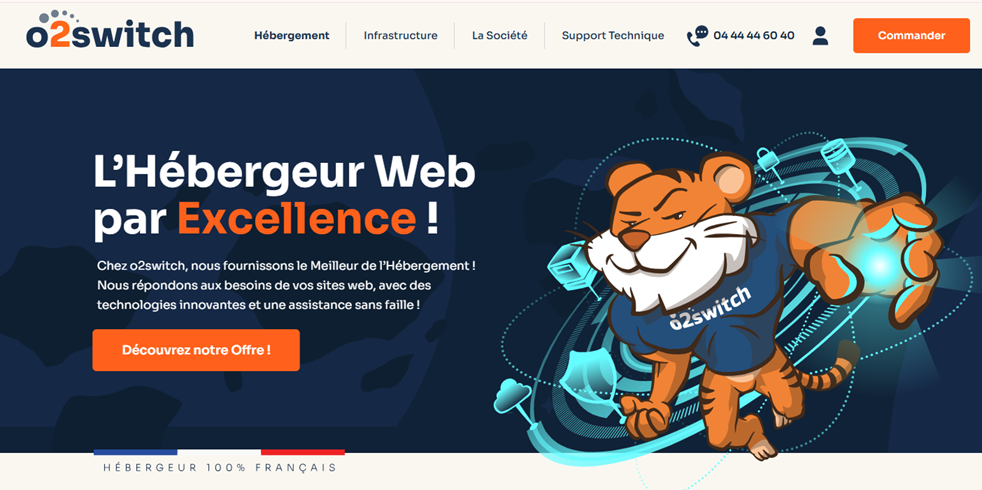
#4 - o2switch: French shared hosting-simple and with no hidden surprises.
o2switch is, in a way, the antithesis of large, complex cloud platforms. This French company, founded in 2003 and based in Clermont-Ferrand, has built its reputation on a simple and radical model: a single, unlimited shared hosting plan at a fixed price. No endless catalog, no options to check off, and no hidden fees at renewal.
Their value proposition is straightforward: for a fixed monthly fee, you get unlimited resources in terms of disk space, databases, email accounts, and subdomains. Everything is hosted on servers located exclusively in France, with in-house technical support (not outsourced).
Here's what you'll get:
The o2switch service is based on cPanel, the most widely used control panel in the shared hosting industry. It makes it easy to manage WordPress installations (via Softaculous), email accounts, free SSL certificates (Let's Encrypt), MySQL databases, and automatic daily backups.
Performance consistently scores well in entrepreneurs benchmarks, largely due to the use of LiteSpeed Web Server (which is faster than Apache in real-world conditions) and built-in caching. For WordPress or PrestaShop sites with moderate to medium traffic, this is more than sufficient.
One important detail: o2switch offers a 30-day money-back guarantee if you're not satisfied, which is rare in this industry.
Pricing:
"Infini" Special Offer: approximately €6.99/month (with a one-year contract), including everything with no reported data limits.
No "entry-level" or "premium" plans: one price, one plan.
Free website transfer from your previous hosting provider.
Who is this for?
Freelancers, consultants, and small businesses looking for simple, high-performance web hosting from a French provider, without having to grapple with the intricacies of an IaaS cloud. o2switch is the ideal solution for WordPress sites, portfolios, mid-sized e-commerce stores, and projects that don’t require a custom infrastructure. For non-technical users, it’s often the most recommended option.
Benefit from a on o2switch .
20% off on any plan (excluding domain name)
Find our best discount right now with o2switch and save on your software subscriptions. We offer over 850 promo codes and discounts on the best software and SaaS on the market.
#5 - PlanetHoster: French-Canadian hybrid hosting, built for scalability.
PlanetHoster occupies a unique position in this comparison: founded by French-Canadian entrepreneurs, the company operates data centers in France (Île-de-France) and Canada (Montreal), with a philosophy firmly focused on flexibility and scalability.
What sets PlanetHoster apart is its "World" shared hosting plan, which is based on proprietary technology called N0C (Network Operations Center). In practical terms, this architecture allows PlanetHoster to offer shared hosting with guaranteed, dedicated resources, whereas most hosting providers share resources among clients without any formal guarantee. In other words, your traffic spikes do not affect your neighbors’ sites, and vice versa.
What PlanetHoster offers:
The offering is organized into two main product lines. World Shared Hosting is the flagship offering: a modern HestiaCP interface, LiteSpeed, free SSL, daily backups, and SSH access. The Reseller line is designed for web agencies and freelancers who manage their clients’ hosting and wish to resell hosting under their own brand.
In the dedicated server and VPS segment, PlanetHoster offers robust configurations with responsive support (available in French 24/7, according to their official statement). WordPress integration is well-designed, with simplified installation and migration tools.
PlanetHoster is also a signatory to the Charter for Responsible Digital Technology and highlights its commitments regarding energy consumption and carbon offsetting.
Pricing:
World Lite Plan: starting at ~€3.99/month (limited resources, ideal for getting started)
World Pro Plan: around €9.99/month, for websites with higher traffic and more features
World Elite Plan: starting at ~€19.99/month for high-traffic projects
Cloud VPS Plan: starting at approximately €15/month, depending on the configuration
Note: PlanetHoster regularly offers sign-up promotions; the prices listed on Freelance Stack include exclusive discount .
Who is this for?
Agencies, freelancers working on multiple projects, and small and medium-sized businesses that need shared hosting with above-average performance guarantees. PlanetHoster is also an excellent choice for those who want to host their sites in both Europe and Canada, or for businesses targeting a French-speaking North American audience.
Benefit from a on PlanetHoster .
25% off on any plan
Find our best discount with PlanetHoster and save on your software subscriptions. We offer over 850 promo codes and discounts on the best software and SaaS on the market.
Which European web host should you choose based on your needs? 👤
Finding the right accommodation depends less on your budget than on your needs. Here are some practical guidelines.
🧑💻 Developer or tech startup:
Scaleway or OVH Public Cloud will be your natural platforms of choice. Both offer a level of infrastructure flexibility that shared hosting solutions simply can’t match. Scaleway stands out for its developer experience and product innovation (serverless, GPU). OVH excels in certifications, scale, and the maturity of its ecosystem. If you have an AI project on the side, Scaleway’s GPUs are definitely worth a look.
🏢 Small businesses, SMEs, or web agencies:
o2switch and PlanetHoster are the most obvious choices. The former focuses entirely on simplicity and transparent pricing. The latter offers a significant boost in performance and flexibility for agencies that manage multiple client websites. Both are French-speaking, with accessible support teams.
🌿 A profile focused on compliance and digital ethics:
Infomaniak is hard to beat in this area. Its ISO certification, Swiss law (which often offers greater protection than the GDPR in certain scenarios), and genuine commitment to environmental sustainability make it the go-to choice for organizations that take these issues seriously, such as medical and law firms, as well as associations.
🚀 Freelancers or new solopreneurs:
o2switch remains the most common recommendation for getting started: a single plan, no need to compare options, a reasonable price, and more than enough performance for everyday projects. You can always migrate to a more robust infrastructure as your project grows.
Pros and cons of each solution.
Infomaniak:
👍 Pros:
Data hosted in Switzerland under Swiss law, documented commitment to environmental sustainability, comprehensive suite (cloud, email, video conferencing), responsive French-speaking support, transparent pricing.
👎 Cons:
The interface can be less intuitive for beginners than that of its Anglo-Saxon competitors; prices are slightly higher than those of entry-level shared hosting providers; and the technical cloud offering is less extensive than that of OVH or Scaleway.
OVH Public Cloud:
👍 Pros:
World-class infrastructure, HDS and ISO certifications, an extensive product catalog, competitive pricing on compute instances, and a mature Kubernetes deployment.
👎 Cons:
Steep learning curve for non-technical users; the console interface is less user-friendly than Scaleway’s; support has sometimes been criticized for slow response times outside of paid plans.
Scaleway:
👍 Pros:
One of the best developer experiences on the European market, transparent and predictable pricing, an innovative serverless and GPU offering, and a very clean console.
👎 Disadvantages:
Fewer data centers than OVH (mainly in Paris and Amsterdam), documentation available only in English, less suitable for non-technical projects.
o2switch:
👍 Pros:
Maximum simplicity, a straightforward, no-surprises plan, LiteSpeed included, in-house support (not outsourced), a 30-day money-back guarantee, and everything in French.
👎 Disadvantages:
Not suitable for projects requiring a custom server configuration; the service does not include VPS or IaaS cloud options; it offers shared hosting with inherent technical limitations (no Docker, no full root access).
PlanetHoster:
👍 Pros:
N0C architecture with guaranteed resources, choice of location (France or Canada), reseller program for agencies, clear commitment to CSR, and 24/7 French-speaking support.
👎 Disadvantages:
Less well-known than their competitors and sometimes accompanied by less comprehensive documentation, entry-level offerings remain limited despite the guaranteed resources.
Overall comparison table 📊
Here is a summary of the top 5 European web hosting providers to help you make a quick decision.
Frequently Asked Questions About European Web Hosting ❓
Each of these 5 solutions has its own deal on Freelance Stack, giving you access to discounted rates. To explore further, you can also check out our Domain Names & Hosting category to discover other solutions available on the platform.
1️⃣ Is hosting in Europe mandatory to comply with the GDPR?
No, the GDPR does not strictly require data to be hosted in Europe. It requires that the personal data of European citizens be protected to a standard equivalent to that of the GDPR, regardless of where it is hosted. However, choosing a European hosting provider greatly simplifies compliance, particularly because you do not have to implement standard contractual clauses or expose yourself to the risks associated with the U.S. Cloud Act.
2️⃣ What is the difference between shared hosting, VPS, and cloud IaaS?
Shared hosting (o2switch, PlanetHoster, Infomaniak at the entry level) involves sharing the resources of a physical server among multiple clients. It’s simple, inexpensive, and sufficient for most websites. A VPS (virtual private server) provides you with a virtualized server featuring dedicated resources and full administrative access. IaaS cloud services (OVH Public Cloud, Scaleway) take it a step further: you build your infrastructure on demand, resource by resource, with pay-as-you-go billing. More flexible, but more technical.
3️⃣ Is it easy to switch from a U.S. hosting provider to a European one?
Generally speaking, yes. Most European web hosts offer migration tools or support services. o2switch even offers free migration. The process varies depending on the complexity of your site (standard WordPress vs. custom application), but for a standard site, migration takes anywhere from a few hours to a few days.
4️⃣ Are European web hosts less reliable than American ones?
This is a myth that no longer holds true in 2026. Solutions like Scaleway, OVH, and Infomaniak achieve performance levels comparable to AWS and Azure for common use cases. The difference may be noticeable in very specific projects requiring highly specialized deployment regions or massive volumes of Asian traffic, but for projects with a primarily European audience, European hosting providers are fully competitive.
5️⃣ How do you choose between Scaleway and OVH for a technical project?
This is a relevant question because the two are often compared. OVH is better suited for projects requiring high-level certifications (HDS, healthcare, or finance), contractual enterprise support, or bare-metal configurations. Scaleway is the better choice if you prioritize the developer experience, serverless offerings, or on-demand GPU resources for AI projects. Both are available at a discount Freelance Stack, allowing you to test them without a significant commitment.
6️⃣ Is Infomaniak really worth the extra cost compared to o2switch?
It all depends on your specific needs. If you handle sensitive data (customer, patient, or financial information), Infomaniak’s compliance with Swiss law and ISO certification may justify a slightly higher price. If you’re simply looking to host a showcase website or a professional blog, o2switch offers value for money that’s hard to beat. Both remain excellent choices in their respective segments.
Tags
CloudHostingFrench SolutionInfomaniakOVH Public CloudScalewayo2switchPlanetHoster