





Our selection of AI tools for content creators in 2026.
We reviewed the most robust solutions on the market in 2026, focusing on those that…
Read more


By 2026, simply having an online presence will no longer be enough. Every day, millions of websites, profiles, and newsletters compete for the attention of the same internet user. What has changed is not just the volume of content produced, but the sophistication of the channels that need to be mastered: SEO, social media, email marketing, paid advertising, behavioral analytics... Each channel operates by its own rules, and it has become unrealistic to think that we can manage them all manually.
According to a BrightEdge study, 68% of online traffic comes from organic search (combining SEO and paid search). In other words, if you don’t appear in Google’s search results for queries related to your business, a very large proportion of your potential customers will simply never find you.
For entrepreneurs, freelancers, startups, and small and medium-sized businesses looking to expand their online presence without dedicating an entire team to the task, the solution often lies in the right SaaS tools: platforms designed to automate, optimize, and measure every aspect of visibility. But navigating the overwhelming array of options available today can be a challenge.
This article reviews the most relevant solutions, organized by major acquisition channel, providing for each one a detailed overview, the user profiles that will benefit most from it, and a comprehensive comparison to help you build your own stack.


SEMrush has become an must-have tool must-have digital marketing professionals. The platform covers the entire SEO spectrum: keyword research, technical site audits, backlink analysis, ranking tracking, and even a module dedicated to paid advertising. In practice, it’s the first tool you open in the morning to monitor the status of your organic presence.
Its main strength lies in the breadth of its database. With over 21 billion indexed keywords and data covering 140 countries, SEMrush not only allows you to analyze your own performance but also to dissect your competitors’ SEO strategies, which represents a significant competitive advantage.
SEMrush is primarily aimed at businesses with an active SEO strategy: digital agencies, marketing managers, growing startups, or any organization that generates a significant portion of its revenue online. The Pro plan is sufficient for most entrepreneurs small businesses. The Guru plan becomes a good fit when you manage multiple domains or need advanced competitive analysis features.
On the other hand, if you're new to SEO and don't yet have a well-structured website, the tool may seem intimidating. In that case, it's better to start with a more user-friendly solution like Mangools.
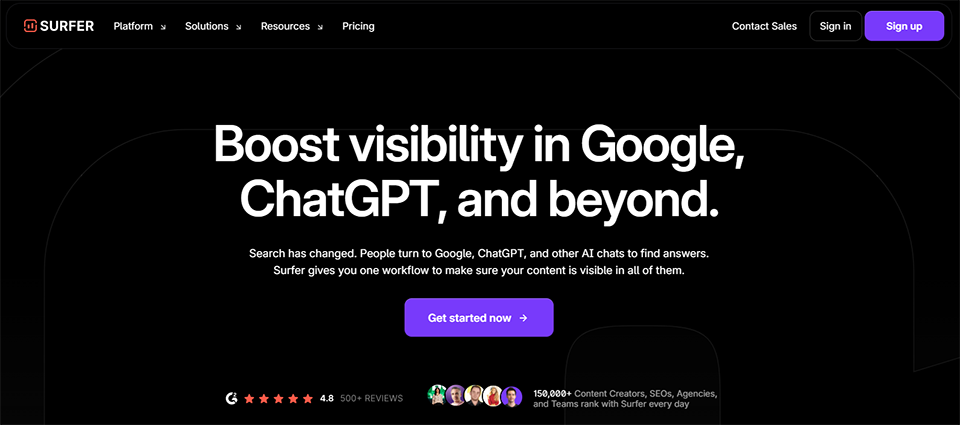

While SEMrush is a comprehensive analytics platform, Surfer SEO has taken a more focused approach: helping users create and optimize editorial content to rank on Google. Its flagship feature, the Content Editor, analyzes pages that rank for your target keywords in real time and guides you through the writing process to maximize your chances of appearing on the first page.
Specifically, Surfer SEO analyzes hundreds of factors (keyword density, ideal length, heading structure, semantic entities to include) and provides you with an optimization score that improves as you write. This is particularly useful for content creators who aren’t necessarily technical SEO experts.
Surfer SEO is particularly well-suited for writers, content managers, professional bloggers, and SEO consultants who produce content on a regular basis. Content agencies also find it immediately valuable, especially for ensuring consistent quality in client deliverables.
For a freelancer who runs their own blog or portfolio website and wants to rank on the first page for targeted search queries, the Essential plan is often more than enough.


Mangools is often described as the affordable alternative to the SEO giants. The suite includes five distinct tools: KWFinder (keyword research), SERPChecker (SERP analysis), SERPWatcher (ranking tracking), LinkMiner (backlink analysis), and SiteProfiler (comprehensive domain audit). The entire suite is offered at a significantly lower price than SEMrush or Ahrefs, without sacrificing any essential features.
What makes Mangools so appealing is its user-friendliness. The visuals are polished, the interfaces are clean, and the data is presented in a way that’s easy to understand, even for someone new to SEO. KWFinder’s KD (Keyword Difficulty) metric, in particular, is renowned for its reliability.
Mangools is ideal for entrepreneurs, small businesses, and SEO beginners who want reliable data without breaking the bank. It’s also perfect for entrepreneurs who handle their own SEO and need a simple tool to identify opportunities and monitor their rankings.

Moz is one of the oldest SEO platforms on the market, and it has played a major role in popularizing metrics that have become industry standards, including Domain Authority (DA) and Page Authority (PA). Today, Moz Pro offers a suite of tools covering keyword research, site audits, rank tracking, and link analysis.
Another thing that sets Moz apart is its community and educational resources. The Moz Blog and its SEO guides are among the most frequently cited educational resources in the industry. For anyone looking to improve their SEO skills while using the tool, this is a significant advantage.
Moz is particularly well-suited for entrepreneurs SEO consultants, marketing teams at small and medium-sized businesses, and anyone who values reliable authority metrics. It’s also a great choice for those looking to advance their SEO skills through the many educational resources available in the Moz ecosystem.
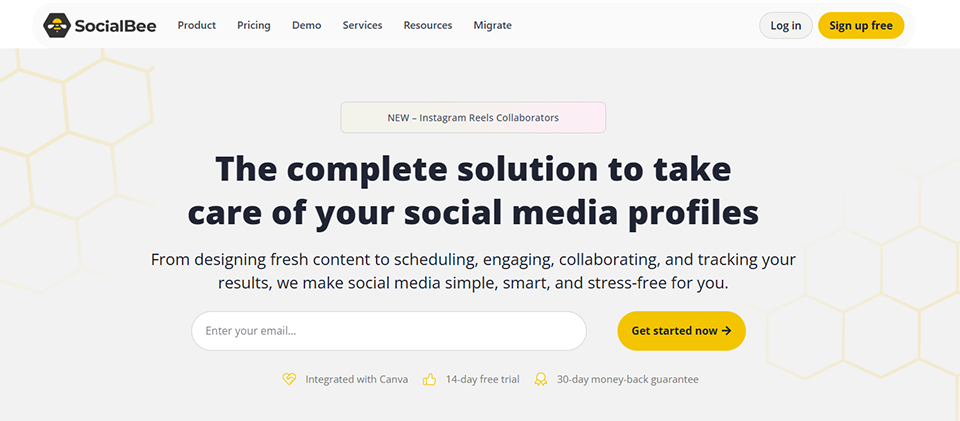

SocialBee takes a unique approach to content planning: rather than scheduling posts one by one, the platform lets you organize your content by Categories (educational, promotional, curative, personal...) and set up an automatic rotation. The result: your editorial calendar fills up intelligently, maintaining a balance among the content types you’ve predefined.
This approach is particularly useful for content creators and entrepreneurs who struggle to post consistently on social media without spending too much time on it.
SocialBee is primarily designed for solopreneurs, freelancers, and small marketing teams who manage multiple social media accounts and want to automate their workflow without sacrificing editorial control. The Categories system Categories particularly popular among consultants who support clients with their social media efforts.


Buffer is often the first social media management platform recommended to beginners, and that’s no accident. Its interface is clean and simple, it’s almost instantly intuitive to use, and it covers all the essentials: scheduling posts, analyzing performance, and responding to messages. No unnecessary features—just what you need.
The platform has evolved significantly in recent years, particularly with the addition of content analytics features and a landing page builder. For someone new to professional social media, Buffer remains one of the best places to start.
Buffer is perfect for freelancers, content creators, and entrepreneurs who manage 2 to 5 social media accounts and don’t need advanced features. It’s also an excellent choice for anyone just starting out with their social media strategy who wants to develop good planning habits without getting bogged down by the complexity of an enterprise-level tool.
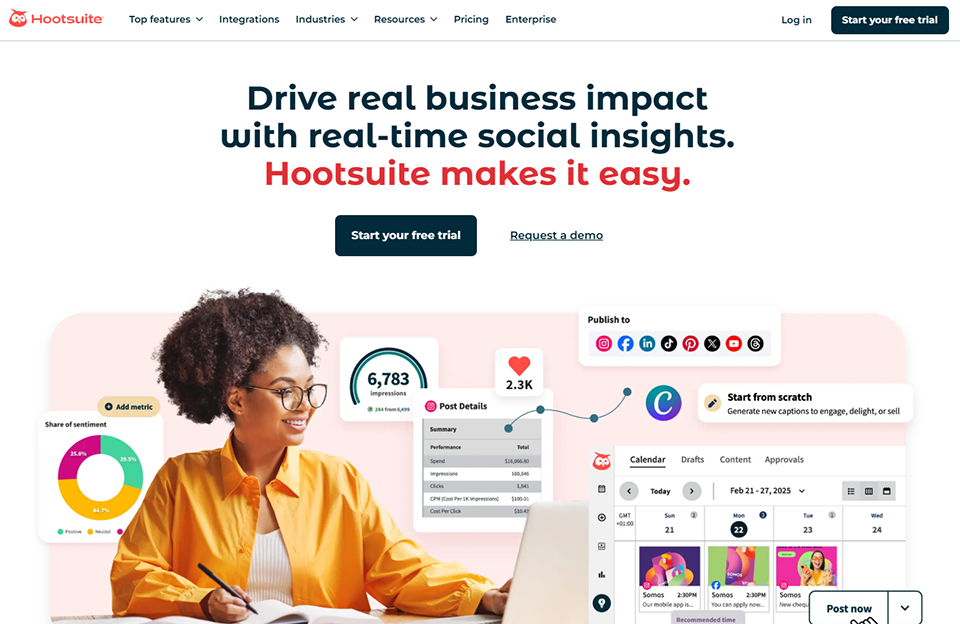
Hootsuite is one of the oldest and most comprehensive platforms on the market. It is primarily designed for teams that manage a large number of accounts and need a centralized overview: multi-feed dashboard, large-scale engagement management, detailed reports, and collaboration among team members.
The platform recently enhanced its AI capabilities with features for content suggestions, rephrasing, and optimizing posting schedules. For organizations that rely heavily on social media, Hootsuite remains a reliable choice.
Hootsuite is better suited for agencies, medium- to large-sized marketing teams, and companies that manage social media accounts across multiple platforms simultaneously. The cost is significant for a entrepreneur, but the platform’s capabilities justify the investment if social media is a key channel.
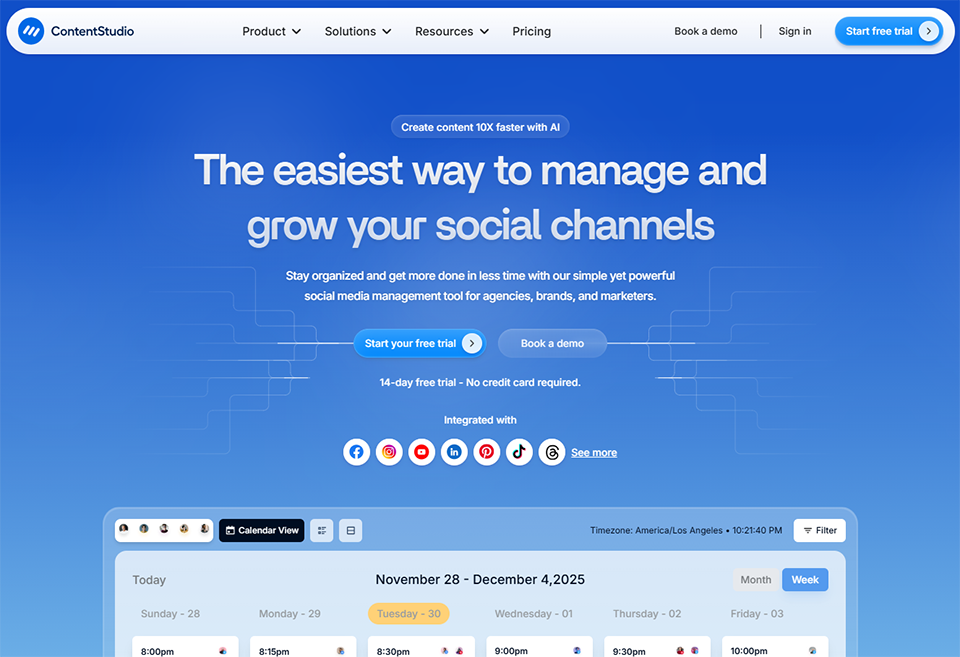

ContentStudio stands out for its all-in-one approach: content planning, RSS/web source curation, AI-powered content generation, and analytics—all within a single interface. This is particularly useful for businesses that need to regularly update their accounts without having to create all the content from scratch.
The Discover feature lets you find trending articles in your industry and share them with just a few clicks, which greatly simplifies your content curation strategy.
ContentStudio is ideal for professionals who rely on an active content marketing strategy, particularly those who combine original content with curated content. Agencies managing multiple clients also benefit from its multi-workspace features.

Brevo, formerly Sendinblue, has established itself as one of the most comprehensive email marketing platforms on the European market. Its main competitive advantage is a pricing model based on the number of emails sent (rather than the size of the list), which is particularly beneficial for organizations that have a large contact base but do not necessarily send campaigns very frequently.
Beyond email, Brevo now offers features for SMS marketing, online chat, lightweight CRM, and marketing automation. It is a platform that clearly aims to become a central hub for customer relationship management for small and medium-sized businesses.
Brevo is an excellent choice for European startups, SMEs, and entrepreneurs looking for an all-in-one solution for their digital communications. The per-email pricing model, rather than per-contact, is particularly advantageous for organizations with large mailing lists but a moderate sending frequency. For freelancers and entrepreneurs, the free plan is a great way to get started.

GetResponse stands out from its competitors with a focus on conversion and lead generation. In addition to standard email marketing features, the platform offers a webinar creation tool (capable of hosting up to 1,000 participants, depending on the plan), a conversion funnel builder, and landing pages.
This is particularly relevant for entrepreneurs who sell training courses, consulting services, or any product that requires an educational and nurturing process before conversion.
GetResponse is particularly well-suited for trainers, coaches, content creators, and consultants looking to build a comprehensive lead nurturing system that spans from lead capture to the sale. The built-in webinar feature offers significant cost savings compared to subscribing to a dedicated tool.

Mailchimp remains the world's most well-known email marketing platform, and for good reason: during , it has made professional email communication tools accessible to everyone. Today, the platform has expanded to cover much more than just email: landing pages, social media ads, basic CRM, and advanced audience management.
Its widespread recognition also means it integrates natively with virtually every other tool on the market, which is a significant advantage in a complex marketing stack.
Mailchimp remains a solid choice for organizations just getting started with email marketing that want a reliable platform with extensive support resources. It’s also a good fit for businesses whose marketing stack already includes numerous tools and that will benefit from Mailchimp’s native integrations.

Google Ads remains the most powerful advertising platform for capturing existing demand. When someone types a query into Google, they’re expressing an active need: ranking for those queries allows you to be visible at exactly the right moment, in front of exactly the right people. Search (text), Display (banners), YouTube (video), and Performance Max (automated multi-channel) campaigns offer a wide range of options.
Google Ads is ideal for any business whose offerings meet a demand that prospects are actively searching for on Google. E-commerce businesses, service providers, consulting firms, B2B SaaS companies... For a startup or small business looking to quickly accelerate customer acquisition, Google Ads offers an immediate solution. Be careful, however: effectively managing a Google Ads campaign requires learning the ropes or hiring a specialist to avoid wasting your budget.

For B2B companies, LinkedIn Ads is a unique acquisition channel. Nowhere else can you target prospects with such precision based on professional criteria: industry, company size, job title, seniority, skills, and more. If your target audience is a CFO at an industrial SME with 50 to 200 employees, LinkedIn allows you to reach them directly.
There are a variety of formats available: Sponsored Content (feeds), Message Ads (InMail), Dynamic Ads, and Lead Gen Forms, which allow you to collect leads without the prospect leaving LinkedIn.
Controllable budget; cost per click is generally higher than Google Ads but justified by the quality of B2B targeting. Welcome credits are available for new advertisers.
LinkedIn Ads is must-have B2B companies, consulting firms, recruiters, and any organization targeting a professional audience. For a freelance consultant or a B2B SaaS startup, it’s often the most direct way to reach decision-makers.
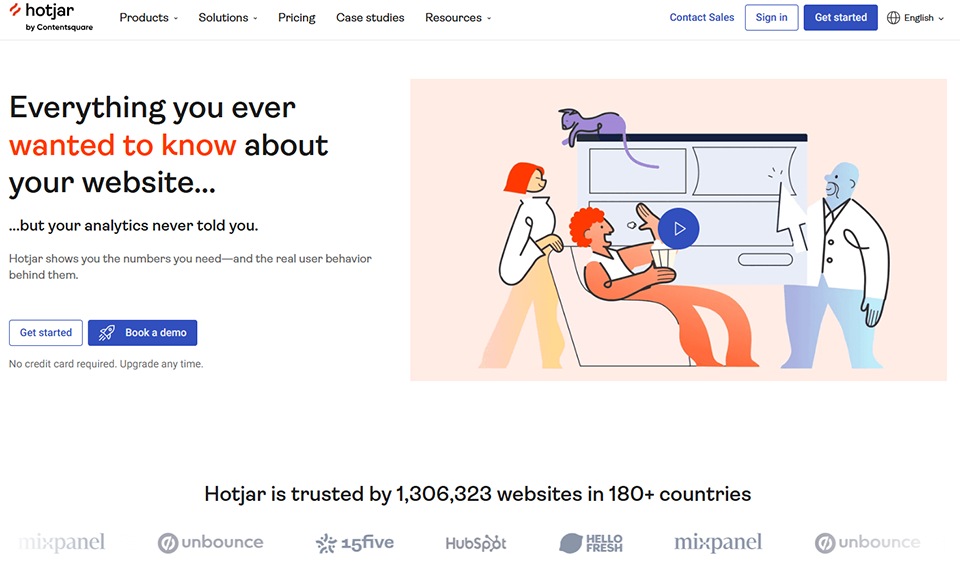
Hotjar is a behavioral analytics tool that supplements the numerical data from Google Analytics with visual data: heatmaps (which show where users click and scroll), session recordings (replays of visits), and surveys/questionnaires displayed directly on the website.
It is a valuable tool for understanding why visitors aren't converting, identifying friction points in a purchase funnel, or improving the landing page experience.
Hotjar is useful for any website with a conversion goal: e-commerce stores, landing pages, SaaS platforms with free trials, and more. It’s particularly popular among growth marketers, UX designers, and product managers. If you’re getting traffic but your conversion rates are disappointing, Hotjar will help you figure out where the problem lies.

Simple Analytics is an alternative to Google Analytics designed for professionals who are concerned about GDPR compliance and protecting their visitors' privacy. The platform does not set cookies, does not use fingerprinting, and does not share any personal data with third parties. As a result, you don't need a cookie consent banner to use it.
The interface is intentionally streamlined: key metrics (page views, unique visitors, traffic sources, most-viewed pages) are displayed on a minimalist dashboard. This deliberate choice to simplify the interface can be a strength or a limitation, depending on your needs.
Simple Analytics is ideal for freelancers, entrepreneurs, bloggers, and startups who want to track their traffic without worrying about GDPR compliance and without cluttering their dashboard with unnecessary metrics. It’s also a strong ethical choice for companies looking to reduce their tracking footprint.
Here is a summary of the tools discussed in this article to help you get up to speed quickly.
| Tool | Category | Starting price | Ideal for | Complexity |
|---|---|---|---|---|
| SEMrush | SEO | ~€130/month | Marketing teams, agencies | ⭐⭐⭐ |
| Surfer SEO | SEO / Content | ~€99/month | Editors, content managers | ⭐⭐ |
| Mangools | SEO | ~$29/month | entrepreneurs, SEO beginners | ⭐ |
| Moz SEO | SEO | ~$49/month | SEO Consultants, Small and Medium-Sized Businesses | ⭐⭐ |
| SocialBee | Social media | ~$29/month | Solopreneurs, freelancers | ⭐⭐ |
| Buffer | Social media | ~$6/month/channel | Beginners, creators | ⭐ |
| Hootsuite | Social media | ~$99/month | Agencies, large teams | ⭐⭐⭐ |
| ContentStudio | Social media + content | ~$25/month | Curators, agencies | ⭐⭐ |
| Brevo | Email marketing | Free / ~€9/month | SMEs, European startups | ⭐⭐ |
| GetResponse | Email + Webinars | ~€16/month | Trainers, coaches | ⭐⭐ |
| Mailchimp | Email marketing | Free / ~€13/month | Beginner-level structures | ⭐⭐ |
| Google Ads | Advertisement | Variable | All organizations | ⭐⭐⭐ |
| LinkedIn Ads | B2B Advertising | Variable | B2B, consultants | ⭐⭐⭐ |
| Hotjar | Behavioral analytics | Free / ~$39/month | Growth, UX, E-commerce | ⭐⭐ |
| Simple Analytics | GDPR Analytics | ~$9/month | Freelancers, startups | ⭐ |
The prices listed are for reference only. Please visit the relevant pages for current offers.
You don't need to activate all these options at once. Here are a few realistic configurations based on your situation:
Prioritize local visibility and professional credibility. Use an affordable SEO tool like Mangools to identify the right keywords, Buffer to maintain a presence on LinkedIn and Instagram without spending hours on it, Brevo (free plan) to send regular newsletters to your prospects and customers, and Simple Analytics to track your website traffic without any GDPR complications. Estimated monthly budget: €40–€80.
The priority is to move quickly and test. SEMrush or Surfer SEO for SEO content, SocialBee for automating social media, GetResponse or Brevo for email marketing and lead nurturing, Google Ads to accelerate user acquisition for target keywords, and Hotjar for continuously optimizing conversions. Estimated monthly budget: €300 to €600.
A balanced mix of organic and paid acquisition. SEMrush as the central SEO tool, Hootsuite or ContentStudio for team-based social media management, Mailchimp or Brevo for email campaigns, and LinkedIn Ads if the target audience is B2B. Estimated monthly budget: €400 to €800.
Below are the most frequently asked questions about developing a digital visibility strategy. For more information, check out our comparisons of SEO software, email marketing tools, and social media management solutions available on Freelance Stack.
Start with the basics: a professional, SEO-optimized website (consider WordPress or Webflow), an optimized LinkedIn profile, and an analytics tool to track what’s working. SEO and email marketing are the two key strategies to prioritize, as they generate cumulative results over time. Social media and paid advertising come next to amplify what’s already working organically.
The two aren’t mutually exclusive; they complement each other. SEO is a long-term investment: it takes between 3 and 12 months to see significant results, but the traffic it generates is sustainable and costs nothing once it’s up and running. Paid advertising (Google Ads, LinkedIn Ads) produces immediate results but stops as soon as the budget runs out. The optimal strategy is to invest in SEO from the start while using paid campaigns to accelerate acquisition until organic search gains traction.
It’s better to use 3 or 4 tools that you’ve mastered than 10 tools that you don’t use to their full potential. Using too many tools drives up costs and divides your attention. Start by identifying your primary acquisition channel (SEO, social media, or email) and invest first in the best tool for that channel. Gradually add others based on your actual needs.
AI is transforming these tools without replacing them. SEMrush, Surfer SEO, Brevo, SocialBee... All of them now incorporate AI features to boost productivity. But strategy, understanding your target audience, and interpreting data remain irreplaceable human skills. AI speeds up execution; it doesn’t set the direction.
First, define your goals: organic traffic, leads generated, newsletter subscribers, conversions... Each channel should have its own KPIs. Google Analytics (or Simple Analytics) will provide you with traffic data. Email marketing tools track opens and clicks. Google Ads and LinkedIn Ads provide their own conversion reports. The challenge is to link each touchpoint to a concrete business outcome: leads, customers, revenue.
No, and that’s often a rookie mistake. It’s better to excel on one or two platforms than to be mediocre on five. Choose the platforms where your target audience is actually present and active. For a professional B2B audience, LinkedIn is must-have. For a creative or younger audience, Instagram and TikTok are more relevant. For general B2C audiences, Facebook remains very effective. Focus your energy where your audience actually is.
Yes, as soon as you have a website. Even on a tight budget, a tool like Mangools—which costs less than €30 per month—will allow you to identify the keywords your content ranks for, track your progress, and analyze what your competitors are doing. Not doing SEO from the start means delaying the organic results you’ll eventually achieve.