





The Best Software for Developing a Mobile App in 2026
This comparison reviews seven of the most robust solutions on the market for building a mobile app in 2026,…
Read more


3D modeling is no longer limited to large production studios or engineering firms. Architects, entrepreneurs, product designers, freelance animators, game developers, mechanical engineers, and construction professionals: every industry has its own requirements, its own file formats, and, above all, its own workflows.
Choosing the wrong software can be costly-not only in terms of subscription fees, but especially in terms of training time, friction with your clients or partners, and sometimes technical incompatibilities that jeopardize an entire project. Conversely, the right tool, when used effectively, becomes a powerful driver of productivity and competitiveness.
The global market for CAD (computer-aided design) software is now worth billions of dollars and is experiencing steady growth, driven in particular by the widespread adoption of 3D printing, the development of digital twins, and the rise of the creative industries. For entrepreneurs small businesses, this means both more choices and greater complexity when navigating the various options available.
In this comparison, we focus on software available through Freelance Stack in the Design and Modeling (CAD) category: AutoCAD, AutoCAD LT, Autodesk Fusion, Autodesk Maya, Autodesk 3ds Max, Autodesk Revit LT, and SolidWorks. Seven robust tools, each with a distinct positioning.

AutoCAD is undoubtedly the world's most well-known technical drafting software. Published by Autodesk for over forty years, it remains the gold standard today for all aspects of computer-aided drafting, whether for architectural plans, industrial technical diagrams, or civil engineering drawings.
What fundamentally sets it apart is its versatility. AutoCAD covers both 2D drafting (plans, elevations, sections) and 3D solid and surface modeling. It also offers a large library of blocks and symbols, a highly sophisticated layer system, and universal compatibility with the .DWG format, which has become the de facto standard in the construction and engineering industries.

AutoCAD LT is a streamlined version of AutoCAD, designed for professionals whose work focuses primarily on 2D drafting. It retains the core functionality of the software while removing 3D features, advanced customization options (AutoLISP, .NET API), and certain specialized tool sets.
For many drafting professionals in design offices, architects who outsource 3D modeling, or technicians who work exclusively with plans and sections, AutoCAD LT meets 90% of their needs at a significantly lower price.

Autodesk Fusion (formerly Fusion 360) occupies a unique position in the market: it brings together parametric CAD modeling, simulation, computer-aided manufacturing (CAM), electronics (PCB), and real-time collaboration into a single platform. It is a tool designed for engineers, product designers, and makers who need to cover the entire lifecycle of a physical product.
Its cloud-native model also sets it apart from most of its competitors: projects are hosted in the Autodesk cloud, which facilitates distributed teamwork and ensures a complete version history.

Revit is the global standard for BIM (Building Information Modeling). The LT version is a simplified version designed for professionals who work alone or in small teams and want to adopt BIM without the constraints (and cost) of the full version.
BIM is much more than just a drafting tool: it is a modeling approach in which every building component (wall, door, window, slab) is a smart object containing technical data, properties, and cost information. This makes it possible to automatically generate plans, sections, and quantity takeoffs, and to detect conflicts between trades.

Autodesk Maya is the 3D animation software used by virtually all major Hollywood studios, AAA video game teams, and VFX production companies. It is an extremely comprehensive solution for character creation, animation, simulation, and rendering, but it is also a tool that requires a significant investment of time to learn.
Maya is not a traditional CAD tool. It is not used to design mechanical parts or buildings, but rather to create objects, characters, and environments intended to be viewed, animated, and rendered. It is both an artistic and technical creation tool.
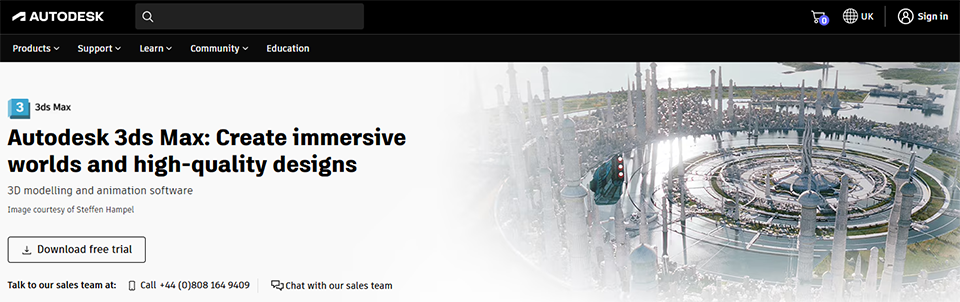
3ds Max is often seen as the during to Maya during design and visualization. While Maya dominates in character animation and VFX, 3ds Max has established itself in architectural visualization (photorealistic renderings of buildings), interior design, the creation of video game assets, and advertising.
Its plugin ecosystem is particularly robust, especially with third-party rendering engines such as V-Ray, Corona Renderer, and Chaos, which are industry standards in architecture firms and visualization studios.
Please note: 3ds Max is available exclusively on Windows, unlike Maya, which also supports macOS and Linux.

SolidWorks, published by Dassault Systèmes, is the most widely used mechanical CAD software in the global manufacturing industry. It stands out for its robust parametric approach, an interface that has historically been more user-friendly than CATIA (its "big brother" within the Dassault group), and a comprehensive ecosystem that covers not only design but also simulation, product data management, and manufacturing.
It is the natural choice for many design firms, industrial SMEs, freelance engineers, and subcontractors working on mechanical parts, complex assemblies, molds, industrial equipment, or consumer products.
Each software program is designed for specific industries and use cases. Here’s how to identify the one that truly fits your business.
AutoCAD LT covers the essentials of 2D technical drafting at a reasonable cost. For those looking to transition to BIM and work with smart data (automatic takeoffs, consistent drawings, coordination with MEP systems), Autodesk Revit LT is the logical starting point. The transition requires an investment in training, but the productivity gains on recurring projects are significant.
SolidWorks remains the industry standard if you work with industrial clients: file compatibility is a key factor in this sector, and SolidWorks is often mandated by clients. Autodesk Fusion is a strong alternative for entrepreneurs small businesses, offering more affordable pricing and integrated CAM tools that are particularly useful if you work directly with CNC machines or 3D printing.
Autodesk Fusion offers a good balance between precise parametric modeling and sculpting tools for organic shapes. SolidWorks is the better choice if your work involves complex mechanical assemblies or if you need to deliver files to manufacturers. For more conceptual designs or presentation renderings, Autodesk 3ds Max is a useful addition to the suite.
Autodesk Maya is practically must-have you work for production studios on films, TV shows, or commercials. Proficiency in Maya is a sought-after and often required skill. Autodesk 3ds Max remains a relevant choice for animation projects intended for commercials or animated architectural visualization.
AutoCAD (full version) or AutoCAD LT for 2D drawings, and Autodesk 3ds Max for photorealistic renderings. This is, in fact, a very common combination in high-end interior design firms, which export their drawings from AutoCAD and import them into 3ds Max for visualization.
Autodesk Maya for character creation and animation, Autodesk 3ds Max for creating environments and static assets. Both are compatible with major game engines (Unreal Engine, Unity). The choice often depends on what the team is already proficient in or what the studio you’re working with requires.
Autodesk Fusion likely offers the best value for money in this category: CAD design, simulation, CAM, and electronics-all on a single cloud-based platform accessible from any computer.
Seven software programs with very different uses-here’s an overview to help you quickly identify the one that best suits your profession and skill level.
| Software | Primary sector | Type of modeling | Recommended level | Platform | Key strengths |
|---|---|---|---|---|---|
| AutoCAD | Architecture, Civil Engineering, Industry | Versatile 2D and 3D | Intermediate/Advanced | Windows, Mac, Web | Universal, .DWG format |
| AutoCAD LT | Architecture, Technical Drawing | 2D only | Beginner/Intermediate | Windows, Mac, Web | Price, .DWG compatibility |
| Autodesk Fusion | Product, Hardware, CAM | Parametric + Sculpt + CAM | Intermediate | Windows, Mac | All-in-one, cloud, price |
| Autodesk Revit LT | Architecture (BIM) | Parametric BIM | Intermediate/Advanced | Win | Accessible BIM, coordination |
| Autodesk Maya | Animation, VFX, Games | Polygonal, NURBS, Sculpt | Expert | Windows, Mac, Linux | Animation, physical simulation |
| Autodesk 3ds Max | Architectural Visualization, Games, Advertising | Polygonal, procedural | Intermediate/Advanced | Windows only | Plugins, photorealistic rendering |
| SolidWorks | Industry, Mechanical Engineering, Product | Parametric mechanical CAD | Intermediate/Advanced | Windows only | Durability, industry standard |
The prices listed are approximate estimates based on publicly available information at the time of writing. They are subject to change. Please check the deals pages for the latest terms and discount .
Answers to the most frequently asked questions to help you choose the right design software and avoid making a bad investment.
Yes, and it’s becoming increasingly common. Both software programs offer official free resources (Autodesk Knowledge Network for Autodesk products, MySolidWorks for SolidWorks), and there is a wealth of online training available on platforms like LinkedIn Learning and YouTube. That said, to reach a professional level in Maya or SolidWorks, structured training saves a considerable amount of time.
Autodesk does indeed offer a free version of Fusion, subject to certain conditions: it is reserved for users whose annual revenue from Fusion is less than $1,000. Above that threshold, a paid subscription is required. For most freelancers just starting out or makers, the free version covers everyday needs.
Mechanical CAD (SolidWorks, Fusion) focuses on the design of physical parts and assemblies: mechanical stresses, tolerances, and manufacturing. BIM (Revit) focuses on building design: each element is an object containing data (materials, costs, thermal performance). Both use parametric 3D modeling, but their objectives and methodologies are very different.
If you're interested in character animation, VFX, or the video game industry, start with Maya. If you're in architectural visualization or rendering-focused product design, 3ds Max is often a better fit. In either case, mastering the basics of 3D modeling beforehand will make the learning process easier.
Yes, but to varying degrees. SolidWorks and Autodesk Fusion are best suited for preparing files for 3D printing (STL export, resolving manifold issues). AutoCAD can export to STL but isn’t the most optimized tool for this purpose. Maya and 3ds Max produce meshes that often require some repair work before printing.
Freelance Stack promo codes and negotiated pricing for all of these tools. Simply create a (free) account and visit the corresponding deals pages. Some discount available with the freemium plan, while others are reserved for the premium plan. Find all the offers in the Design and Modeling (CAD) category.
Often, yes. In the professional world, workflows frequently involve multiple tools: an architect might model in Revit and create 3D renderings in 3ds Max. A product designer might design in Fusion and create presentation renderings in KeyShot. Mastering one or two complementary software programs gives freelancers a real competitive edge.