





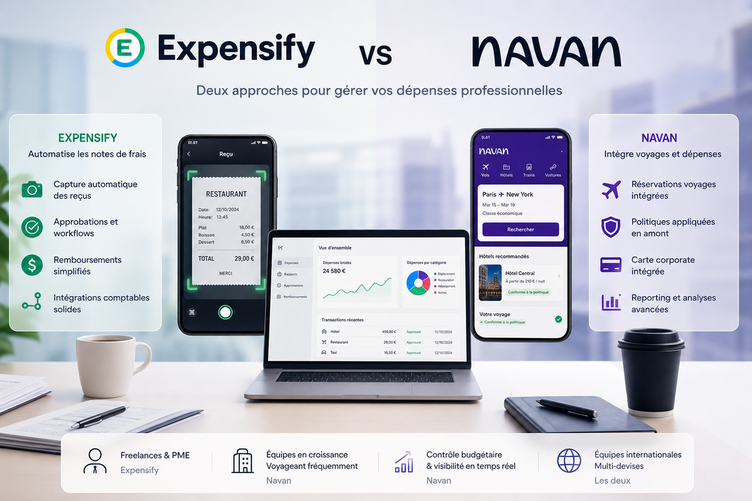
Expensify vs. Navan: Features, Differences, and Use Cases
Choosing between the two isn't just a matter of price. It's a matter of priorities: Are you looking to…
Read more


There’s one decision that many entrepreneurs make a little too quickly: choosing a payment processor. They often go with what they’re already familiar with, or what the developer has integrated by default, without really considering whether it’s a good fit for their revenue model, their target markets, or the way their customers prefer to pay.
However, the payment solution you use has a tangible impact on your conversion rate, your operating costs, your ability to expand internationally, and the strength of your financial infrastructure. Choosing the wrong solution from the start often leads to a painful migration a few months down the line.
Stripe and Mollie are two of the most established players in the European and global markets. They share a solid reputation, seamless technical integration, and widespread popularity among startups and small and medium-sized businesses. However, their philosophies, strengths, and use cases remain very different.
In this article, we provide an honest and detailed comparison to help you choose the solution that truly fits your situation, whether you're a freelancer, a SaaS founder, an e-commerce manager, or the head of a fast-growing SME.

Founded in 2010 in San Francisco by brothers Patrick and John Collison, Stripe has established itself as the leading online payment solution for startups and tech companies around the world. It is currently valued at around $65 billion and processes hundreds of billions of transactions each year.
Its reputation is built on an exceptional technical stack, developer documentation that ranks among the best in the industry, and a suite of products that extends far beyond simple payments: billing, subscriptions, KYC, fraud management, vendor payments, tax optimization... Stripe has become a true financial operating system for digital businesses.
Available in more than 46 countries and compatible with more than 135 currencies, it’s the obvious choice if you have international ambitions or a complex tech business.
Stripe uses a pay-as-you-go pricing model, with no mandatory monthly subscription for basic features:
Online payments (credit cards):
Bank transfers and SEPA direct debits:
Stripe Billing (subscriptions and recurring billing):
Stripe Connect (marketplace and multiple payments):
There are also customized plans available for businesses with high transaction volumes. The rates listed are for informational purposes only; we recommend that you check them directly on the Stripe website, as they are subject to change.

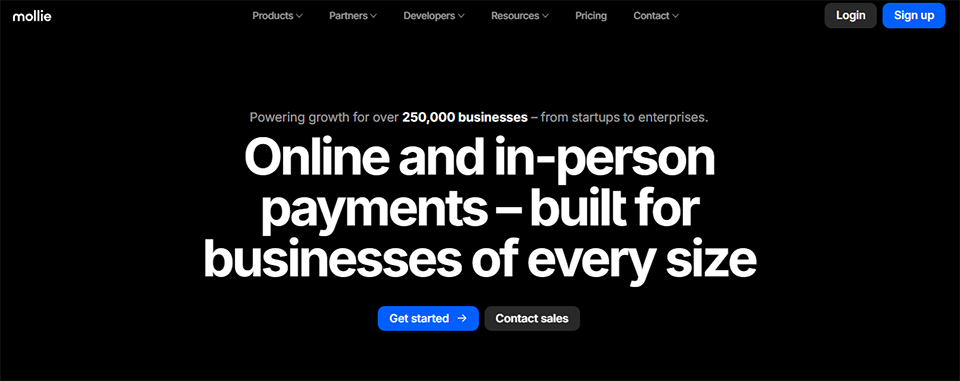
Mollie is a Dutch fintech company founded in Amsterdam in 2004 that has gradually established itself as one of the most popular payment solutions among European merchants, particularly in Belgium, the Netherlands, Germany, and France. It now has more than 250,000 business customers across the continent.
The key difference between Mollie and Stripe is that Mollie was built with a truly merchant-oriented approach rather than a developer-oriented one. The interface is more user-friendly, it’s easier to get started, and local European payment methods (iDEAL, Bancontact, SOFORT, Klarna, etc.) are natively integrated in a more seamless way.
This solution is particularly appealing to online stores, B2B service providers, and small and medium-sized businesses that want to accept payments in Europe without having to develop a sophisticated technical infrastructure.
Mollie also operates without a monthly subscription for its standard plan, with per-transaction pricing:
Credit cards (Visa, Mastercard):
Local payment methods:
SEPA Direct Debits:
PayPal:
Mollie also offers Mollie Growth, a negotiated pricing plan for higher transaction volumes. Again, these rates are for reference only and are subject to change; please check the current terms directly with Mollie.

What sets Stripe apart from the vast majority of its competitors is the quality and richness of its technical ecosystem. The APIs are documented with rare thoroughness, the SDKs cover all common programming languages (Node.js, Python, PHP, Ruby, Go, Java...), and webhooks enable highly granular automation of financial workflows.
For a SaaS startup looking to set up a recurring billing system with free trials, upgrades, downgrades, and automated payment failure handling, Stripe Billing is likely the most comprehensive tool on the market. It natively supports billing cycles, automatic dunning, discounts, invoices, and credit memos.
Stripe has gradually built a full-fledged ecosystem of financial products:
Stripe Radar: a machine learning-based fraud detection engine, powered by data from millions of merchants worldwide.
Stripe Connect: ideal for marketplaces and platforms that need to distribute funds to multiple sellers or service providers.
Stripe Treasury: embedded banking services to create virtual accounts or cards for your customers.
Stripe Tax: Automatic calculation of VAT and taxes in over 50 countries.
Stripe Atlas: to start a U.S. company (in Delaware) online.
This vertical integration is a significant advantage for companies that want to centralize their financial infrastructure on a single platform.
Stripe is available in more than 46 countries, accepts more than 135 currencies and supports dozens of local payment methods. If you sell in the United States, the Asia-Pacific region, or Latin America, Stripe is very often the only provider capable of covering all of your markets consistently.
Stripe is particularly well-suited if you are:
While Stripe remains a product designed with the U.S. market in mind (with local adaptations), Mollie was designed for the European market. The difference is noticeable in several areas: native support for local payment methods (iDEAL accounts for more than 60% of online transactions in the Netherlands), a multilingual interface that includes French, and customer support available in Europe with hours tailored to the region.
For a store that primarily sells in France, Belgium, or the Netherlands, Mollie makes it possible to offer the payment methods that local customers expect, without having to develop complex integrations.
One of Mollie's biggest advantages is that you don't need a technical team to integrate it. The official plugins for WooCommerce, PrestaShop, Shopify, Magento, and other CMS platforms are well-documented and regularly maintained. In just a few hours, an e-commerce site can be up and running with a functional, well-designed checkout page.
The Mollie dashboard is also easier to read and more intuitive for non-technical users: transaction tracking, refunds, accounting exports—everything is accessible without needing to be familiar with API architecture.
Mollie natively supports about 15 payment methods, several of which are specific to certain European markets. Klarna (installment payments), Bancontact, iDEAL, SOFORT, Belfius, and others are directly integrated, with transparent fees for each method. This wide range of options is a real advantage for merchants who want to maximize their conversion rates in specific markets.
For low volumes or frequent small transactions, Mollie may be less expensive than Stripe in certain use cases. Paying a fixed fee (rather than a percentage) for payment methods such as iDEAL or SEPA direct debits is an advantage for merchants who process a large number of small orders.
Mollie is especially well-suited if you are:
✅ Top-quality technical documentation; one of the most robust APIs on the market.
✅ A comprehensive product ecosystem (billing, fraud, taxes, Connect, Treasury...).
✅ Operates in more than 46 countries and accepts 135+ currencies.
✅ Advanced subscription and recurring payment management.
✅ Native integration with hundreds of tools (Zapier, HubSpot, Salesforce, Notion...).
✅ Stripe Radar for real-time fraud detection.
✅ Supports many alternative payment methods (Apple Pay, Google Pay, Link...).
⚠️ Steeper learning curve for non-technical users.
⚠️ Fees may be higher for certain types of transactions in Europe.
⚠️ Customer support may be slow or difficult to reach for smaller accounts.
⚠️ The management interface is less intuitive than Mollie's for non-developers.
⚠️ Some advanced features (Connect, Tax, Treasury) add complexity and incur additional fees.
✅ A clear and user-friendly interface, even for those without technical skills.
✅ Excellent coverage of local European payment methods.
✅ Easy integration with leading e-commerce CMS platforms.
✅ Transparent and predictable pricing.
✅ Customer support in French, with teams based in Europe.
✅ GDPR and PSD2 compliance are natively supported.
✅ Quick onboarding, with no long-term commitment.
⚠️ Available only in the European Economic Area (and a few neighboring countries).
⚠️ Less suitable for complex technical architectures or multi-vendor marketplaces.
⚠️ Fraud management features are less advanced than Stripe Radar.
⚠️ Less depth on subscriptions and complex recurring billing.
⚠️ The ecosystem of partners and integrations is still smaller than Stripe's.
The prices listed in this table are for reference only. We recommend that you check them directly on the respective Stripe and Mollie websites, as they are subject to change.
| Criterion | Stripe | Mollie |
|---|---|---|
| Available countries | 46+ countries | EEA + a few other countries |
| Accepted Currencies | 135+ | 30+ |
| European card fees | 1.5% + €0.25 | 1.8% + €0.25 |
| Local payment methods (iDEAL, Bancontact, etc.) | Available | Native and optimized |
| Subscriptions / recurring payments | Very Advanced (Stripe Billing) | Functional but less comprehensive |
| Marketplace / Connect | Yes (Stripe Connect) | Limited |
| Anti-fraud | Stripe Radar (AI) | Basic |
| Ease of integration | Technical (API) | Simple (CMS plugins) |
| Dashboard | Comprehensive but dense | Intuitive and clear |
| Customer Support | Email, chat (response times may vary) | Email, chat in French |
| CMS plugins | Yes | Yes (very well maintained) |
| VAT management | Stripe Tax (paid option) | Basic |
| Ideal for | SaaS, tech, international | E-commerce, SMEs, Europe |
Stripe is the natural choice. Its rich API, subscription management, automatic dunning, and compatibility with hundreds of third-party tools make Stripe the ideal backbone for a SaaS financial infrastructure. If you're building a platform or a marketplace, Stripe Connect is practically a must-have.
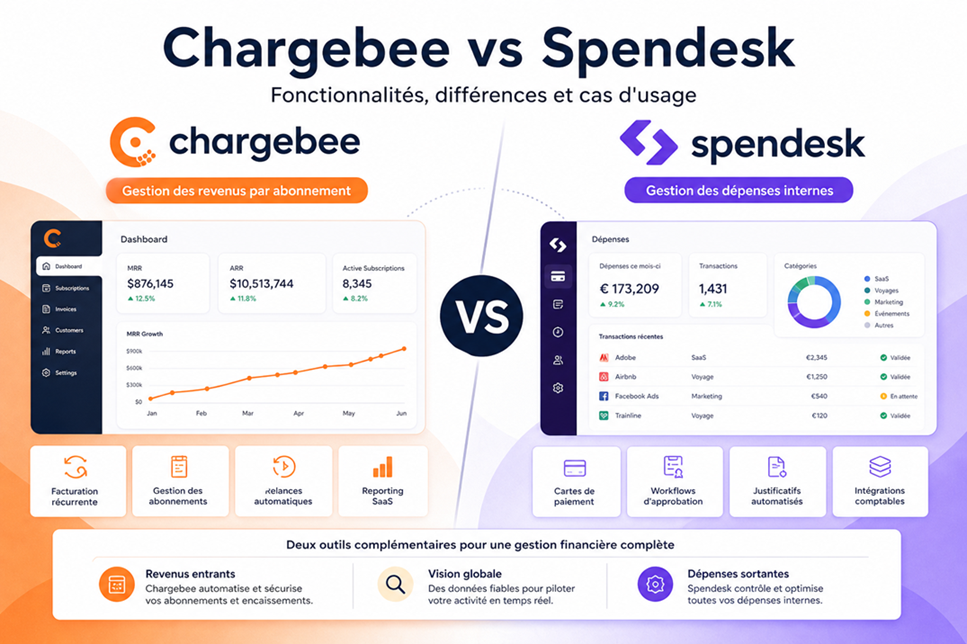
Note that Chargebee may also be a good option if you're looking for an even more advanced subscription management layer to integrate with Stripe.
Mollie is often the better choice. Its easy integration with WooCommerce, PrestaShop, or Shopify, its wide range of local payment methods, and its user-friendly interface for managing refunds and accounting exports make it a very solid choice for e-commerce merchants.
If you operate primarily in the Netherlands or Belgium, Mollie is practically indispensable for offering iDEAL and Bancontact under favorable terms.
Both solutions work, but Mollie is often easier to set up if you don't have technical expertise. For recurring billing (monthly retainers, subscriptions), Stripe offers more flexibility.
If you're looking for a simple payment solution for your quotes and invoices, GoCardless is also an option worth considering, especially for direct debits.
Stripe. Its geographic coverage, multi-currency support, and product suite (Tax, Treasury, Connect) are hard to match. If you want a solution that won’t need to be replaced as your business scales, Stripe is the more robust of the two.
Mollie. Its lack of technical complexity, French-language support, well-managed PSD2 compliance, and wide range of local payment methods make it the most practical solution for this profile.
To learn more about tools for managing recurring payments and electronic invoicing, Payplug is another French solution worth exploring for online merchants.
Here are your questions about Stripe and Mollie.
Both solutions offer invoicing features, but neither is currently certified as electronic invoicing software under the French reform (which will be phased in starting in 2026). Stripe generates invoices, but to comply with French requirements, you will likely need to supplement it with dedicated accounting or invoicing software.
Technically, yes. Some merchants use Stripe for international card payments and Mollie for local European payment methods. In practice, this setup adds complexity. It’s better to choose one primary solution and scale it as needed.
Not always. For European cards, Mollie charges a slightly higher commission (1.8% vs. 1.5%). However, for certain local payment methods and SEPA direct debits, Mollie may be less expensive. The actual cost depends on your payment mix: currencies, payment methods, and average transaction amount.
Mollie generally offers faster onboarding: expect to be up and running in a few hours to a day. Stripe sometimes requires more thorough identity verification, but the vast majority of organizations can still get set up within a few days.
Stripe Connect, without a doubt. It's the most mature solution on the market for managing payment flows between a platform and its sellers, with comprehensive documentation and advanced features for regulatory compliance.
No, not for either solution in their standard versions. You pay only per transaction. Paid options are available (Stripe Billing, Mollie Growth) for advanced features or high transaction volumes.
Yes. Both Stripe and Mollie are compliant with the GDPR and PSD2. However, since Mollie is based in Europe (Amsterdam), some users prefer its data management model, which is perceived as being more in line with European standards.
No. Stripe generates valuable financial data and invoices, but it does not replace accounting software. It integrates very well with tools like Pennylane, QuickBooks, or Xero, but it does not handle month-end closing, tax filings, or expense report management.