






GoCardless vs. Chargebee: Features, Differences, and Use Cases
In this article, we compare GoCardless and Chargebee in terms of their features, pricing, and real-world use cases, to help you…
Read more


There’s a truth that few entrepreneurs like to admit: a significant portion of the time they spend managing their business is taken up by tasks that shouldn’t even exist. Following up with a customer who hasn’t paid their bill. Checking to see if this month’s direct debit went through. Manually sending a third reminder to the same subscriber. Finding a transaction in an Excel spreadsheet from six months ago.
That's not management. That's administrative survival.
And yet, most startups, freelancers, and small teams continue to pile up these micro-tasks—often out of habit, sometimes because they don’t have time to look for better solutions, and sometimes because they think “it doesn’t apply to their income level yet.” It is precisely this line of thinking that needs to be questioned.
Unpaid invoices are costly—and not just in terms of money. According to a study by the Banque de France, about 25% of French business failures are directly linked to cash flow problems caused by late payments or non-payments. And beyond the financial cost, it takes a mental toll: sending reminders, negotiating, figuring out what you can legally do, and waiting.
Today, there are tools that address this issue at its root. These aren’t traditional accounting software, but solutions specifically designed to automate the management of incoming payments, secure payment flows, and maintain a healthy relationship with customers without unnecessary friction. Three of them are worth taking a closer look at.
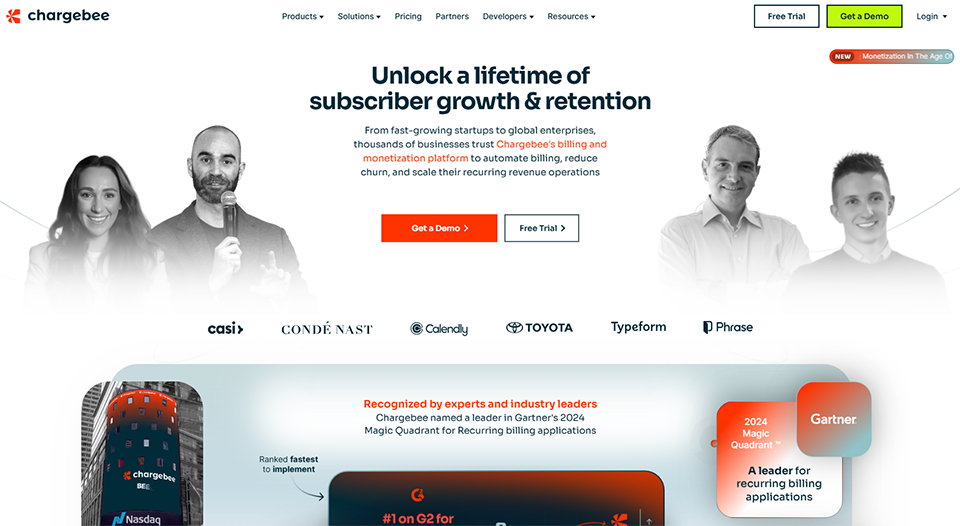
Chargebee is a platform for managing subscriptions and recurring revenue. Unlike a traditional billing tool, it is not designed to issue invoices on demand, but rather to manage the entire subscription lifecycle: creation, renewal, modification, cancellation, follow-up in the event of a failed payment, and calculation of related metrics.
This positioning is important. If your business model relies on predictable, recurring revenue (monthly or annual subscriptions, SaaS licenses, memberships, subscription boxes, etc.), Chargebee quickly becomes a central pillar of your financial operations.
The dunning feature deserves special attention. Many companies lose revenue not because their customers refuse to pay, but because a credit card has expired or a spending limit has been temporarily reached. Chargebee can attempt to charge the card multiple times at configurable intervals, send automated emails to the customer asking them to update their payment information, and notify the team only if the issue remains unresolved after several attempts. As a result, a fraction of the unpaid invoices are resolved on their own, without human intervention.
Chargebee offers several pricing plans based on the volume of revenue managed:
The free plan is sufficient for testing the platform and is suitable for organizations with a limited transaction volume. Beyond that, upgrading to a paid plan represents a significant investment, which is justified when automation results in measurable time savings or reduces the churn rate caused by payment issues.
SaaS startups in the growth phase:
Once a startup begins managing dozens or hundreds of active subscriptions, manual management becomes a bottleneck. Chargebee makes it possible to streamline this process without hiring a finance team. Native integrations with Stripe, Salesforce, and HubSpot make the tool particularly well-suited for technical environments that are already well-equipped.
Software publishers or creators of subscription-based content:
Whether you’re selling a B2B SaaS product or access to a training platform, the logic is the same: recurring revenue, customers who can upgrade or downgrade, and the need to track key metrics (MRR, ARR, churn rate, LTV). Chargebee generates this data natively.
Teams that sell internationally:
Cross-border tax compliance (VAT, GST, U.S. sales tax, etc.) is one of the most time-consuming tasks for businesses that sell internationally. Chargebee includes tax rules that can be configured by region, which greatly simplifies compliance without requiring a tax firm for each new market.


GoCardless approaches the problem from a different angle. While Chargebee manages the entire subscription lifecycle, GoCardless tackles the root cause of unpaid invoices: the payment method itself.
Most companies collect payments from their customers via bank transfer (and wait for the funds to arrive) or by credit card (which can be declined, reach its limit, or expire). GoCardless offers a third option: automated direct debit, based on the SEPA network in Europe and on local equivalents in other countries (BACS in the United Kingdom, ACH in the United States, etc.).
In practical terms, once your customer has authorized a direct debit, you’re the one who initiates the payment when the time comes. The customer doesn’t have to do anything. They can’t forget. They can’t decide to delay it. And in the event of a technical failure, GoCardless offers Success+, a smart retry technology that identifies the best time to retry the direct debit based on behavioral signals related to the payer’s bank account activity.
For companies that regularly bill the same clients (agencies on retainer, SaaS companies, providers of recurring services, mutual insurance companies, nonprofit organizations, etc.), this represents a paradigm shift.
GoCardless operates on a per-transaction fee model, with no fixed subscription fee for entry-level plans:
This per-transaction pricing model is attractive for organizations whose payment volume fluctuates or is growing: the cost naturally adjusts to the level of activity, with no fixed costs to absorb during slower months.
Agencies and service providers that operate on a subscription or retainer basis:
An agency that bills 30 clients each month via traditional bank transfer spends an enormous amount of time verifying bank statements, following up with late payers, and waiting. By switching to direct debit through GoCardless, cash flow becomes predictable and the administrative burden is virtually eliminated.
Nonprofits and organizations with recurring membership dues:
Nonprofits that collect annual or monthly dues will find that GoCardless offers a much more reliable and cost-effective solution than checks or manual bank transfers. The direct debit mandate also simplifies the relationship with members, who no longer have to worry about making payments.
Startups operating in the B2B sector that want to avoid late payments:
In B2B, late payments are culturally ingrained. Offering direct debit from the very start of the business relationship changes the dynamic: payment becomes an administrative formality, not a tacit negotiation. GoCardless makes it possible to seamlessly integrate direct debit into the customer onboarding process.

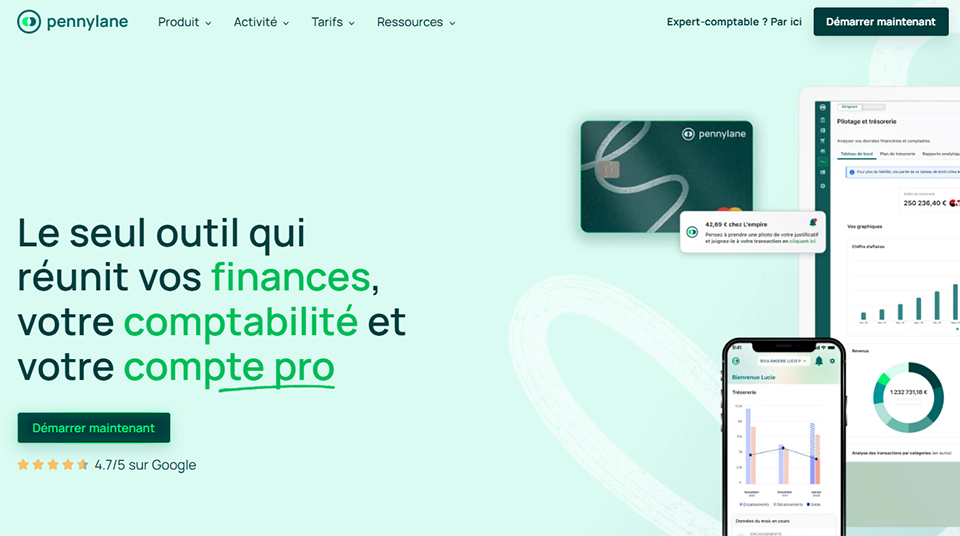
Pennylane tackles the problem of unpaid invoices by providing visibility. What often prevents many leaders of small organizations from taking swift action when faced with late payments is a lack of clarity: What is the status of the invoices that have been sent? Which ones are past due? By how much? Who should be contacted first?
Pennylane is an accounting and financial platform designed for French entrepreneurs and small and medium-sized businesses, offering a unified view of a company’s financial health: invoicing, tracking of payments received, automated bank reconciliation, collaboration with an accountant, and—soon—an expanding range of features to automate the accounting cycle.
The tool is not debt collection software in the strict sense. But by giving executives a real-time view of their receivables and cash flow, it tangibly changes the way they manage late payments: fewer belated responses, more proactive planning.
Pennylane offers several plans tailored to different scenarios:
One of the advantages of Pennylane over purely accounting-based solutions is that its price includes features that, in other ecosystems, would require several separate subscriptions.
Freelancers and independent consultants:
For a consultant who handles their own billing, Pennylane is undoubtedly the most comprehensive solution and the best fit for the French market. It covers everything from creating quotes and invoices to tracking payments, preparing accounting records, and ensuring legal compliance. And the automated reminder feature eliminates the hassle of having to manually write a reminder email every time.
Owners of micro-businesses who work with a certified public accountant:
Pennylane’s collaborative workspace is one of its most underrated features. No more back-and-forth emails with attachments, year-end FEC file exports, or follow-up phone calls to approve a document. Everything is done within a shared interface, which also reduces the costs of the accounting engagement.
Companies preparing for the electronic invoicing reform:
The electronic invoicing reform in France (which will become mandatory in phases starting in 2026–2027, depending on company size) will affect all French small and medium-sized enterprises (SMEs). Pennylane, which is already registered as a Partner Digitization Platform (PDP), is one of the few tools that allows businesses to comply with the regulations right now without having to switch to a different tool in a few years.
Before reviewing this table, keep in mind that these three tools aren't necessarily in direct competition with one another. They are often used in combination: Chargebee for managing subscriptions, GoCardless for reliable payment processing, and Pennylane for accounting and working with your accountant.
| Criterion | Chargebee | GoCardless | Pennylane |
|---|---|---|---|
| Type of solution | Subscription Management & Recurring Revenue | Automated direct debit | Accounting & Billing |
| Ideal for | SaaS, complex subscriptions | Recurring Service Providers, B2B | Freelancers, French micro-businesses |
| Automation of Follow-ups | ✅ Advanced (dunning) | ✅ Smart Retry (Success+) | ✅ Email follow-up scenarios |
| Billing | ✅ Yes | ❌ No | ✅ Yes |
| Compliance in France | ⚠️ Partial | ⚠️ Partial | ✅ Complete (PDP, VAT, etc.) |
| Payment method supported | Multiple (card, bank transfer, direct debit) | SEPA Direct Debit Only | Billing Only (Integrates with Stripe and GoCardless) |
| Affordability | ⚠️ Expensive beyond the free plan | ✅ Per transaction | ✅ Affordable |
| Integrations | ✅ Very numerous | ✅ Many via API | ✅ Good (French ecosystem) |
| Learning | ⚠️ Learning curve | ✅ Pretty simple | ✅ User-friendly interface |
Managing your income is one thing; securing your cash flow is another. From automating direct debits to tax compliance, here are the answers to the key questions for your financial management in 2026.
Billing software like Pennylane lets you issue invoices, track payments, and manage the associated accounting. A subscription management tool like Chargebee goes much further: it manages the entire lifecycle of a recurring customer (creating a plan, upgrades, downgrades, pauses, cancellations, dunning, and calculating MRR and churn). For a business with truly recurring and complex revenue streams, the two are complementary.
Yes, it’s completely legal. In Europe, direct debits are based on the SEPA (Single Euro Payments Area) system, which is governed by specific regulations. Your customer signs a direct debit mandate (online or on paper) that authorizes you to initiate debits from their account. GoCardless automates the entire process: collecting mandates, initiating direct debits, managing required notifications, and handling any returns.
There’s no universal threshold, but there is a common-sense rule: if you spend more than 2 to 3 hours a month managing payment reminders or reconciling payments, an automation tool generally pays for itself very quickly. Even with just 15 to 20 recurring customers, setting up GoCardless or payment reminder workflows in Pennylane can make a noticeable difference in your daily workload.
In most cases, yes. Chargebee, GoCardless, and Pennylane all offer native or API-based connectors with major platforms such as Stripe, HubSpot, Salesforce, Slack, QuickBooks, Xero, and many others. Before adopting any of these tools, it’s a good idea to make a list of the solutions you’re already using and check for compatibility directly on their websites or integration marketplaces.
The SEPA framework provides for an 8-week dispute period for authorized direct debits and a 13-month dispute period for unauthorized direct debits. In practice, disputes are rare and are handled directly with your bank. GoCardless includes features for managing refunds and sending notifications in the event of a dispute.
Gradually, yes. The French reform requires companies to submit their invoices through approved platforms and to be able to receive standardized electronic invoices. If you already use Pennylane, which is PDP-certified, you’ll be in compliance without having to switch tools. For those who still use non-compliant solutions or manual processes, the transition will require some effort to adapt.
It depends on the level of internationalization. Chargebee is the most robust solution for selling in multiple countries with different tax rules. GoCardless covers about 30 countries with local direct debit networks. Pennylane, on the other hand, is primarily designed for companies operating in France. If your international business accounts for a significant portion of your revenue, it’s best to integrate it as an accounting layer for France and use dedicated solutions for foreign markets.