
Business telephony has undergone a profound transformation over the past decade. Gone are the days of bulky physical switchboards and rigid carrier contracts: today, a freelancer can manage their business calls from their personal phone, a ten-person startup can set up a call center in a matter of hours, and an SME with fifty employees can centralize all its communications in a single tool connected to its CRM.
This trend, driven by VoIP ( Voice over Internet Protocol) and cloud solutions, has radically democratized access to features that were once reserved for large companies. But it has also greatly increased the number of available options, which can sometimes make choosing the right one difficult.
The key issue: not all phone solutions are suited to the same user profiles. A solopreneur who just wants a business number doesn’t have the same needs as a 20-person sales team that handles 200 calls a day. In between these two extremes, there are about ten reputable solutions, each with its own strengths, limitations, and pricing structure.
This article will help you get a clearer picture. We've reviewed the solutions available on Freelance Stack identify the one that best fits your situation, based on the size of your team and your specific needs.
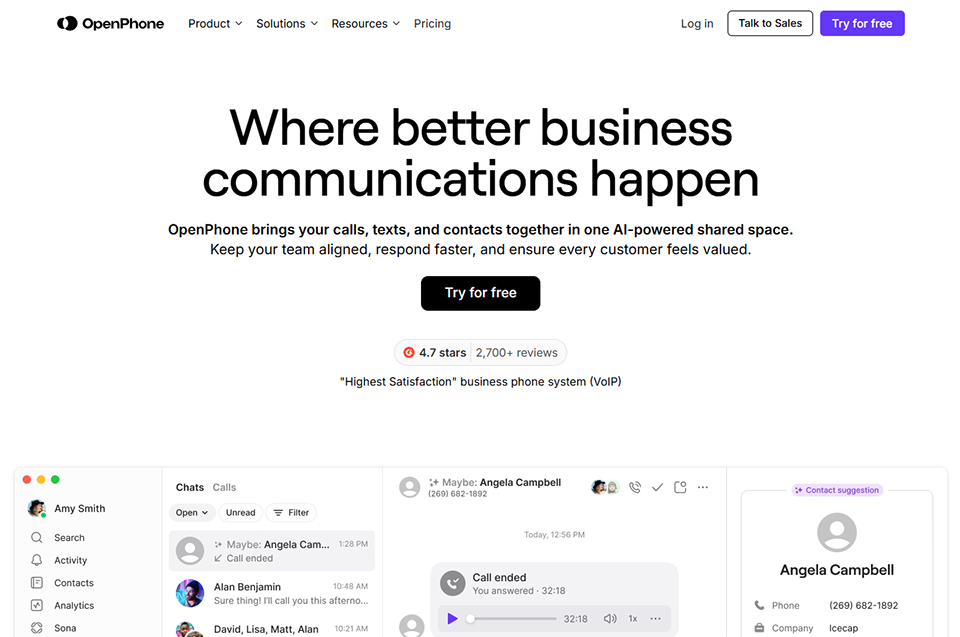
In recent years, OpenPhone has established itself as the go-to solution for freelancers, consultants, and small teams looking for a simple , affordable, and mobile-first business phone system . Founded in San Francisco, the product was designed with one goal in mind: to make a business phone number accessible to anyone, without the need for complex infrastructure.
The basic idea is appealing: you get one or more U.S. or Canadian phone numbers (French numbers aren’t yet available natively, which is a real limitation for 100% France-based use), which you manage through a mobile and desktop app. All your calls, text messages, and voicemails are consolidated into a unified inbox, which you can share with colleagues if needed.
What sets OpenPhone apart from traditional tools is its interface. It looks more like a messaging app than business phone software. No complex menus, no technical jargon: you create a contact, assign a number to it, set up a greeting message, and you’re good to go.
The features cover the basics and then some: an auto-attendant, call routing, call groups for sharing a number among multiple team members, call recording, automatic transcription of voicemails (primarily in English), and integrations with HubSpot, Salesforce, and Zapier.
The management of business text messages is handled with particular care, which is a real strength for teams that communicate with their customers via text.
OpenPhone offers three pricing tiers:
The value for money is hard to beat for small businesses. There are no setup fees, and no mandatory annual commitment for the basic plans.
OpenPhone is particularly well-suited for freelancers and consultants who want to keep their professional and personal lives separate without investing in hardware, for small sales teams (2 to 10 people) who want to share a phone number and have a comprehensive view of customer interactions, and for early-stage startups looking to move quickly without getting bogged down in setup.
However, if you need a French local number, a call center with advanced queue management, or detailed reports on your team's performance, other solutions will be more suitable.

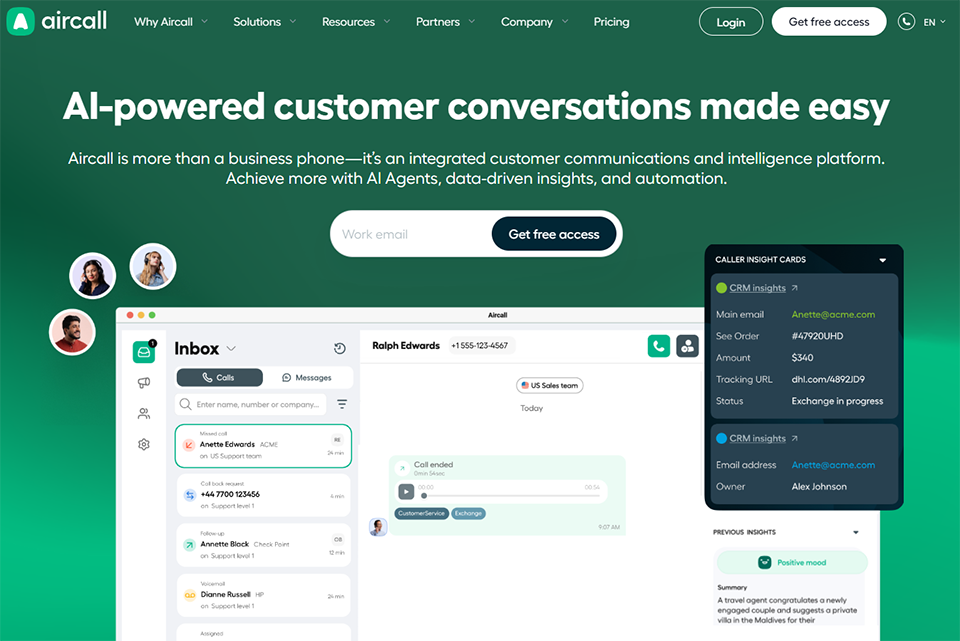
Aircall is probably the best-known cloud-based phone solution in France for sales and customer service teams. Founded in Paris in 2014, the company has successfully carved out a niche for itself: a solution simple enough to be deployed without an IT department, yet comprehensive enough to meet the needs of structured teams.
Aircall is based on a fully cloud-based telephony model. No hardware, no physical SIM cards: everything goes through the internet. Agents work from their browser or the desktop app, and calls are managed through a centralized interface that gives each supervisor a real-time view of activity.
What really sets Aircall apart is the depth of its integrations. It offers more than 100 native connectors with CRMs, helpdesks, and productivity tools, including HubSpot, Salesforce, Pipedrive, Intercom, Zendesk, Slack, and many others. Each call can be automatically linked to a contact record in your CRM, along with notes, call duration, and the recording.
The list is extensive: phone numbers in over 100 countries, smart queues, IVR (interactive voice response), call whispering (a manager can speak to an agent during without the customer hearing), call recording and transcription, real-time analytics, a power dialer for sales teams, and agent availability management.
Theinsight cards feature is worth mentioning: when a call comes in, a pop-up window automatically displays the contact's information from your CRM, without having to switch tabs.
Aircall operates on a per-seat model, with a minimum of 3 users:
The price is higher than OpenPhone's, but the value is different. For a structured sales team, the time saved through CRM integrations more than justifies the investment.
Aircall is designed for sales teams of 5 to 50 people who handle a significant volume of calls and already use a CRM. It’s also an excellent option for support and customer success teams that handle incoming tickets and need to track them.
Startups in the growth phase that are streamlining their sales processes will find this to be a valuable ally, particularly thanks to analytics that make it possible to quickly identify what’s working and what’s not.

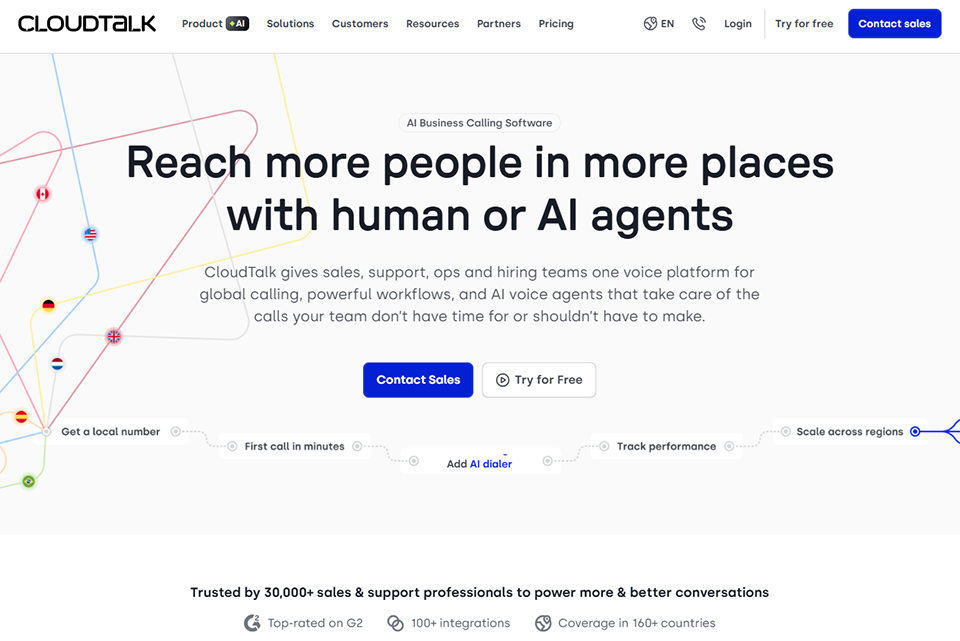

CloudTalk is a Slovak company founded in 2016 that has quickly established itself as one of the leading alternatives to Aircall, particularly in Europe. Its positioning is clear: to provide advanced call center features to medium-sized teams at slightly more competitive rates.
CloudTalk operates on the same model as other cloud solutions: everything is browser-based, with no hardware required. But where it really stands out is in the sophistication of its call flow management tools. The flow designer is particularly well thought out and requires no technical skills.
The solution covers more than 160 countries with local phone numbers, which is a real advantage for companies with an international presence or that work with customers in multiple countries.
CloudTalk stands out in several areas: advanced routing based on agent skills, automatic callbacks (calling the customer back if the wait time is too long), intelligent call queuing, call recording, transcripts, sentiment analysis on certain plans, and a high-performance power dialer for sales teams.
The integrations cover the market's leading tools: Salesforce, HubSpot, Pipedrive, Zendesk, Intercom, Freshdesk, Zapier, and Make.
One advantage worth noting: unlike Aircall, CloudTalk does not require a minimum number of users on certain plans, making it accessible to smaller teams.
CloudTalk is well-suited for small and medium-sized businesses with 10 to 100 employees that have a structured sales or customer service department, for sales teams that conduct large-scale cold calling and need a reliable power dialer, and for companies with an international presence that need local phone numbers in multiple countries.
If you're looking for an alternative to Aircall that offers slightly better value for money and comparable features, CloudTalk is definitely worth considering.

Dialpad occupies a unique position within this ecosystem. While most solutions focus solely on telephony, Dialpad has built a unified communications platform that integrates calls, video conferencing, team messaging, and—in recent years—a rather impressive layer of artificial intelligence.
Dialpad's promise is simple: to replace multiple communication tools with a single one. Teams that use both phone software, Zoom or Meet, and Slack can theoretically consolidate all of that into Dialpad.
What really sets the platform apart is Dialpad AI, its natively integrated artificial intelligence engine. It transcribes calls in real time, detects customer questions and suggests responses to agents, generates automatic call summaries, and analyzes the sentiment of conversations to help managers identify key moments.
The list is extensive: VoIP telephony, video conferencing for up to 150 participants, team messaging, file sharing, real-time AI-powered transcription, automatic post-call summaries, AI coaching for agents, and integrations with Salesforce, HubSpot, Google Workspace, Microsoft 365, Zendesk, and Slack.
Dialpad AI Scorecards automatically evaluate call quality based on customizable criteria, a feature that is highly valued by sales coaching teams.
The Standard plan is remarkably competitive given everything it includes. If you're looking for an all-in-one solution without breaking the bank, it's undoubtedly the best value for money on the market.
Dialpad is particularly well-suited for teams looking to consolidate their communication tools (phone + video + internal messaging), managers and sales leaders who want insights into the quality of conversations without spending hours listening to recordings, and tech companies familiar with AI tools that want to integrate artificial intelligence into their sales or support processes.
Teams of 5 to 50 people in the early stages of development will find this a versatile solution, especially if they want to avoid signing up for multiple subscriptions.

Freshcaller (now called Freshdesk Contact Center) is the phone solution from Freshworks, the Indian software company known for its CRM and help desk suite. If you already use Freshdesk or Freshsales, this option is definitely worth considering first.
Freshcaller positions itself as a comprehensive cloud-based call center that requires no physical infrastructure. Its greatest strength is its native integration with the entire Freshworks suite. When a customer calls, their history of tickets, orders, or sales interactions automatically appears in the agent’s interface.
Even without using the rest of the Freshworks suite, Freshcaller remains a fully functional solution, with its own free plan.
Freshcaller covers the basics of call center operations: customizable IVR, skill-based routing, call recording, real-time monitoring, performance reporting, phone numbers in over 90 countries, and an AI-powered phone bot on higher-tier plans.
The management of business hours and automated messages is particularly well designed—a detail that matters when you want to project a professional image without spending hours on it.
Freshcaller offers a free (limited) plan and three paid plans:
The free plan is a real advantage for testing the solution before committing.
Freshcaller is ideal for users already in the Freshworks ecosystem (Freshdesk, Freshsales, Freshservice), support teams with 3 to 30 agents who need a structured tool without having to opt for premium solutions, and startups that want to start with a free plan before upgrading.
If you don't use Freshworks for other purposes, its value proposition is less clear compared to Aircall or CloudTalk.
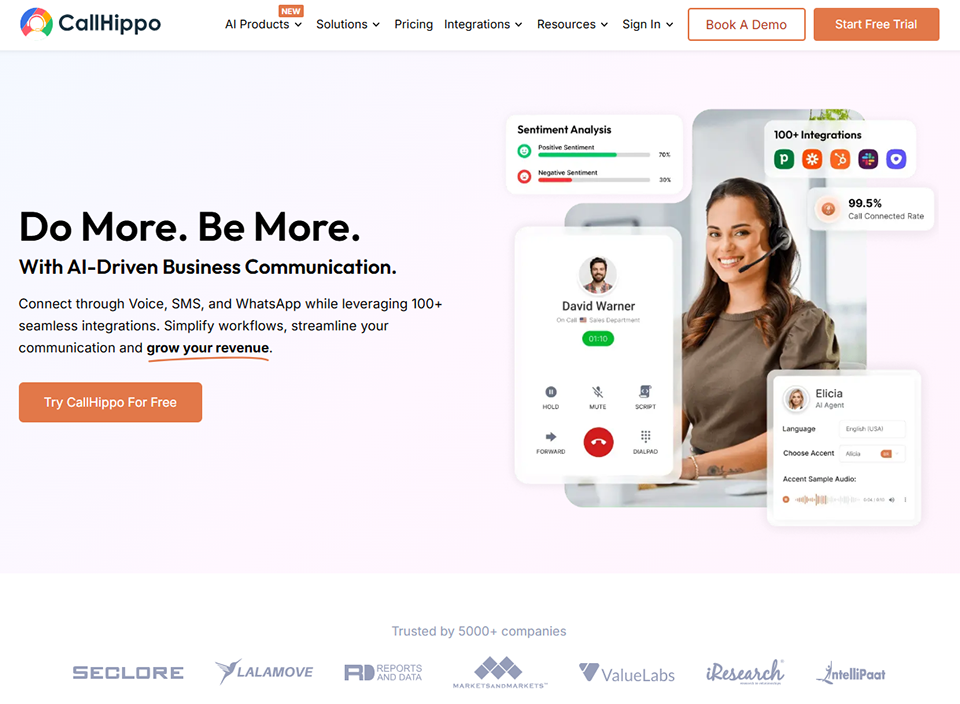
CallHippo is an Indian solution that has earned a strong reputation among sales teams engaged in large-scale cold calling, primarily thanks to its highly competitive price-to-feature ratio.
CallHippo offers standard cloud-based VoIP telephony, available in more than 50 countries, with a web interface and mobile apps. Its positioning is straightforward: to provide the essential features of a professional call center at a lower price than the market leaders.
Power dialer, auto dialer, smart switch (automatically switches between multiple carriers to ensure quality), call recording, performance analytics, click-to-call from the CRM, and integrations with HubSpot, Salesforce, Pipedrive, Zoho, Freshdesk, and Slack.
The smart switch feature is particularly useful for teams that make international calls: if the call quality is poor on one carrier, the system automatically switches to another.
These rates are among the lowest on the market for the level of features offered.
CallHippo is a good option for sales teams that do a lot of cold calling and need a power dialer without paying the price of Aircall or CloudTalk, for startups on a very tight budget that don't want to sacrifice basic features, and for companies that primarily make international calls.
The quality of the interface and support doesn't quite measure up to that of premium European solutions, but for heavy use at a lower cost, it's a sensible choice.
Here is a summary to help you make your decision. The prices listed are approximate (mid-tier plans, monthly billing) and should be verified directly with the providers.
| Criterion | OpenPhone | Aircall | CloudTalk | Dialpad | Freshcaller | CallHippo |
|---|---|---|---|---|---|---|
| Estimated price per user per month | ~23 $ | ~30–50 € | ~30 $ | ~$15–$25 | ~$15–$39 | ~$18–$30 |
| Free map | No | No | No | No | Yes (limited) | Yes (very limited) |
| Ideal team size | 1 to 10 | 5 to 50 | 10 to 100 | 5 to 50 | 3 to 30 | 5 to 50 |
| Power Dialer | No | Yes (Pro) | Yes | No | No | Yes |
| Native AI | No | Partial | Yes (Expert) | Yes (native) | Yes (Enterprise) | No |
| French issues | No | Yes | Yes | Yes | Yes | Yes |
| CRM Integrations | HubSpot, Salesforce | 100+ | 25+ | HubSpot, Salesforce, 70+ | Freshworks ++ Continued | HubSpot, Salesforce, Pipedrive |
| Easy to use | ⭐⭐⭐⭐⭐ | ⭐⭐⭐⭐ | ⭐⭐⭐ | ⭐⭐⭐⭐ | ⭐⭐⭐⭐ | ⭐⭐⭐ |
| Ideal for | Freelancer / small team | Sales and Support Team | SMEs / call centers | Unified Platform | Freshworks Ecosystem | Cold Calling on a Tight Budget |
Comparison charts are great. But in the end, the question remains the same: which one should you choose for your specific situation?
Here is a summary by profile.
What you need: a business number that's separate from your personal number, without a restrictive contract, that you can use on your phone.
OpenPhone is clearly the most logical choice. Simple, mobile-first, affordable, and perfectly suited for individual use. The SMS management feature is a real plus if you also communicate with your customers via text message.
Your needs: sharing a phone number, having a shared view of customer interactions, and a few basic integrations.
OpenPhone is still a good option for groups of up to about ten people. Dialpad is an interesting alternative if you also need video conferencing and team messaging: the Standard plan at $15/month is hard to beat in terms of value for money.
If you're already using Freshdesk or Freshsales, Freshcaller should be your first choice.
Your needs: analytics, agent coaching, deep CRM integrations, and real-time monitoring.
This is the playground ofAircall and CloudTalk. Aircall wins on the quality of its integrations and user interface; CloudTalk wins on price and international coverage. If your team does a lot of outbound prospecting, CallHippo can save you a significant amount of money without sacrificing essential features.
For teams that want to incorporate AI into their daily work, Dialpad offers the most comprehensive solution available at this time.
Your needs: reliability, SLA, advanced customization, performance reports, dedicated support.
Aircall and CloudTalk both offer custom plans tailored to large teams. Dialpad is particularly appealing if you want to consolidate your communications stack (phone, video, and internal messaging) onto a single platform.
Here are the questions that come up most often when choosing a cloud-based phone system.
Traditional telephony (PSTN or GSM) uses physical networks dedicated to calls. VoIP, on the other hand, transmits voice over the Internet in the form of digital data. The result: significantly lower costs, total flexibility (you can make calls from any connected device), and advanced features that would have been impossible or very expensive with traditional telephony.
No. All the solutions presented here work entirely through a web browser or mobile app. A good-quality headset is recommended for comfort during calls, but no dedicated hardware is required. Some solutions also allow you to use standard IP phones if you prefer.
Aircall, CloudTalk, Dialpad, Freshcaller, and CallHippo all offer French phone numbers (both geographic and non-geographic). OpenPhone is the only solution on this list that does not yet natively support French phone numbers—something to keep in mind if this is an important factor for you.
Both are robust solutions for structured sales and support teams. Aircall stands out for the quality and depth of its integrations (100+ native connectors) and its exceptionally polished interface. CloudTalk has the edge in terms of price and international coverage. If your team is international and heavily focused on outbound prospecting, CloudTalk is worth serious consideration. If you’re more of an inbound-focused team with a well-established CRM, Aircall will likely be easier to adopt.
Yes, that’s precisely one of their strengths. Since everything is done online, an agent can work from home just as they would from the office—using the same interface, the same phone number, and the same experience. That’s one of the reasons that has accelerated the adoption of these cloud solutions since 2020.
Most solutions offer both options, with a discount around 15 to 25% for an annual commitment. For a startup testing the waters, it may make sense to start with a monthly subscription, even if that means switching to an annual plan once you’ve validated the tool in practice.
In most cases, yes. Number portability is regulated, and reputable providers offer a guided migration process. The time it takes varies by country and carrier, but generally, it takes a few business days for a French number.
Aircall, CloudTalk, Dialpad, CallHippo, and OpenPhone all offer HubSpot integrations. Aircall is often cited as having the best native integration, with automatic synchronization of calls, notes, and recordings directly into the HubSpot contact record. Dialpad is also very well integrated, with the added benefit of automatic transcription that is uploaded to HubSpot.