Our selection of tools to enhance the candidate experience in 2026.
In this article, we’ve selected tools available on Freelance Stack cover the entire recruitment process: from posting job openings to onboarding new hires. Each solution was chosen for its suitability for different user profiles: hyper-growth startups, established SMEs, and HR teams that recruit without a dedicated HR director.
Why has the candidate experience become a strategic priority?
The customer experience is often cited as a driver of growth. However, the candidate experience is still too often overlooked, even though it directly influences the quality of hires, employer reputation, and, ultimately, an organization’s ability to attract the right talent.
In 2026, the job market remains tight in many sectors. Candidates, especially the most qualified ones, evaluate recruitment processes with the same critical eye they use when comparing products. An overly long application form, weeks of silence after an interview, or disorganized scheduling immediately paint a negative picture of a company. Conversely, a smooth process, regular updates, and thoughtful communication can make all the difference—even if the salary offered isn’t the highest on the market.
According to a Talent Board study, 68% of candidates who have had a bad experience do not hesitate to share their experience with others, whether online or within their professional network. For startups and small and medium-sized businesses that are recruiting without the brand recognition of a large corporation, this is particularly critical.
The good news is that the tools available today make it possible to streamline and automate much of the candidate journey without sacrificing the human touch. From modern ATS systems to asynchronous video interview tools and intelligent scheduling solutions, the SaaS market offers practical solutions for every stage of the recruitment funnel.
In this article, we’ve selected tools available on Freelance Stack cover the entire recruitment process: from posting job openings to onboarding new hires. Each solution was chosen for its suitability for different user profiles: hyper-growth startups, established SMEs, and HR teams that recruit without a dedicated HR director.
#1 - Ashby: The go-to ATS for teams looking to combine analytical rigor with an impeccable candidate experience.
Ashby is a next-generation ATS ( Applicant Tracking System) designed for teams that recruit at a fast pace and need a powerful analytics dashboard in addition to standard tracking features. Founded in 2018, it has quickly established itself as the go-to tool in the tech startup ecosystem, thanks in particular to its ability to centralize sourcing, pipeline management, interview scheduling, and reporting within a single interface.
What sets Ashby apart from traditional ATS systems is the depth of its analytics. Every stage of the funnel is trackable: conversion rates between stages, average processing time, source of applications, and candidate diversity. This data makes it possible to pinpoint friction points in the process and, therefore, take action where it’s truly needed.
When it comes tothe candidate experience, Ashby offers customizable career pages, configurable application forms, and automated notifications for every status update. Candidates receive clear emails at specific times, which drastically reduces the need for follow-ups and minimizes frustration.
Main features :
Comprehensive management of the recruitment pipeline (multiple positions, multiple teams).
Integrated meeting scheduling with calendar synchronization.
Step-by-step automated email templates.
Branded career pages.
Advanced analytics across the entire funnel.
Integrations with LinkedIn, Slack, Google Workspace, Notion, and many HRIS systems.
Pricing:
Ashby offers several plans.
The Starter plan starts at around $300/month for small teams, the Growth plan starts at $800/month, and the Enterprise plan is available upon request. Please check the pricing directly on the Ashby website, as rates vary depending on the size of the hiring team.
👥 What kind of candidate are we looking for?
Startups in the scaling phase (Series A+):
Ashby is designed for teams that hire dozens of candidates each year and need to streamline their processes without compromising the quality of the candidate experience. Its robust analytics enable a Head of Talent to justify their decisions and continuously optimize their approach.
In-house HR teams at tech SMEs:
If you're managing multiple positions at once with a small team, automated interview scheduling and communication templates will save you a significant amount of time on repetitive tasks.
Recruitment agencies:
Its multi-client capabilities and customizable workflows make it an ideal tool for organizations that manage a variety of client accounts.
Highlights:
✅ A particularly polished and intuitive interface.
✅ Some of the most powerful analytics tools on the market.
✅ Excellent candidate experience thanks to automated communications.
Limitations:
⚠️ High cost; not well suited for very small organizations (fewer than 10 hires per year).
⚠️ The platform's extensive features require a significant amount of time to get up to speed.
⚠️ It is mainly in English, which may be a barrier for some French teams.
Benefit from a on Ashby .
20% off during 12 months
Find our best discount right now with Ashby and save on your software subscriptions. We offer over 850 promo codes and discounts on the best software and SaaS on the market.
#2 - Flatchr: the French ATS that simplifies recruitment for small and medium-sized businesses and teams without a dedicated HR manager.
Flatchr is a French applicant tracking system designed for organizations that cannot afford—or do not need—an enterprise-level ATS. Launched in Lyon, Flatchr has won over thousands of French small and medium-sized businesses by offering a pragmatic approach: handling the core aspects of the recruitment process with a quick learning curve and affordable pricing.
The platform lets you create and post job listings on about 40 partner job boards with just a few clicks, centralize all applications in a visual Kanban-style pipeline, and manage communication with candidates from a unified inbox. The interface is intentionally simple, designed for operational managers or versatile HR professionals who don’t want to spend hours setting up their tool.
To enhance the candidate experience, Flatchr offers customizable career pages hosted directly on the platform, as well as automated messages at each key stage. Interview management is built-in, with synchronization with Google Calendar and Outlook.
Main features :
Posting on over 40 job boards (Indeed, LinkedIn, Welcome to the Jungle, APEC, etc.).
Kanban view of the application pipeline.
Customizable careers page.
Centralized candidate messaging.
Scheduling meetings with calendar synchronization.
Basic reports on volume and sources.
Pricing:
Flatchr offers plans starting at around €149/month for small and medium-sized businesses, with discounted rates based on team size and hiring volume. Details are available on their website.
👥 What kind of candidate are we looking for?
French small and medium-sized enterprises (SMEs) and mid-sized companies (50–500 employees):
Flatchr is clearly in its element when working with companies that regularly hire without having a large HR department. Automatic posting to multiple job boards saves time right away.
Operational managers who hire directly:
The Kanban interface is intuitive enough that a sales or technical manager can manage applications without any prior training.
Small businesses with recurring needs:
For small businesses that hire a few people each quarter, Flatchr offers a good balance between features and simplicity.
Highlights:
✅ Very quick to get started (less than a day).
✅ Posting on French job boards is key to reaching the right candidates.
✅ Responsive French-speaking customer support.
✅ Good value for money for small and medium-sized businesses.
Limitations:
⚠️ Analytics are less advanced than those of Ashby or other enterprise ATS platforms.
⚠️ Workflow customization is limited on any plan .
⚠️ Less suitable for highly technical or high-volume hiring.
Benefit from a on Flatchr .
10% off on "BASIC" and "PRO" plan
Find our best discount right now with Flatchr and save on your software subscriptions. We offer over 850 promo codes and discounts on the best software and SaaS on the market.
3# - Taleez: a collaborative ATS that puts the quality of communication at the heart of the recruitment process.
Taleez positions itself as a collaboration-focused ATS, particularly well-suited for teams where multiple people are involved in the recruitment process (managers, HR, team members) and need to be able to share feedback, rate candidates, and move forward together in a structured manner.
The tool stands out for the quality of its candidate-facing interface: the career pages are modern and highly customizable, the automated notifications to candidates are detailed and configurable, and the candidate portal allows each applicant to track the status of their application. This last point, which is often overlooked, has a direct impact on how the company is perceived.
Taleez also includes a collaborative feedback space for interviewers, which helps standardize evaluations and prevent decisions based solely on intuition.
Taleez offers a free plan to try out the tool, as well as paid plans starting at around €99/month, depending on the number of open positions and users. Please check the pricing directly.
👥 What kind of candidate are we looking for?
Companies with a multi-step recruitment process:
When multiple stakeholders are involved (HR, manager, and team lead), Taleez’s collaborative features really come into their own.
Companies looking to improve their employer brand:
The applicant portal is a real game-changer. Allowing applicants to track the status of their applications shows them respect—and everyone knows it.
Growing companies (10–200 employees):
Taleez combines the simplicity of Flatchr with the power of Ashby, making it a solid choice for organizations in the process of structuring their HR operations.
Highlights:
✅ A gated entrance, a rare feature in this price range.
✅ Well-planned cross-team collaboration.
✅ Modern, user-friendly interface.
✅ Good level of customization for communications.
Limitations:
⚠️ Less analytical depth than Ashby.
⚠️ Some advanced integrations require higher-tier plans.
⚠️ Less well-known than some competitors, which may lead to initial skepticism.
Benefit from a on Taleez .
€300 in credits
Find our best discount right now with Taleez and save on your software subscriptions. We offer over 850 promo codes and discounts on the best software and SaaS on the market.
#4 - Willo: the asynchronous video interview solution that saves recruiters time without compromising the candidate experience.
Benefit from our free deal on Willo.
25% off on annual plan
Find over 300 free deals as well as over 850 Premium deals right now with Willo and save on your software subscriptions. Whether you're an entrepreneur, a startup or a solo freelancer, save hundreds of euros thanks to our discounts and promo codes.
Willo is a platformfor pre-recorded ( asynchronous)video interviews . The concept is simple: the recruiter sends an invitation with a series of pre-recorded questions, and the candidate answers them on video using their smartphone or computer at a time that suits them. The recruiter then reviews the responses when they are available.
This format offers several practical advantages. For recruiters, it eliminates the logistical complexity of scheduling mass phone interviews, particularly for high-volume positions. For candidates, it offers the flexibility to prepare and express themselves under better conditions than an impromptu call. The platform also offers a re-recording option, which reduces the stress associated with the process.
Willo places a strong emphasis on customization: recruiters can add their logo, customize the home screen, and include a video welcome message to create a warm first impression. This directly contributes to the employer brand.
Integrations with leading ATS platforms (Ashby, Flatchr, Greenhouse, etc.).
Option to automatically transcribe responses.
Analytics on interview completion rates.
Pricing:
Willo offers a free plan with limited features, as well as paid plans starting at around $83/month (billed annually). Check their official website for pricing details.
👥 What kind of candidate are we looking for?
Teams with a high volume of applications:
Sales, customer success, support, and other HR-related roles often attract dozens of applications, making it time-consuming to conduct individual phone interviews. Asynchronous video interviews offer an effective middle ground.
Recruiters who prioritize the candidate experience:
The flexible format (candidates choose their own time slot) and the ability to re-record their answers are viewed positively in candidate satisfaction surveys.
Startups without a dedicated HR team:
Willo makes it easy to streamline the pre-screening process without tying up sales or founder time with discovery calls.
Highlights:
✅ Significant time savings during the pre-screening phase.
✅ A positive candidate experience (flexibility, no scheduling stress).
✅ Customizable branding that strengthens the employer brand.
✅ Seamless integration with leading ATS platforms.
Limitations:
⚠️ This format may put off some candidates who aren't comfortable with video.
⚠️ Less suitable for senior positions where direct interaction is valued from the outset.
⚠️ The free plan is quite limited for regular professional use.
Benefit from a on Willo .
Additional 50% off on any plan during 6 months
Find our best discount right now with Willo and save on your software subscriptions. We offer over 850 promo codes and discounts on the best software and SaaS on the market.
#5 - Noota: the AI tool that automatically transcribes, summarizes, and organizes your job interviews.
Benefit from our free deal on Noota.
Up to 34% off on annual plan
Find over 300 free deals as well as over 850 Premium deals right now with Noota and save on your software subscriptions. Whether you're an entrepreneur, a startup or a solo freelancer, save hundreds of euros thanks to our discounts and promo codes.
Noota is an AI assistant designed for meetings and interviews, and it has proven particularly effective for HR use cases. When connected to your video conferencing tool (Google Meet, Zoom, Teams), it records the interview, transcribes it in real time, and then automatically generates a structured summary that includes key points, candidate information, and any scoring notes.
For recruiters who conduct four to five interviews a day, taking notes is a significant cognitive burden that often hinders their ability to listen effectively. With Noota, they can focus on the conversation without worrying about missing an important detail. The transcript is available just minutes after the interview ends.
Beyond simple transcription, Noota allows you to create structured evaluation templates (with predefined criteria) and automatically populate candidate profiles in integrated ATS systems. This saves a significant amount of time on post-interview administrative tasks.
Main features :
Automatic transcription of interviews (40+ languages).
Summary and structured AI report.
Customizable evaluation templates.
Synchronization with ATS systems (Ashby, Flatchr, Taleez, and others).
Integration with Google Meet, Zoom, and Microsoft Teams.
Candidate database automatically updated.
Pricing:
Noota offers a free plan (with a limited number of minutes) and paid plans starting at €19 per month per user. Plans with more minutes and integrations range from €39 to €59 per month, depending on your needs. Check their website for details.
👥 What kind of candidate are we looking for?
Recruiters with busy schedules:
As soon as you have more than three interviews in a day, automatic transcription really makes a difference in the quality of the transcripts.
Teams with a structured evaluation process:
Noota's scoring templates help standardize evaluations across multiple interviewers, reducing bias and improving the consistency of decisions.
Recruitment agencies:
The ability to automatically generate candidate profiles based on interviews results in significant productivity gains for high-volume projects.
Highlights:
✅ Accurate transcription, including in French.
✅ A relevant AI summary that goes beyond a simple transcript.
✅ Affordable pricing, especially for individual plans.
✅ Native integrations with leading HR tools.
Limitations:
⚠️ Transcription quality may vary due to strong accents or poor connection quality.
⚠️ Some candidates may feel uncomfortable with the recording (please inform them in advance).
⚠️ Advanced integration features require higher-tier plans.
Benefit from a on Noota .
Additional 20% off during 12 months
Find our best discount with Noota and save on your software subscriptions. We offer over 850 promo codes and discounts on the best software and SaaS on the market.
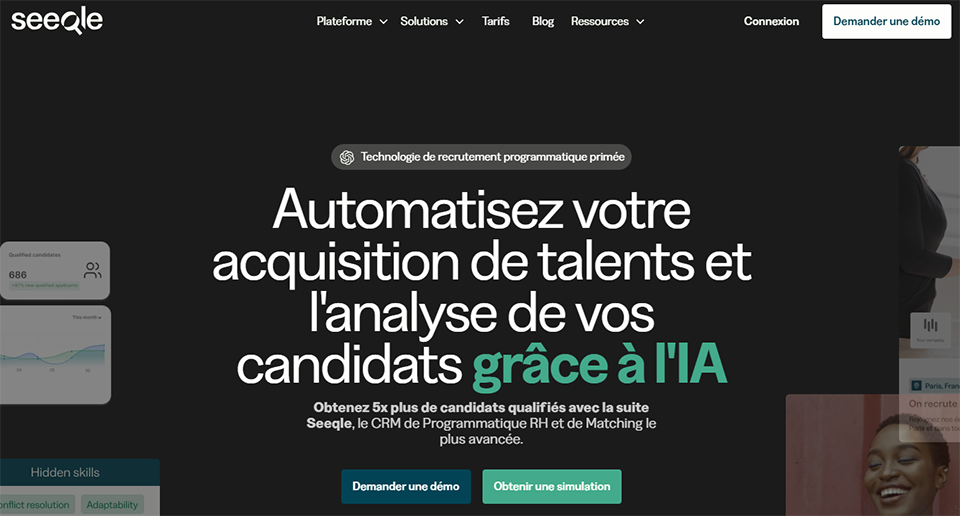
#6 - Seeqle: the programmatic platform that maximizes the visibility of your job postings to the right candidates.
Seeqle is a programmatic recruitment solution that uses targeting algorithms to post your job listings on the most relevant channels—job boards, social media, and specialized websites—based on the profiles you’re looking for. The goal is simple: to attract qualified candidates, not just volume.
Whereas traditional job posting sends your job listing to a fixed list of platforms, Seeqle optimizes distribution in real time based on each channel’s performance. If a job listing receives few qualified applications through a given job board, the budget is automatically redirected to higher-performing channels. This is the principle of programmatic advertising applied to recruitment.
For recruiters, this translates into discount spent posting and reposting job listings, as well as higher-quality applications, which directly improves the first impression candidates have when they see more targeted and better-written job postings.
Main features :
Targeted distribution across 1,000+ channels (job boards, social media, industry-specific websites).
Automatic optimization of budgets by channel.
A/B testing of ads.
Performance dashboard by offer and channel.
Detailed geographic and industry targeting.
Integration with leading ATS platforms.
Pricing:
Seeqle operates on a performance-based model or through dedicated subscriptions. Pricing is available upon request and depends on the number of job postings and the advertising budget. Please contact us directly for a quote.
👥 What kind of candidate are we looking for?
HR at an SME with limited time for posting:
If you currently post your job listings manually on 5–6 different platforms for each new position, Seeqle fully automates this step.
Fast-growing companies with high-volume needs:
For organizations that recruit on an ongoing basis for a wide range of positions, a programmatic approach makes it possible to maintain a steady stream of applications without dedicating disproportionate resources to the process.
Recruiters who want to improve the quality of applications:
Fewer off-target resumes also means less time wasted reading irrelevant applications, and a better experience for applicants, since they’re responding to a job opening that truly matches their qualifications.
Highlights:
✅ Smart distribution across a vast network of sources.
✅ Automatic budget optimization, with no manual intervention required.
✅ A clear dashboard for measuring ROI by channel.
✅ discount in publication time.
Limitations:
⚠️ The pricing model is not very transparent online (requires contacting a sales representative).
⚠️ Less relevant for highly specialized recruitment targeting extremely niche profiles.
⚠️ The programmatic approach requires a minimum media budget to be effective.
Benefit from a on Seeqle .
28% off on any plan
Find our best discount right now with Seeqle and save on your software subscriptions. We offer over 850 promo codes and discounts on the best software and SaaS on the market.
7# - Doodle: the scheduling tool that eliminates endless back-and-forth when setting up an interview.
Benefit from our free deal on Doodle.
No deals currently available
Find over 300 free deals as well as over 850 Premium deals right now with Doodle and save on your software subscriptions. Whether you're an entrepreneur, a startup or a solo freelancer, save hundreds of euros thanks to our discounts and promo codes.
Doodle is one of the most widely used collaborative scheduling tools in Europe. Its basic principle is well known: it presents a group of people with several time slots and automatically identifies the time that works for everyone. But beyond the standard poll, Doodle has developed features specifically designed for one-on-one meetings, making it a particularly useful tool in a recruitment context.
The Booking Pages feature allows recruiters to share a unique link where candidates can select their own interview time slot, without the need for email exchanges. The calendar automatically syncs with Google Calendar or Outlook, preventing double bookings, and automatic reminders help reduce no-shows.
For the candidate experience, this sends a strong message: a company that provides a self-service booking link shows that it respects the time of those it interacts with. It’s simple, but it matters.
Main features :
Multi-participant availability surveys.
Booking Pages (self-service booking).
Synchronization between Google Calendar, Outlook, and iCal.
Automatic email reminders.
Integration with Zoom, Google Meet, and Teams (automatic video call link).
Customizing the booking page.
Pricing:
Doodle offers a free plan ( with ads), a Pro plan for about €6.95/month, and a Team plan starting at €8.95 per user per month. Check their website for current pricing.
👥 What kind of candidate are we looking for?
Any team that schedules regular meetings:
Once you’re scheduling more than 5 or 6 meetings a week, the time wasted on coordinating schedules becomes significant. Doodle solves this problem neatly.
Organizations without an assistant or office manager:
In small teams, it’s often the founder or the manager themselves who handles scheduling. Having a shareable booking link saves time right away.
Multi-stakeholder process:
For interviews with multiple team members, the polling feature makes it easy to quickly find a time that works for everyone without having to send a series of emails.
Highlights:
✅ Very easy to use, whether you're a recruiter or a candidate.
✅ Shareable booking link, perfect for incoming applications.
✅ Reliable calendar synchronization.
✅ Very affordable price.
Limitations:
⚠️ Less advanced features than dedicated tools like Calendly when it comes to individual bookings.
⚠️ The free plan displays ads, which looks unprofessional in a recruitment context.
⚠️ No advanced analytics on candidate behavior.
Benefit from a on Doodle .
No deals currently available
Find our best discount with Doodle and save on your software subscriptions. We offer over 850 promo codes and discounts on the best software and SaaS on the market.
#8 - Typeform: Application forms that finally feel like a conversation.
Benefit from our free deal on Typeform.
16% off on annual plan
Find over 300 free deals as well as over 850 Premium deals right now with Typeform and save on your software subscriptions. Whether you're an entrepreneur, a startup or a solo freelancer, save hundreds of euros thanks to our discounts and promo codes.
Typeform is a platform for creating forms and surveys that stands out for its conversational approach: questions appear one at a time in a clean, minimalist interface, creating a completion experience that is very different from a traditional form that must be filled out all at once. For job applications, this translates into higher completion rates and a more positive perception of the employer brand.
In a recruitment context, Typeform allows you to create pre-qualification forms that intelligently filter applications before they even reach the ATS. You can include scenario-based questions, multiple-choice questions, rating scales, and even document uploads. Responses are centralized in a dashboard and can be exported or sent to other tools via integrations.
For job postings that attract a large number of unqualified applicants, a well-designed Typeform can cut the number of resumes to be processed in half, while offering candidates a much more engaging application experience.
Main features :
Customizable conversational forms.
Conditional logic (questions that adapt based on previous answers).
Upload files (resume, portfolio).
Integrations with HubSpot, Slack, Google Sheets, ATS, etc.
Response dashboard with analytics.
Advanced customization (colors, logo, images).
Pricing:
Typeform offers a free plan ( 10 responses per month), a Basic plan for €25 per month, a Plus plan for €50 per month, and a Business plan for €83 per month (annual pricing). Check directly on Typeform.
👥 What kind of candidate are we looking for?
Startups and scale-ups that prioritize their employer brand:
Typeform is the perfect tool for making a memorable first impression on candidates. Its sleek interface and animated transitions give it a modern feel that fits well with the culture of tech companies.
Teams that receive a large number of unsorted applications:
A smart pre-qualification form ensures that only applications that meet the job’s essential criteria are processed.
Recruiters who want to get to know their candidates better before the first call:
Open-ended questions and role-playing exercises allow you to go beyond what’s on the resume.
Highlights:
✅ A candidate experience that is significantly better than traditional forms.
✅ Powerful conditional logic to customize the user journey.
✅ Sleek design, easily customizable with your brand.
Limitations:
⚠️ This may seem excessive for infrequent hiring.
⚠️ The free plan is very limited (only 10 responses per month).
⚠️ Some advanced integrations require higher-tier plans or a Zapier subscription.
Benefit from a on Typeform .
Additional 40% off on annual plan
Find our best discount right now with Typeform and save on your software subscriptions. We offer over 850 promo codes and discounts on the best software and SaaS on the market.
To help you get a clearer picture, here is a summary of the eight tools discussed in this article.
Tool
Category
Admission price
Ideal for
Candidate Experience
Ashby
ATS
~$300/month
Scale-ups, tech HR teams
⭐⭐⭐⭐⭐
Flatchr
ATS
~€149/month
French SMEs
⭐⭐⭐⭐
Taleez
Collaborative ATS
~€99/month
Companies with 10–200 employees
⭐⭐⭐⭐⭐
Willo
Asynchronous video interviews
~$83/month
Mass Hiring
⭐⭐⭐⭐
Noota
AI interviews
~$19/month
Recruiters who conduct multiple interviews
⭐⭐⭐
Seeqle
Programmatic advertising
Upon request
Growing SMEs
⭐⭐⭐⭐
Doodle
Planning
~€6.95/month
All sizes
⭐⭐⭐⭐
Typeform
Forms
~€25/month
Startups, employer brand
⭐⭐⭐⭐⭐
💡 The prices listed below are for reference only. We recommend checking the current rates directly on the publishers' websites, as they are subject to change.
See all the software of this category: Recrutement
Check out all the other software and discount we offer in this category. Explore other tools and choose the perfect solution to grow your business.
Here are a few frequently asked questions to help you learn more about the candidate experience.
1️⃣ What exactly is the candidate experience?
The candidate experience refers to all the interactions a person has with a company throughout the recruitment process: from the first time they read the job posting to the final response (whether positive or negative). This includes the clarity of the job posting, the ease of applying, the quality of communication, the smoothness of interviews, response times, and how a rejection is communicated. A positive candidate experience isn’t limited to those who are hired; it applies to all applicants.
2️⃣ Why invest in HR tools designed to enhance the candidate experience?
The short answer: because candidates have a choice. In a tight job market across many industries, a poorly organized or uncommunicative recruitment process can drive qualified candidates to competitors. Furthermore, every candidate is a potential ambassador—for better or for worse. Investing in tools that streamline and improve the candidate experience is also an investment in your employer brand.
3️⃣ Is an ATS essential for improving the candidate experience?
Not necessarily, especially if you’re hiring on an ad-hoc basis. For 2–3 hires per year, a combination of Typeform (for applications), Doodle (for interviews), and Noota (for follow-up notes) may be sufficient. An ATS becomes useful when you’re managing multiple open positions at once or want to structure your hiring pipeline for the long term.
4️⃣ What is the difference between an ATS and an HRIS?
An ATS (Applicant Tracking System) is designed exclusively for recruitment: it manages applications, pipelines, communications with candidates, and sometimes career pages. An HRIS (Human Resources Information System) has a broader scope: it covers the entire employee lifecycle, from onboarding to leave management and payroll. Some HRIS platforms, such as Rippling, include ATS modules, but dedicated ATS systems often remain more powerful when it comes to recruitment.
5️⃣ Are asynchronous video interviews really well received by candidates?
The feedback has been generally positive, especially when the format is well presented. Candidates appreciate the flexibility (being able to respond at 8 p.m. rather than being constrained by a fixed time slot) and the ability to re-record themselves to give their best answer. On the other hand, the format can come across as impersonal if the recruiter doesn’t take care to include a warm introductory video and a clear explanation of the next steps.
6️⃣ How can I measure the quality of the candidate experience in my organization?
Several metrics are useful: the application completion rate (a form that’s too long = abandonment), the response rate to interview invitations, the candidate Net Promoter Score (NPS sent at the end of the process, regardless of the outcome), and the average time between each stage. Tools like Ashby allow you to track these metrics natively. For simpler setups, a Typeform sent to all candidates at the end of the process provides valuable feedback.
7️⃣ Is it possible to improve the candidate experience without increasing the HR budget?
Yes, for the most part. Many improvements start with attitude and organization: responding to all applications (even with a rejection), setting realistic deadlines, preparing for interviews, and explaining the process. Tools then come in to automate and amplify these best practices, but they don’t replace them. A well-used Doodle and a well-written rejection email have more impact than a costly, poorly configured ATS.