
Managing employees using Excel spreadsheets, scattered emails, and an overflowing shared calendar: many companies started out that way. It works—to a point. When the team grows, pay stubs pile up, leave requests come in from all directions, and onboarding new hires becomes a project in itself, you quickly reach your limit.
This is where the HRIS, or Human Resources Information System, comes in. Behind this somewhat dry acronym lies a simple concept: centralizing all aspects of an organization’s human resources management into a single tool or a suite of integrated tools.
In practical terms, an HRIS typically covers payroll management, leave and absences, recruitment, onboarding, performance tracking, training, and often the administrative management of contracts. Some go even further with modules for HR analytics, salary benchmarking, or employee benefits management.
The real question entrepreneurs and HR managers ask themselves is: at what point does it become truly necessary? The honest answer: sooner than you might think. With as few as 10 or 15 employees, certain functions like automated payroll or absence tracking already save valuable time. With 30 to 50 employees, the lack of an HRIS starts to take a heavy toll in terms of errors, lost HR time, and managerial friction.
In this article, we review the best HRIS software solutions available today, highlighting their strengths, limitations, pricing, and the types of organizations they are best suited for.
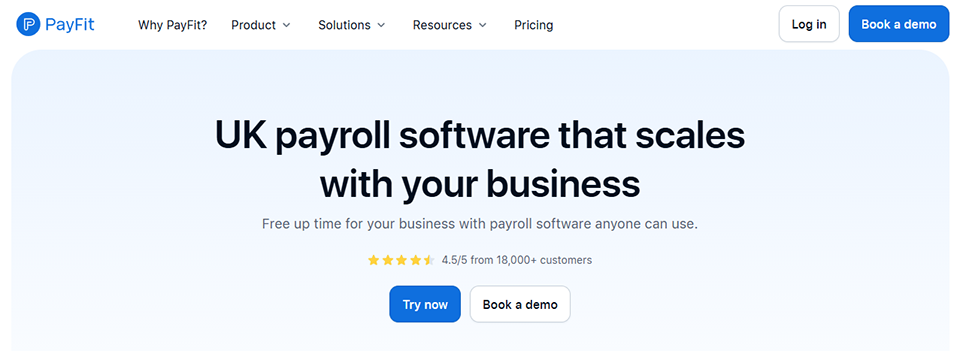
PayFit has established itself as the leading French provider in the automated payroll segment for SMEs and startups. Founded in Paris in 2015, the solution was built with one goal in mind: to make payroll management accessible to teams without specialized HR expertise.
The core idea behind PayFit is to take payroll out of the hands of accountants and put it directly into the hands of operational teams. You don’t need a background in labor law to produce compliant pay stubs. The software automatically calculates contributions, applies collective bargaining agreements, and manages social security filings.
PayFit offers comprehensive payroll management with automatic calculation of payroll taxes, leave and absence management, an employee portal for accessing pay stubs and leave balances, expense report management, and an onboarding module for new hires. Synchronization with DSN (Déclarations Sociales Nominatives) is built-in, eliminating the need for tedious double-entry data entry.
Growing startups (10 to 200 employees):
PayFit is perfectly suited for this segment. The interface is designed for non-technical users, the support team is responsive, and the solution scales well as a team grows.
SMEs without a dedicated HR manager:
When HR management falls to an office manager or a CFO, PayFit lets you stay in control without spending hours on payroll every month.

Lucca is a French HR software suite that stands out for its modular approach. Rather than imposing a monolithic solution, Lucca offers a dozen entrepreneurs modules entrepreneurs companies can activate as needed: payroll, time off, expense reports, interviews, organizational charts, and more.
Lucca is designed for companies that want a "customized" HRIS without the need for custom development. Each module operates independently, but all share the same employee data foundation, ensuring consistency of information across the organization.
Key modules include: Pagga for payroll, Timmi Absences for leave and absence management, Cleemy for expense reports, Poplee for performance reviews and tracking, and Lucca Organigram for visualizing team structures. All of these are connected to a centralized employee portal.
Mid-sized companies and large SMEs (100 to 1,000+ employees):
This is where Lucca really shines. Its functional depth and customization capabilities are well-suited to the needs of more structured organizations.
Companies with an HR director:
Lucca is most effective when used by HR teams that know how to configure and analyze the data. It is not the most intuitive solution for those unfamiliar with it.

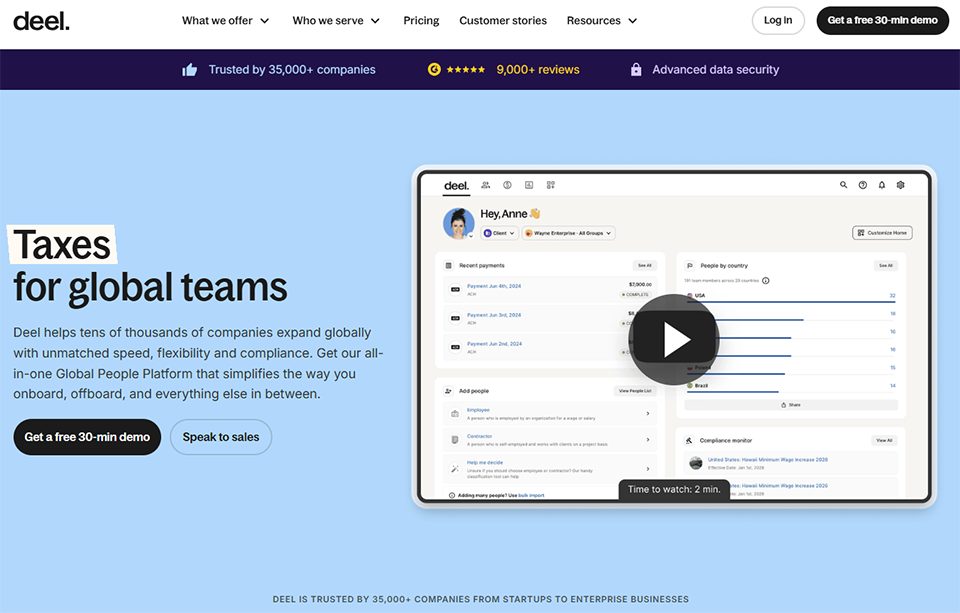

Deel has revolutionized the way companies hire beyond their borders. Founded in 2019 in San Francisco, the platform has quickly become the global standard for managing international teams, offering local contracts, legal compliance in over 150 countries, and payroll in local currencies.
Deel solves a specific problem: hiring a developer in Romania, a designer in Colombia, or a sales representative in Canada requires understanding local labor laws, setting up a legal entity, or working through an Employer of Record (EOR). Deel simplifies all of this by offering either EOR solutions (the company doesn’t need a local entity) or compliant international freelance contracts.
Deel covers international contract management, payroll in local currencies across more than 150 countries, legal compliance management, country-specific employee benefits (health insurance, retirement plans), and a comprehensive HRIS for global teams (time off, documents, organizational chart). The solution also includes a module for freelance contractor teams.
Startups and scale-ups with international remote teams:
That’s its main use. If part of the team is based abroad, Deel is pretty much a must.
Companies that hire freelancers internationally:
The management of international contracts and payments is seamless and compliant.
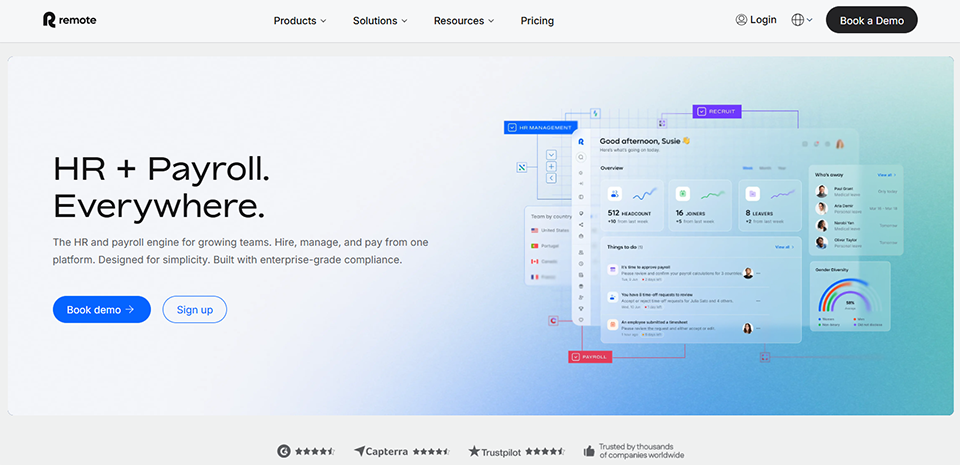
Remote is often compared to Deel, and the comparison is valid: both platforms handle the management of international teams through EOR services. Remote stands out for its more affordable pricing structure for small businesses and its strong focus on compliance.
Remote has chosen to establish its own legal entities in every country where it operates, rather than relying on third parties. This approach allows for greater control over processes and, in theory, reduces legal complications. The platform covers more than 180 countries.
Employer of Record in over 180 countries, international payroll management, contracts compliant with local laws, benefits administration, employee portal, leave management, and HR document management. Remote also offers a contractor management service with compliant contracts and streamlined payments.
Early-stage startups hiring their first employee abroad:
Remote work is often the most accessible option for small businesses.
Distributed teams across Europe and globally without a budget for a local entity:
Remote's European coverage is particularly strong.
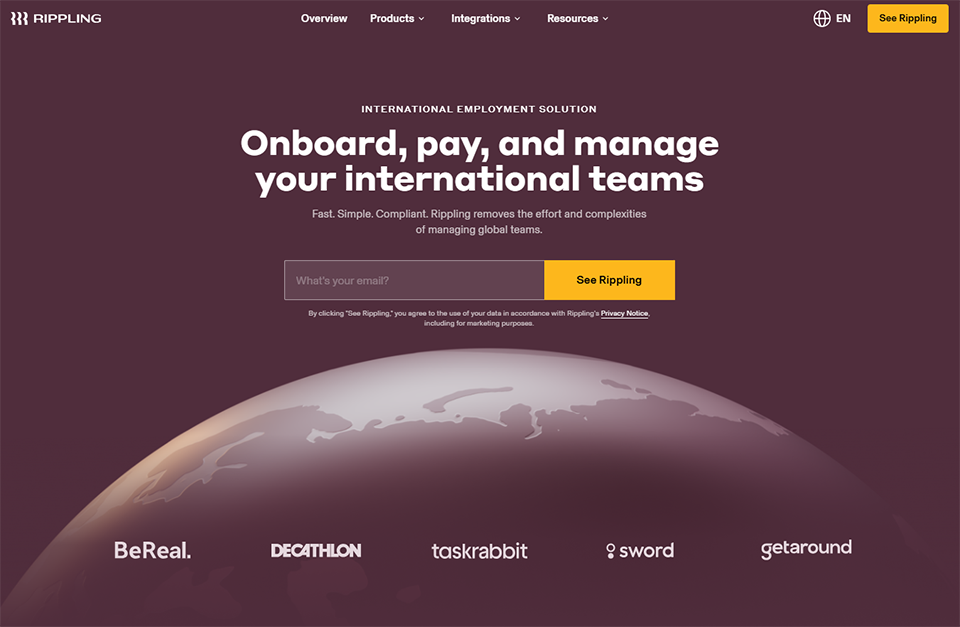
Rippling is a platform unlike any other. While most HRIS systems focus on human resources, Rippling has chosen to integrate employee management with IT management (devices, software, access) and finance. The concept: when someone joins a company, everything is set up automatically. When they leave, everything is revoked.
Rippling's goal is to become the "operating system" of the company. Whenever an HR event occurs (hiring, promotion, departure), dozens of actions are triggered automatically: creating an email account, assigning software licenses, configuring the computer, updating payroll, and modifying access rights. This is a radically different approach from traditional HRIS systems.
Rippling covers payroll (primarily in the U.S., but available internationally via EOR), benefits management, automated onboarding and offboarding, device management (MDM), software access management, expense reporting, and a recruitment module. The automations between modules are where the real value lies.
Tech scale-ups (50 to 500 employees):
HR/IT automation is particularly valuable for tech teams that manage a large number of tools and access permissions.
Companies with remote teams and high turnover:
Automated onboarding and offboarding saves hours of time with every new hire or departure.

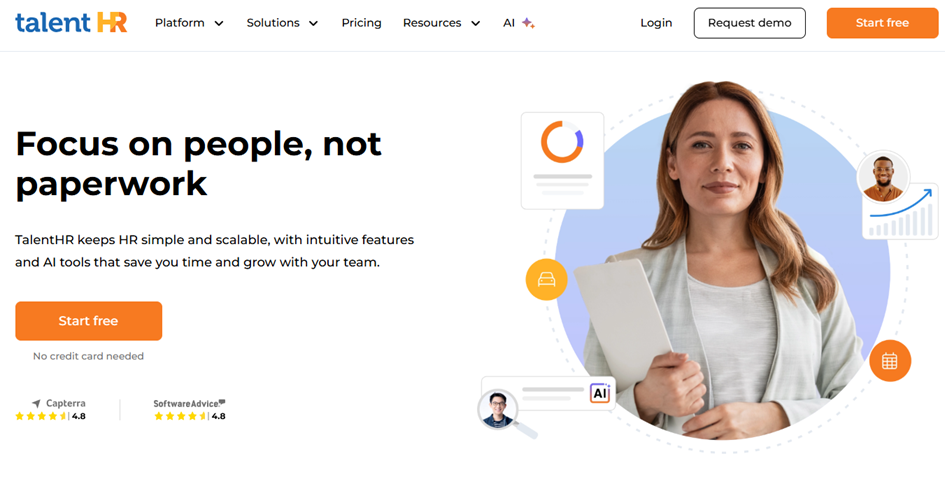
TalentHR caters to an often-overlooked segment: very small businesses and early-stage startups that need a solid HR foundation without a significant investment. The platform offers essential HRIS features in a user-friendly interface at a competitive price.
TalentHR’s goal is to make HRIS accessible to teams of 5 to 50 people who lack the budget or resources to implement Lucca or Rippling. Onboarding takes just a few hours, and the features cover all essential needs: employee management, time off, documents, and performance reviews.
TalentHR offers employee profile management, leave and absence tracking, HR document management, onboarding workflows, and feedback and interview tools. Payroll is not natively integrated, but connectors are available for third-party tools.
Startups and small businesses (5 to 50 employees):
The perfect way to lay the groundwork for HR without straining the budget.
Founders who handle HR themselves:
The simple interface makes it easy for even a non-expert to get the hang of it quickly.

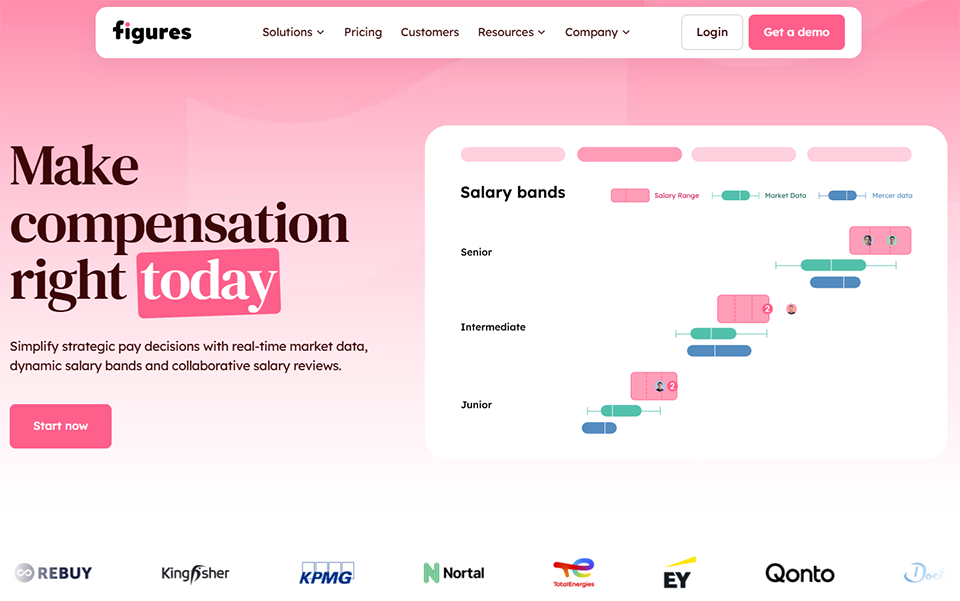
Figures HR is unlike any other tool on this list. It isn’t an HRIS in the strict sense, but rather a benchmarking and salary intelligence platform that fits into an overall HR strategy. Its mission: to provide startups and scale-ups with the data they need to make competitive and fair compensation decisions.
Compensation is one of the most complex challenges for HR teams in growing companies: how should they position themselves relative to the market? How can they develop consistent pay scales? Figures HR aggregates anonymized salary data from hundreds of companies to provide accurate benchmarks by job title, level of experience, location, and industry.
Figures provides access to a real-time salary database, tools for creating pay scales, internal pay equity analyses, and benchmarks by position and market. The platform integrates with several HRIS systems to cross-reference internal data with market benchmarks.
Fast-growing scale-ups (50 to 500 employees):
This is where the issue of pay scales becomes critical and where Figures adds the most value.
HR and People Ops professionals who want reliable data:
The tool is designed for HR professionals looking to structure their compensation policies.

This is the central question of this article, and the answer requires some nuance depending on the various aspects of HR management:
💰 For payroll:
With as few as 5 to 10 employees, automating the generation of pay stubs and social security reports can save several hours each month. The risk of manual errors also becomes significant once this threshold is reached.
🏖️ Regarding leave and absences:
Once you have 15 to 20 employees, managing leave requests via email or a shared spreadsheet can become a source of friction. An automated approval system solves the problem easily.
🤝 For onboarding:
For every new hire, a structured process makes all the difference in the employee experience. Even a 10-person startup benefits from an onboarding workflow, if only for access rights and contractual documents.
🗂️ For comprehensive HR management:
Once a company has 30 to 50 employees, not having an HRIS starts to take a toll in terms of HR time, errors, and a lack of visibility into employee data.
🌍 For international teams:
From the very first hire abroad, tools like Deel or Remote become virtually indispensable for managing legal compliance without setting up a local entity.
Here is a summary table to help you compare the six solutions presented in this article. The prices listed are approximate and may vary depending on the plans and team size. We recommend checking them directly with the providers.
| Software | Ideal size | Native payroll | International | Key strength | Estimated price |
|---|---|---|---|---|---|
| PayFit | 10 to 200 employees | ✅ France | ❌ | Simple Automated Payroll | ~€20–40 per employee per month |
| Lucca | 50 to 1,000+ employees | ✅ France | ❌ | Modularity and customization | ~€3–6 per module per employee per month |
| Deel | 10 to 500+ | Midterm | ✅ 150+ countries | EOR and international contractors | $49–$599/month |
| Remote | 5 to 500+ | Midterm | ✅ 180+ countries | Own entities, compliance | ~$599 per EOR per month |
| Rippling | 50 to 500+ | ✅ US/partial | ✅ | Merger of HR, IT, and Finance | ~$8 per employee per month + modules |
| TalentHR | 5 to 50 employees | ❌ | ❌ | Accessibility and simplicity | Free → ~$2–$4 per employee per month |
| HR figures | 50 to 500+ | ❌ | ✅ Europe | Salary benchmarking | Annual subscription |
Prices are for reference only. We recommend that you check them directly with the publishers, as rates are subject to change.
There is no one-size-fits-all answer, but some general guidelines emerge depending on each organization’s specific situation:
🇫🇷 Are you a French startup with fewer than 50 employees and no dedicated HR manager?
PayFit is probably your best place to start. Payroll is automated, the interface doesn’t require HR expertise, and support is available in French.
🏢 Are you a French small or medium-sized business with a structured HR department?
Lucca offers the functional depth and modularity needed to meet advanced HR requirements, with a truly coherent "suite" approach.
🌍 Your team is spread out across the globe:
Deel and Remote are the two leading options. Deel has the edge in terms of user interface and features, while Remote stands out for its compliance and transparent pricing. Both are worth a thorough comparison depending on your target countries.
🔗 Looking to merge HR and IT management:
Rippling doesn't really have any competitors when it comes to this value proposition. If you manage a lot of tools, access points, and equipment, the automation it offers makes the investment worthwhile.
🌱 You're just starting out and looking to build a solid HR foundation without a large budget:
TalentHR is the most accessible entry point for essential features at a minimal cost.
📊 Do you need to structure your compensation policy:
Figures HR is a valuable addition to your core HRIS, especially if you are a fast-growing tech scale-up.
Here are the answers to the most frequently asked questions about HRIS systems, to help you explore the topic further.
Payroll software is part of an HRIS, but it is only one component of it. An HRIS encompasses all aspects of HR management: payroll, leave, recruitment, training, performance management, and contractual documents. Standalone payroll software covers only the accounting and reporting aspects of compensation.
Yes, provided you choose the right solution. Tools like TalentHR offer free or very affordable plans for small teams. For payroll, PayFit is used by companies with as few as 5 or 6 employees. The investment in time and money remains minimal, and the organizational benefits are real even on a small scale.
These are two Categories . Tools like Notion, Asana, or Monday allow you to manage tasks and projects, but they do not replace an HRIS for payroll, time off, or HR compliance. The two can coexist, and some HRIS systems offer integrations with the most popular project management tools. If you’re looking for discount project management software, Freelance Stack several great deals in this category.
It depends heavily on the solution and the size of the team. TalentHR or PayFit can be up and running in a matter of hours to a few days. Lucca or Rippling, with their advanced configurations, typically take a few weeks to a few months, depending on the complexity of the existing HR processes.
The solutions discussed in this article, particularly European solutions such as PayFit and Lucca, are designed to be GDPR-compliant. For U.S. solutions such as Rippling, Deel, or Remote, GDPR compliance is assured, but it is important to review the contractual terms and verify where the data is hosted. This is an issue that should always be clarified before any deployment.
Yes, most HRIS systems offer native integrations or API integrations with leading accounting software. For example, PayFit and Lucca are connected to solutions like Pennylane and Sage. Rippling takes integration a step further with its native connectors to dozens of financial tools.
There are a few open-source solutions, such as Odoo (which includes an HR module) or OrangeHRM. These options are suitable for teams that have the technical resources to deploy and maintain them. For most small and medium-sized businesses and startups, the time required for maintenance often outweighs the savings on licensing costs. Commercial SaaS solutions generally offer better value for money.
The return on investment for an HRIS can be measured in several ways: time saved by HR each month (payroll processing, absence management, onboarding), discount payroll discount , an improved employee experience and lower turnover, and better legal compliance, which reduces the risk of tax reassessments. For a team of 30 people, the time savings can easily amount to several dozen hours per month.