




Expensify vs. Navan: Features, Differences, and Use Cases
Choosing between the two isn't just a matter of price. It's a matter of priorities: Are you looking to…
Read more


When launching or scaling a startup, choosing a payment solution often takes a back seat to a thousand other priorities. This is a mistake. Yet it’s one of the few technical decisions that directly impacts your cash flow, your customer experience, and your ability to operate internationally. A poor setup, hidden fees, or a subpar user experience at checkout can take a toll on your entire conversion funnel.
In 2026, the payment solutions market has matured considerably. Established players like Stripe have been joined by specialized alternatives, tools focused on recurring payments, and others designed for small businesses and brick-and-mortar stores. The range of options is vast and can sometimes be difficult to navigate.
A few figures to set the stage: according to the latest industry studies, the global digital payments market is expected to exceed $20 trillion in transaction volume by 2027. In Europe, the PSD2 directive and the rise of instant payments have profoundly reshaped shoppers’ expectations and merchants’ obligations. For a startup, failing to adapt to this shift can result in abandoned shopping carts, unrecovered unpaid balances, or penalties for non-compliance.
Choosing a payment solution is therefore not just a technical decision. It is also a business decision (what payment methods do you offer your customers?), a financial decision (how does it affect your margins?), and an operational decision (how does it integrate with your accounting, CRM, and billing systems?).
This article provides an honest and detailed overview of the best options available to French and European startups this year: their features, pricing, strengths, and the situations in which they are truly essential.

It’s hard to talk about online payments without starting with Stripe. Launched in 2010, this American giant has established itself as the global standard for developers and startups. Its strengths include a remarkably clear API, comprehensive documentation, and a range of features that go far beyond simple payment processing.
Stripe handles online payments in over 135 currencies, subscriptions and recurring billing via Stripe Billing, bank transfers, point-of-sale payments with Stripe Terminal, and even business financing via Stripe Capital. For SaaS startups in particular, the suite is nearly complete: it handles free trials, upgrades/downgrades, coupons, and partial refunds. Everything can be configured via the API or directly from the dashboard.
Compliance is built in natively: Stripe automatically handles VAT in countries where it applies (via Stripe Tax, which is optionally enabled), SCA (Strong Customer Authentication) rules in Europe, and PCI-DSS requirements for card payments.
One of Stripe’s often-overlooked strengths is its ecosystem. More than 4,000 integrations are available through the Stripe Apps marketplace: from Slack to Salesforce, from Xero to HubSpot, including subscription management tools like Chargebee and no-code platforms like Notion and Zapier. When you choose Stripe, you tap into a vast network of integrations that simplifies building your tech stack.
Stripe Radar is also worth mentioning: it’s the built-in fraud prevention module, based on machine learning models trained on billions of transactions. It allows you to set custom rules to block suspicious payments, reduce chargebacks, and improve the acceptance rate for legitimate transactions. For a startup that’s starting to see volume, it’s a tool that’s well worth the investment.
Stripe is the go-to tool for SaaS startups and digital products that need technical flexibility and a robust infrastructure from the start. If you have a developer on your team or work with an agency, it’s hard to beat. However, for a business without a developer and with basic needs, the tool may seem overkill.
International startups will also appreciate the multi-currency support and the ability to create Stripe accounts in multiple countries through Stripe Connect.

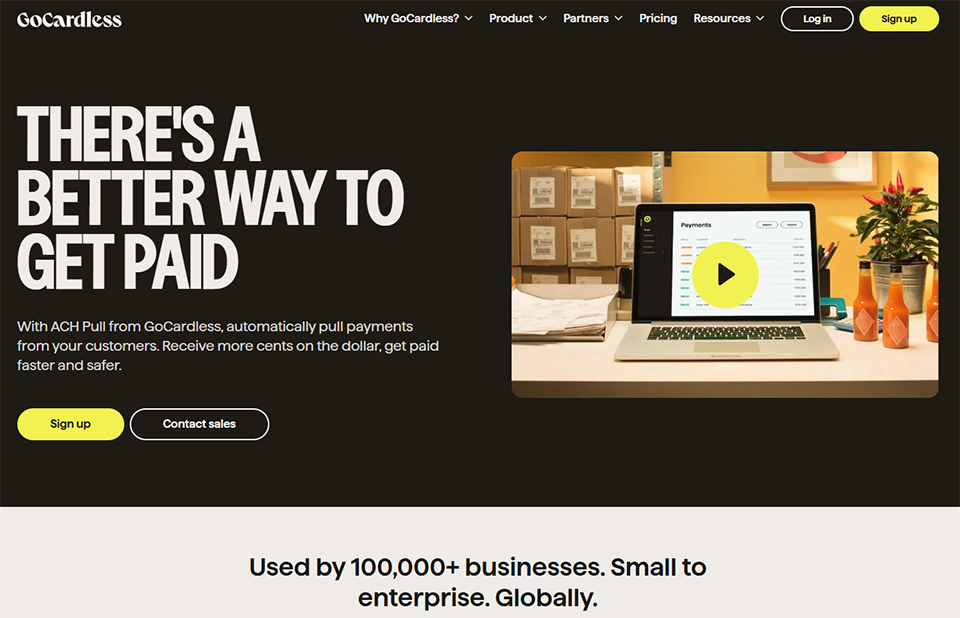
GoCardless occupies a very clear niche: direct bank debits (SEPA Direct Debit in Europe, BACS in the United Kingdom, and ACH in the United States). If your business model relies on monthly subscriptions, recurring payments, or B2B collections, it is likely the most sophisticated solution on the European market.
The proposition is straightforward: GoCardless lets you collect payments directly from your customers’ bank accounts, without going through the Visa/Mastercard network. The result: significantly lower fees than card payments, a lower payment failure rate, and greater predictability in cash receipts.
The solution includes a feature for automatically recovering failed payments (smart follow-up, adaptive retry via the Success+ module), which is particularly useful for subscriptions. According to GoCardless, Success+ can recover up to 70% of failed payments that would otherwise have been lost. For a startup with 500 subscribers, this can amount to several thousand euros in preserved MRR each month.
GoCardless currently supports more than 30 countries and offers a well-documented API as well as native integrations with tools such as Xero, QuickBooks, Salesforce, and Chargebee. The platform handles both one-time SEPA direct debits and recurring direct debits with variable amounts, providing significant flexibility for usage-based billing models.
When it comes to open banking, GoCardless has invested heavily in recent years in instant payments via Open Banking (Instant Bank Pay in the UK, with a gradual rollout across Europe). In practice, this allows your customers to pay in just a few seconds directly from their banking app, without having to enter any card information. It’s a real plus for reducing friction.
The fees are significantly lower than those for card payments, which can result in substantial savings at scale.
GoCardless is designed for startups with a subscription or recurring billing model: B2B SaaS, service platforms, and management software with annual licenses. Firms, agencies, and freelancers who regularly bill the same clients will also find it a suitable tool.
B2B companies will particularly appreciate the option of instant payments combined with SEPA direct debits, which allows them to collect payments quickly while maintaining a streamlined accounting process.

Less well-known in France than in the Netherlands or Belgium, where it has a strong presence, Mollie is gaining ground in Europe. And for good reason: the solution offers a balanced experience that combines ease of integration, a variety of payment methods, and transparent pricing. No hidden fees, no monthly minimum: you pay only for what you use.
Mollie accepts credit cards (Visa, Mastercard, Amex), bank transfers, iDEAL (must-have in the Netherlands), Bancontact (Belgium), SEPA Direct Debit, PayPal, Apple Pay, Google Pay, Klarna, and other local payment methods. The list is long and is regularly expanding. For startups that want to offer their customers their preferred payment method, this is a real advantage.
The API is clean, the documentation is adequate, and the official plugins support WooCommerce, Magento, PrestaShop, and Shopify. The dashboard is clear, and reports can be easily exported.
What really sets Mollie apart from the other providers in this selection is its handling of local European payment methods. When you sell in Europe, you can’t rely solely on credit cards: iDEAL accounts for more than 60% of online payments in the Netherlands, Bancontact dominates in Belgium, and bank transfers remain widely used in Germany. Mollie handles all of this through a single integration, which eliminates the need to use multiple payment service providers (PSPs) depending on the market.
Mollie also offers an invoice financing solution (Mollie Capital) and subscription management features via its API, although the latter are less sophisticated than dedicated tools like Chargebee. For simple use cases (fixed monthly subscriptions), they are more than sufficient.
Mollie stands out for its transparency: no fixed subscription fee, just pay-per-transaction billing.
Mollie is particularly well-suited for e-commerce startups and marketplaces operating in Europe that want to support as many local payment methods as possible. It’s also a good option for startups that don’t yet have a dedicated developer: integration via a plugin is simple, and setup times are short.
Teams that work with Belgian or Dutch clients will find that Mollie offers a clear competitive advantage thanks to its local payment methods (iDEAL, in particular, accounts for more than 60% of online payments in the Netherlands).

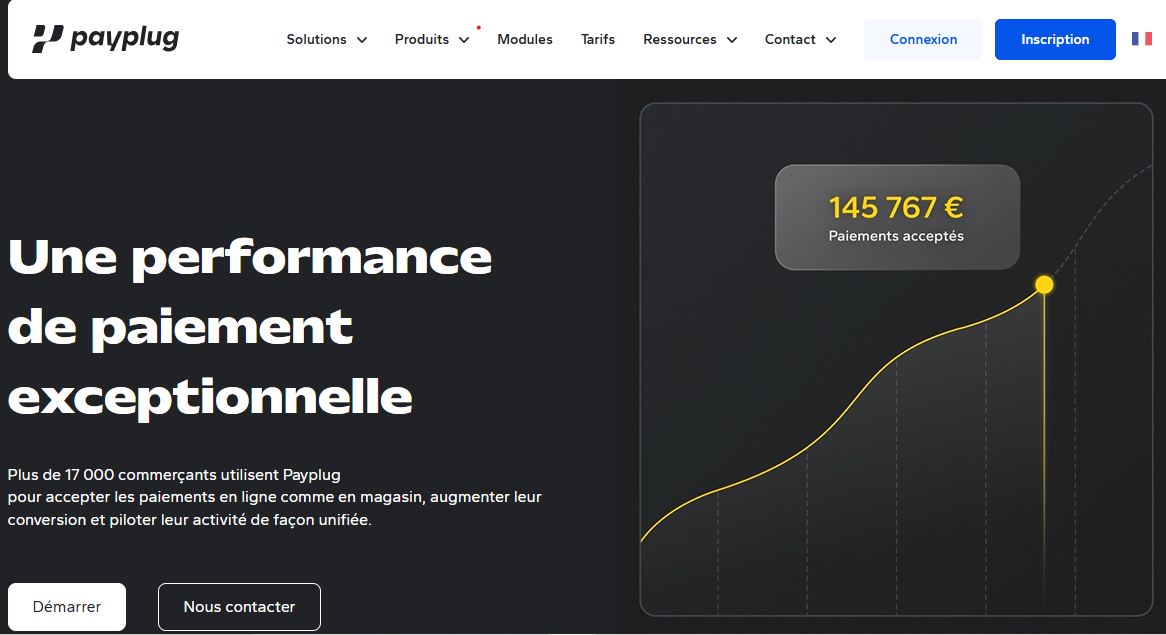
Payplug occupies a unique position: it’s a French solution, a subsidiary of Crédit Mutuel Arkéa, designed specifically for merchants and e-commerce sites. If you operate primarily in France and want a local point of contact, seamless integration with French CMS platforms, and support available in French, Payplug is definitely worth considering.
The solution supports card payments (Visa, Mastercard, CB), installment payments, payment links, hosted payment pages, and in-store payments via a connected terminal. For e-commerce, plugins for PrestaShop, WooCommerce, Magento, and Shopify are officially supported. PCI-DSS certification is provided, and 3DS2 is integrated.
Payplug also offers a split-payment feature (in 2, 3, or 4 installments) that can significantly improve the conversion rate for medium- to high-value shopping carts. This is a feature that many startups are looking to integrate, and it often requires a partnership with a third-party provider (such as Alma). With Payplug, it’s built right in.
Another strength often mentioned by users is the quality of support. Payplug has a team based in France that can be reached quickly and is able to answer technical questions accurately. For a startup that doesn’t yet have in-house payment expertise, this is a significant safety net.
The solution also allows you to create custom, hosted, and secure payment pages (Payplug Checkout) without having to manage the server-side infrastructure. This is convenient for sending payment links via email or text message, managing quotes online, or simply processing payments from customers without an integrated e-commerce store.
Rates are competitive for large volumes and annual commitments. Please check their website for detailed pricing.
Payplug is designed for e-commerce startups primarily operating in France that want a reliable solution that complies with local requirements and offers genuine human support. It’s also a good fit for B2C startups with medium-to-high average order values that want to offer installment payments without relying on third-party solutions.
Organizations that prefer to work with French partners and within a well-defined regulatory framework will also appreciate the “made in France” aspect and the relationship with a French banking group.

Square is a well-established American solution that stands out for its versatility: it covers both online and in-person payments (payment terminals, cash registers, QR codes). For a startup that operates both online and in the real world, it’s a serious option to consider.
The Square platform includes a comprehensive point-of-sale system (Square for Retail, Square for Restaurants), mobile payment terminals, an invoicing tool, an e-commerce solution with an integrated online store, and inventory and staff management features. All of these components are connected within a cohesive ecosystem with centralized reporting.
For online payments, Square offers an API, payment links, embeddable forms, and integration with WooCommerce. It supports card payments, Apple Pay, and Google Pay.
What sets Square apart in this selection is the breadth of its offerings for brick-and-mortar businesses. The mobile card reader (a small Bluetooth dongle) lets you accept payments anywhere. The Square Stand turns a tablet into a full-featured point-of-sale system. The Square for Restaurants solution handles table orders, bills, and tips. It’s hard to find a more comprehensive solution for an in-person business.
On the digital front, Square Appointments is an online appointment scheduling tool with built-in payment processing that is widely used by service providers (hair stylists, coaches, practitioners, consultants). It’s an example of how Square has successfully expanded its original offering (the card reader) into a full-fledged business management platform.
Additional software (advanced inventory management, payroll, loyalty programs, etc.) is billed separately.
Square is an excellent option for startups or emerging businesses that combine a physical and digital presence: restaurants, stores, studios, markets, food trucks, and service providers. It’s also a good fit for content creators or B2C service providers who want to invoice customers easily without a complex infrastructure.
While less suitable for pure-play SaaS startups that don’t have a physical point of sale, the tool truly shines in hybrid business models.

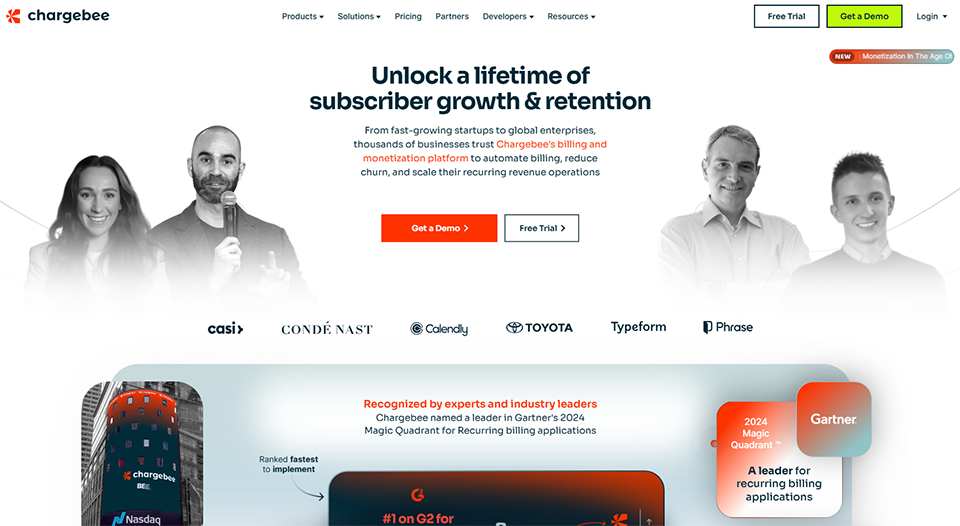
Chargebee operates in a slightly different league than the other tools in this selection. It isn’t strictly speaking a payment solution: it’s a recurring revenue management platform (Revenue Operations, or RevOps) that integrates with your existing payment solutions (Stripe, GoCardless, Braintree, etc.) to manage billing, subscriptions, reminders, and accounting.
Chargebee handles the management of pricing plans (monthly, annual, usage-based, freemium), subscription lifecycles (upgrade, downgrade, pause, cancellation, reactivation), automated billing, payment reminders for failed transactions, management of discounts and trial periods, and synchronization with accounting tools such as Xero, QuickBooks, or Pennylane. International tax compliance is automated (EU VAT, U.S. taxes via Avalara).
For SaaS startups with multiple plans, multiple markets, and complex pricing models, Chargebee eliminates the need to reinvent the wheel when it comes to billing infrastructure.
Here’s a concrete example: Imagine you offer a SaaS product with three plans (Starter, Pro, Enterprise), 14-day free trials, discounts for annual commitments, and customers in France, Germany, and the United Kingdom. Manually managing upgrades, prorated billing, trial expiration reminders, local VAT, and accounting exports would easily take several hours a week. Chargebee automates all of this, including dunning emails (automatic reminders for unpaid invoices) and Slack notifications when a customer churns or upgrades.
The built-in analytics are also robust: MRR, ARR, churn rate, LTV, expansion revenue... Dashboards designed for founders and finance teams who want to track their SaaS metrics accurately in real time.
Chargebee has transitioned to a freemium model:
The free plan is generous for early-stage startups, making it a good choice right from the first few weeks of operation.
Chargebee is designed for growing SaaS startups that offer multiple subscription plans, have customers in multiple countries, and require structured financial reporting. It’s also the ideal tool for teams that want to experiment with different pricing models (free trials, usage-based, freemium) without having to build an in-house infrastructure.
CFOs and finance teams at startups will particularly appreciate the reporting capabilities, integrations with accounting tools, and automated tax compliance.

To help you quickly get your bearings, here is a summary table of the six solutions presented in this article. It is not a substitute for an in-depth analysis tailored to your specific context, but it provides a useful overview for comparing how they are positioned.
| Solution | Ideal for | Payment Method | Indicative Fees | Distinctive feature |
|---|---|---|---|---|
| Stripe | Tech startups, SaaS | Credit card, SEPA, bank transfers | 1.5% + €0.25 | Industry-standard API, comprehensive ecosystem |
| GoCardless | B2B subscriptions, recurring | SEPA Direct Debit | 0.5% + €0.20 (capped at €4) | Direct debit specialist, low fees |
| Mollie | E-commerce Europe | Multi-method | 1.2% + €0.25 | Best coverage of local methods |
| Payplug | E-commerce in France | Card, installment payment | 0.9% + €0.10 (Pro) | French provider, installment payments |
| Square | Brick-and-mortar + online retail | Card, mobile | 1.6% to 1.9% | Omnichannel, integrated hardware |
| Chargebee | SaaS, RevOps | (via Stripe/GoCardless) | Free up to $250,000 ARR | Subscription management + tax compliance |
Prices are indicative; be sure to check them directly with each vendor.
Choosing a payment solution doesn’t necessarily mean choosing just one. In reality, a growing startup often uses a combination of tools that complement each other depending on its needs. Here are a few common setups that work well.
Stripe + Chargebee. Stripe handles the payment infrastructure (credit cards, SEPA, bank transfers), while Chargebee manages billing, subscriptions, and tax compliance. This combination covers virtually all the needs of a growing B2B or B2C SaaS company.
GoCardless for recurring payments (fewer chargebacks, lower costs) + Success+ for automatic reminders. Pair with Chargebee if subscription management is complex.
Use Mollie as your primary payment service provider (PSP) for local payment methods (iDEAL, Bancontact, Klarna...), possibly supplemented by GoCardless if you have B2B customers with recurring billing.
Square for brick-and-mortar stores, paired with a solution like Stripe or Mollie for the digital channel, with accounting data synced to Pennylane or a similar service.
Payplug offers an excellent balance of simplicity, compliance, and support to get you started, without requiring a developer. It’s ideal for validating your business model before moving on to a more advanced tech stack.
The golden rule: First, choose based on your revenue model (transactional vs. recurring, B2B vs. B2C, local vs. international), and then based on your technical constraints. Transaction costs are one factor, but they should not overshadow the quality of execution, compliance, and the robustness of the infrastructure.
Before you go any further with your research, here are the questions startups ask most often on this topic.
It all depends on your business model. If you sell SaaS or a digital product with a subscription, Stripe remains the essential foundation, possibly paired with Chargebee for revenue management. If your customers are primarily in Europe and you bill on a recurring basis, GoCardless can significantly reduce your transaction costs. For multi-country e-commerce in Europe, Mollie is an excellent alternative.
Yes, and that’s actually common practice. Many startups use Stripe for credit card payments and GoCardless for SEPA direct debits, all managed through Chargebee. Some also combine Stripe and Mollie depending on the geographic market.
There are several strategies you can use: negotiate customized rates once you reach a certain volume, prioritize SEPA direct debits (which are cheaper than credit cards), enable the payment methods most commonly used in your target markets, and reduce the payment failure rate using smart recovery tools (GoCardless Success+, Stripe Radar).
For the most part, yes. The PSD2 directive and SCA (Strong Customer Authentication) rules are handled natively by Stripe, GoCardless, Mollie, and Payplug. However, managing international VAT remains your responsibility, unless you use Chargebee (which automates it) or enable Stripe Tax as an add-on.
Not necessarily. Payplug, Mollie, and Square offer official plugins for the major CMS platforms (WooCommerce, PrestaShop, Shopify) that require no coding. Stripe and GoCardless also offer no-code solutions (payment links, hosted pages), but their full potential is realized through API integration.
Stripe Billing is the most comprehensive solution for multi-currency subscriptions. Chargebee integrates with it to add a layer of advanced management. GoCardless focuses on the SEPA region and a few other markets (UK, US, Australia, etc.), which may be sufficient if you don’t yet operate outside of Europe.
All the tools in this selection allow you to manage refunds directly from their dashboard. For disputes and chargebacks, Stripe offers Stripe Radar with customizable anti-fraud rules. Mollie and Payplug also include dispute management features. The key is to document your transactions and respond quickly to dispute requests.