GDPR Compliance for Startups: What You Really Need to Do
This article won’t overwhelm you with legal jargon. The goal is to clarify exactly what you need to do, depending on where your business stands, and to provide you with practical tools that will help you get compliant without spending weeks on it.
Why does the GDPR remain a blind spot for startups?
One might think that the GDPR, which took effect in May 2018, has now been fully embraced by businesses. The reality is more nuanced. According to the CNIL, a significant portion of the complaints received each year involve organizations with fewer than 50 employees-organizations that are often not acting maliciously, but are simply overwhelmed.
The reason is simple: when you launch a startup, you focus on the product, growth, and customer acquisition. Regulatory compliance tends to fall to the bottom of the list. Plus, GDPR is a lengthy and technical process, and the resources required to address it are costly.
Except that the risk is very real. An administrative fine can reach up to 20 million euros or 4% of global annual revenue, whichever is higher. For a startup, even a symbolic penalty can have disastrous effects on its reputation and investor confidence.
This article won’t overwhelm you with legal jargon. The goal is to clarify exactly what you need to do, depending on where your business stands, and to provide you with practical tools that will help you get compliant without spending weeks on it.
What the GDPR actually requires of you.
Before discussing tools, we need to establish the framework. The GDPR is based on a few fundamental requirements that every company processing personal data must comply with, even if it has only two employees.
The lawfulness of processing:
Every instance of data collection must have a legal basis. The six bases recognized by the regulation are: consent, performance of a contract, legal obligation, protection of vital interests, public interest mission, and legitimate interest. For the vast majority of startups that collect email addresses, engage in remarketing, or track user behavior, consent is the applicable basis. And consent must be freely given, informed, specific, and not pre-checked.
User information:
Your privacy policy must be in place, easily accessible, and contain specific information: who processes the data, why, for how long, and what rights data subjects have (access, correction, erasure, portability, objection).
Cookie management:
This is one of the most visible yet most poorly implemented requirements. Since the CNIL’s 2020 guidelines, the use of non-essential cookies requires prior consent. A banner stating “by continuing to browse, you accept cookies” is no longer valid. Opting out must be just as easy as opting in.
The processing log:
Any organization that processes personal data must maintain a record documenting its processing activities. This is often the requirement most overlooked by small organizations, even though it is explicitly provided for in Article 30 of the Regulation.
Data security:
Appropriate technical and organizational measures must be in place. These include encryption, restricted access, security updates, and the ability to notify the CNIL within 72 hours in the event of a breach.
Subcontractor management:
Every SaaS tool you use that processes your users' data is a data processor. You must ensure that it is compliant and sign a data processing agreement (DPA) with it.
Tools to help you manage your GDPR compliance.
There are now solutions designed specifically to help teams without in-house legal counsel manage their compliance in a structured way. Here are four available on Freelance Stack, tailored to different needs.
#1 - Axeptio: France's leading provider of consent forms that don't sound like legal jargon.
Founded in 2018, it has established itself as a leading player in the French-speaking market, largely thanks to its editorial approach: making consent less anxiety-inducing and more transparent for users.
Axeptio’s approach is deliberately different from traditional banners. Rather than a gray block of legal jargon, the solution offers conversational and visually appealing interfaces, with clear explanations of each cookie and its purpose. The idea is that consent obtained through education is legally more robust and better received by the user.
Main features :
The platform covers the basics of cookie compliance: creating and customizing consent banners, managing granular preferences by cookie category (analytics, marketing, functional), storing proof of consent, generating privacy policies, and integrating with major CMS platforms and tag managers (WordPress, Shopify, GTM, etc.).
Axeptio also offers a cookie scanner that automatically detects trackers on your website and makes it easy to categorize them. The solution complies with the requirements of the CNIL and TCF 2.0 (IAB Europe’s Transparency and Consent Framework).
Pricing:
Free Plan: up to 5,000 visitors per month, essential features.
Starter Plan: around €14/month for higher data allowances.
Growth Plan: Volume-based pricing, advanced features, and multi-domain support.
Enterprise Plan: Available upon request for large organizations.
👤 Who is Axeptio designed for?
🚀 The startup in its launch phase:
You've just launched your website and don't have a legal advisor yet. Axeptio is probably the most accessible option for quickly ensuring compliance, without any complex setup.
🛍️ The high-traffic e-commerce site:
You use Meta pixels, Google Analytics, and retargeting tools. Granular management of cookies by category and proof of consent are essential for your legal peace of mind.
🇫🇷 The company with a French-speaking audience:
The French interface, compliance with CNIL guidelines, and local support are tangible advantages.
✅ Highlights:
Well-designed user interface, with acceptance rates often above average.
Less suitable if you need a comprehensive GDPR compliance solution (beyond cookies).
Advanced features require a paid subscription.
Technical documentation is sometimes insufficient for non-standard configurations.
Benefit from a on Axeptio .
3 months free
Find our best discount right now with Axeptio and save on your software subscriptions. We offer over 850 promo codes and discounts on the best software and SaaS on the market.
#2 - Cookiebot: the go-to technical solution for teams operating internationally.
It is one of the most established solutions in the European consent management market, with a presence in over 150 countries and millions of client websites.
While Axeptio focuses on user experience and design, Cookiebot places greater emphasis on technical robustness and multi-jurisdictional regulatory compliance. The solution is designed for companies that need to manage compliance across multiple countries with different regulations (GDPR, California’s CCPA, Brazil’s LGPD, etc.).
Key features:
The core feature of the product is its automatic cookie scanner: it crawls your site regularly (at the frequency you choose) and detects all trackers placed on it, even those introduced by your subcontractors or third-party scripts. This is a significant advantage, as cookies can appear on your site without you even realizing it.
The platform then generates a customizable consent banner, a detailed preferences widget, and a cookie statement that can be incorporated into your privacy policy. It stores consent records with a timestamp and the user’s ID, which serves as legally admissible evidence in the event of an audit.
Cookiebot integrates with WordPress (via a dedicated plugin), Squarespace, Wix, and via JavaScript snippets for custom websites.
Pricing:
Freemium Plan: Free for up to 1 page or 100 visitors per month (very limited).
Small Plan: starting at around €9/month for small websites.
Medium/Large Plan: tiered pricing based on the number of pages and domains.
Unlimited Plan: for large websites and agencies.
👤 Who is Cookiebot designed for?
🌍 The startup with an international audience:
If you operate in Europe as well as in the United States or Latin America, Cookiebot’s multi-region management is a real advantage. You don’t have to manage multiple tools depending on the region.
🔍 The team that wants robust technical compliance:
The automatic scanner and consent documentation are particularly useful for teams that don’t have time to manually review their cookies.
⚙️ The developer or tech team:
The API and advanced integrations enable fine-grained customization, which appeals to technical teams.
The banner's user interface is less visually polished than Axeptio's.
The free version is practically unusable for a real website.
Less suitable for non-technical teams when it comes to advanced configurations.
Benefit from a on Cookiebot .
40% off during 3 years
Find our best discount right now with Cookiebot and save on your software subscriptions. We offer over 850 promo codes and discounts on the best software and SaaS on the market.
#3 - CookieChimp: Get compliant in just a few minutes, hassle-free.
Benefit from our free deal on CookieChimp.
20% off on annual plan
Find over 300 free deals as well as over 850 Premium deals right now with CookieChimp and save on your software subscriptions. Whether you're an entrepreneur, a startup or a solo freelancer, save hundreds of euros thanks to our discounts and promo codes.
CookieChimp is a newer solution that targets a specific market segment: simple, fast, and affordable consent management, primarily for small businesses and entrepreneurs.
The tool stands out for how easy it is to set up. In just a few minutes, you can have a compliant consent banner up and running on your site, with no complex configuration required. That’s the solution’s main selling point: quick implementation and virtually no learning curve.
Key features:
CookieChimp covers all the essentials: customizable banner creation, cookie categorization, user preference management, and consent storage. The solution also includes a privacy policy generator and a cookie notice. The admin interface is intentionally streamlined.
Pricing:
Free Plan: basic features, 1 domain.
Pro Plan: affordable pricing, multi-domain support, and advanced features.
Business Plan: for agencies and organizations with multiple locations.
👤 Who is CookieChimp for?
🧑💻 Freelancers or consultants with a portfolio website:
You don't need an enterprise solution. You want to be compliant without spending three hours on it. CookieChimp is the perfect solution for you.
🏗️ The agency that manages multiple client websites:
Affordable multi-domain management makes it a viable option for web agencies looking for a standardized solution for their clients.
✅ Highlights:
Very quick setup.
A simple and user-friendly administration interface.
Good value for small businesses.
Multi-domain management available.
⚠️ Limitations:
Fewer native integrations than Cookiebot or Axeptio.
Lighter documentation.
Less suitable for advanced or multi-regulatory compliance needs.
Benefit from a on CookieChimp .
Additional 50% off during 12 months
Find our best discount right now with CookieChimp and save on your software subscriptions. We offer over 850 promo codes and discounts on the best software and SaaS on the market.
#4 - CookieHub: The most flexible visual editor for optimizing the consent experience.
Benefit from our free deal on CookieHub.
9% off on annual plan
Find over 300 free deals as well as over 850 Premium deals right now with CookieHub and save on your software subscriptions. Whether you're an entrepreneur, a startup or a solo freelancer, save hundreds of euros thanks to our discounts and promo codes.
CookieHub is an Icelandic solution that has established a strong foothold in the European cookie compliance market. It strikes a balance between the simplicity of CookieChimp and the technical robustness of Cookiebot.
CookieHub emphasizes the ease with which the consent banner can be customized, without compromising regulatory compliance. The solution is valued for its visual editor, which allows users to adapt the consent interface to the website’s visual style without touching the code.
Key features:
Key features include: a comprehensive visual banner editor, consent management by category, automatic cookie scanning, storage of consent records, and an analytics dashboard tracking acceptance and rejection rates. This last feature is particularly useful for optimizing the wording of your consent messages.
CookieHub integrates via a universal JavaScript snippet, a WordPress plugin, and an API for developers.
Pricing:
Free Plan: up to 25,000 sessions per month, essential features.
Starter Plan: Affordable monthly rate for higher data volumes.
Pro/Business Plan: Advanced features and multi-domain support.
Enterprise Plan: Price upon request.
👤 Who is CookieHub for?
🎨 The company that prioritizes user experience:
If your design is important to you and you don't want a generic banner that stands out on your site, CookieHub's visual editor is a real asset.
📊 The data team looking to optimize its consent rates:
The consent analytics dashboard allows you to test different wording and measure its impact.
🌍 The startup expanding across Europe:
GDPR compliance is well documented, and the solution addresses the specific requirements of several European countries.
✅ Highlights:
A highly flexible visual banner editor.
Consent analytics (acceptance rate).
Generous free plan (up to 25,000 sessions).
Intuitive administration interface.
⚠️ Limitations:
Less well-known than Cookiebot or Axeptio, with a smaller user base.
Advanced analytics features are available only on paid plans.
According to user feedback, customer support is sometimes less responsive.
Benefit from a on CookieHub .
Additional 20% off during 12 months
Find our best discount right now with CookieHub and save on your software subscriptions. We offer over 850 promo codes and discounts on the best software and SaaS on the market.
#5 - Termly: Much more than just a cookie tool: the platform for generating all your legal documentation.
Benefit from our free deal on Termly.
25% off on annual plan
Find over 300 free deals as well as over 850 Premium deals right now with Termly and save on your software subscriptions. Whether you're an entrepreneur, a startup or a solo freelancer, save hundreds of euros thanks to our discounts and promo codes.
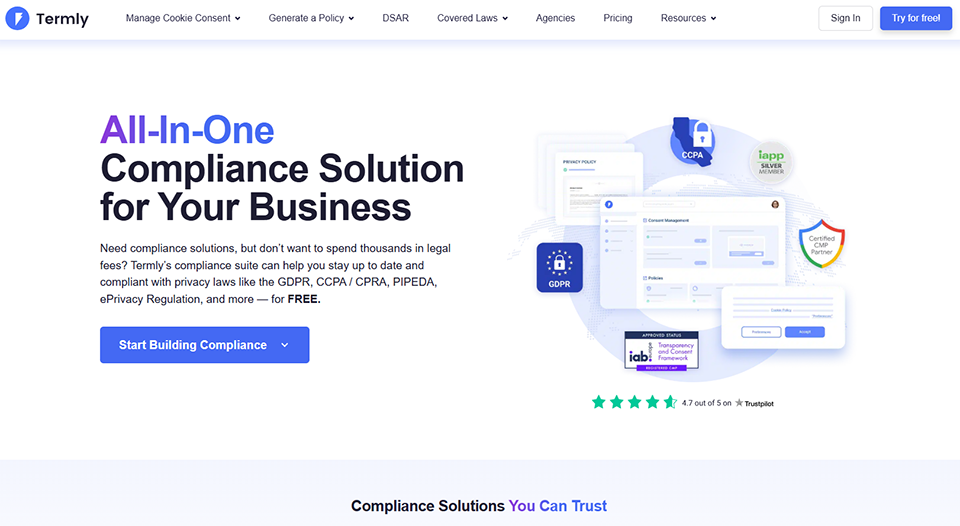
Termly is a U.S.-based solution that takes a different approach from the previous four. Rather than focusing solely on cookies, Termly offers a broader legal compliance platform, with the generation of legal documents as a central component.
The core concept behind Termly is to enable any startup to generate legally compliant documents (privacy policy, terms of service, cookie policy, refund policy) without needing to hire a lawyer for standard cases. Cookie management is an additional feature, designed as part of an integrated compliance platform.
Key features:
The document generator is the solution’s standout feature. By answering a guided questionnaire about your business, your data processing practices, and your audience, Termly generates customized legal documents that are kept up to date in line with regulatory changes. This saves startups a considerable amount of time, especially those that cannot afford to hire an in-house lawyer.
When it comes to consent, Termly offers a customizable cookie banner, an automatic scanner, consent storage, and easy integration via a script or a WordPress plugin.
The platform covers the GDPR as well as the CCPA, COPPA, and other international regulations.
Pricing:
Free Plan: limited features, Termly watermark on documents.
Pro Plan: starting at approximately €14/month (billed monthly), full features.
Agency Plan: for agencies managing multiple clients.
👤 Who is Termly for?
📄 The startup that needs comprehensive legal documentation:
If you don't yet have a privacy policy, terms of service, or cookie policy, Termly lets you generate all of them in a single session, ensuring they're consistent and kept up to date.
🇺🇸 The company with an American and European audience:
Managing both the GDPR and the CCPA at the same time is a clear advantage for organizations that serve both markets.
💡 The founder who wants to understand what he’s signing:
Termly's guided questionnaire encourages users to reflect on their data collection practices, which is educational in itself.
✅ Highlights:
Includes the generation of legal documents (privacy policy, terms of service, etc.).
Compliance with multiple regulations (GDPR, CCPA, COPPA, etc.).
A simple interface that is easy for non-lawyers to use.
Automatic updating of documents in response to regulatory changes.
⚠️ Limitations:
American solution: Axeptio has a more nuanced understanding of CNIL regulations than Axeptio.
The watermark on the free version looks unprofessional.
The ability to customize generated documents remains limited.
Benefit from a on Termly .
An additional 35% off on any plan
Find our best discount with Termly and save on your software subscriptions. We offer over 850 promo codes and discounts on the best software and SaaS on the market.
Each tool covered here addresses the basics of cookie compliance, but the differences lie in the details. Here is a brief overview to help you choose the right one for your situation.
Criterion
Axeptio
Cookiebot
CookieChimp
CookieHub
Termly
Origin
🇫🇷 France
🇩🇰 Denmark
🇬🇧 United Kingdom
🇮🇸 Iceland
🇺🇸 United States
Cookie banner
✅
✅
✅
✅
✅
Auto-detect cookies
✅
✅
✅
✅
✅
Generation of legal documents
Midterm
❌
❌
❌
✅
Analytics Consent
Midterm
✅
❌
✅
❌
Multiple regulations (CCPA, etc.)
Midterm
✅
❌
✅
✅
CNIL Compliance
✅
✅
✅
✅
Midterm
Free, usable map
✅
Limited
✅
✅
Limited
Easy to set up
⭐⭐⭐⭐
⭐⭐⭐
⭐⭐⭐⭐⭐
⭐⭐⭐⭐
⭐⭐⭐⭐
Ideal for
French Audience, UX
International, technical
Small businesses
Design + Analytics
Legal Documentation
Prices and features are subject to change. Please visit the official websites for the latest information.
What these tools don't do for you ❌
We need to be honest about the limitations of these solutions. While they cover a wide range of areas, GDPR compliance is not limited to a cookie banner and an automatically generated privacy policy.
The processing register:
This must be kept up to date manually or using a dedicated tool. None of the five tools presented here can replace this. Solutions such as Witik, Captain DPO, or specialized consultants can assist you with this aspect.
Data Processing Agreements (DPAs):
You need to sign agreements with your service providers (Stripe, HubSpot, Intercom, AWS, etc.). Many of these providers offer standard data processing agreements (DPAs) that can be signed online, but you’ll need to identify them and handle the process. In this regard, PandaDoc or DocuSign can help streamline the signing and archiving of these documents.
Data security:
This involves technical measures (encryption, access management, strong authentication) that do not depend on a compliance tool but rather on your infrastructure choices and DevOps practices.
Management of individuals' rights (right to erasure, portability, and rectification):
Must be operational. You must be able to respond to a request within the legal timeframe (generally one month), which requires that you have mapped out where your data is stored.
For fundamental legal matters (articles of incorporation, customized privacy policies, complex data processing agreements), platforms like Legalstart or LegalPlace can connect you with specialized legal professionals at affordable rates.
Where to start, depending on your situation.
GDPR compliance isn't a black-and-white issue. Priorities vary depending on where you are in the process.
💻 You just launched your website and haven't done anything:
Start by setting up a consent management solution (Axeptio or CookieChimp, depending on your budget and audience), and create a privacy policy using Termly or through a lawyer. This is the minimum requirement and the area most likely to be scrutinized during an audit.
🍪 You already have a cookie banner, but it dates back to 2019:
The rules have changed significantly since the CNIL’s 2020 guidelines. An “informational” banner without an explicit opt-in or opt-out option is no longer compliant. Check with Cookiebot or CookieHub to ensure you have an up-to-date solution.
👩💻 You have a significant following and collect a lot of data:
Compliance is becoming a serious issue. You need to go beyond cookies: a record of processing activities, data processing agreements with all your processors, an internal data management policy, and the appointment of a data protection officer. At this stage, it is advisable to consult with an external DPO or a specialized firm.
💵 Are you getting ready to raise funds or sign a deal with a major client?
GDPR compliance will be systematically assessed as part of the due diligence process. Having comprehensive documentation and tools in place reassures investors and speeds up the process.
See all the software of this category: Conformité & RGPD
Check out all the other software and discount we offer in this category. Explore other tools and choose the perfect solution to grow your business.
The GDPR raises many questions, often the same ones across different organizations. Here are the answers to the questions most frequently asked by founders and managers of small teams.
1️⃣ My website only collects email addresses for a newsletter. Does the GDPR apply to me?
Yes. An email address is personal data as defined by the regulation. You must have a legal basis for collecting it (generally, explicit consent), inform individuals about how their data will be used, and allow them to easily unsubscribe.
2️⃣ Is Google Analytics GDPR-compliant?
This is a complex issue. Google Analytics Universal was deemed non-compliant by several European authorities, including the CNIL in 2022, due to data transfers to the United States. Google Analytics 4, when properly configured (IP anonymization, disabling certain features, consent mode), is more acceptable, but the issue remains sensitive. European alternatives such as Matomo are available for organizations that wish to avoid any ambiguity.
3️⃣ Am I required to appoint a DPO (Data Protection Officer)?
Appointing a DPO is mandatory in three cases: if you are a public body, if your main activity involves the regular and systematic monitoring of individuals on a large scale, or if you process so-called "sensitive" data on a large scale. For most startups, this is not a legal requirement, but it is considered best practice once the company reaches a certain size.
4️⃣ Are social media platforms and pixels (Meta, LinkedIn) subject to consent?
Yes. Tracking pixels set cookies and transmit data to third parties. They require prior consent. Your consent management solution must be able to block these scripts until the user has given their consent.
5️⃣ What are the actual consequences of non-compliance?
Penalties can take several forms: a formal notice (granting a deadline to comply), an administrative fine (which can reach €20 million or 4% of global revenue), an order to cease processing, and publication of the decision. For startups, the most immediate risk is often the loss of trust among users or partners, even before any formal penalties are imposed.
6️⃣ Is hosting my data in Europe sufficient to ensure compliance?
No. Hosting data in Europe is a positive step, particularly to avoid transfers to third countries, but it does not guarantee compliance with the GDPR. The requirements regarding the lawfulness of processing, information, security, and the management of rights apply regardless of where the data is located.
7️⃣ How long does it take to become fully compliant?
For a standard website with a few analytics and marketing tools, one to two weeks of focused work is enough to cover the essentials: a compliant cookie banner, an up-to-date privacy policy, a basic data processing register, and data processing agreements with key processors. Compliance is then an ongoing process, not a one-time project.