





Our selection of cybersecurity tools for small and medium-sized businesses.
This ranking reviews the best cybersecurity tools available to SMEs and entrepreneurs 2026…
Read more


There’s something universal about the way teams react to the word “compliance”: a mix of good intentions and open admission of procrastination. The GDPR went into effect in May 2018, and yet many startups and small businesses are still flying by the seat of their pants, somewhere between an incomplete processing register and a privacy policy copied and pasted from a competitor.
It’s not necessarily negligence. The fact is that regulatory compliance is a complex field that requires time, legal expertise, and an internal organizational structure that most companies with fewer than 100 employees simply don’t have. Add to that ISO 27001, SOC 2, or other certifications if you’re looking to work with enterprise clients, and the picture quickly becomes daunting.
This is precisely where tools like Drata and Sprinto come in: platforms designed to automate compliance processes, centralize documentation, and make audits much less of a hassle. Both solutions have established themselves as leaders in their respective categories, but they aren’t aimed at exactly the same types of users, nor do they address the same priorities.
In this article, we provide an honest comparison of their features, pricing, use cases, advantages, and limitations. The goal is simple: to help you choose the tool that fits your specific situation, not some generic use case.
💡 If you're looking for other tools to help you secure and streamline your compliance efforts, check out the Compliance & GDPR category on Freelance Stack to access discount the best software on the market.
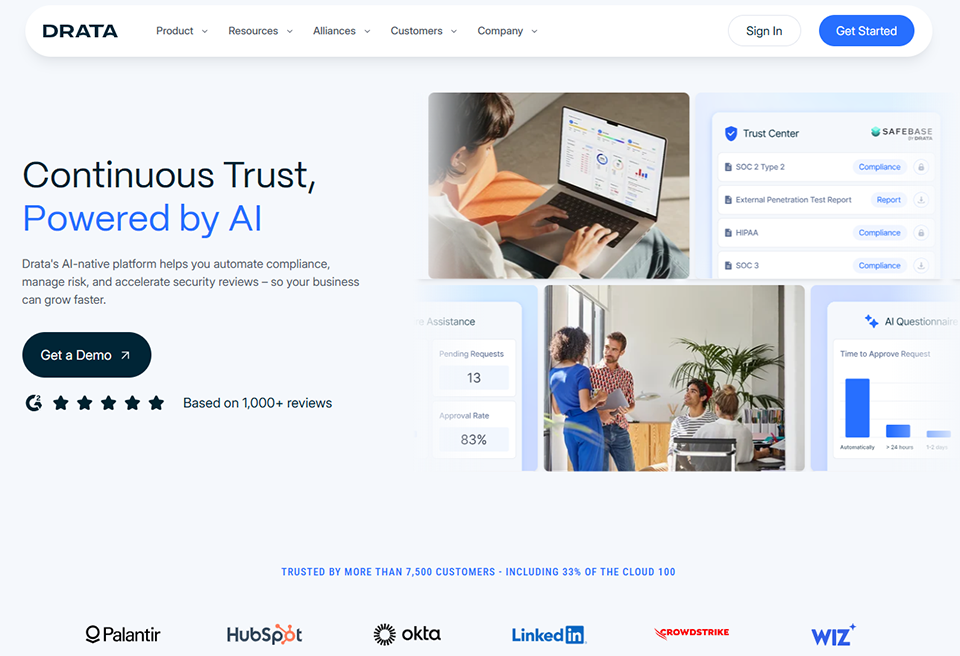
Drata is a U.S.-based continuous compliance management platform founded in 2020 that has quickly become one of the most widely adopted solutions in the SaaS and tech sectors. Its core value proposition: to automate the collection of evidence and the monitoring of security controls to prepare for audits (SOC 2, ISO 27001, HIPAA, GDPR, and many others) without spending weeks on the process.
In practice, Drata connects to your tech stack (AWS, GitHub, Google Workspace, Okta, Slack, Jira, etc.) via native integrations, then continuously monitors the status of your controls. You can see in real time whether your organization meets the requirements of a given framework, which areas are compliant, which pose risks, and where to focus your efforts ahead of an audit.
The tool is renowned for the quality of its interface, the breadth of its integrations (more than 75 native connectors), and the maturity of its platform: Drata has raised tens of millions of dollars and supports thousands of companies, including many hyper-growth startups that need certifications to secure their first major clients.
Drata is built around several complementary modules. Automated compliance monitoring is at the heart of the product: it continuously collects evidence of compliance (logs, configurations, access, policies) without requiring manual intervention. The Trust Center is a public page that you can share with your prospects or customers to show them your compliance status-a significant selling point.
The tool also includes a risk management module, a system for monitoring suppliers and subcontractors (which is important for GDPR compliance), as well as a library of ready-to-use security policies that you can adapt to your specific context.
The multi-framework management feature is particularly well-designed: if you need to meet both SOC 2 and ISO 27001 requirements at the same time, Drata automatically maps the overlaps between the two, eliminating the need to address the same requirements twice.
Drata uses a custom pricing model, which is common in this market segment. Publicly available information indicates that prices start at around $600 to $1,000 per month, depending on the size of the organization, the number of frameworks covered, and the level of support required. There is no freemium plan or public trial version.
The total cost can quickly add up if you include multiple frameworks, additional connectors, or licenses for a larger team. This makes it a solution better suited for startups in the scaling phase or tech companies that already have a dedicated budget for security and compliance.

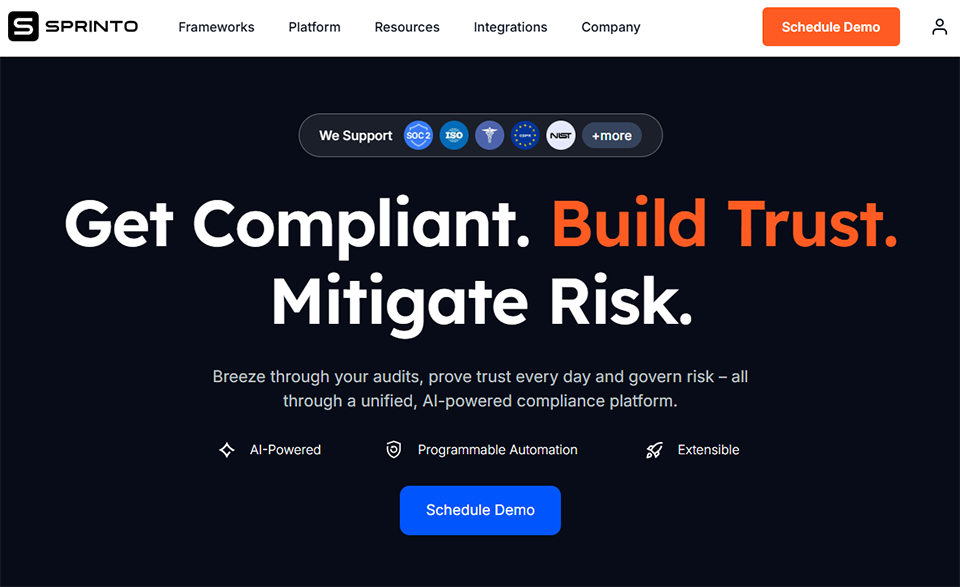
Sprinto is a compliance automation platform founded in 2020 in India, now operating in over 30 countries. It primarily targets SaaS startups and scale-ups seeking to obtain certifications (SOC 2, ISO 27001, HIPAA, GDPR, PCI-DSS, etc.) quickly and systematically, often to meet specific business requirements.
What sets Sprinto apart at first glance is its strong focus on business results: the tool highlights how quickly certifications can be obtained, audit success rates, and the ability to unlock business opportunities through compliance. The message is clear: Sprinto helps you certify your organization, and that certification opens doors for you.
Technically, Sprinto operates on the same automation principle as Drata: connecting to your cloud infrastructure and business tools, automatically collecting evidence, providing continuous monitoring, and offering a compliance dashboard. The platform is designed to be deployed and up and running quickly, with human support included in most plans.
At the heart of Sprinto is its automatic mapping engine, which aligns your existing controls with the requirements of target frameworks. From the moment you onboard, the platform assesses what’s already in place within your organization and clearly identifies the gaps that need to be addressed.
Sprinto includes a built-in employee training module (covering security awareness, phishing, and GDPR best practices), which is a real advantage for small organizations that lack a dedicated training program. Vendor and subcontractor management is also well handled, with a third-party risk assessment system.
One of Sprinto's unique features is the inclusion of human compliance advisors (known as "compliance success managers") in certain plans. These experts guide teams through the certification process, which can make a significant difference for teams without specialized expertise.
Trust Vault (the equivalent of Drata's Trust Center) allows you to share your compliance status with your partners and prospects.
Sprinto offers slightly more transparent pricing than Drata. Plans start at around $500/month for the first framework, with a tiered pricing structure if you add additional certifications. Pricing also varies depending on the size of the organization (number of employees, infrastructure scale).
There are specific plans available for early-stage startups, making this tool potentially more affordable during the seed stage than Drata. In any case, both tools fall within the same price range, and it’s worth requesting a customized quote.

Drata stands out for the depth of its technical coverage. The number of available integrations (more than 75 native connectors by 2025) is hard to match in the market. For organizations with complex, hybrid, or multi-cloud stacks-or those that use numerous third-party tools-this coverage is a major selling point.
Drata’s continuous monitoring is particularly sophisticated: the platform doesn’t just take a snapshot of your compliance status at the time of an audit; it constantly monitors and issues alerts as soon as compliance deteriorates. It’s an “as code” approach to compliance that technical teams appreciate.
One of the features most frequently used by Drata customers is the Public Trust Center, a dedicated page that centralizes your certifications, penetration test reports, security policies, and responses to security questionnaires. For B2B startups looking to speed up their sales cycles with large enterprises, it’s a real game-changer! Prospects can review your security posture on their own, without having to wait for a response to every inquiry.
Drata is particularly well suited for the following situations:
A company that has just signed its first enterprise contracts and needs to quickly obtain SOC 2 Type II certification. The platform makes it possible to streamline the process in a matter of weeks rather than several months of manual work.
And wants to avoid duplicating work. Drata’s cross-referencing of controls is very effective in this regard.
Anyone who wants to integrate compliance into their CI/CD workflows and take advantage of an API to further automate the process.
Sprinto has recognized that many startups don’t have a CISO, don’t have a full-time DPO, and don’t necessarily have the internal resources to manage an end-to-end certification project. Integrating compliance success managers directly into the platform (depending on the plan) is a real game-changer for these teams.
It’s not just about support. These consultants play an active role in the certification process: they help prioritize actions, answer complex questions, and prepare teams for audits. For an organization without in-house compliance expertise, this is often the difference between a successful project and one that gets bogged down.
Sprinto frequently highlights the speed of its certification process, and customer feedback seems to back up this claim. The platform was designed to minimize audit preparation time by automating repetitive tasks-such as collecting evidence, sending reminders, and updating policies-and guiding users through the process step by step.
Integrated employee training also saves a considerable amount of time: rather than searching for a training provider or creating your own modules, you have access to a program directly through the platform.
Sprinto is naturally suited for the following situations:
Organizations that have not yet established a compliance framework but are receiving requests from clients or investors to produce a SOC 2 or ISO 27001 report. Rapid implementation and personalized support are critical in this context.
Where SOC 2 is often a business requirement. Sprinto has extensive experience with this framework and a proven track record.
Who needs a guided solution rather than a highly flexible platform that is complex to configure.
On paper, the two tools look alike. This table highlights where the differences really matter.
| Criterion | Drata | Sprinto |
|---|---|---|
| Year founded | 2020 | 2020 |
| Primary target | Startups, scale-ups, and tech companies | Early- to mid-stage SaaS startups |
| Supported frameworks | SOC 2, ISO 27001, HIPAA, GDPR, PCI-DSS, and more | SOC 2, ISO 27001, HIPAA, GDPR, PCI-DSS, and more |
| Number of integrations | 75+ native integrations | Over 200 integrations (including via connectors) |
| Personalized support | Limited in standard plans | Compliance success managers included |
| Employee Training | Available | Integrated and well-developed |
| Trust Center / Trust Vault | ✅ Yes | ✅ Yes |
| Multi-framework | ✅ Native and very well treated | ✅ Available |
| Estimated price | ~$600 to $1,000 per month | ~$500/month (first framework) |
| Suitable for non-technical users | Method | Okay |
| Platform maturity | Very high | High |
Both tools essentially serve the same purpose: automating compliance, reducing the audit burden, and enabling you to demonstrate your security posture to your stakeholders. The real difference lies more in the profile of the team using them and the organization’s level of maturity.
Drata excels when you have a complex technical stack, a team with in-house security expertise, and a need to manage multiple certifications simultaneously. Sprinto shines when you’re looking to obtain certification quickly, need guidance, and don’t necessarily have the resources to manage this project in-house.
Two robust tools, but not suited for the same situations. Here’s how each one stacks up based on user profiles.
Who need to quickly generate enterprise-grade certifications to sign major contracts. The platform’s maturity and extensive integrations are well-suited for organizations that already have a well-established cloud infrastructure.
Able to make full use of the tool's capabilities, configure controls, and take advantage of continuous monitoring.
Organizations that manage SOC 2, ISO 27001, and GDPR simultaneously, and that want to avoid duplication of effort through cross-mapping of controls.
Who sell to large corporate clients and want to use the Trust Center as a selling point and to speed up the sales cycle.
Who are receiving their first compliance requests from clients or investors and need a tool to guide them through the entire process without requiring in-house expertise.
This is particularly true in the United States and the United Kingdom, where SOC 2 is often a prerequisite for moving forward in the procurement process.
Founders, operations managers, or legal professionals who need personalized guidance to navigate the complexities of regulatory frameworks.
And who need a comprehensive training program to educate their teams without having to hire an outside vendor.
💡 To discover other useful tools in the legal and compliance ecosystem, be sure to check out Axeptio (GDPR consent management) or Contractbook (contract management), two solutions available at a discount Freelance Stack.
Compliance raises a lot of questions, especially if you're not a lawyer or a CISO. Here are the most common ones.
Both tools treat the GDPR as a standalone framework. That said, their roots lie in the U.S. market, which means that SOC 2 often remains the most thoroughly documented framework within their interfaces. For pure GDPR compliance, both solutions are functional, but it may be helpful to specifically verify the available GDPR controls with their sales team before committing.
Yes, but with some differences. Sprinto is better suited for teams without dedicated technical staff, thanks to its hands-on support. Drata requires a basic understanding of security concepts to be used to its full potential. In both cases, a guided onboarding process is provided.
No, and it’s important to understand this clearly. These platforms automate compliance processes and streamline documentation, but they do not replace a DPO’s legal analysis or their ability to handle requests to exercise rights or manage a data breach. They are organizational and monitoring tools, not legal experts.
Timelines vary depending on the size of the organization and its initial level of maturity. With Sprinto, some clients report obtaining SOC 2 Type I certifications in 6 to 8 weeks. For a Type II certification (which requires a monitoring period of several months), expect a minimum of 4 to 6 months in both cases. The tool speeds up the preparation process, not the audit itself.
Yes, both tools support multi-framework mapping. Drata is particularly well-known for its cross-mapping capabilities, which prevent the same requirements from being processed twice when two frameworks share common controls (which is common between SOC 2 and ISO 27001, for example).
They are primarily designed for organizations with a cloud infrastructure and SaaS tools. An SME with a predominantly on-premises infrastructure or very specific tools may encounter limitations regarding available integrations. That said, Sprinto, in particular, has developed offerings tailored to small businesses, and both solutions remain relevant as long as you use common cloud services (AWS, Google Workspace, GitHub, etc.).
For organizations starting out with a limited budget, tools like Axeptio can address specific needs (consent management, cookie banners) at a lower cost. For comprehensive, automated compliance, Drata and Sprinto remain significant investments, which are primarily justified once you have clear contractual or regulatory obligations to meet.