







Axeptio or Cookiebot: Which cookie banner should you use on your website?
The cookie banner is far from being a mere formality: since the GDPR and the tightening of recommendations from…
Read more

Creating an online form or survey seems simple. And yet, when it comes time to choose a tool, the options multiply, the features all look the same on paper, and the real differences only become apparent once you start using them.
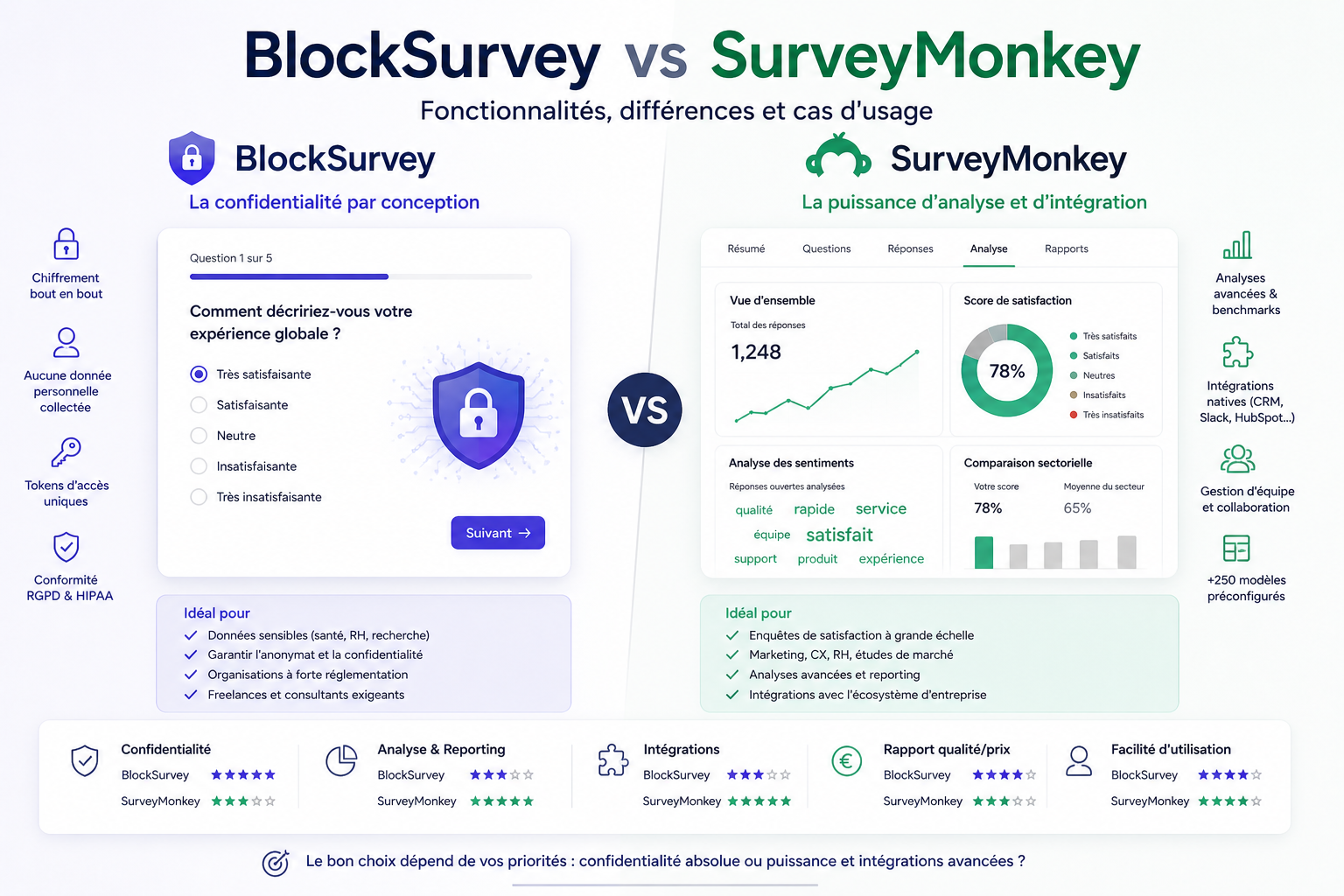
Everyone knows SurveyMonkey. It’s the long-standing industry standard that companies have been using for years. BlockSurvey, on the other hand, is a more recent alternative built on very different values: data privacy, transparency, and an architecture that deliberately limits the collection of information.
So, which one should you choose? The answer depends on what you actually do with your data, the type of organization you run, and how sensitive your surveys are. This article helps you see things clearly, without any fluff.

BlockSurvey is a platform for creating forms and surveys based on a principle that’s quite radical for the industry: your data doesn’t belong to them. Technically, the tool relies on the Stacks blockchain and end-to-end encryption, which means that not even BlockSurvey can access the collected responses. Only the form owner holds the decryption key.
This positioning is not merely a marketing ploy. It addresses a genuine market need, particularly in the healthcare, HR, and research sectors, as well as among organizations that collect sensitive data. BlockSurvey has also established itself as the preferred choice for organizations operating in highly regulated environments (GDPR, HIPAA).
BlockSurvey offers several plans, including a free plan that allows you to create up to 3 active forms. Paid plans start at around $29/month for entrepreneurs increase depending on the volume of responses and advanced features. A team plan is available for organizations that need multi-user collaboration.
Get the discountBenefit from a on BlockSurvey .20% off during 12 monthsFind our best discount right now with BlockSurvey and save on your software subscriptions. We offer over 850 promo codes and discounts on the best software and SaaS on the market.
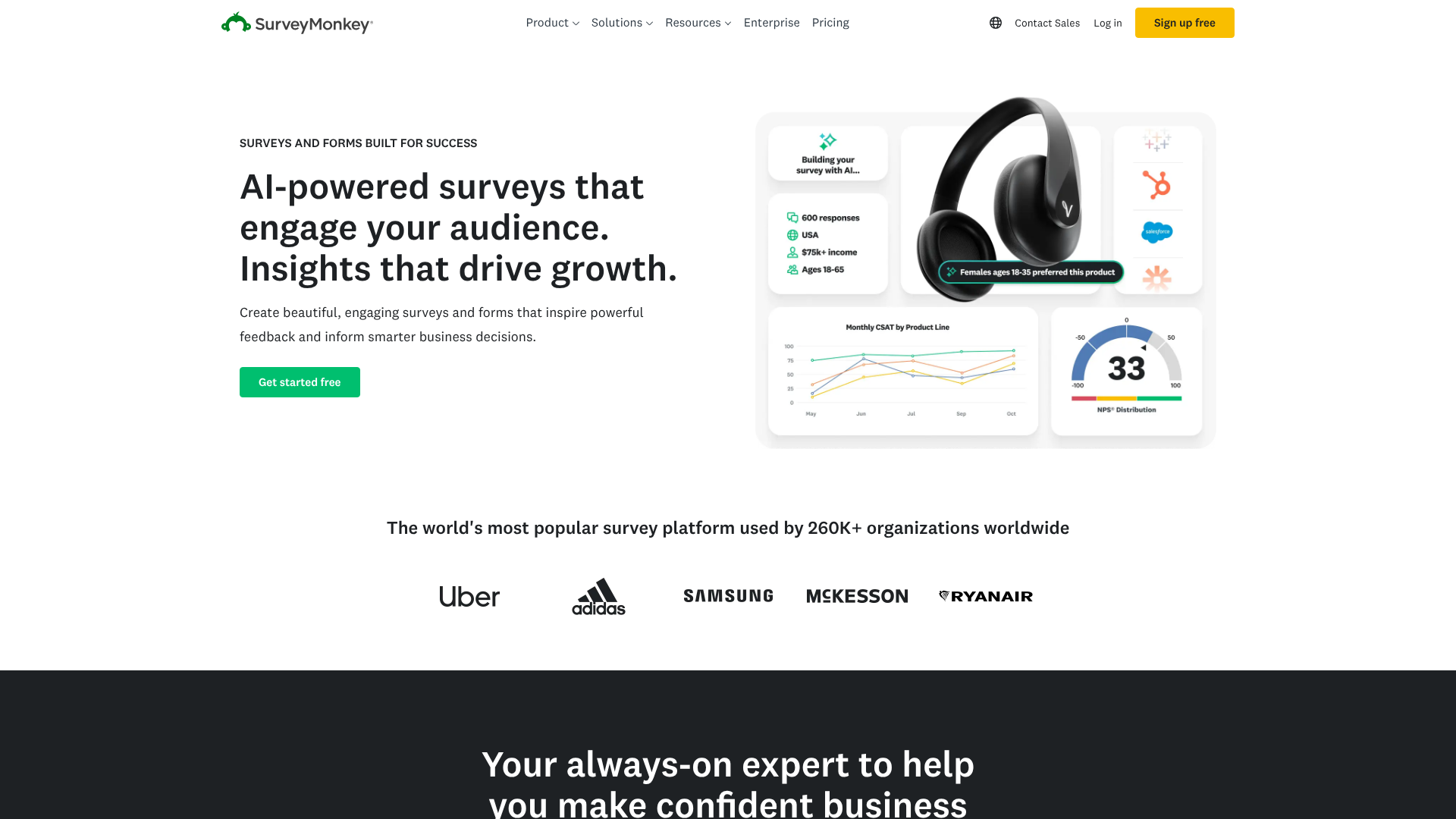
SurveyMonkey has been around since 1999. Acquired by Momentive in 2021 (before reverting to the SurveyMonkey brand), it is now one of the most widely used survey platforms in the world, with hundreds of millions of surveys created. It is so well-known that it is often used as a generic term for online survey tools.
The platform is designed to meet a wide range of needs: collecting customer feedback, conducting market research, HR surveys, satisfaction assessments, internal polls, and more. Although its interface is more feature-rich than that of some competitors, it remains accessible to non-technical users. SurveyMonkey has also expanded its analytics capabilities with benchmarking features and automated insights based on the collected data.
SurveyMonkey offers a very limited free plan (maximum of 10 questions per survey, maximum of 25 responses). Individual plans start at around €39/month (billed annually), and team plans are significantly more expensive. Annual billing is strongly encouraged, which can represent a substantial commitment.
Get the discountBenefit from a on SurveyMonkey .20% off on annual planFind our best discount right now with SurveyMonkey and save on your software subscriptions. We offer over 850 promo codes and discounts on the best software and SaaS on the market.
What fundamentally sets BlockSurvey apart from all its competitors is its technical architecture. End-to-end encryption isn’t an option you enable in the settings—it’s the default behavior. As a result, the data collected never travels in plain text through BlockSurvey’s servers. Even in the event of a data breach or a legal request, no readable data can be extracted.
For sectors such as academic research, mental health, human resources, and nonprofit organizations, this is a guarantee that few tools are able to offer.
BlockSurvey pays special attention to the respondent-facing interface. Forms are displayed one question at a time, which reduces the “wall of text” effect and significantly improves completion rates, especially on mobile devices. Visual customization (colors, images, typography) is accessible without being complex.
The tool also offers conversational forms, a format that feels more like a conversation than a traditional questionnaire. This type of interface is particularly effective for sensitive surveys or feedback questionnaires.
Conditional logic allows you to tailor the survey path in real time based on previous responses, which helps avoid irrelevant questions. BlockSurvey also includes unique access tokens, a useful feature for precisely controlling who can complete a form without having to create an account.
Native integrations are still more limited than those offered by SurveyMonkey, but Zapier and Make integrations allow you to connect most existing workflows. For developers, an API is available on higher-tier plans.
BlockSurvey is particularly well-suited for:
SurveyMonkey has had 25 years to refine its product, and it shows. The platform offers more than 250 pre-configured survey templates, organized by industry and purpose. When you need to create a questionnaire quickly without starting from scratch, that’s a significant advantage.
The variety of question types is also impressive: grids, rankings, slider questions, NPS, open-ended questions with automatic semantic analysis... SurveyMonkey supports complex survey structures without requiring any special technical skills.
While BlockSurvey takes a relatively straightforward approach to analysis, SurveyMonkey goes much further. Results are automatically displayed as charts, with options to filter by segment. The Sentiment Analysis feature automatically analyzes open-ended responses to identify trends.
For companies that regularly conduct satisfaction or market surveys, the ability to compare their results with built-in industry benchmarks is a real added value. This is something that few tools offer out of the box.
SurveyMonkey integrates natively with Salesforce, HubSpot, Slack, Microsoft Teams, Mailchimp, Google Sheets... The list goes on. For teams working in environments that are already well-equipped with SaaS tools, this is a deciding factor. Survey data can be fed directly into a CRM or trigger automated workflows without requiring a third-party tool.
Multi-user management is also more advanced on SurveyMonkey: differentiated permissions, shared workspaces, and real-time collaboration on surveys.
SurveyMonkey is the natural choice for:
✅ Native, irreversible end-to-end encryption, with no compromises.
✅ Well-designed, responsive interface; high completion rate on mobile.
✅ Effective conversational forms for sensitive topics.
✅ Unique access tokens to manage respondents.
✅ GDPR and HIPAA compliance built into the architecture itself.
✅ Affordable rates for entrepreneurs small businesses.
❌ Fewer native integrations than legacy solutions.
❌ More basic analytics and reporting features.
❌ Limited number of preconfigured templates.
❌ The learning curve may come as a surprise to users who are accustomed to traditional forms.
❌ The decentralized approach can be difficult to explain to non-technical clients.
✅ A very comprehensive platform with over 250 templates.
✅ Powerful built-in analytics, industry benchmarks, sentiment analysis.
✅ Native integrations with the leading tools on the market (CRM, marketing, HR).
✅ Advanced team and access rights management.
✅ High profile and extensive documentation (tutorials, support).
✅ Suitable for large-scale surveys.
❌ Data stored and accessible by SurveyMonkey (no end-to-end encryption).
❌ Very limited free plan (25 responses, 10 questions).
❌ High prices for team plans; annual billing is strictly required.
❌ The interface can sometimes feel cluttered with advanced features.
❌ Less suitable for uses that require complete confidentiality.
Here is a brief overview of the two tools to help you quickly assess each solution based on your priorities.
| Criterion | BlockSurvey | SurveyMonkey |
|---|---|---|
| Data Encryption | End-to-end (native) | Standard Encryption |
| Free map | ✅ Yes (3 forms) | ✅ Yes (very limited) |
| Admission fee (paid) | ~$29/month | ~39€/month |
| GDPR/HIPAA Compliance | ✅ Native architecture | ✅ Certified, but data is accessible |
| Conversational Forms | ✅ Yes | ⚠️ Limited |
| Preconfigured Models | Limited | +250 models |
| Native integrations | Limited (+ Zapier/Make) | A great many (Salesforce, HubSpot, etc.) |
| Analysis and Reporting | Basic | Advanced (sentiment analysis, benchmarks) |
| Team Management | Available | Very well-crafted |
| Primary target | Privacy, Sensitive Data | Business, Marketing, HR |
⚠️ The pricing information above is for reference only. Please check the official websites for the most up-to-date prices.
If your business involves collecting medical, psychological, legal, or human resources-related information, BlockSurvey is the obvious choice. The confidentiality guarantee is not a configurable option—it is built into the very architecture of the product. No administrator, third party, or service provider can access the responses. This is structurally different from simply “being GDPR-compliant.”
For marketing, CX, or HR teams that handle large volumes of responses and need automated analytics, benchmarks, and CRM integrations, SurveyMonkey holds its own. Its rich set of analytics features and mature integrations make it a solid choice for structured enterprise use cases.
If you offer services to clients who value privacy or if you work in regulated industries, BlockSurvey will give you a competitive edge. If, on the other hand, you need to quickly create a variety of surveys with minimal hassle, SurveyMonkey will be more versatile thanks to its many templates.
It all depends on your data. If you mainly collect product feedback or leads, SurveyMonkey covers most of your needs. If you have a strong CSR initiative or if your customers are asking for assurances regarding data management, BlockSurvey can become a selling point in its own right.
BlockSurvey is by far the best option. The anonymity guaranteed by its architecture, unique access tokens, and HIPAA compliance perfectly meet the requirements of ethics committees and research protocols.
Here are some frequently asked questions about BlockSurvey and SurveyMonkey that go beyond a simple comparison of features.
Yes, and the difference is structural. With BlockSurvey, the data is encrypted before it even reaches their servers. Not even the BlockSurvey team can read it. With SurveyMonkey, the data is protected but accessible to the platform’s administrators. This isn’t a judgment on SurveyMonkey’s practices—it’s a reputable platform—it’s simply a difference in architecture.
Yes. SurveyMonkey is GDPR-compliant and offers features to help European companies meet their obligations (right to be forgotten, option to store data in Europe). BlockSurvey is also compliant, but takes a different approach: privacy is guaranteed through technical measures, not just contractual commitments.
With SurveyMonkey, anonymity is configurable but relies on a promise: the platform does not collect certain information if you enable the anonymous option. With BlockSurvey, anonymity is technically guaranteed: even if someone wanted to identify respondents, the data does not allow it.
There are other solutions worth mentioning depending on your needs: SurveySparrow stands out for its well-designed conversational interface and customer satisfaction features (NPS, CSAT). Drag'n Survey is a French option that may be of interest to organizations looking for a locally hosted tool. These alternatives are worth exploring depending on your specific situation.
It depends on what you're collecting for your clients. If your surveys cover sensitive topics (HR, internal organization, health), BlockSurvey is a strong professional choice. If, on the other hand, you need to quickly create a variety of satisfaction surveys with built-in reporting, SurveyMonkey will be more effective for day-to-day use.
SurveyMonkey creates responsive forms, but the mobile experience can be overwhelming for long surveys. BlockSurvey, with its question-by-question format, is inherently better suited for mobile and generally achieves higher completion rates on that platform.
Yes, both tools offer this feature, but with varying levels of sophistication. SurveyMonkey provides more advanced translation options and natively supports a wider range of languages. BlockSurvey also allows you to create multilingual forms, which is sufficient for most purposes.
SurveyMonkey strongly encourages annual billing, offering discount compared to monthly billing. BlockSurvey also offers attractive annual plans but with more flexibility on its entry-level plans. In both cases, a free plan allows you to try the service before committing.