The 6 Best European Cloud Providers for Startups That Want to Keep Their Data in Europe.
This article reviews the 6 best options for startups, entrepreneurs small teams looking to build a robust infrastructure without compromising their data sovereignty.
Why is hosting your data in Europe no longer an option?
Since the GDPR took effect in 2018, the issue of data sovereignty has evolved from a marketing talking point to a legal requirement. Yet, a majority of startups and small businesses continue to host their infrastructure with American tech giants, often out of habit or for the sake of convenience. AWS, Google Cloud, Azure: these platforms are powerful, well-documented, and ubiquitous in technical startup guides. It’s hard to fault them for existing.
The problem is that since the 2020 Schrems II ruling and the recent geopolitical tensions surrounding the U.S. CLOUD Act, the legal landscape has become significantly more complex. Hosting in the United States or through an entity subject to U.S. law-even if the servers are physically located in Europe-potentially exposes your data to extraterritorial access requests. For a startup that handles personal data from European customers, this is a real risk, not just a theoretical one.
And then, beyond compliance, there is another reality: the European cloud ecosystem has become deeply established in recent years. Alternatives exist; they are competitive, and several of them have been designed specifically to meet the needs of companies that want to retain control over their data. Scaleway, OVH, Clever Cloud, Infomaniak, Proton Drive, and Platform.sh each have their own strengths, use cases, and unique positioning.
This article reviews the 6 best options for startups, entrepreneurs small teams looking to build a robust infrastructure without compromising their data sovereignty.
#1 - Scaleway: The French technical cloud, tailored for teams that know what they're doing.
Scaleway is one of must-have French sovereign cloud must-have . A subsidiary of the Iliad Group (the parent company of Free), the platform started out as a traditional hosting provider before transforming into a full-fledged cloud provider with a service offering that now seriously competes with the American giants in several segments.
What sets Scaleway apart is the breadth of its technical offerings. This isn’t just about server hosting: the platform provides compute instances (including GPUs for AI workloads), S3-compatible object storage, managed databases, Kubernetes, serverless functions, container registries, and even offerings specifically designed for training machine learning models. The entire infrastructure is hosted in data centers in France and the Netherlands, which are ISO 27001 certified and GDPR compliant.
Key features :
Computing instances (General Purpose, CPU Optimized, GPU).
Startup credits: available to startups through the Scaleway Startup program.
Prices are generally lower than those of AWS or GCP for equivalent configurations, which is a real advantage for growing startups. The console is user-friendly, the technical documentation is high-quality, and the API is well-designed.
👤 Who is this for?
Scaleway is primarily aimed at technical teams: developers, DevOps professionals, and SaaS startups in need of scalable infrastructure. If you’ve already worked with AWS or GCP and are looking for a European alternative without having to start from scratch, Scaleway is likely the most natural choice. S3 compatibility also makes it easy to migrate from Amazon.
It is also an excellent option for AI/ML projects that want to take advantage of GPUs at competitive prices without relying on U.S. infrastructure.
👍 Strengths:
100% European infrastructure (France, Netherlands).
A comprehensive technical catalog that is constantly expanding.
Competitive pricing, particularly for compute and storage.
S3 compatibility to facilitate migrations.
Startup program with dedicated funding.
👎 Cons:
Less suitable for non-technical users (no "turnkey" interface).
The managed services ecosystem remains less extensive than that of AWS or GCP.
Customer support is sometimes reported to be slow at the entry level.
Benefit from a on Scaleway .
€500 in credits
Find our best discount right now with Scaleway and save on your software subscriptions. We offer over 850 promo codes and discounts on the best software and SaaS on the market.
#2 - OVH Public Cloud: The European giant, for those looking for a large-scale cloud partner.
OVH is Europe’s leading cloud provider in terms of capacity and revenue. With over 400,000 servers deployed and a presence in more than 140 data centers worldwide (a large number of which are in Europe), the Roubaix-based group is a must-have partner must-have businesses looking to scale up without leaving Europe.
The OVH Public Cloud offering is built on OpenStack, the widely adopted open-source platform in the industry, which simplifies migrations and minimizes vendor lock-in. It includes all the components needed for a modern cloud infrastructure: compute instances, object storage, managed databases, Kubernetes, streaming, AI, and more.
Key features :
Computing resources: General Purpose, CPU, Memory, GPU.
Advanced networking (VPC, load balancers, CDN, IP failover).
Cold Archive for long-term storage.
AI & Machine Learning Tools.
Pricing:
Rates: starting at ~€0.006 per hour.
Object Storage: starting at €0.0118/GB/month.
Managed databases: starting at ~€10/month.
Pay-as-you-go billing: a simulator is available on the website.
OVH also offers a startup program (OVH Startup) that provides cloud credits worth up to several thousand euros for eligible startups.
👤 Who is this for?
OVH Public Cloud is suitable for a wide range of users, from entrepreneurs developers entrepreneurs technical teams at SMEs and startups. The robustness of the infrastructure and the diversity of available services make it a reliable option for ambitious projects that anticipate scaling up. It is also the preferred choice for companies with strict regulatory requirements (healthcare, finance, public sector) that need HDS- or SecNumCloud-certified hosting.
If you’re looking for a cloud partner that will still be around in 10 years and can support your business’s growth over the long term, OVH is hard to ignore.
👍 Strengths:
A largely European infrastructure, with data centers in France, Germany, Poland, the UK, and other countries.
The management interface (customer portal) is sometimes considered complex by those unfamiliar with it.
The quality of support varies depending on the contract level.
A few historical incidents (notably the Strasbourg fire in 2021) have occasionally tarnished its reputation for reliability.
Benefit from a on OVH Public Cloud .
€150 offered on any plan
Find our best discount right now with OVH Public Cloud and save on your software subscriptions. We offer over 850 promo codes and discounts on the best software and SaaS on the market.
#3 - Clever Cloud: The French PaaS that frees you from infrastructure management.
Clever Cloud occupies a unique position in the market: it isn’t really an IaaS (Infrastructure as a Service) like Scaleway or OVH, but rather a PaaS (Platform as a Service) designed so that developers no longer have to worry about infrastructure. You deploy your code, and Clever Cloud takes care of the rest: automatic scaling, high availability, backups, and security updates.
The company is based in Nantes, its data centers are located in France (with options in Europe), and it is one of the few to have obtained ANSSI’s SecNumCloud certification, making it the solution of choice for organizations with strict digital sovereignty requirements (the public sector, operators of critical infrastructure, and companies handling sensitive data).
The absence of egress fees is a factor that is often overlooked: with AWS or GCP, outbound data transfers can account for a significant portion of the bill. With Clever Cloud, this is not the case.
👤 Who is this for?
Clever Cloud is ideal for developers and startups who want to focus on their product rather than managing infrastructure. If your team is small, you don’t have a dedicated DevOps team, and you want a simple and reliable deployment without sacrificing data sovereignty, this is likely one of the best options on the market.
It is also the go-to solution for French public and quasi-public entities that require a SecNumCloud-certified cloud.
👍 Strengths:
ANSSI SecNumCloud certification (rare and valuable).
A PaaS designed to simplify deployment: ideal for teams without a DevOps team.
No data export fees.
True automatic scalability.
100% hosted in France.
👎 Cons:
Less flexible than a pure IaaS solution if you have specific infrastructure requirements.
A more limited range of services than Scaleway or OVH.
Slightly higher prices for equivalent configurations (but the actual cost in terms of DevOps time is often offset).
Benefit from a on Clever Cloud .
90% off during 3 months
Find our best discount right now with Clever Cloud and save on your software subscriptions. We offer over 850 promo codes and discounts on the best software and SaaS on the market.
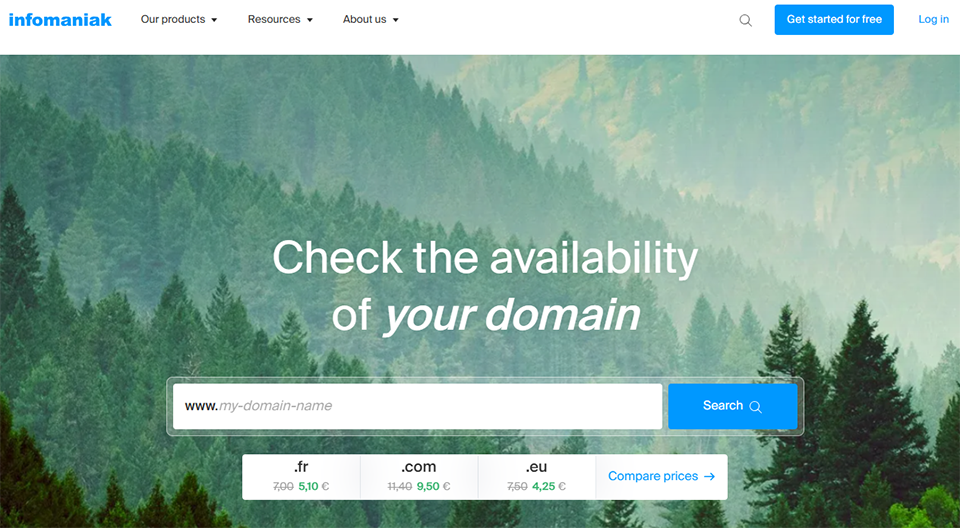
#4 - Infomaniak: The ethical Swiss cloud, where privacy is non-negotiable.
Benefit from our free deal on Infomaniak.
10% off on annual plan
Find over 300 free deals as well as over 850 Premium deals right now with Infomaniak and save on your software subscriptions. Whether you're an entrepreneur, a startup or a solo freelancer, save hundreds of euros thanks to our discounts and promo codes.
Infomaniak is a Swiss company founded in 1994 that has built a solid reputation based on two pillars: data privacy and environmental commitment. All of its data centers are located in Switzerland, one of the world’s most protective jurisdictions when it comes to personal data. Switzerland is not a member of the EU, but it is recognized by the European Commission as providing an adequate level of protection (adequacy decision), making it compliant with the GDPR.
on plan its product offerings, Infomaniak provides both traditional cloud services (web hosting, domains, email) and a more technical cloud portfolio that has expanded in recent years: storage, cloud servers, Kubernetes, and a suite of collaboration tools (kDrive, kSuite) that positions itself as an alternative to Google Workspace or Microsoft 365.
Key features :
Web hosting and VPS cloud services.
kDrive: Secure cloud storage with file sharing.
kSuite: collaborative suite (email, calendar, documents, video, chat).
Managed Kubernetes (Swiss Kubernetes).
Dedicated cloud servers.
Domains and SSL certificates.
Infomaniak AI Tools (generative AI hosted in Switzerland).
Pricing:
kDrive plan: starting at €4.23/month (2 TB included).
Web hosting: starting at ~$5/month.
Cloud servers: starting at ~$14/month.
Pricing: kSuite starting at ~$4.86 per user per month.
Infomaniak has also been committed to carbon neutrality since 2021 and powers its data centers entirely with renewable energy, making it an attractive choice for companies with ambitious CSR policies.
👤 Who is this for?
Infomaniak is particularly well-suited for freelancers, small businesses, and startups looking for an all-in-one solution: web hosting, professional email, storage, and collaboration-all within a single ecosystem-without relying on Google or Microsoft. It’s also the right choice for industries that handle sensitive data (legal, medical, financial) and for which Swiss jurisdiction offers a real competitive advantage.
Teams that aren't purely technical but need simple, well-integrated collaboration tools will find kSuite to be a serious alternative to American solutions.
👍 Strengths:
The Swiss legal system is among the most protective in the world.
Strong commitment to the environment (100% renewable, carbon-neutral).
An interface that is easy for non-technical users to use.
👎 Cons:
The technical cloud offering (IaaS) is less mature than Scaleway or OVH.
Fewer advanced managed services (no GPUs, few AI options on the infrastructure side).
Support is primarily available in French, English, and German (less suitable for international teams using less common languages).
Benefit from a on Infomaniak .
additional 20% off on any plan
Find our best discount right now with Infomaniak and save on your software subscriptions. We offer over 850 promo codes and discounts on the best software and SaaS on the market.
Find over 300 free deals as well as over 850 Premium deals right now with Proton Drive and save on your software subscriptions. Whether you're an entrepreneur, a startup or a solo freelancer, save hundreds of euros thanks to our discounts and promo codes.
Proton originated in the world of secure email (Proton Mail, launched at CERN in 2014) and has gradually expanded its ecosystem to meet all the digital needs of privacy-conscious professionals. Proton Drive is the cloud storage service within this suite, and it stands out with a strong promise: end-to-end encryption on all files, including metadata.
In practical terms, not even Proton’s own teams can access the contents of your files. This is a “zero-knowledge” architecture that goes further than what most competitors offer, including some European providers. All servers are located in Switzerland.
The offering was expanded in 2024 and 2025 with the addition of collaborative features: secure file sharing, version control, shared folders with access controls, and a desktop app available on Windows, macOS, and Linux.
Secure file sharing with password-protected links.
File version control.
Desktop applications (Windows, macOS, Linux) and mobile applications (iOS, Android).
Integrated into the Proton ecosystem: Mail, Calendar, VPN, Pass, Docs, Sheets.
Servers located exclusively in Switzerland.
An open-source protocol that has been independently audited.
Pricing (via Proton plans):
Free Plan: 1 GB included.
Unlimited Plan: ~€9.99/month (500 GB, access to the entire Proton suite).
Business Plan: starting at ~€6.99 per user per month.
Visionary and Family plans are available.
Note that with a Proton Unlimited subscription, you get access to Proton Mail, Proton VPN, Proton Calendar, Proton Pass, and Proton Docs in addition to storage, which offers excellent value for money as a replacement for many Google tools.
👤 Who is this for?
Proton Drive is designed for users who prioritize privacy above all else: journalists, lawyers, healthcare professionals, as well as any entrepreneur who simply wants to maintain control over their data without worrying about who has access to it. It’s also an excellent choice for freelancers and small teams looking to migrate away from Google Drive or Dropbox with maximum security.
The "all-in-one suite" approach (email + VPN + storage + calendar + password manager) makes it a comprehensive solution for those who want to streamline their tech setup while enhancing their security.
👍 Strengths:
End-to-end encryption for all files (zero-knowledge architecture).
Swiss jurisdiction.
Comprehensive integrated suite (email, VPN, calendar, documents, passwords).
Open source and independently audited.
Competitive pricing given the included bundle.
👎 Cons:
Not an infrastructure cloud: no compute instances, no databases, no Kubernetes.
Real-time collaboration is still in its early stages compared to Google Drive.
Less storage space on entry-level models.
Benefit from a on Proton Drive .
Additional 25% off on annual plan
Find our best discount with Proton Drive and save on your software subscriptions. We offer over 850 promo codes and discounts on the best software and SaaS on the market.
#6 - OVH Platform.sh: The go-to PaaS for development teams looking for reproducible environments.
Platform.sh is a PaaS platform acquired by OVH in 2021 that has since established itself as one of the most advanced solutions for development teams requiring fully consistent preview, staging, and production environments. The core concept: each Git branch corresponds to an isolated deployment environment, complete with its own database, services, and environment variables.
This tool is designed for teams that work collaboratively-specifically, teams with multiple developers, review cycles, and the need to test features in isolation before merging them into production. The underlying infrastructure is hosted by OVH, which is based in Europe, and complies with GDPR requirements.
Key features :
Deployment environments by Git branch (preview environments).
Production Plan: starting at ~€50/month (depending on resources).
Free trial available.
The pricing is higher than that of a standard VPS, but this is the cost of a managed platform that saves you a considerable amount of time in managing environments.
👤 Who is this for?
Platform.sh is the right choice for mid-sized web development teams: 2 to 15 developers working on a complex project, with regular release cycles and a need for consistency across environments. It is particularly popular among web agencies, teams maintaining Symfony, Laravel, Drupal, or Magento applications, and startups that have moved beyond the MVP stage and need to structure their deployment workflow.
If you're working alone or on a simple project, Platform.sh is probably overkill. But for a team of five or more developers, it's an infrastructure that really streamlines day-to-day operations.
👍 Strengths:
Preview environments by Git branch: a significant advantage for teams.
A wide range of managed services available.
Zero-downtime deployments.
Hosting by OVH (Europe, GDPR).
Excellent support for popular PHP frameworks (Symfony, Drupal).
👎 Cons:
Higher prices than simpler IaaS or PaaS alternatives.
There is a significant learning curve (configuring the system via YAML files can be confusing).
Less suitable for non-web projects (data workloads, AI, etc.).
Benefit from a on OVH Platform.sh .
Find our best discount right now with OVH Platform.sh and save on your software subscriptions. We offer over 850 promo codes and discounts on the best software and SaaS on the market.
Here are a few frequently asked questions to help you make an informed decision before choosing your infrastructure.
1️⃣ Is the European cloud really more secure than American solutions?
The technical security (encryption, firewalls, certifications) of major U.S. providers is generally up to par. That’s not where the difference lies. The real issue is legal certainty: a provider subject to the U.S. CLOUD Act could theoretically be compelled to hand over your data to U.S. authorities, even if your servers are physically located in Europe. A European provider, subject solely to European law, offers different safeguards. For sensitive data, this distinction is far from trivial.
2️⃣ GDPR and the cloud: what are the basic rules to follow?
The GDPR requires that the personal data of European citizens be processed in accordance with its rules, regardless of where it is hosted. However, it also imposes strict restrictions on data transfers outside the EEA (European Economic Area). Hosting your data with a European provider allows you to avoid having to manage these transfer restrictions and significantly simplifies your compliance efforts.
3️⃣ IaaS or PaaS: What’s the practical difference for a startup?
IaaS (Infrastructure as a Service) gives you access to raw resources: servers, storage, and networking. You retain full control, but you must manage configuration, updates, and scalability yourself. A PaaS (Platform as a Service) abstracts all of that: you deploy your code, and the platform handles the underlying infrastructure. For a startup without a dedicated DevOps team, PaaS often represents the best balance between cost, simplicity, and reliability.
4️⃣ What is the SecNumCloud certification, and why is it important?
SecNumCloud is a certification issued byANSSI (the French National Cybersecurity Agency), France’s leading authority on cybersecurity. It is the gold standard for sovereign cloud services in France and is required, in particular, for hosting sensitive data in the public and quasi-public sectors. To date, very few providers have obtained this certification: Clever Cloud is one of them, which gives it a unique position in the market.
5️⃣ Is migrating to a European cloud complicated?
It depends on your current architecture. If you use services that are very specific to AWS (Lambda, DynamoDB, etc.), the migration may require significant customization. On the other hand, if you use standard services (compute, S3-compatible object storage, traditional databases), most European providers have designed their offerings to facilitate this migration. Scaleway and OVH, in particular, have worked on S3 and OpenStack compatibility specifically to reduce the cost of switching.
6️⃣ Can we use multiple European cloud services at the same time?
In fact, it’s often recommended. A multi-cloud strategy might involve, for example, hosting your core infrastructure with Scaleway or OVH, your collaboration tools with Infomaniak or within the Proton ecosystem, and your application deployments via Clever Cloud or Platform.sh. Diversification helps avoid vendor lock-in and improves overall resilience.
7️⃣ Are European cloud services really cheaper?
The honest answer: not always, but often yes when comparing equivalent configurations, particularly in terms of computing and storage. What is certain is that hidden costs (data egress fees, support costs, and additional GDPR compliance costs associated with non-European hosting) often tip the scales in favor of local providers when you look at the big picture.
Tags
DataStorageCloud: HostingSovereign CloudScalewayOVH Public CloudClever CloudInfomaniakProton DriveOVH Platform.sh