15 Software Tools to Help Salespeople Close Deals in 2026
This article reviews 15 must-have software solutions in 2026 to optimize the entire sales cycle: from initial prospecting through to contract signing, including lead qualification, pipeline management, and call analysis. Each tool was selected because it addresses a specific need in the sales process.
Why Does Your Sales Stack (Really) Make a Difference?
The closing process is often what separates a good year from an excellent one. And while people skills remain at the heart of sales, the tools used are playing an increasingly critical role in the performance of sales teams.
In 2026, a salesperson without a solid sales stack is a bit like a chef without sharp knives: they can still cook, but they’ll waste precious time at every step. The best salespeople aren’t necessarily the ones who work the hardest, but the ones who know how to focus their energy on the right prospects, at the right time, with the right arguments.
The numbers speak for themselves: according to a Salesforce study, sales representatives spend, on average, only 28% of their time on actual selling. The rest is spent on administrative tasks, searching for information, updating data… all activities that the right tools can automate or streamline significantly.
This article reviews 15 must-have software solutions in 2026 to optimize the entire sales cycle: from initial prospecting through to contract signing, including lead qualification, pipeline management, and call analysis. Each tool was selected because it addresses a specific need in the sales process.
Whether you're a freelancer working on your own, a five-person sales team at a startup, or a sales director looking to streamline your processes, you'll find solutions here that are tailored to your situation.
#1 – Pipedrive: The CRM that thinks like a salesperson.
Pipedrive is probably the most popular CRM among mid-sized sales teams, and that’s no coincidence. Designed from the ground up by salespeople for salespeople, it puts pipeline management at the center of the user experience rather than overwhelming the user with complex analytical dashboards.
The Kanban interface lets you instantly see where each opportunity stands in the sales cycle. You move deals from one column to another, see which ones need follow-ups, and identify deals that have stalled. It’s simple, visual, and naturally encourages action.
Among the features that really make a difference are the AI sales assistant that suggests next steps, follow-up automations (reminders, scheduled emails, automated tasks), and sales forecast reports that provide real insight into future revenue. Pipedrive also integrates with hundreds of third-party tools, making it a central hub that easily connects to the rest of your tech stack.
Pricing:
Essential Plan: €14/month/user.
Advanced Plan: €29/month/user.
Professional Plan: €59/month/user.
Power Plan: €69/month/user.
Enterprise Plan: €99/month/user.
👤 Who is this for?
Sales teams of 2 to 50 people who want a pipeline-focused CRM without spending weeks setting it up. Ideal for growing startups and small and medium-sized businesses that need to structure their sales processes without a heavy IT infrastructure. Less suitable for very large organizations with complex CRM needs and custom workflows.
✅ The benefits:
Intuitive interface, quick to learn (you'll be up and running in less than an hour).
Highly efficient pipeline visualization.
Built-in AI assistant to suggest next steps.
A robust library of integrations.
👎 The downsides:
Marketing features are fairly limited compared to HubSpot.
Customizable reports are available only on higher-tier plans.
Customer support can sometimes be slow for entry-level plans.
Benefit from a on Pipedrive.
30% off on any plan during 12 months
Find our best discount right now with Pipedrive and save on your software subscriptions. We offer over 850 promo codes and discounts on the best software and SaaS on the market.
#2 – HubSpot: The comprehensive ecosystem for teams that want to centralize everything.
HubSpot has achieved something rare: building a platform that spans from marketing acquisition to customer service, including sales, without it feeling like a software Frankenstein. The Sales Hub, in particular, has become a benchmark for teams looking to align marketing and sales around a single source of truth.
In practical terms, HubSpot lets you track the entire customer journey: from the first click on a blog post to the signing of the contract. For a sales representative, this means knowing exactly which pages a prospect has visited, which emails they’ve opened, and which content they’ve downloaded—even before the first call. This information radically improves the quality of sales conversations.
The Sales Hub's key features: automated email sequences, real-time tracking of opens and clicks, integrated meeting scheduling, lead scoring, and increasingly sophisticated AI for drafting emails and analyzing deals.
Pricing:
Free Plan: Basic features, unlimited CRM.
Starter Plan: starting at €15/month/user.
Pro Plan: starting at €90/month/user.
Enterprise Plan: starting at €150/month/user.
👤 Who is this for?
Companies that have a true inbound strategy and want their marketing and sales teams to work on the same platform. It’s especially well-suited for growing organizations that need scalability. The free version is also an excellent option for getting started without a financial commitment.
Extremely thorough behavioral tracking of prospects.
An exceptional community and training resources.
👎 The downsides:
Upgrading can quickly become expensive.
Some advanced features are available only on Pro and Enterprise plans.
May be oversized for teams of 1 to 3 people.
Benefit from a on HubSpot.
90% off during 1 year
Find our best discount right now with HubSpot and save on your software subscriptions. We offer over 850 promo codes and discounts on the best software and SaaS on the market.
#3 – Close: The CRM tailored for high-volume teams.
Benefit from our free deal on Close.
20% off on annual plan
Find over 300 free deals as well as over 850 Premium deals right now with Close and save on your software subscriptions. Whether you're an entrepreneur, a startup or a solo freelancer, save hundreds of euros thanks to our discounts and promo codes.
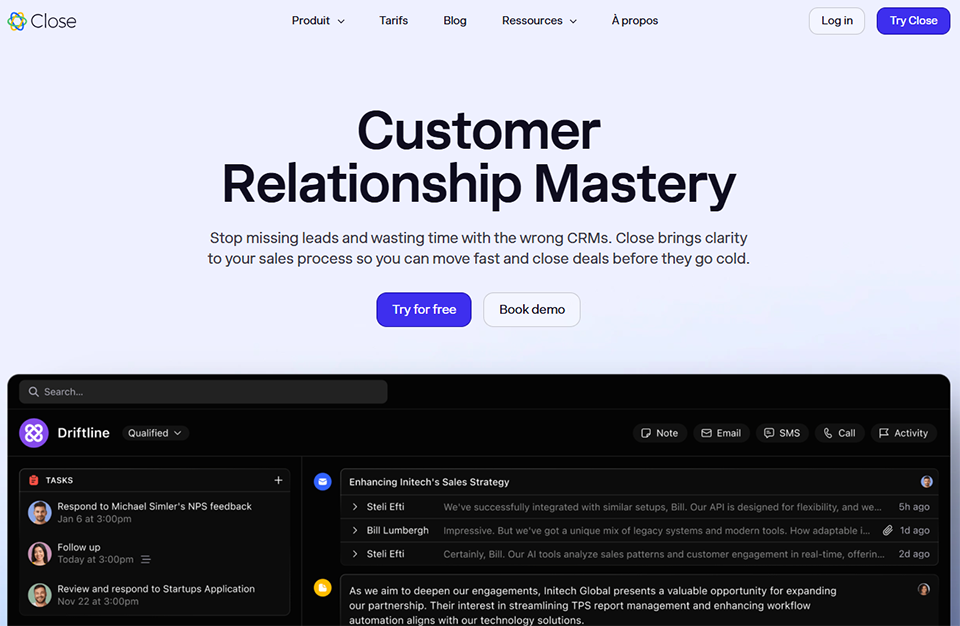
Close is probably the least well-known CRM among the general public, but it has a solid reputation among sales teams that make a lot of calls and do a lot of cold outreach. Its philosophy is simple: anything that wastes a salesperson’s time should be automated or streamlined. The result is an incredibly streamlined interface focused on the actions that need to be taken.
What sets Close apart is its integrated communication system. Phone calls, text messages, emails—everything is handled through the interface, with automatic call recording, AI transcription, and suggested responses. For teams that make hundreds of calls a week, this saves a tremendous amount of time.
Automated workflows allow you to precisely define what to do after each action (lead created, unanswered call, email opened, etc.), ensuring systematic follow-ups without any manual effort. The search engine is also particularly powerful for finding and segmenting leads.
Pricing:
Startup Plan: $49/month (up to 3 users).
Professional Plan: $99/month/user.
Enterprise Plan: $139/month/user.
👤 Who is this for?
Teams that engage in intensive cold calling, SaaS sales, or remote sales with short cycles. Particularly well-suited for startups in the traction phase that need a tool built around pace and volume. Less suitable if your sales process is long and complex, involving many stakeholders.
✅ The benefits:
Natively integrated communication (calls, text messages, email).
Ultra-minimalist interface, zero friction.
Highly effective automated follow-up systems.
Call transcription and AI analysis.
👎 The downsides:
It has fewer marketing features than HubSpot.
Pricing in dollars, which is less competitive for small teams.
Learning curve for advanced workflows.
Benefit from a on Close.
An additional 20% off on annual plan
Find our best discount right now with Close and save on your software subscriptions. We offer over 850 promo codes and discounts on the best software and SaaS on the market.
#4 – Folk: The next-generation CRM for modern teams.
Benefit from our free deal on Folk.
20% off on annual plan
Find over 300 free deals as well as over 850 Premium deals right now with Folk and save on your software subscriptions. Whether you're an entrepreneur, a startup or a solo freelancer, save hundreds of euros thanks to our discounts and promo codes.
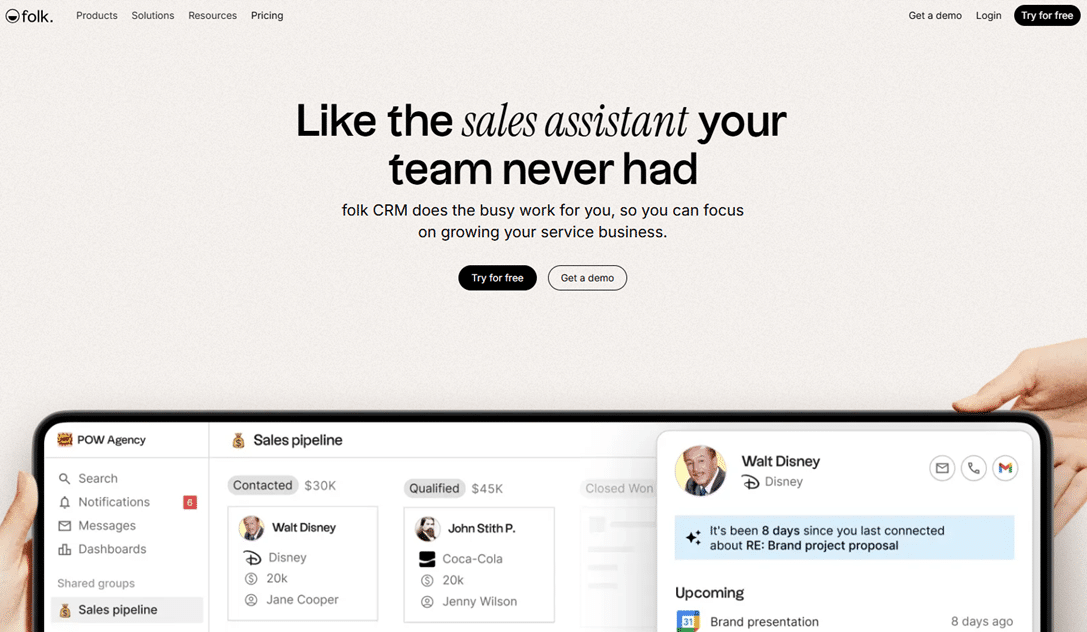
Folk is a hidden gem from France that has established itself as the modern alternative to traditional CRMs. Its positioning is clear: a flexible tool, similar to a collaborative database like Notion, but designed for relationship management and sales tracking. The interface is clean, interactions are seamless, and you can tell the product was designed by people with an eye for aesthetics.
What really sets Folk apart is its ability to adapt to any type of relationship: clients, partners, investors, and candidates. It works like a smart address book onto which you can apply your own data structures. The Chrome extension lets you import contacts from LinkedIn in just a few seconds, which significantly speeds up the sourcing process.
Email sequences can be personalized with AI-generated dynamic variables, and the tool provides tracking of interactions (opens, clicks) to gauge prospect engagement.
Pricing:
Standard Plan: €20/month/user.
Premium Plan: €40/month/user.
Custom Plan: Price upon request.
👤 Who is this for?
Founders, business developers, independent professionals, and small teams looking for a lightweight, flexible CRM that’s a pleasure to use every day. Excellent for people who juggle multiple types of relationships (clients, partners, network). Less suitable if you need advanced sales reporting or complex team management.
✅ The benefits:
An exceptionally well-designed interface.
Very effective LinkedIn import via the Chrome extension.
Flexibility of data structures.
AI for email personalization.
👎 The downsides:
Reporting features are still limited.
Less advanced than Pipedrive or HubSpot in terms of advanced features.
Third-party integrations are still under development.
Benefit from a on Folk.
30% off on the first 3 months
Find our best discount right now with Folk and save on your software subscriptions. We offer over 850 promo codes and discounts on the best software and SaaS on the market.
#5 – Attio: The data-driven CRM for teams that love data.
Attio positions itself as the next-generation CRM: entirely based on real-time data, with configuration flexibility comparable to a no-code tool. If you’ve ever felt that your CRM didn’t quite fit the way you actually work, Attio is probably the right choice for you.
Attio's greatest strength is its ability to automatically sync data from your emails, calendars, and third-party tools to continuously enrich your contact records. No manual entry is needed: interactions are captured automatically, contacts are updated, and relationships are mapped.
The views and filters system is extremely powerful: you can build highly precise segmented lists, create custom workflows, and generate personalized reports without needing a developer. For teams that want to build their own sales process rather than adapt to the tool’s process, this is a major advantage.
Pricing:
Free Plan: Free (up to 3 members).
Plus Plan: $34/month/user.
Pro Plan: $69/month/user.
Enterprise Plan: Price upon request.
👤 Who is this for?
Tech startups, revenue ops teams, and analytics professionals who want a highly customizable CRM. Highly valued by founders who want an accurate view of their pipeline without being limited by predefined structures. Less suitable for teams looking for a turnkey solution that requires minimal configuration.
✅ The benefits:
Automatic data synchronization (emails, calendar).
Extremely high configuration flexibility.
A modern, high-performance interface.
Free to get started.
👎 The downsides:
Requires some initial setup time.
Some integrations are still under development.
It may be difficult to get the hang of without a technical background.
Benefit from a on Attio.
Find our best discount with Attio and save on your software subscriptions. We offer over 850 promo codes and discounts on the best software and SaaS on the market.
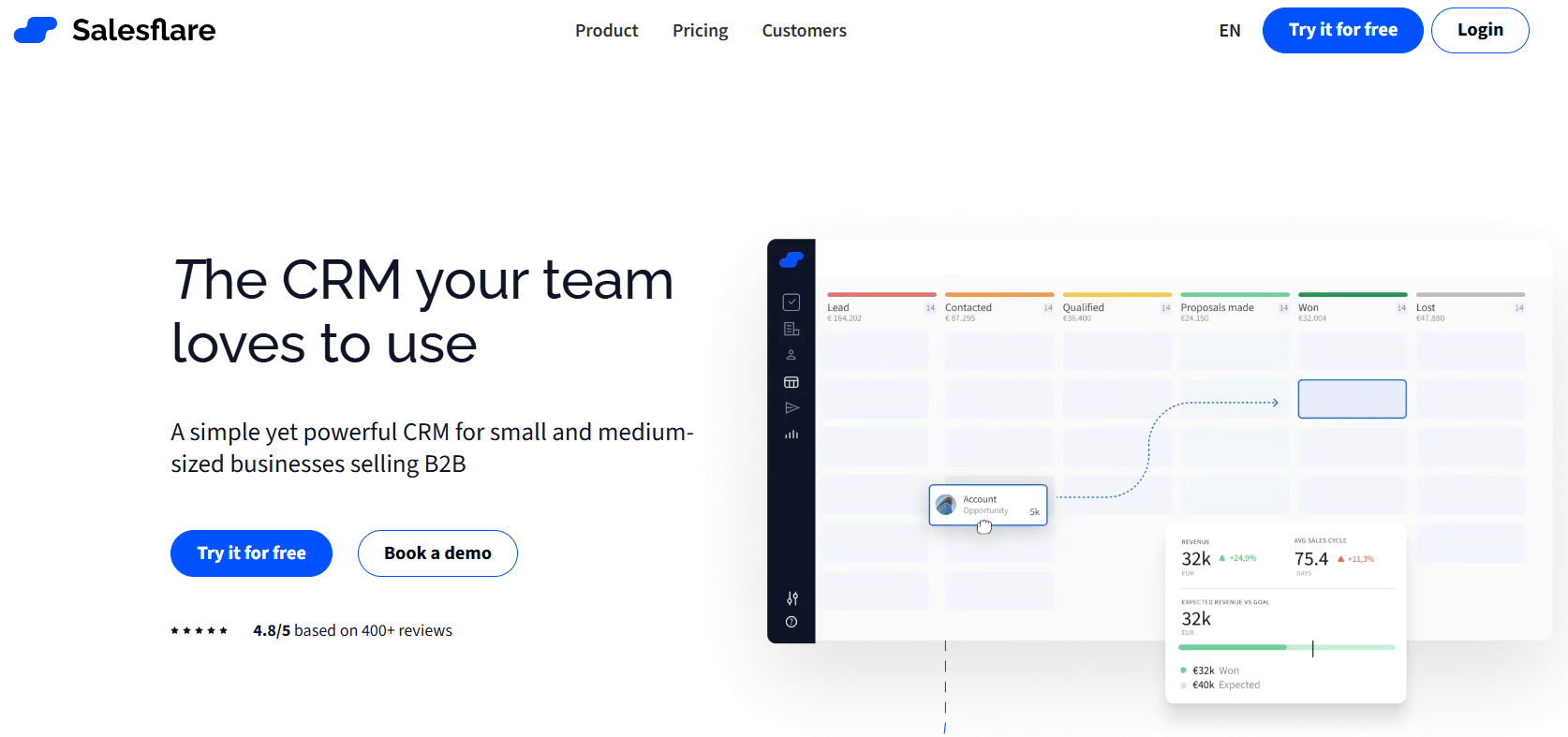
Salesflare starts with a simple but accurate observation: salespeople hate entering data into their CRM. Its solution? To automate data entry as much as possible by gathering information from emails, phone calls, social media, and calendars. The result is a CRM that updates itself almost entirely on its own, which significantly improves data quality.
The tool is particularly popular with small B2B teams that sell to other businesses and need to track multiple contacts within a single account. The multi-contact management feature per company is built-in and well-designed. Automatic reminders to follow up with unresponsive prospects are also a significant advantage.
Pricing:
Growth Plan: $29/month/user.
Pro Plan: $49/month/user.
Enterprise Plan: $99/month/user.
👤 Who is this for?
Small B2B teams (1 to 20 people) who want a smart CRM without spending hours on it. Perfect for agencies, consultants, and early-stage startups. Less suitable if you need a tool with robust marketing capabilities or complex team management features.
✅ The benefits:
Automatic data entry (emails, calls, social media).
Smart reminders for follow-ups.
A simple and effective interface.
Good value for the money.
👎 The downsides:
Reporting capabilities are less robust than those of market leaders.
A more limited number of native integrations.
Less well-known, and therefore with a smaller ecosystem of resources.
Benefit from a on Salesflare.
30% off during 3 months
Find our best discount right now with Salesflare and save on your software subscriptions. We offer over 850 promo codes and discounts on the best software and SaaS on the market.
#7 – Lemlist: The go-to tool for personalized cold emails.
Benefit from our free deal on Lemlist.
20% off on annual plan
Find over 300 free deals as well as over 850 Premium deals right now with Lemlist and save on your software subscriptions. Whether you're an entrepreneur, a startup or a solo freelancer, save hundreds of euros thanks to our discounts and promo codes.
Lemlist has pioneered the large-scale personalization of prospecting emails. While most tools allow you to insert a first name or company name, Lemlist goes much further: personalized images featuring the prospect’s logo, embedded videos, and dynamic variables generated by AI based on the contact’s LinkedIn profile.
The result is campaigns that feel less like mass mailings and more like handwritten emails. This has a positive impact on open and response rates. Lemlist also integrates LinkedIn and phone calls into its sequences, making it a comprehensive multichannel tool for outbound prospecting.
The platform also offers an integrated lead database (Lemlist Leads), which allows users to build their lists directly within the tool without having to use an external data enrichment service.
Pricing:
Email Starter Plan: $39/month/user.
Email Pro Plan: $69/month/user.
Multichannel Expert Plan: $99/month/user.
Outreach Scale Plan: $159/month/user.
👤 Who is this for?
SDRs, growth hackers, and outreach teams that conduct high-volume email prospecting with a focus on personalization. Excellent for B2B startups and SMBs that have a clear message and want to optimize their cold outreach. Less relevant if your volumes are low or if you work primarily with inbound leads.
The interface may seem a bit overwhelming to beginners.
Pricing that climbs quickly for multichannel teams.
Monitor email deliverability based on volume.
Benefit from a on Lemlist.
An additional 20% off on annual plan
Find our best discount with Lemlist and save on your software subscriptions. We offer over 850 promo codes and discounts on the best software and SaaS on the market.
Find over 300 free deals as well as over 850 Premium deals right now with La Growth Machine and save on your software subscriptions. Whether you're an entrepreneur, a startup or a solo freelancer, save hundreds of euros thanks to our discounts and promo codes.
La Growth Machine (LGM) is one of the most sophisticated French solutions for multichannel sales prospecting. The concept: build sequences that intelligently alternate between LinkedIn, email, and Twitter/X, adapting to the prospect’s behavior. If someone doesn’t respond on LinkedIn, LGM automatically switches to email. If the email bounces, the tool adapts.
What sets LGM apart is the quality of its execution on LinkedIn: actions are carried out in a human-like manner to avoid being flagged as bots, and the tool adheres to the platform’s limits. The built-in AI helps draft messages, personalize outreach, and analyze campaign performance.
The platform integrates natively with leading CRMs (HubSpot, Pipedrive, Salesforce) to automatically sync contacts and activities.
Pricing:
Basic Plan: €50/month/user.
Pro Plan: €80/month/user.
Ultimate Plan: €120/month/user.
👤 Who is this for?
B2B sales teams that engage in serious outbound prospecting and want to coordinate their approach across multiple channels without spending hours on it. Particularly well-suited for growth agencies, startups with a well-defined LinkedIn target audience, and sales managers who want to structure their prospecting efforts.
✅ The benefits:
Truly smart multichannel sequences.
Humanized execution on LinkedIn (account security).
AI for content creation and personalization.
Native CRM integrations.
👎 The downsides:
Higher prices than some competitors.
Requires a predefined prospecting strategy.
Learning curve for properly configuring sequences.
Benefit from a on La Growth Machine.
2 additional months free
Find our best discount right now with La Growth Machine and save on your software subscriptions. We offer over 850 promo codes and discounts on the best software and SaaS on the market.
Waalaxy is the most widely used LinkedIn automation tool in France. Its promise: to enable any sales representative to prospect on LinkedIn without needing technical skills, thanks to ready-to-use sequence templates and a particularly user-friendly interface.
The features cover the entire LinkedIn process: automated connection requests, welcome messages, follow-up sequences, exporting visited profiles, and more. All of this is done within quotas that comply with LinkedIn’s Terms of Use to protect the user’s account. The tool also includes an email tab to combine LinkedIn prospecting with cold emailing.
The template library is a real asset for teams just getting started who are looking for proven templates for outreach messages.
Pricing:
Freemium Plan: Free (limited features).
Advanced Plan: €36/month/user.
Business Plan: €77/month/user.
👤 Who is this for?
Independent professionals, consultants, and small teams who want to automate their LinkedIn prospecting without any technical investment. Ideal for those just getting started with LinkedIn outreach who want quick results with minimal setup. Less suitable if you need highly complex sequences or advanced multichannel integration.
✅ The benefits:
Very easy to get started with.
Ready-to-use sequence templates.
Free version to test it out.
Built-in LinkedIn security quotas.
👎 The downsides:
Less powerful than LGM on complex sequences.
More limited message customization.
Less advanced email features.
#10 – Apollo.io: A database and outreach tool all in one.
In just a few years, Apollo.io has become one of the most comprehensive sales platforms on the market. Its value proposition is twofold: a database of over 275 million enriched B2B contacts, AND a complete suite of outreach tools (email sequences, dialer, LinkedIn). In other words, you can find your prospects AND contact them using the same tool.
The quality of the database is particularly highly regarded for email data: Apollo claims high accuracy rates for business email addresses, with data updated continuously. The search filters allow for highly precise segmentation: industry, company size, technology used, funding level, hiring behavior, and more...
The built-in AI can generate personalized bulk emails, analyze campaign performance, and suggest optimizations.
Pricing:
Free Plan: free (limited credits).
Basic Plan: $49/month/user.
Professional Plan: $79/month/user.
Organization Plan: $119/month/user.
👤 Who is this for?
Sales and growth teams that do large-scale B2B prospecting and want to avoid switching back and forth between a data enrichment tool and an outreach tool. Especially great for startups in the scaling phase that need to quickly build qualified lists.
✅ The benefits:
A very extensive and regularly updated B2B contact database.
Enrichment + outreach in a single tool.
Very powerful segmentation filters.
A usable free plan.
👎 The downsides:
Data quality varies by market (it is better in English-speaking markets).
The interface can sometimes be difficult to master.
Enrichment credits that can run out quickly.
#11 – Kaspr: Enrich LinkedIn contacts with a single click.
Kaspr is a contact enrichment tool that stands out for its ease of use and its focus on the European market. The Chrome extension lets you retrieve a LinkedIn profile’s contact information (work email, direct phone number) with a single click, directly from the contact’s page.
What makes Kaspr particularly appealing to French and European teams is the quality of its data on these markets, which is often superior to that of U.S. tools. GDPR compliance is also central to its value proposition, which is an increasingly important factor for European companies.
The tool integrates with leading CRM systems and allows you to export contacts directly into your pipeline.
Pricing:
Free Plan: free (limited credits).
Starter Plan: $49/month/user.
Business Plan: $79/month/user.
Organization Plan: $99/month/user.
👤 Who is this for?
SDR and sales reps who are prospecting on LinkedIn and need to quickly gather reliable contact information, particularly in the European market. Excellent value for money for teams that don’t handle massive volumes but need accurate data.
✅ The benefits:
A very easy-to-use Chrome extension.
High-quality European data.
Native GDPR Compliance
Free trial plan.
👎 The downsides:
Limited credits on entry plans.
Less data is available on markets outside Europe and the U.S.
Non-integrated outreach features (tool dedicated solely to data enrichment).
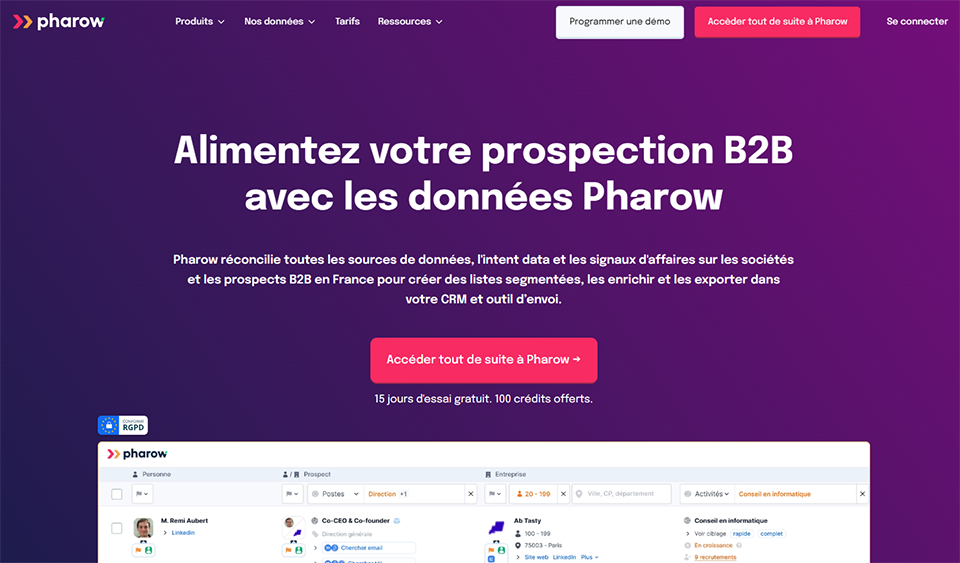
#12 – Pharow: B2B prospecting with a French database.
Pharow is a French B2B prospecting solution that deserves to be better known. What sets it apart is its database focused on French companies, with data enriched from official sources (SIREN, Bodacc, social media). For prospecting in the French market, it’s often more accurate than American tools.
The platform allows you to build highly targeted prospect lists based on specific criteria: industry, NAF code, company size, location, and growth indicators (recent hiring, fundraising, new branch openings, etc.). These intent signals are particularly useful for prioritizing the accounts most likely to be receptive to a sales approach.
Pricing:
Starter Plan: €99/month.
Growth Plan: €199/month.
Scale Plan: €399/month.
👤 Who is this for?
Sales teams that primarily target the French market and want reliable data on French companies. Particularly well-suited for agencies, digital services firms, and B2B service providers that target French SMEs and mid-sized companies.
✅ The benefits:
A very comprehensive French database.
Intent signals (hiring, fundraising) to target at the right time.
Native GDPR compliance.
Legal information (SIREN, etc.) included.
👎 The downsides:
Coverage is limited to French-speaking markets.
Pricing per account rather than per user.
The interface is less modern than that of some competitors.
#13 – PandaDoc: From quote to signature, friction-free.
PandaDoc is often overlooked in discussions about sales tools, but that’s a mistake. Closing a deal doesn’t end with the prospect saying “yes”—you still need to send a clear proposal, get a signature, and manage internal approvals. That’s exactly what PandaDoc solves.
The platform lets you create professional sales proposals using customizable templates, embed videos, interactive tables, and ROI calculators, and then send them for a legally valid electronic signature. Real-time tracking shows you when the prospect opened the document, which page they spent the most time on, and whether they shared it with anyone else.
This information is invaluable for anticipating objections and following up at the right time. Integration with CRM systems (HubSpot, Pipedrive, Salesforce, etc.) allows you to create proposals pre-filled with deal data directly from your CRM.
Pricing:
Starter Plan: $19/month/user.
Business Plan: $49/month/user.
Business Pro Plan: $59/month/user.
Enterprise Plan: Price upon request.
👤 Who is this for?
Any sales team that regularly sends proposals, quotes, or contracts. Essential as soon as you have more than 3 or 4 sales documents to send per month. Particularly useful for service providers, agencies, and SaaS providers.
✅ The benefits:
Create professional proposals very quickly.
Accurate reading tracking (page by page).
Legally valid electronic signature.
Native CRM integrations.
👎 The downsides:
The most advanced templates take a little time to set up.
Tl;dv (short for "Too Long; Didn't View") has established itself as the go-to tool for transcribing and analyzing sales meetings. Integrated with Zoom, Google Meet, or Teams, it automatically records, transcribes, and summarizes every call. But where it really shines for sales teams is in its analytics features.
Tl;dv’s AI can identify recurring objections in your calls, pinpoint key moments in a conversation (mentions of competitors, discussions about pricing, buying signals, etc.), and generate structured reports that are sent directly to your CRM. For sales managers, it’s an exceptional coaching tool: you can review the key moments of a call without having to listen to the entire recording.
The search feature lets you find, in just a few seconds, all calls in which a specific keyword was mentioned, which is very useful for analyzing how competitors are mentioned or how prospects react to a specific selling point.
Pricing:
Free Plan: free (unlimited recordings, limited AI features).
Pro Plan: €18/month/user.
Business Plan: €59/month/user.
Enterprise Plan: Price upon request.
👤 Who is this for?
Sales teams that make a lot of calls and want to improve their performance by analyzing conversations. Very useful for sales managers coaching their teams, and for account executives who want to prepare their follow-ups with precision. The free version is more than sufficient for individual use.
✅ The benefits:
Accurate transcription in several languages (including French).
AI Analysis of Objections and Key Moments.
CRM integrations for automated reporting.
A very generous free plan.
👎 The downsides:
Advanced analytics features are available only with paid plans.
#15 – Fireflies.ai: The AI assistant that never misses a call.
Fireflies.ai is in the same league as Tl;dv, but with a few notable differences. The tool stands out for the depth of its conversational analysis: sentiment analysis, tracking of topics discussed, measurement of the speaking ratio among participants, and identification of action items and questions asked.
For a salesperson, it’s a goldmine of information: finding out if you talked too much during a call with a prospect, identifying questions that generate engagement, and spotting missed buying signals in the recordings. The “soundbites” feature lets you create audio clips to share internally for coaching sessions.
The free version is quite generous, and the platform integrates with over 40 CRMs and collaboration tools. The Fireflies bot automatically joins your meetings and starts transcribing without any action on your part.
Pricing:
Free Plan: free (800 minutes of storage).
Pro Plan: $18/month/user.
Business Plan: $29/month/user.
Enterprise Plan: Price upon request.
👤 Who is this for?
Sales teams looking for a conversational intelligence tool with a focus on coaching and behavioral analysis. Ideal for sales managers who want objective data on their teams’ performance during calls. Also relevant for solo AEs who want to improve by analyzing their own calls.
An automated bot that joins meetings without any manual intervention.
Extensive library of integrations (40+ tools).
A good free plan to get started.
👎 The downsides:
The interface is sometimes less intuitive than Tl;dv.
The quality of the French transcription needs to be checked for accents.
Limited storage on the free plan.
Comprehensive comparison of the 15 tools.
The prices listed are for informational purposes only and are based on information available at the time of writing. They are subject to change: be sure to check them directly with the publishers.
The topic of sales software raises a lot of questions, many of them legitimate. Here are the answers to the most frequently asked ones.
1️⃣ What is the difference between a CRM and a prospecting tool?
A CRM (Customer Relationship Management) system is used to manage all aspects of your customer relationships: the sales pipeline, interaction history, deal tracking, and reporting. A prospecting tool like Waalaxy or Lemlist is used to contact prospects on a large scale in an automated way. The two are complementary: prospecting feeds new leads into the CRM.
2️⃣ Do you really need a CRM if you’re a freelancer or independent consultant?
It doesn't have to be a complex CRM, but some basic tracking is essential once you have more than 10 or 15 active prospects at the same time. Tools like Folk or Salesflare are very well suited to solo professionals thanks to their simplicity and value for money.
3️⃣ Won't LinkedIn automation get my account banned?
There is a risk if you use tools that simulate non-human behavior or exceed the limits set by LinkedIn. Reputable tools like La Growth Machine or Waalaxy have built-in safeguards (random delays, daily limits) to reduce this risk. It is essential to adhere to the limits recommended by the tool.
4️⃣ Apollo.io or Kaspr for enriching your contacts?
It all depends on your target market. Apollo.io is stronger in English-speaking markets and offers a very extensive global database. Kaspr is often more accurate when it comes to European contacts, particularly in France. Many teams use both in combination.
5️⃣ Tl;dv or Fireflies: Which one should you choose to analyze your calls?
Tl;dv is often preferred for its interface and the quality of its French transcriptions. Fireflies.ai stands out for the depth of its behavioral analysis (sentiment, talk ratio). If you’re a manager and team coaching is your priority, Fireflies may be a better fit. For individual use, Tl;dv is generally more accessible.
6️⃣ Is PandaDoc really necessary if I send quotes from my invoicing software?
Billing software generates functional quotes, but they’re rarely optimized to win over clients. PandaDoc adds a real sales-oriented dimension: professional design, read tracking, embedded videos, and simplified e-signatures. For companies whose deals exceed a few thousand euros, the impact on the closing rate can be significant.
7️⃣ How do you build your sales stack when you’re starting from scratch?
The golden rule: start simple. A CRM (Pipedrive or the free version of HubSpot, depending on your needs), a prospecting tool suited to your main channel (LinkedIn or email)—that’s already a lot. Add tools as you go along, as you identify pain points in your process. Piling on 8 tools right from the start without mastering any of them is counterproductive.
8️⃣ Do these tools work well outside the tech industry?
Absolutely. CRM platforms like Pipedrive and Sellsy are used across a wide range of industries: real estate, recruitment, consulting, financial services, and manufacturing. Prospecting tools like Lemlist and La Growth Machine can be adapted to any industry as long as your target audience can be reached via email or LinkedIn.
9️⃣ Are there any tools for managing follow-ups after a sales call?
There are several tools available to meet this need. Automatic follow-up sequences in HubSpot or Close let you schedule structured follow-ups. PandaDoc alerts you when a prospect reopens your proposal, which is often the best indicator for following up at the right time.