






ATS: What exactly is it, and do you really need it?
In this guide, we analyzed the essential recruitment solutions for small organizations, from the simplicity of LinkedIn…
Read more


Finding the right candidates takes time. All too often, HR teams and managers spend hours juggling resumes received by email, rough tracking spreadsheets in Excel, and job postings published manually on three or four different job boards. The result: missed opportunities, longer timelines, and candidates who end up accepting an offer elsewhere.
It is precisely to address this issue that ATS (Applicant Tracking System) software has gained ground in recent years. But with the growing number of solutions available on the market, the choice itself has become a source of uncertainty.
Two French tools stand out in particular for mid-sized organizations: Taleez and Seeqle. The first offers a comprehensive and intuitive ATS approach, designed to simplify the entire recruitment cycle. The second takes a different approach, focused on multichannel outreach and candidate acquisition through programmatic advertising.
Two philosophies, two distinct approaches, but one shared goal: to help you recruit better and faster.
In this article, we take a detailed look at these two solutions so you can choose the one that truly meets your needs, team size, and budget constraints.

Taleez is a French solution launched in 2018, whose goal is to provide SMEs, mid-market companies, and startups with a recruitment tool on par with those used by large corporations, but without the associated complexity or cost. The platform covers the entire recruitment cycle: creating job postings, multi-channel distribution, managing applications, communicating with candidates, internal collaboration, and reporting.
The first thing that stands out about Taleez is how user-friendly the interface is. The dashboard is clean, the pipeline stages are easy to visualize, and getting started doesn’t require extensive training. For an HR team of 2 to 10 people, this is a tangible benefit in day-to-day operations.
Taleez offers a pricing structure based on the volume of hires and the size of the team. For reference:
A free trial is available so you can test the solution before making any commitment. Prices are subject to change; we recommend checking them directly on the Taleez website.

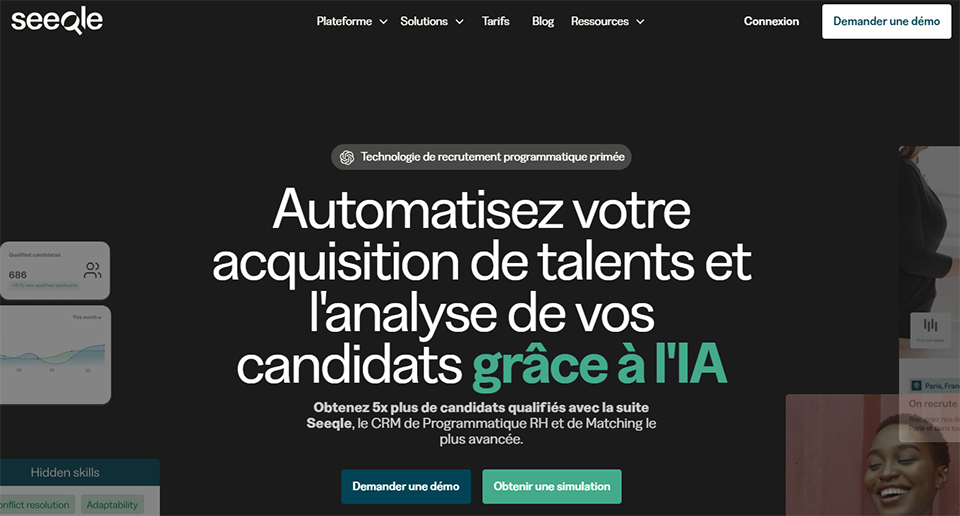
Seeqle focuses on a very specific segment of digital recruitment : candidate acquisition through advertising. Specifically, the solution uses artificial intelligence algorithms to automatically display your job postings where your target candidates are, whether on Facebook, Instagram, Google, or specialized job boards.
It is not an ATS in the traditional sense. Seeqle sees itself more as a “recruitment marketing” tool: you build recruitment campaigns, optimize audiences, and manage budgets. The approach is similar to what a marketing team would do to generate leads, but applied to attracting talent.
Developed in France, the platform is particularly popular among companies with recurring and high-volume hiring needs (retail, logistics, food service, healthcare) that struggle to attract candidates through traditional channels.
Seeqle operates on a model that combines a platform subscription with an advertising budget. The pricing structure generally includes:
Exact pricing varies depending on the selected configuration and the size of the organization. We recommend that you request a customized quote directly from Seeqle, as pricing is often tailored to your specific needs.
At the heart of Taleez is its visual pipeline. Each application moves from one stage to the next (pre-screening, phone interview, HR interview, manager interview, job offer), and the entire team can see the status in real time. No more internal emails to find out “where this candidate is in the process”: everything is centralized in a single interface.
Recruiters can leave comments on each profile, assign ratings, and tag colleagues. Collaboration is built right in—it’s not an afterthought.
With Taleez, you can post a job listing, and it’s published simultaneously on about 30 job boards: Indeed, Welcome to the Jungle, LinkedIn, Pôle Emploi, APEC, and many others. There’s no need to copy and paste your listing onto each platform separately. This saves a considerable amount of time for teams that recruit regularly.
Taleez lets you create a careers page customized with your company’s branding, integrated directly into your website. This is an important way to build your employer brand without having to bring in a developer every time you post a job opening.
Communication with candidates can be largely automated: confirmation emails, follow-ups, and rejection notices. These automated processes help maintain a professional relationship with all applicants, even when the volume of applications increases.
Taleez is particularly well-suited for startups in the growth phase that are recruiting for multiple positions simultaneously, for SMEs without a dedicated HR director that are looking to structure their processes without overcomplicating things, and for mid-sized HR teams seeking a scalable tool. It’s also a good option for organizations that want to move away from Excel and email without having to deploy a heavy enterprise tool.
The solution integrates with tools you probably already use, such as HubSpot for contact management or Notion for internal documentation.
✅ User-friendly interface and easy to learn.
✅ Built-in multi-job board posting.
✅ A visual and collaborative recruitment pipeline.
✅ Customizable career page—no developer needed.
✅ Automated communication with candidates.
✅ 100% French solution, support in French.
✅ Good value for money for SMEs.
⚠️ Less suitable for mass hiring or very large-scale recruitment.
⚠️ More limited active sourcing (outreach) capabilities than some competitors.
⚠️ Although analytical features are available, they are more basic than those found in enterprise-level tools.
⚠️ Advanced workflow customization requires upgrading to a higher plan.
The idea behind Seeqle stems from a simple observation: the best candidates aren’t necessarily actively looking for a job. They don’t check Indeed every day. However, they do see ads on Facebook, Instagram, or Google. Seeqle leverages this channel to promote your job postings to qualified audiences, targeted based on geographic, demographic, and behavioral criteria.
The algorithm automatically optimizes campaign distribution to maximize the number of relevant applications relative to the budget invested. This approach is similar to what marketing teams do with their acquisition campaigns, but applied to recruitment.
For certain industries or professions, traditional job boards are no longer enough. Candidates for hard-to-fill roles (skilled workers, technicians, healthcare professionals, drivers) are often scarce on LinkedIn or Indeed, but very active on social media. Seeqle lets you reach them where they actually are.
Instead of managing Meta Ads, Google Ads, and job board campaigns separately, Seeqle centralizes everything in a single interface. You set a budget and target specific profiles; the platform takes care of the rest. Performance metrics (cost per application, conversion rate, reach) are available in real time.
Seeqle is not intended to replace your ATS—it’s designed to complement it. The platform integrates with several applicant tracking systems so that candidates generated by campaigns are routed directly into your existing pipeline. This architecture allows you to combine the power of candidate acquisition with the organizational capabilities of an ATS.
Seeqle primarily serves the needs of companies with high-volume, recurring hiring needs: retail chains, the restaurant industry, logistics, the healthcare sector, and home care services. It is also a valuable solution for companies recruiting for hard-to-fill profiles that are underrepresented on traditional job boards, as well as for HR departments that want to manage their recruitment like marketing acquisition, with clear KPIs and continuous optimization.
To take candidate data management even further, some teams combine Seeqle with Airtable to build customized talent databases.
✅ A unique approach based on programmatic advertising.
✅ Precise targeting to reach candidates who are inactive on job boards.
✅ Centralization of all advertising budgets in a single interface.
✅ Optimization algorithms to maximize campaign ROI.
✅ Particularly effective for hard-to-fill roles.
✅ Detailed reporting and data-driven decision-making.
⚠️ A business model with two costs (license + advertising budget) that can be expensive.
⚠️ Less suitable for one-time or low-volume hiring.
⚠️ Does not replace an ATS: it often needs to be used in conjunction with one.
⚠️ Learning curve on the “marketing campaign” mindset for traditional HR teams.
⚠️ Results depend on the allocated advertising budget.
Here is a summary table that provides a quick overview of the main differences between the two solutions:
| Criterion | Taleez | Seeqle |
|---|---|---|
| Type of solution | Complete ATS | Programmatic Recruitment Platform |
| Philosophy | Organize and manage the recruitment process | Attract and acquire candidates |
| Target audience | SMEs, startups, mid-market companies | High-volume companies, marketing-driven HR |
| Job Board Postings | ✅ Built-in (30+ boards) | ✅ Through automated campaigns |
| Pipeline management | ✅ Native and visual | ❌ No (must be used with an ATS) |
| Programmatic Advertising | ❌ No | ✅ Core of the product |
| Careers Page | ✅ Included | ❌ No |
| Internal Collaboration | ✅ Multi-user | Limited |
| Reporting | Basic to intermediate | Advanced (Campaign ROI) |
| Pricing | Fixed monthly subscription | License + advertising budget |
| Learning curve | Low | Moderate |
| Suitable for one-time hiring | ✅ Yes | ❌ Not as good |
| Effective for hard-to-fill roles | Moderately | ✅ Very good |
Prices and features are provided for information only. We recommend checking the information directly with each vendor, as it is subject to change.
You recruit regularly but on an ad hoc basis, for a variety of roles. You need a tool that centralizes everything, that your team can get up to speed on quickly, and that saves you from having to manage a dozen job boards separately. Taleez is designed for you.
Taleez’s visual pipeline will help you establish a clear structure: who approves what, at what stage, and based on what criteria. It’s also a good way to involve managers in the process without overwhelming them with complex tools.
With automated communication tools and a personalized careers page, Taleez helps you project a professional image to candidates, even with a small HR team.
Taleez’s fixed pricing is more predictable than a model with a variable advertising budget. For organizations with limited resources, this is a significant advantage.
You regularly need 20, 50, or 100 candidates per month. Traditional job boards are no longer enough, and you want to streamline your sourcing process. Seeqle’s campaign-based approach is designed to meet this need.
Operators, technicians, nursing assistants, delivery drivers: if your ideal candidates aren’t on LinkedIn or Indeed, reaching them through social media and Google is a game-changer. That’s where Seeqle makes a difference.
If your HR team is familiar with concepts such as cost per acquisition, conversion rates, or A/B testing of messages, Seeqle fits right in. You’ll manage your hiring efforts using clear marketing KPIs.
If you’re already using an applicant tracking system, Seeqle complements it to boost your recruitment efforts. In this scenario, the two solutions aren’t necessarily in competition with each other.
For some organizations, combining the two tools makes sense: Seeqle to generate qualified candidates through targeted campaigns, and Taleez to manage and steer the pipeline in a structured way. If you’re in an industry where recruitment is a matter of both volume and quality, this approach may be worth exploring.
For teams looking to take their talent pool management or the automation of certain steps to the next level, Flatchr is another French solution worth considering in the ATS category.
Here are some frequently asked questions about recruitment tools that we hear often, along with our straightforward answers.
As soon as you hire more than five people a year, the organizational benefits of using an ATS are well worth the investment. Managing applications via email or in Excel quickly becomes chaotic, and the risk of overlooking a strong candidate or leaving a candidate without a response increases rapidly.
An ATS manages the internal process: receiving applications, the pipeline, and collaboration among recruiters. A programmatic tool like Seeqle manages external candidate acquisition: attracting candidates through targeted advertising. Both address different stages of the recruitment cycle.
This is a question you should ask the teams at both vendors directly, since native integrations are constantly evolving. However, if a direct connection isn’t available, automation tools like Make can serve as a bridge between the two platforms.
Taleez offers a free trial. For Seeqle, the model is more focused on a personalized demo followed by a sales proposal. In either case, feel free to request a demo to see firsthand how the tool works for your specific use cases.
Taleez and Seeqle are two French solutions, which makes it easier to comply with regulations on the processing of personal data. It is still recommended to check with each vendor the terms for processing candidate data, particularly retention periods.
Seeqle consolidates multiple advertising channels, but the exact configurations vary by plan. To maximize your presence on LinkedIn, you can also explore LinkedIn Ads or LinkedIn Sales Navigator, depending on your sourcing strategy.
Both tools offer reporting, but from different perspectives. Taleez measures process metrics (recruitment time, conversion rates by stage, source of applications). Seeqle focuses more on campaign performance (cost per application, reach, click-through rate). For a 360° view, combining both data sources is ideal.
Taleez is primarily focused on the French and French-speaking markets. Seeqle offers broader geographic targeting capabilities, which may be suitable for companies recruiting in multiple European countries. In both cases, check the availability of partner job boards in the relevant countries.