




GDPR Compliance for Startups: What You Really Need to Do
This article won't overwhelm you with legal jargon. The goal is to clarify what you really need to…
Read more

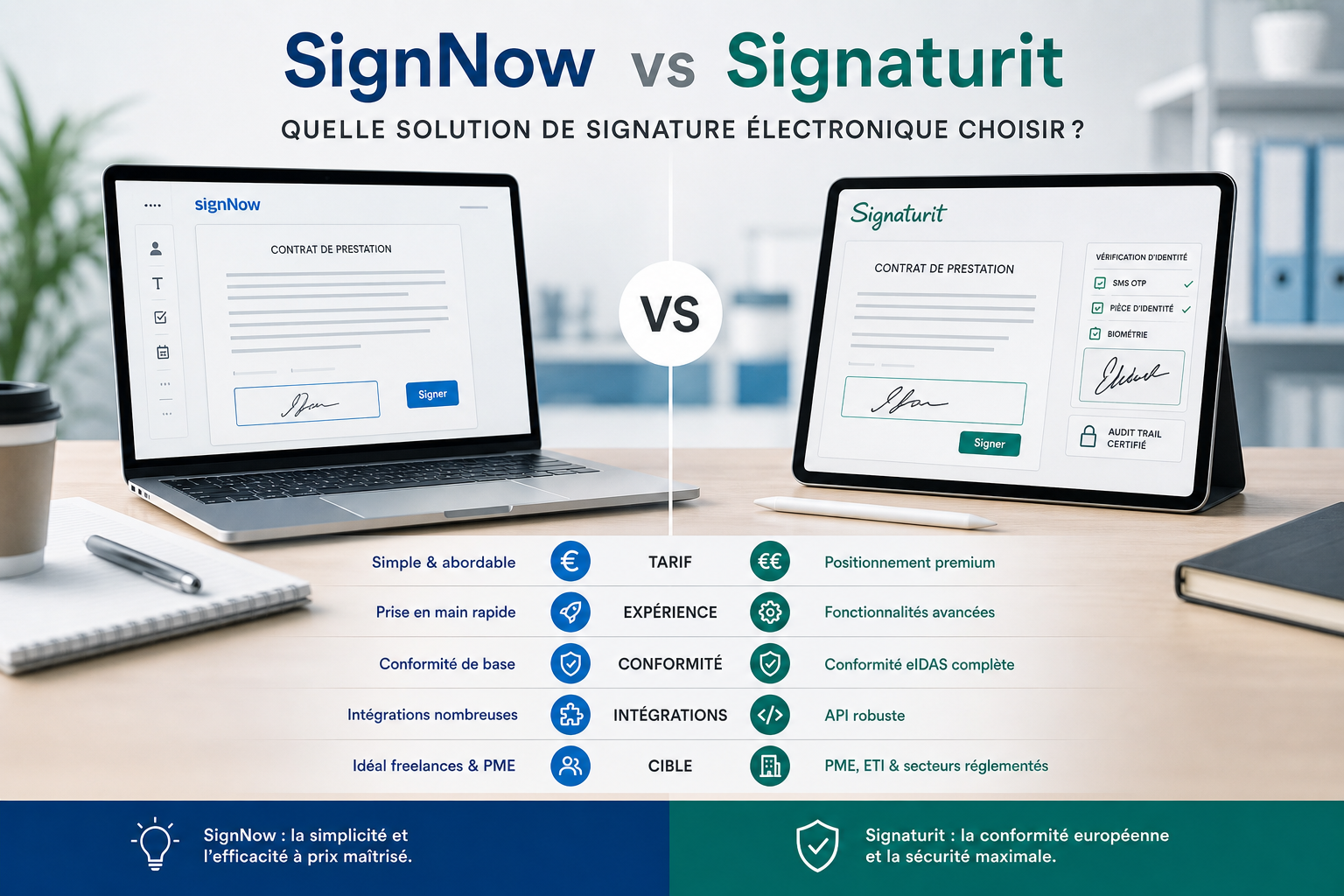
Today, electronic signatures are a must-have freelancers, consultants, small and medium-sized businesses, and sales teams who want to work quickly, reduce paperwork, and secure their contractual transactions. But with so many options available, choosing the right tool isn’t always easy.
SignNow and Signaturit are two solutions that frequently appear in comparisons. One focuses on simplicity and competitive pricing, while the other emphasizes compliance with European regulations and a rich feature set. Two consistent approaches, two very distinct market positions.
This article helps you get a clear picture: features, pricing, strengths, limitations, and, most importantly, which tool is truly right for your situation.
SignNow is published by airSlate, a U.S.-based company specializing indocument automation. Launched to address a clear need-enabling any business to implement electronic signatures quickly and without excessive costs-SignNow has established itself as one of the leading providers in the market’s “value-for-money” segment.
The platform is primarily aimed at microbusinesses, small and medium-sized businesses, freelancers, and sales teams that regularly sign documents without needing highly complex workflows. Its interface is specifically designed to be easy to use in just a few minutes, with no prior training required.
SignNow offers several plans tailored to teams of different sizes:
SignNow really stands out when it comes to pricing: for standard use, it’s one of the most affordable solutions on the market, which has made it quite popular among entrepreneurs small businesses.

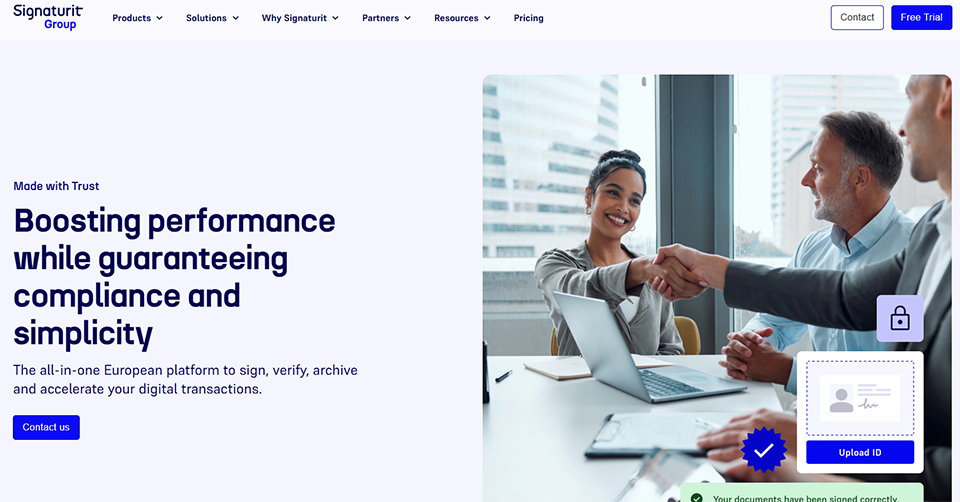
Signaturit is a Spanish company founded in Barcelona in 2013. Its value proposition is clear: to offer an electronic signature and document management solution that is fully compliant with European requirements, including the eIDAS Regulation and the GDPR. This positioning makes all the difference for companies operating in Europe or handling sensitive data.
The platform supports several types of signatures (simple, advanced, and qualified) and includes biometric features, a detailed audit trail, and enhanced authentication-elements that are often critical in sectors such as finance, real estate, human resources, and regulated professional fields.
Signaturit organizes its offerings around three main packages:
Signaturit is positioned in a slightly higher tier than SignNow, consistent with its level of compliance and the breadth of its features related to European regulations.
SignNow covers all your basic electronic signature needs. Specifically, you can import any document (PDF, Word, image), add signature, text, or date fields, and send a signature request with just a few clicks. The signer receives an email, accesses the document through their browser without needing to install anything, signs it, and returns it in less than a minute.
In addition to this basic workflow, SignNow offers:
What sets SignNow apart is, above all, its value for money. For less than $10 per month per user, you get access to a comprehensive, stable solution that integrates seamlessly with major SaaS ecosystems. That’s rare in this industry.
The tool is also highly rated for its ease of use. The interface is clean and uncluttered, the sending workflows are straightforward, and there are no unnecessary features that would slow down the experience. For a team just getting started with electronic signatures or one that doesn’t have an IT director to set up complex workflows, this is a real advantage.
SignNow is particularly well-suited for the following situations:
Freelancers and consultants who regularly send project contracts, terms of service, or engagement letters to their clients. The volume is rarely high, the need for advanced eIDAS compliance is limited, and costs must be kept under control.
Sales teams at small and medium-sized businesses that manage sales cycles involving quotes and contracts that need to be signed quickly. SignNow integrates well with lean sales stacks.
HR for small organizations regarding standard employment contracts, amendments, or onboarding documents.
Agencies or service providers that work with many different clients and need a tool that’s quick to set up and easy to explain to their clients.
From the outset, Signaturit has stood out for the depth of its approach to compliance and security. The platform supports three levels of electronic signatures as defined by the eIDAS Regulation:
In addition to digital signatures, Signaturit offers:
Signaturit positions itself as the go-to solution for European companies with stringent compliance requirements. While SignNow offers basic compliance that is sufficient for the vast majority of use cases, Signaturit goes much further with enhanced proof mechanisms.
Another distinctive strength: behavioral biometrics. When a signature is made on a tablet or touchscreen, Signaturit captures not only the image of the signature but also the way it was drawn. In the event of a dispute, this serves as particularly strong evidence.
Finally, the solution is designed for vertical industry sectors (banking, insurance, real estate, healthcare, HR) where document management does not end with the signature and where processes must be auditable from start to finish.
Signaturit is a good fit for the following profiles:
Regulated professions (attorneys, notaries, certified public accountants, financial advisors) for whom the probative value of a signed document may be challenged in court and who require a higher standard of proof.
HR departments at medium- to large-sized organizations that manage employment contracts, confidentiality agreements, or regulatory documents subject to strict legal requirements.
Companies that process sensitive data (health, insurance) and must ensure full compliance with the GDPR by hosting their data in Europe.
B2B sales teams dealing with complex sales cycles involving high-value contracts, where the risk of disputes warrants an advanced level of authorization.
Companies that wish to integrate digital signatures into their own software via an API, with guarantees of compliance with European regulations at every stage.
✅ Very competitive pricing: For organizations with a limited budget, SignNow offers a level of functionality that’s hard to find at this price point on the market.
✅ Get started right away: The interface is truly intuitive. No documentation or training is needed to start sending documents for signature.
✅ Robust integrations: Compatibility with everyday tools (Google Workspace, Microsoft 365, Dropbox, Salesforce, Zapier) is a real advantage for teams that don't want to change their routines.
✅ Mobile availability: The iOS and Android app is well-designed, which is important for field teams or sales reps on the go.
✅ Audit trail included: Even with entry-level plans, actions are tracked and the legal validity of the document is preserved.
⚠️ SignNow’s main limitation relates to European regulatory compliance. The solution is based in the United States, and while it is legally valid in the EU for simple signatures, it does not natively support the levels of advanced or qualified signatures as defined by eIDAS. For regulated industries or high-stakes contracts, this can be a real obstacle.
⚠️ User reviews sometimes note that customer support could be improved, particularly for entry-level plans, where response times aren't always up to par.
⚠️ The advanced workflow features are less robust than those of some competitors. For complex approval processes involving multiple stakeholders, SignNow may reach its limits.
⚠️ Finally, the interface customization options (branding) are limited to higher-tier plans, which may be a drawback for service providers who want to offer an experience tailored to their brand from the start.
✅ Native eIDAS compliance: This is clearly the main advantage. All three levels of digital signatures are supported, and data is hosted in Europe. For companies subject to strict legal requirements, this is a deal-breaker.
✅ Behavioral biometrics: Few tools in this price range offer this level of data capture during the signing process. In the event of a dispute, the evidentiary value is maximized.
✅ Certified audit trail: The evidence generated is highly detailed and complies with the strictest European legal requirements.
✅ Well-documented API: For technical teams looking to integrate digital signatures into their own tools, Signaturit offers a comprehensive and well-maintained API.
✅ Tailored to specific industries: The tool was designed for specific industries and offers features tailored to business-specific document workflows.
⚠️ Higher price: Signaturit's premium positioning is reflected in the bill. For a small business with simple needs, the cost-to-benefit ratio may be hard to justify.
⚠️ Learning curve: The wealth of features comes at a cost. It takes a little more time to fully master the tool, especially when setting up advanced workflows.
⚠️ Less modern interface: Some users note that the user experience is functional but less intuitive and less visually polished than solutions like SignNow or DocuSign.
⚠️ Fewer native integrations: The integration ecosystem is more limited than SignNow's, although the API makes up for this for technical teams.
Here is an overview to help you compare. The pricing information is for reference only, and we encourage you to verify it directly with the publishers.
| Criterion | SignNow | Signaturit |
|---|---|---|
| 🌍 Origin | United States (airSlate) | Spain (Europe) |
| 💶 Admission price | ~$8/month/user | ~35 €/month |
| 📜 eIDAS Compliance | Partial (single signature) | Complete (basic, advanced, certified) |
| 🔐 Biometrics | No | Yes |
| 🧩 Native integrations | A great many | Moderate |
| ⚙️ API | Yes | Yes (sturdy) |
| 📱 Mobile app | Yes | Yes |
| 🎨 Customization (branding) | Advanced Formulas | Available |
| 📂 Advanced Workflows | Limited | Yes |
| 🏢 Data Hosting | USA (possibly the EU) | Europe |
| 🆘 Support | Standard | Dedicated according to the plan |
| 👥 Primary Target | Freelancers, Microbusinesses, Small and Medium-Sized Businesses | Small and medium-sized enterprises (SMEs), mid-sized companies, regulated sectors |
This comparison table is for informational purposes only. Features and pricing are subject to change. Please verify the information directly with the software providers.
SignNow is probably the right choice for you. You need to send engagement agreements, engagement letters, or terms and conditions to your clients quickly and professionally. The cost is reasonable, it’s easy to get started, and the level of compliance is more than sufficient for this type of document.
If you work in a regulated profession (law, financial consulting, public accounting), the issue takes on a different dimension: the evidentiary value of your records is paramount, and Signaturit therefore deserves serious consideration.
SignNow can handle most of your day-to-day needs: commercial contracts, partnership agreements, and common HR documents. Integration with your CRM or management tool is often possible via Zapier or native integrations.
If you handle a large volume of signatures and your contracts have a high unit value (or if you operate in a sensitive industry), Signaturit is a valuable solution because of the legal certainty it provides.
Signaturit is clearly the solution of choice. Full eIDAS compliance, biometrics, and a certified audit trail are not optional extras in your context-they are essential safeguards for the validity of your transactions and for protecting your organization in the event of a dispute.
Both solutions offer an API. Signaturit’s API is considered more robust and better documented for complex integrations, with guarantees of compliance with European regulations. If you’re integrating with an ERP or HRIS, Signaturit is often the preferred choice. If your integration needs are more standard (Salesforce, HubSpot, Slack), SignNow covers those scenarios very well.
Both tools offer trial periods. SignNow requires a smaller financial commitment to get started, making it a good first step for teams that want to try out electronic signatures without taking on any financial risk.
If you're in France and are also looking for local alternatives, Yousign is a French eIDAS-compliant solution worth considering in this comparison.
Here are the most common questions about electronic signatures and these two tools.
In France and the European Union, yes, under certain conditions. The 2014 eIDAS Regulation recognizes the legal validity of electronic signatures. A simple electronic signature is valid for the vast majority of legal acts. A qualified electronic signature (the highest level) is legally equivalent to a handwritten signature in all member states. The key lies in the level of proof you are able to provide in the event of a dispute.
The simple signature is the most common: one click to accept, an SMS code to confirm. It covers the majority of business needs. Advanced signatures involve verifying the signer’s identity (biometrics, OTP) and establish a stronger link between the signature and the individual. Qualified signatures require a certificate issued by an accredited Trust Service Provider and are the legal equivalent of a handwritten signature throughout Europe.
SignNow offers GDPR compliance options, but its default hosting is in the U.S. European hosting options are available depending on the plan. If data sovereignty is a major concern for your organization, be sure to verify this point carefully before committing.
Yes. The Signaturit interface is available in French, as are the documents and emails sent to signers. This is important for ensuring a seamless experience with French-speaking clients.
Yes, in both cases. The signer receives a link via email, can open the document in their browser, and sign it without creating an account on the platform. This is essential for successful adoption by external parties.
SignNow is often cited as particularly effective for high-volume use cases thanks to its shared signature links and templates. Signaturit also handles high volumes very well, particularly through its API. It all depends on whether your priority is speed of delivery or the level of compliance for each signature.
Both tools allow the signer to reject the document or leave comments. In this case, you will be notified and can resend or modify the document. The audit trail also records the rejection, which can be useful in certain contractual situations.
Yes. DocuSign remains the global leader, but its pricing is higher. Yousign is a French alternative that complies with eIDAS, often favored by French companies for its simplicity and built-in compliance. Zoho Sign is an attractive option if you’re already part of the Zoho ecosystem.