





3D Design: Which Tool Should You Choose Based on Your Industry?
In this comparison, we focus on the software available through Freelance Stack the Design and Modeling (CAD) category…
Read more

Just a few years ago, developing a web application meant juggling a local IDE, installing dependencies, configuring hosting, and maintaining a deployment pipeline. Today, several platforms have completely reimagined this experience, bringing the entire process into the browser.
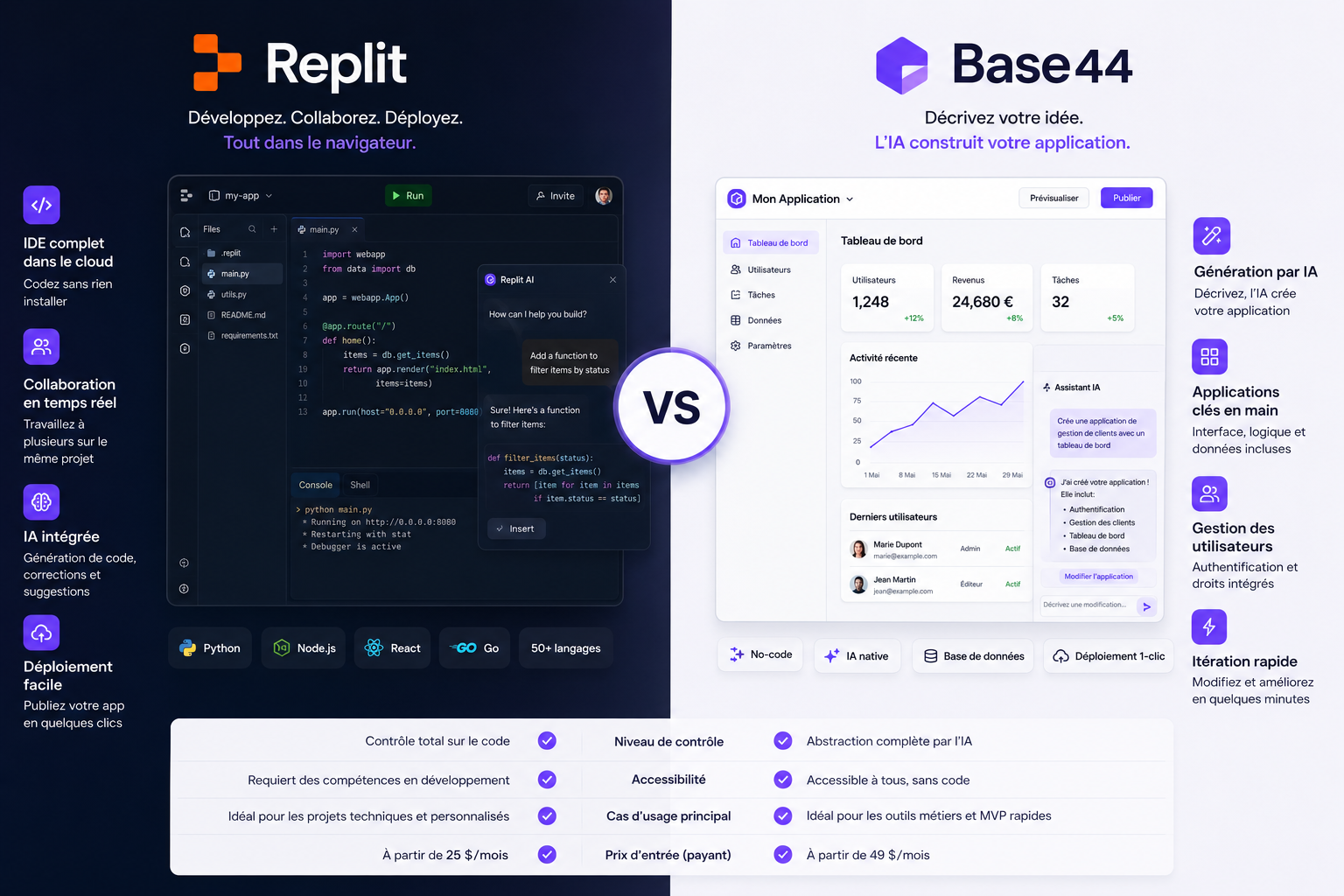
Replit and Base44 are part of this trend, but they don’t target exactly the same audience, nor do they solve the same problems. One is a collaborative development platform designed for developers; the other is an AI-first app builder designed to enable non-developers to create functional business tools in just a few minutes.
Understanding this distinction is essential before making a decision. A poorly thought-out choice can cost you time, money, and a lot of frustration. This comparison helps you see things clearly, whether you’re an experienced developer, an entrepreneur who does a little coding, or a founder who doesn’t want to touch a single line of code.

Founded in 2016, Replit has established itself as one of the world’s leading online development platforms. The platform allows users to code, test, collaborate, and deploy applications without installing anything locally. It supports more than 50 programming languages, giving it a level of versatility rarely found among its competitors.
Its recent evolution has been marked by the integration of an AI assistant (Replit AI, formerly Ghostwriter) capable of generating code, correcting errors, and answering technical questions in context. This “AI-first” approach enhances its appeal to developers who want to move quickly without sacrificing control.

Base44 is a no-code/AI platform that lets you generate functional web applications based on natural language prompts. The idea is simple: you describe what you want to build, and Base44 generates the interface, the logic, and the associated database. No coding knowledge required.
Launched more recently than Replit, the platform is clearly aimed at non-technical creators, operational teams, and entrepreneurs who want to prototype or automate internal processes without relying on a development team.
Base44 natively includes features such as user authentication, database management, forms, and dashboards. This makes it a solid option for quickly building internal tools or MVPs.

Replit doesn't aim to abstract away development—it simply makes it more accessible and seamless. While other tools hide the code behind graphical interfaces, Replit exposes it and gives you the tools to master it. This is a major philosophical difference.
The console, editor, and terminal are always available. You can edit any file, view logs in real time, install packages, configure environment variables, and run scripts just as you would on your local machine—all without ever leaving your browser.
Replit's built-in AI assistant goes far beyond simple autocomplete. It can generate entire functions, explain a block of code, suggest corrections, refactor complex sections, and even create a basic application from a prompt. It's not a replacement for developers, but an effective tool to speed up the process for those who know what they're doing.
For junior or apprentice-level professionals, AI can also play a useful educational role by explaining why a particular pattern is recommended.
Replit allows multiple developers to work simultaneously on the same project, with real-time synchronization similar to what Google Docs offers for documents. This is a major advantage for distributed teams, boot camps, education, and remote pair programming.
Replit projects can be published directly from the platform, without any external configuration. A custom domain can be associated with a project, and Replit's "Deployments" allow you to host applications in production in a stable manner, with scaling options.
Replit is particularly well-suited for several types of users: developers who want to work from any device without setting up a local environment; educational teams and students looking for a ready-to-use environment to learn how to code; freelancers who are developing client projects and need to easily share their code; and developers who want to quickly test an idea, a prototype, or an API without setting up any infrastructure.
It is also widely used in hackathons, where speed of implementation is crucial.
Base44 delivers on a promise that many no-code platforms have never fully fulfilled: enabling non-technical users to create truly usable applications, not just interactive prototypes.
By describing your needs in natural language, you get an application with an interface, a database, and functional business logic—all in just a few minutes, not a few weeks.
While Replit is a general-purpose tool geared toward development, Base44 is optimized for a specific type of application: internal tools. Simplified CRM, tracking dashboards, customer onboarding forms, ticket management tools, knowledge bases… these are just some of the use cases that Base44 handles effectively.
User authentication, access rights management, and the data structure are generated automatically. These are building blocks that can take an experienced developer several days to implement, but Base44 delivers them in a matter of seconds.
Unlike Replit, where AI is just one feature among many, in Base44 it is the central engine. Every change, feature addition, or correction involves interacting with the AI. This makes the platform very accessible, but it also requires some practice to formulate effective prompts.
For an entrepreneur or project manager who wants to validate an idea without bringing in a technical team, Base44 is a highly effective tool. The ability to modify an application through just a few exchanges with the AI significantly speeds up validation cycles. Rather than waiting for a development sprint, you can test, adjust, and start over in just a few hours.
Base44 is primarily designed for those who want to build quickly without coding. Entrepreneurs who want to validate a concept or create an MVP without a development budget. Operational teams (HR, finance, ops) who need custom internal tools. Consultants who want to offer turnkey tools to their clients. Product creators who want to iterate quickly on an idea without holding up their technical roadmap.
It's also an excellent complement to tools like Airtable or Notion for teams that need a more robust application layer than what these basic tools offer.
✔️ Supports more than 50 programming languages, from Python to Rust, including JavaScript, Go, and PHP.
✔️ Complete development environment (editor, terminal, deployment) with no installation required.
✔️ Real-time collaboration is very well implemented.
✔️ Powerful built-in AI to speed up development.
✔️ Active community and extensive library of templates.
✔️ Ideal for learning, teaching, and rapid prototyping.
✔️ Integration with GitHub and Vercel for more advanced workflows.
❌ Requires development skills to get the most out of the platform.
❌ Performance in production may be limited on lower-end models.
❌ Some advanced configurations (complex databases, microservices) remain challenging.
❌ The free plan is quite limited in terms of computing resources.
❌ Non-zero learning curve for non-technical users.
✔️ No prior technical skills required.
✔️ Generating complete applications (UI + logic + data) based on natural language prompts.
✔️ Native integration of authentication and user management.
✔️ Very fast for prototyping and testing ideas.
✔️ Suitable for building internal tools and small SaaS products.
✔️ No infrastructure management required on the user's end.
❌ Less flexible than solutions coded for very specific needs.
❌ Reliance on the quality of prompts to achieve the right results.
❌ Advanced customization can sometimes be difficult to achieve without modifying the code.
❌ May not be suitable for complex application architectures or high-traffic environments.
❌ The integration ecosystem is still under development compared to competitors like Bubble or Glide.
Here is an overview of the main differences between the two platforms to help you make your decision.
| Criterion | Replit | Base44 |
|---|---|---|
| Target audience | Developers, students, tech teams | Entrepreneurs, non-technical teams, OPs |
| Required level | Intermediate to Advanced | Beginner to intermediate |
| Supported Languages | 50+ | Generated by AI (complete abstraction) |
| Built-in AI | Development Co-Pilot | Central Power Generation Plant |
| Collaboration | Real-time, multi-user | Multi-user access depending on the plans |
| Deployment | Built-in, customizable | Integrated and automated |
| Primary use case | Development, technical prototyping | Internal tools, no-code MVPs |
| Free map | Yes | Yes |
| Admission fee (paid) | ~$25/month | ~$49/month |
| Technical Flexibility | Very high | Average |
| Speed of implementation | Depends on skills | Very fast |
The prices listed are for reference only. They are subject to change. We recommend that you check them directly on the official websites before making any decisions.
You know how to code (or are learning) and are looking for a modern development environment that you can access from any device, without the hassles of a local installation. You value having complete control over your code, dependencies, and infrastructure.
It's particularly well-suited for freelance developers working on multiple projects at the same time, remote tech teams looking to streamline collaboration, teachers and instructors who use code in their classes, and solo developers who want to deploy personal projects quickly.
If you already use tools like GitHub or Vercel in your workflow, Replit integrates seamlessly into that ecosystem.
You have an idea for a tool or product, but you don't have the time or the skills to develop it yourself. You're looking for a solution that will let you build something functional quickly, without having to go through an agency or a developer.
It is particularly well-suited for non-technical founders who want to test an MVP before investing in a development team, for operations managers who need custom internal tools without having to involve the IT department, for entrepreneurs consultants who want to offer customized solutions to their clients, and for project leaders who want to validate an idea in a matter of hours rather than weeks.
If you're looking to round out your tech stack with no-code tools, solutions like Bubble, Lovable, or Bolt.new may also be worth exploring, depending on your specific needs.
The question to ask yourself is simple: Do you need technical control or speed of execution? If you're comfortable with code and want to master it from start to finish, Replit is the right choice. If you want to move quickly and are willing to accept the limitations of an AI-generated solution, Base44 will do the trick.
In some cases, both tools can coexist within the same organization: Base44 for prototypes and non-critical internal tools, and Replit for development projects that require true technical expertise.
Do you still have questions before making a decision? Here are the most frequently asked questions about these two platforms, along with straightforward answers to help you narrow down your choice.
Yes, Replit offers a fully functional free plan, but it has significant limitations on computing resources and the number of active projects. For professional use or projects that require high performance, the paid plan quickly becomes necessary.
Yes, it's one of the few tools that truly delivers on this promise for relatively standard use cases: forms, dashboards, data management, and authentication. For very specific needs or complex integrations, however, limitations may arise.
For many use cases, yes. Replit offers a full-featured editor with syntax highlighting, debugging, a terminal, and dependency management. However, for highly complex projects with numerous local services (large databases, microservices, etc.), a local environment is often more efficient.
For an MVP or an internal tool, absolutely. For a SaaS product intended for a large number of users with significant performance and scalability requirements, the issue of scaling needs to be addressed in advance. Some founders use Base44 to validate their concept quickly, then migrate to a more robust architecture once the concept has been proven.
This is one of its most common uses. The lack of configuration, the built-in AI, and the ability to easily share projects make it an excellent environment for learning to develop, regardless of your starting level.
Base44 offers integrations, but its ecosystem is still under development. For advanced integrations with other SaaS platforms, tools like Make or n8n can be used to automate data flows.
It's hard to answer without knowing your specific situation. Replit is cheaper to get started with, but requires time to set up. Base44 has a higher subscription cost but can save you significant amounts of technical work time. The decision depends on your specific needs and how you plan to use it.
Yes. In the world of web development, GitHub (with Codespaces) and Supabase are industry leaders. On the no-code/AI side, Lovable, Bolt.new, and Bubble are also worth considering, depending on your needs.