





Infomaniak: The Ultimate Guide 2026
This guide is for you if you are a freelancer, entrepreneur, or the owner of a small business or SME and you are looking for…
Read more


In the world of cybersecurity and compliance for businesses, Okta and Drata often come up in the same conversations. This is no coincidence: both companies cater to organizations that want to professionalize their approach to security. However, comparing them directly would be almost nonsensical, given how different their missions are.
Okta is an identity and access management platform. Drata, on the other hand, automates regulatory compliance processes. One controls who has access to what within your organization. The other helps you demonstrate to external auditors that you comply with standards such as SOC 2, ISO 27001, and the GDPR.
These are, therefore, two complementary tools that can easily coexist within the same security stack. The real question, ultimately, is which one aligns with your current priorities and which one you should implement first, depending on your stage of development or your industry.
That's what this article invites you to explore—without any unnecessary jargon.

Founded in 2009 in San Francisco, Okta has established itself as one of the world's leading providers of Identity and Access Management (IAM). Its core promise: enable organizations to centrally manage who can access what, from any device and anywhere in the world.
The platform is designed for both IT teams looking to simplify access management and companies that need to secure hybrid environments combining SaaS, on-premises applications, and remote workers.
At the heart of Okta’s offering is Single Sign-On (SSO), which allows your employees to log in just once to access all of their work applications. Say goodbye to password proliferation and repeated friction.
In addition, there is multi-factor authentication (MFA), which significantly enhances connection security by requiring an additional verification step (mobile app, physical key, biometrics). Okta also offers:
Since acquiring Auth0 in 2021, Okta has also been offering a developer-focused solution that allows you to integrate authentication features directly into custom applications. If you're working on a SaaS product or an internal application, this is something worth considering.
Okta structures its offerings around several modules and tiers. Pricing is calculated per user per month, with variations based on the size of the organization.
Workforce Identity (for internal employees):
Customer Identity (for authenticating your own customers via Auth0):

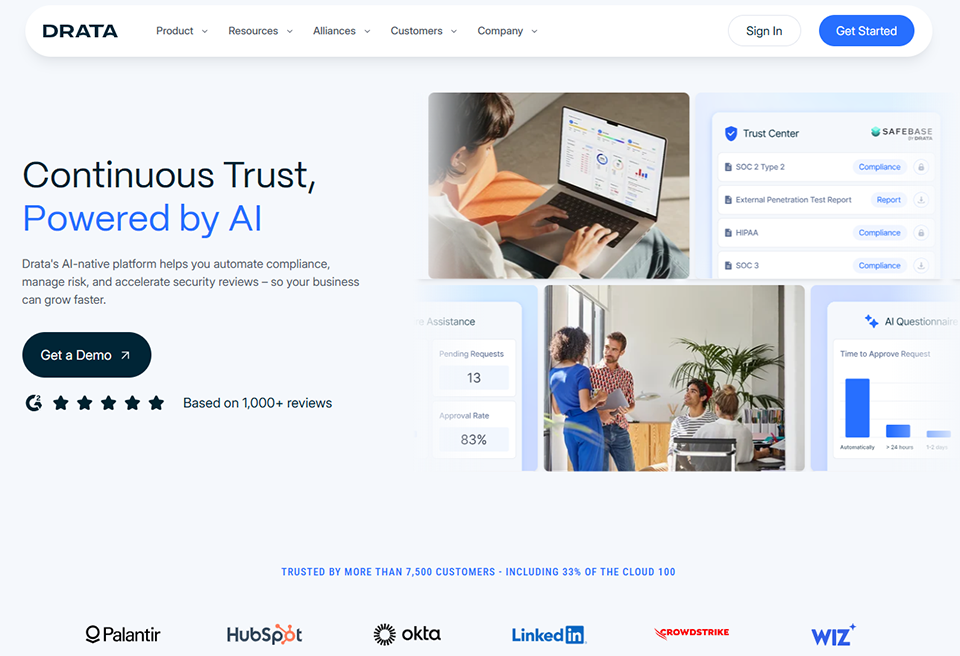
Drata is an automated GRC (Governance, Risk, and Compliance) platform. It was founded in 2020 and has experienced rapid growth, driven in particular by the surge in the number of companies seeking to obtain SOC 2-type certifications to convince their customers of the reliability of their security practices.
Drata's core concept is simple: compliance processes are still largely manual, time-consuming, and prone to errors. The platform connects your existing tools, automatically collects the evidence needed for your audits, continuously monitors your compliance posture, and alerts you when something goes wrong.
Drata manages the entire lifecycle of a security certification, from the initial implementation of controls through to the submission of evidence to your auditors. Its key features include:
It is interesting to note that Drata also offers integrations with tools such as Vanta and Sprinto, even though these platforms are direct competitors in the automated compliance segment.
Drata uses a quote-based pricing model that varies according to several criteria: the number of compliance frameworks targeted, the size of the organization, and the level of support requested.
What we know about the general outline:
Drata also offers solutions with enhanced support through certified partners (audit firms, security consultants), which can be a deciding factor if your team lacks in-house expertise in this area.
⚠️ Drata's rates are not publicly listed and vary significantly depending on the project. Request a quote directly to get an accurate estimate.
What really sets Okta apart in the market is the depth of its integration ecosystem. With more than 7,000 native connectors, it’s rare to come across a SaaS tool that isn’t supported. This makes it a platform particularly well-suited for organizations that have accumulated dozens of different applications and struggle to maintain visibility into who has access to what.
Okta's ability to manage complex hybrid environments is another key strength. If your organization uses a combination of on-premises Active Directory and cloud applications, Okta seamlessly bridges the gap.
Today, the majority of data breaches occur through stolen or poorly protected credentials. By centralizing authentication and strengthening MFA across all applications, Okta automatically reduces this attack surface.
In organizations where headcount fluctuates (such as fast-growing startups or companies that rely on freelancers or external contractors), the ability to automate the creation and revocation of access rights saves a considerable amount of time and ensures that no one retains access they are no longer authorized to have.
Okta's centralized logs provide detailed information about who accessed which system, when, and from which device. This data is invaluable for security audits or for meeting the requirements of frameworks such as SOC 2 or ISO 27001.
For software publishers or startups developing SaaS products, Okta’s Auth0 component makes it possible to integrate robust authentication flows (social login, passwordless login, and SSO for enterprise customers) without having to build everything from scratch.
✅ Exceptional integration ecosystem (7,000+ apps).
✅ Proven reliability and availability at scale.
✅ Comprehensive coverage of IAM needs: SSO, MFA, provisioning, governance.
✅ Robust Auth0 offering for developer-focused use cases.
✅ A clear and well-documented administration interface.
✅ Suitable for both small and medium-sized businesses and large companies.
⚠️ The cost can add up quickly as you enable additional modules.
⚠️ Initial setup and ramp-up may require technical support
Drata is based on an observation that many startup and SME leaders have experienced: obtaining SOC 2 or ISO 27001 certification is becoming an increasingly common business necessity, particularly when selling to corporate clients or entities in regulated sectors (healthcare, finance, government). But the process is lengthy, time-consuming, and technically demanding if you don’t have the right resources.
Drata automates whatever can be automated, which in practice accounts for a significant portion of the work: evidence collection, monitoring of controls, policy documentation, and risk management.
This is likely the most common use case among Drata's clients. A B2B startup seeking contracts with large companies regularly encounters detailed security questionnaires or certification requirements. Drata streamlines the path to certification and significantly reduces the time needed to obtain it.
Getting certified is one thing. Maintaining that certification over time is another story. Drata continuously monitors your controls to ensure they don’t drift, and alerts you before it becomes an issue during the annual audit.
Some organizations must comply with multiple standards simultaneously: a company that sells in the United States may need SOC 2 compliance, a European customer base may require GDPR compliance, and a specific industry may mandate ISO 27001 compliance. Drata manages this overlap of frameworks and identifies common controls to avoid duplication of effort.
Without a dedicated tool, compliance often falls on engineers or operations teams, who must interrupt their work to respond to auditors’ requests. Drata automates much of this evidence collection and frees up time for what truly matters.
✅ Advanced automation of evidence collection and control monitoring.
✅ Broad coverage of frameworks: SOC 2, ISO 27001, HIPAA, PCI-DSS, GDPR, NIST, and more.
✅ Integrations with the main tools in the tech stack (AWS, GCP, GitHub, Okta, Slack...).
✅ An easy-to-read interface that provides a clear overview of compliance status.
✅ An auditor portal that streamlines communication during audits.
✅ Integrated employee training modules.
⚠️ Pricing isn't transparent, which makes it difficult to compare with alternatives like Vanta or Sprinto.
⚠️ This tool is not a substitute for human security expertise: it automates tasks; it does not provide strategic advice.
⚠️ ROI is particularly evident for organizations that have a short- or medium-term certification goal.
⚠️ Some integrations may require a significant amount of initial setup.
Here’s an introduction to interpreting the table below: Okta and Drata operate at different layers of enterprise security. One protects real-time access, while the other structures and demonstrates your compliance over time. Their market positions hardly overlap, which is why many organizations end up adopting both.
| Criterion | Okta | Drata |
|---|---|---|
| Category: principale | IAM / Identity Management | GRC / Automated Compliance |
| Core Use Case | SSO, MFA, access provisioning | SOC 2 Certification, ISO 27001, Audit |
| Target audience | IT, SecOps, developers | CISO, legal teams, founders |
| Supported frameworks | N/A (access tool) | SOC 2, ISO 27001, HIPAA, PCI-DSS, GDPR... |
| Integrations | 7,000+ apps | ~100 key integrations (AWS, GitHub, Okta, etc.) |
| Pricing | Starting at $2 per user per month | Upon request |
| Level of complexity | Medium to high | Method |
| Core Value | Secure Access | Accelerate and Maintain Compliance |
| Complementarity | ✅ Integrates natively with Drata | ✅ Uses Okta data for its audits |
⚠️ The prices listed are for reference only and are subject to change. Please check directly with the publishers before making any decisions.
It is common for organizations to use Okta and Drata together. Okta secures day-to-day access and generates authentication logs. Drata, connected to Okta, automatically retrieves this data to incorporate it into audit evidence. Their complementary nature is well-documented, and the native integration between the two platforms is one of the most common in the Drata ecosystem.
If you have to decide on the order of implementation, the logical approach would generally be: Okta first to secure your access, and then Drata once certification becomes a business or regulatory priority.
Here are a few frequently asked questions to help you learn more, whether you're just discovering these tools or are still trying to decide between them.
No. These are two tools that operate at different levels of security. Okta manages identities and access in real time. Drata automates regulatory compliance and audit management. They are more complementary than competitive.
That's right. Drata connects to many different identity providers: Google Workspace, Microsoft Azure AD, JumpCloud, and others. Okta is one of the available integrations, but it's not a requirement.
Yes, provided there is a genuine need for centralized identity management. For a team of fewer than 10 people with few applications, the added value may be limited relative to the cost. However, as soon as the complexity of the SaaS stack increases or compliance issues arise, Okta quickly becomes a relevant solution.
SOC 2 Type I, which attests to the design of your controls at a specific point in time, can be obtained in a few weeks to a few months. SOC 2 Type II, which attests to ongoing effectiveness over an observation period (typically 3 to 12 months), naturally takes longer. Drata does not shorten the observation period, but it speeds up everything else that can be expedited.
It depends on your sales pipeline. If your corporate prospects consistently ask for SOC 2 certification before signing, you should weigh the cost of Drata against the potential loss of revenue. If compliance isn’t yet an urgent sales issue, lighter-weight alternatives may suffice for the time being.
No, Okta does not replace Active Directory; rather, it complements it. It acts as a federation layer between Active Directory (or other on-premises directories) and cloud applications. You can synchronize users between the two using Okta's AD agent.
For identity management, notable options include Microsoft Entra ID (formerly Azure AD), which is widely used in Microsoft ecosystems, and Auth0 as a standalone solution for developer-focused use cases. For automated compliance, Vanta and Sprinto are the alternatives most directly comparable to Drata, with slightly different positioning depending on the size of the organization and the targeted frameworks. For proactive security testing, Astra Pentest can serve as a useful complement to a compliance initiative.