





AutoCAD or AutoCAD LT: Which version should you choose to get started?
AutoCAD and AutoCAD LT look almost identical, but they’re not intended for the same users. In this guide, we…
Read more


Computer-aided design is no longer the exclusive domain of large engineering firms or automakers. By 2026, a freelance industrial designer, an entrepreneur a hardware startup working out of a coworking space will have access to the same modeling environments as a 200-person engineering firm. The widespread adoption of SaaS licenses and monthly subscriptions has profoundly reshaped the market.
But this abundance also creates a real dilemma. AutoCAD or SolidWorks? Autodesk Fusion for everything, or specialize in Revit for architecture? Maya for visualization, 3ds Max for interior rendering? The answers obviously depend on the industry, workflow, and budget, but also on less obvious criteria: compatibility with partners, export formats, the learning curve, and the required computing power.
This guide reviews the leading CAD software available on Freelance Stack. The goal: to give you enough information to make an informed choice without having to during months testing every tool!

AutoCAD is the gold standard in computer-aided drafting. Launched by Autodesk in 1982, it has literally shaped the way engineers, architects, and industrial designers work for over forty years. In 2026, the software remains the most widely used tool in international project tenders, subcontracting agreements, and technical specifications.
Its main strengths lie in its precision and versatility. AutoCAD handles both technical 2D drawings (working drawings, sections, elevations) and 3D wireframe and solid modeling. Its dimensioning, annotation, and layout tools are among the most advanced on the market. Version 2025 notably enhanced cloud collaboration features, with real-time synchronization via AutoCAD Web and the ability to annotate in the browser without a local installation.
The software now comes with industry-specific toolkits: AutoCAD Architecture, AutoCAD Electrical, AutoCAD MEP, AutoCAD Plant 3D, AutoCAD Map 3D, and others. Each version includes libraries of industry-specific components and tailored workflows. A full AutoCAD license theoretically provides access to all these versions through the Autodesk Industry Collections plan.
AutoCAD is available as a monthly, annual, or three-year subscription. The monthly plan typically costs between €230 and €260 (approximate price; check the Autodesk website for details), with discount available for annual subscriptions. Students and educators can access the software for free through the Autodesk Education program.
🏗️ The architect or structural engineer at a entrepreneur firm entrepreneur
AutoCAD remains must-have you work with clients or partners who require the DWG format. Even if you prefer to model in another tool, knowing how to read and create DWG files is a professional skill that is virtually essential in the construction and manufacturing industries.
🔧 The freelance drafting technician:
If your daily work involves creating detailed shop drawings for manufacturing or installation teams, AutoCAD 2D is hard to beat. Its layout environment, layers, and templates enable you to produce clean, standardized drawings.
🏭 The Methods Department of an industrial SME:
The comprehensive range of industry-specific toolkits (electrical, piping, process) makes the subscription worthwhile for teams that produce highly standardized technical deliverables.

AutoCAD LT is the lighter version of AutoCAD, designed for users who only need 2D technical drafting and don’t want to pay the price of a full license. The main differences: no 3D modeling, no customization via LISP or APIs, and no access to industry-specific toolkits.
On the other hand, it includes the core features of AutoCAD’s 2D technical drafting engine: precision, layer management, dimensioning tools, full DWG compatibility, and access to AutoCAD Web. For many professions, this is more than enough.
AutoCAD LT is significantly less expensive than AutoCAD (about 60 to 70% of the price of the full version; check directly with Autodesk). This is a significant consideration for a entrepreneur primarily produces 2D drawings.
📐 The specialized 2D designer:
If your work involves only creating construction drawings, technical diagrams, or 2D manufacturing documentation, AutoCAD LT meets 100% of your needs at a lower cost.
🏠 The artisan or small design firm:
For an electrician, a plumber, or a small interior design firm that needs to produce clear drawings without complex modeling, LT offers a sensible introduction to the world of AutoCAD.

Autodesk Fusion (formerly Fusion 360) is arguably the software that has shaken up the CAD market the most over the past decade. The original concept behind the product was ambitious: to bring together parametric 3D modeling, simulation, CAM (computer-aided manufacturing), and team collaboration into a single cloud-based platform.
This endeavor has been a resounding success. Fusion now covers an impressive range of needs: solid and surface modeling, sheet metal design, direct sculpting, mechanical simulation (static, thermal, modal), CNC machining programming (milling, turning, waterjet cutting), design for 3D printing, and even PCB design for electronics via Eagle integration. All within a cloud-based environment that facilitates version control and collaboration.
The cloud-native approach is a double-edged sword: it greatly simplifies collaboration and access management, but it requires an internet connection and can sometimes raise data sovereignty concerns for sensitive projects. In offline mode, features remain accessible but with limitations.
Fusion offers a free plan for students, enthusiasts, and startups with revenue below a certain threshold (check the Autodesk website, as terms and conditions have changed). The Fusion (Standard) plan is affordable on a monthly basis. The Plus and Premium plans add advanced machining capabilities, multiphysics simulation, and advanced data management.
⚙️ The maker, hardware designer, or technical founder of a startup:
Fusion is THE go-to solution for anyone designing physical products without a dedicated engineering team. Its combination of modeling, simulation, and CAM makes it an incredibly comprehensive tool for taking an idea from concept to a machined or 3D-printed prototype without having to juggle ten different software programs.
🔩 Freelancing in mechanical engineering:
Fusion's parametric capabilities rival those of much more expensive solutions. Constraint management, assemblies, product configurations-everything an engineer needs to deliver robust industrial designs is right here.
🎓 The student or enthusiast just starting out:
The free plan (subject to terms and conditions) is a great opportunity to learn how to use a professional tool before entering the job market or launching a project.

SolidWorks, published by Dassault Systèmes, has been one of the world's leading software solutions since the 1990s in parametric mechanical modeling. While AutoCAD is the standard for 2D technical drafting, SolidWorks is its equivalent in 3D engineering: when an industrial client mentions a format .SLDPRT or .SLDASM According to the specifications, there is no room for discussion.
The software excels in all aspects of mechanical part design, complex assemblies, and standardized drafting. Its handling of parametric constraints, assembly kinematics, sheet metal tools, molds, and specialized functions such as SolidWorks Weldments (steel structures) or Routing (piping and wiring) make it a tool with a depth of functionality that is hard to match.
SolidWorks also includes capabilities for simulation (SolidWorks Simulation), realistic rendering (Visualize), flow analysis (Flow Simulation), and product data management (PDM). These modules are sold separately, which can drive up costs for a small business.
It is worth noting how the product has evolved: Dassault Systèmes is gradually steering its customers toward its 3DEXPERIENCE ecosystem (cloud, collaboration, PLM), without, however, abandoning SolidWorks in its traditional desktop version, which remains the preferred choice of the majority of current users.
SolidWorks has traditionally been sold as perpetual licenses with maintenance contracts. The SaaS version (3DEXPERIENCE SolidWorks) is available on a monthly or annual subscription basis. The prices are significantly higher than those of Autodesk Fusion. This investment is more justified for professionals for whom this is their core business.
🏭 Senior mechanical engineer or specialized engineering firm:
SolidWorks is the go-to tool for ambitious mechanical design projects: injection-molded parts, multi-body assemblies, and articulated mechanisms. If your clients expect SolidWorks deliverables, there’s no question about it.
🔨 Special-purpose machine or tool designer:
The software's functional depth-particularly its sheet metal, welding, and structural design tools-is particularly well-suited for professionals who design custom industrial equipment.
🎓 An engineering school graduate:
SolidWorks is taught in the vast majority of engineering programs in France and Europe. Proficiency in the software is often listed as a requirement in freelance job postings from engineering firms.

Revit is the industry-standard software for BIM (Building Information Modeling) in the construction sector. Revit LT is a streamlined version designed for small architecture firms and professionals who need BIM without the advanced collaboration and analysis features of the full version.
It’s worth revisiting the concept of BIM: unlike traditional drafting software, Revit doesn’t simply draw lines on a plan. It builds an intelligent 3D model whose 2D views (plans, sections, elevations, details) are generated automatically and remain synchronized. Change the height of a wall in the model, and all your views update automatically. Insert a window, and the corresponding opening appears everywhere. This improvement in consistency is significant on complex architectural projects.
Revit LT retains the essential features: 3D architectural modeling, automatic generation of plans and sections, quantity takeoffs, IFC export for interoperability, and basic rendering. Features omitted compared to the full version of Revit include multi-user collaboration on a central model, certain analysis tools (energy, daylighting), and some advanced parametric family features.
Revit LT is available as a monthly or annual subscription at a lower price than the full version of Revit. It is also included in certain Autodesk collections (Architecture, Engineering & Construction Collection).
🏠 The entrepreneur small firm (2 to 5 people):
If you work alone or in a very small team on residential, small commercial, or interior design projects, Revit LT offers the benefits of BIM without the complexity of managing a shared central model.
📐 The Draftsman as Project Manager:
The automated generation of consistent graphic documents (site plans, construction drawings, and facade details) saves a significant amount of time compared to traditional 2D AutoCAD workflows.
🏗️ The mechanical or structural engineer who works with architects:
Although multi-body collaboration is limited in LT, IFC compatibility enables seamless data exchange with other BIM software (Tekla, ArchiCAD, Allplan).


Maya isn't strictly speaking industrial CAD software. It's a content-driven 3D creation environment designed for characters, environments, visual effects, animation, video games, and film. While SolidWorks is used to design a clock mechanism, Maya is used to animate that same mechanism for a marketing video or a game cutscene.
But the line between the two worlds has become blurred. Product design studios use Maya to create photorealistic visualizations of prototypes before manufacturing. Industrial design firms use it for animated architectural or mechanical renderings. And in the most sophisticated production pipelines, geometric data from CAD software is imported into Maya for the final rendering.
Technically, Maya offers polygonal and NURBS modeling, a skeletal animation (rigging) system, cloth, fluid, and crowd simulation, particle effects, and a built-in Arnold (ray-tracing) render engine. It interfaces with virtually all third-party rendering engines (V-Ray, Redshift, RenderMan) and integrates into the production pipelines of major studios.
Maya is available as a monthly or annual subscription. It is also included in the Autodesk Media & Entertainment Collection.
🎬 3D artist, animator, or VFX artist:
Maya is the go-to tool for animation and VFX studios. If you're a freelancer in these fields, proficiency in Maya is often a non-negotiable requirement.
🎮 Game artist or technical artist:
Maya integrates natively with Unreal Engine and Unity pipelines. Its rigging and animation tools are among the most powerful available for creating characters and game assets.
📸 The product designer who wants photorealistic marketing visuals:
By combining imports from Fusion or SolidWorks with Arnold's rendering capabilities, Maya enables the creation of presentation-quality images and videos that are difficult to achieve using purely CAD tools.
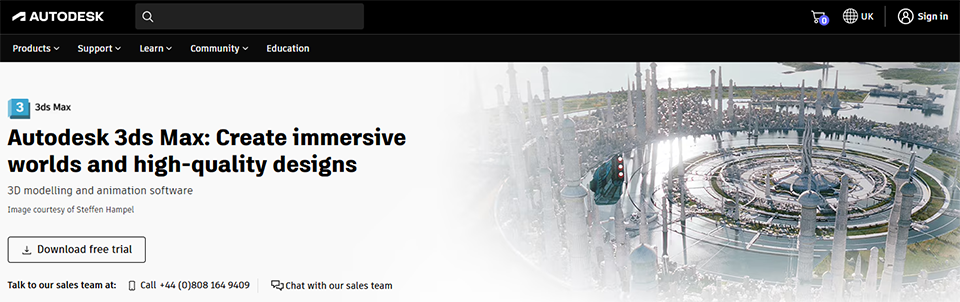
3ds Max occupies a different niche from Maya within the Autodesk ecosystem. While Maya is designed for character animation and cinematic VFX, 3ds Max has established itself in architectural visualization, interior design, and interactive media production (particularly PC and console video games).
The software excels at creating realistic architectural scenes: photorealistic materials, advanced lighting management (both artificial and natural lighting via solar systems), and high-quality renders using Arnold, V-Ray, or Corona Renderer. For architects or interior designers who need to present a project to clients using compelling computer-generated images, 3ds Max remains a top choice.
It also offers advanced polygonal modeling tools, a highly flexible modifier system, scripting via MAXScript and Python, and a rich asset library. Creating virtual tours and presentation animations is a common use case.
3ds Max is available as a monthly or annual subscription, or as part of Autodesk's Media & Entertainment Collection.
🏠 Interior designers or decorators looking for eye-catching visuals:
3ds Max is one of the best tools for creating architectural renderings that impress clients. When used with V-Ray or Corona, the results can be mistaken for photographs.
🎮 Game artist specializing in environments and assets:
3ds Max has long been widely used in video game studios for creating environments, buildings, and props. Its polygonal modeling workflow is highly regarded for this type of content.
🏗️ The architecture firm that produces building permit renderings:
In addition to the building permit itself (which can remain in 2D), 3ds Max allows you to create the presentation renderings and site renderings that clients and planning commissions require.
Seven tools, each with very different features: The table below summarizes the key criteria to help you quickly make an informed choice based on your industry and production needs.
| Criterion | AutoCAD | AutoCAD LT | Autodesk Fusion | SolidWorks | Revit LT | Maya | 3ds Max |
|---|---|---|---|---|---|---|---|
| Primary use | Versatile 2D and 3D Design | Pure 2D drawing | CAD + CAM + simulation | Mechanical Engineering | BIM Architecture | Animation/VFX | Visualization/Rendering |
| 3D Modeling | ✅ Solid/Wire | ❌ | ✅ Advanced Parametric | ✅ Advanced Parametric | ✅ BIM | ✅ Polygonal/NURBS | ✅ Polygonal |
| Technical 2D | ✅ Excellent | ✅ Excellent | ✅ Drafting | ✅ Drafting | ✅ BIM views | ❌ | ❌ |
| Simulation | ❌ | ❌ | ✅ (Standard+ plan) | ✅ (separate module) | ❌ | ❌ | ❌ |
| CAM/Machining | ❌ | ❌ | ✅ | ❌ (via partners) | ❌ | ❌ | ❌ |
| Rendering/Visualization | ✅ Basic | ❌ | ✅ Built-in rendering | ✅ Visualize | ✅ Basic | ✅ Arnold | ✅ Arnold/V-Ray |
| BIM | ❌ | ❌ | ❌ | ❌ | ✅ | ❌ | ❌ |
| Cloud collaboration | ✅ | ✅ | ✅ Native | ✅ (3DEXPERIENCE) | ✅ Limited | ❌ | ❌ |
| Learning curve | High | Moderate | Moderate to high | High | High | Very high | High |
| Price range | 💰💰💰 | 💰💰 | 💰💰 | 💰💰💰💰 | 💰💰 | 💰💰💰 | 💰💰💰 |
| Ideal Profile | Draftsman, versatile engineer | 2D Designer | Maker, mechanical engineer | Senior Mechanical Engineer | Architect and entrepreneur | 3D artist, animator | Interior designer, game artist |
The most frequently asked questions before choosing CAD software, compiled here so you don't have to look elsewhere.
CAD (Computer-Aided Design) generally refers to all types of digital modeling software, whether used in mechanical engineering, electronics, or architecture. BIM (Building Information Modeling) is an approach specific to the construction industry in which the 3D model incorporates structured data (materials, costs, thermal performance, etc.) that goes far beyond simple geometry. Revit LT is BIM software; AutoCAD is CAD software. Both can be used together in the same project.
It all depends on your goal. If you need to produce 2D technical drawings or work in construction or manufacturing with partners who use DWG files, AutoCAD is the obvious choice. If you want to design physical objects or products (prototyping, manufacturing, 3D printing), Autodesk Fusion is more comprehensive and more accessible for those new to 3D. For users starting out without any compatibility constraints, Fusion often offers better value for money.
For a senior mechanical engineer working on complex industrial projects with clients who require SolidWorks: yes, the investment is justified. For a maker, a hardware startup, or a freelancer designing products without format constraints, Autodesk Fusion meets the vast majority of needs at a significantly lower cost. The issue of compatibility with the client’s ecosystem is often the deciding factor.
Autodesk Fusion is best suited for 3D printing design: it includes specialized tools (such as support generation and geometry analysis) and natively exports to STL, OBJ, 3MF, and other formats compatible with slicers (PrusaSlicer, Bambu Studio, Cura, etc.). SolidWorks and AutoCAD also export to STL, but without the same design tools for 3D printing. Maya and 3ds Max can export geometry intended for printing, but are not designed for this workflow.
DWG (Drawing) is AutoCAD’s native file format, created by Autodesk in 1982. It has become the de facto standard for exchanging technical drawings in the construction and global industrial sectors. Virtually all reputable CAD software can import and export DWG files, but compatibility levels vary. If your clients or partners work in DWG, choosing AutoCAD (or AutoCAD LT) will help you avoid conversion issues and data loss during import/export.
For pure architectural visualization (static interior and exterior renderings, presentation animations), 3ds Max has historically been the dominant choice, particularly in Europe. Its ecosystem of architecture plugins (libraries of materials, vegetation, and lighting) and its compatibility with Corona Renderer and V-Ray make it a highly effective tool for this use case. Maya is the preferred choice if the project involves character animation, complex visual effects, or a film/video game production pipeline.
Yes, a few are worth mentioning even though they aren’t listed on Freelance Stack FreeCAD is a rapidly evolving open-source parametric 3D modeling software; Blender, also open source, has become a major player in artistic 3D modeling and animation; OpenSCAD is suitable for makers who prefer script-based modeling. These tools are viable for personal use or projects without client format constraints, but will not replace professional software in most industrial contexts.