






The Best Software for Streaming Events Online
This guide was designed to help you get a clear picture. Here you'll find a detailed overview of the best…
Read more


Many entrepreneurs and freelancers put off launching their first paid ads. The fear of burning through their budget, setting up their campaigns incorrectly, or not understanding the metrics—these are legitimate concerns. And yet, the reality of the market is quite clear: SEO takes time, organic social media is losing reach, and the competition never sleeps.
The good news is that launching effective advertising campaigns no longer requires an agency-level budget or six months of training. Platforms have significantly simplified their interfaces, and third-party tools now make it possible to automate much of the creative and analytical work.
This guide is designed to demystify paid online advertising. We’ll take a look at the main platforms available, the tools that make your day-to-day life easier, and practical strategies for getting started the smart way—without wasting your budget on poorly targeted campaigns.
What matters isn’t spending more. It’s spending better.

Google Ads remains, by far, the most widely used advertising channel in the world. In 2024, Google still accounted for more than 39% of global digital advertising spending. The reason is simple: you reach people who are actively searching for what you offer. It’s not an interruption—it’s a response to a request.
Google Ads primarily operates on a cost-per-click (CPC) bidding system. You select keywords, write text ads, and your ad appears when a user performs a search that matches those keywords. The cost depends on competition for the targeted keywords and your ads’ Quality Score (a combination of relevance, expected click-through rate, and landing page experience).
In addition to traditional Search ads, the platform also offers:
Google Ads provides a suite of tools to manage your campaigns: the Keyword Planner to estimate search volumes and CPCs, ad extensions to enhance your ads (additional links, reviews, phone numbers), and a conversion tracking system to accurately measure results. The platform integrates natively with Google Analytics 4 and Google Merchant Center.
The B2B freelancer or consultant:
Will find in Google Ads a powerful lever to capture prospects in the active search phase. A well-structured campaign on niche keywords can generate qualified leads at reasonable costs, provided the landing page is well designed.
The e-retailer:
Will particularly benefit from Google Shopping, which displays products and prices directly in search results, with conversion rates often higher than traditional text ads.
The startup in its launch phase:
Will be able to test real demand for their product before investing heavily in other channels. Google Ads gives almost immediate feedback on what works.

If your target audience is a professional one, LinkedIn Ads is likely the most precise channel available. The platform allows you to target users by job title, industry, company size, years of experience, and even self-reported skills. No other social media platform offers this level of precision when targeting a professional audience.
If your target audience is a professional one, LinkedIn Ads is likely the most precise channel available. The platform allows you to target by job title, industry, company size, seniority level or even listed skills. No other social network offers this level of precision on a professional audience.
Targeting is the platform’s real strength. You can combine very specific criteria: for example, targeting only “Heads of Marketing” at SaaS companies with 50 to 500 employees in France. This level of precision comes at a price.
LinkedIn offers a particularly effective Lead Gen Forms system: the contact form is pre-filled with data from the LinkedIn profile, which significantly reduces friction and increases conversion rates. The platform also features a conversion pixel for retargeting and analyzing results.
This cost is justified by the quality of the leads generated, but you have to accept a model with lower volume and higher value per lead.
Agencies and consulting firms:
Looking to land significant B2B contracts will find what they need here, provided their average deal value is high enough to offset the acquisition cost.
SaaS software vendors:
When targeting CIOs, marketing directors, or HR directors, there simply isn’t a more precise alternative. LinkedIn remains the go-to network for this type of targeting.
Professional trainers and coaches:
Can use LinkedIn Ads to reach executives in career transitions or managers looking to develop new skills.

TikTok has surpassed 1 billion monthly active users and has established itself as one of the most attractive advertising channels in terms of cost-per-engagement, particularly for reaching 18- to 35-year-olds. CPMs on the platform are still lower than those of Meta or Google in most industries, making it a real opportunity for brands that know how to create native content.
TikTok Ads Manager offers several formats: In-Feed Ads (ads integrated into the “For You” feed), TopView (ads that appear as the first video visible when the app opens), Branded Hashtag Challenges (participatory campaigns), and Spark Ads (which boost existing organic content). For those just getting started, In-Feed Ads are the most accessible format.
TikTok’s recommendation engine is particularly powerful for targeting based on interests and behaviors. The platform quickly learns which profiles convert and automatically optimizes ad delivery.
TikTok Ads Manager includes a video creation tool (Video Editor) built right into the interface, allowing users to produce content in the appropriate formats without needing external software. The platform also offers a pixel system for retargeting, lookalike audiences, and detailed reports on creative performance.
E-commerce brands:
Targeting millennials and Gen Z, they have everything to gain by testing TikTok Ads. The short video format is perfect for product demos, unboxings or quick tutorials.
Content creators and online instructors:
Can leverage the TikTok algorithm to reach a wide audience at lower cost, with Spark Ads that boost their best-performing organic content.
Startups with a visual or lifestyle product:
Will benefit from the native, authentic feel of the format to build initial awareness without a massive investment.


One of the most common obstacles for small businesses looking to run ads is the production of creative assets. Hiring a designer for each ad variation is expensive and time-consuming. AdCreative.ai directly addresses this issue by automatically generating ad creatives optimized for performance.
AdCreative.ai is an artificial intelligence tool specialized in generating advertising visuals. You enter your brand details (logo, colors, key text), and the platform generates dozens of creative variations tailored to the different formats of advertising platforms (Facebook, Instagram, Google Display, LinkedIn, etc.). Each creative receives a performance score predicted by AI, based on thousands of analyzed campaign data points.
The platform offers the ability to generate advertising copy (headlines, descriptions) in addition to visuals, industry-specific templates, and direct integration with major ad platforms for seamless export of creative assets. AdCreative.ai also offers A/B testing features to identify the best-performing creative assets for your audience.
Solo entrepreneurs:
Who do not have the budget for a designer but want professional visuals for their campaigns will save considerable time with AdCreative.ai.
Agencies that manage multiple clients:
Can automate much of their creative production and focus on strategy rather than execution.
E-retailers:
With product catalogs can quickly generate visual variations to test different creative approaches without multiplying production costs.
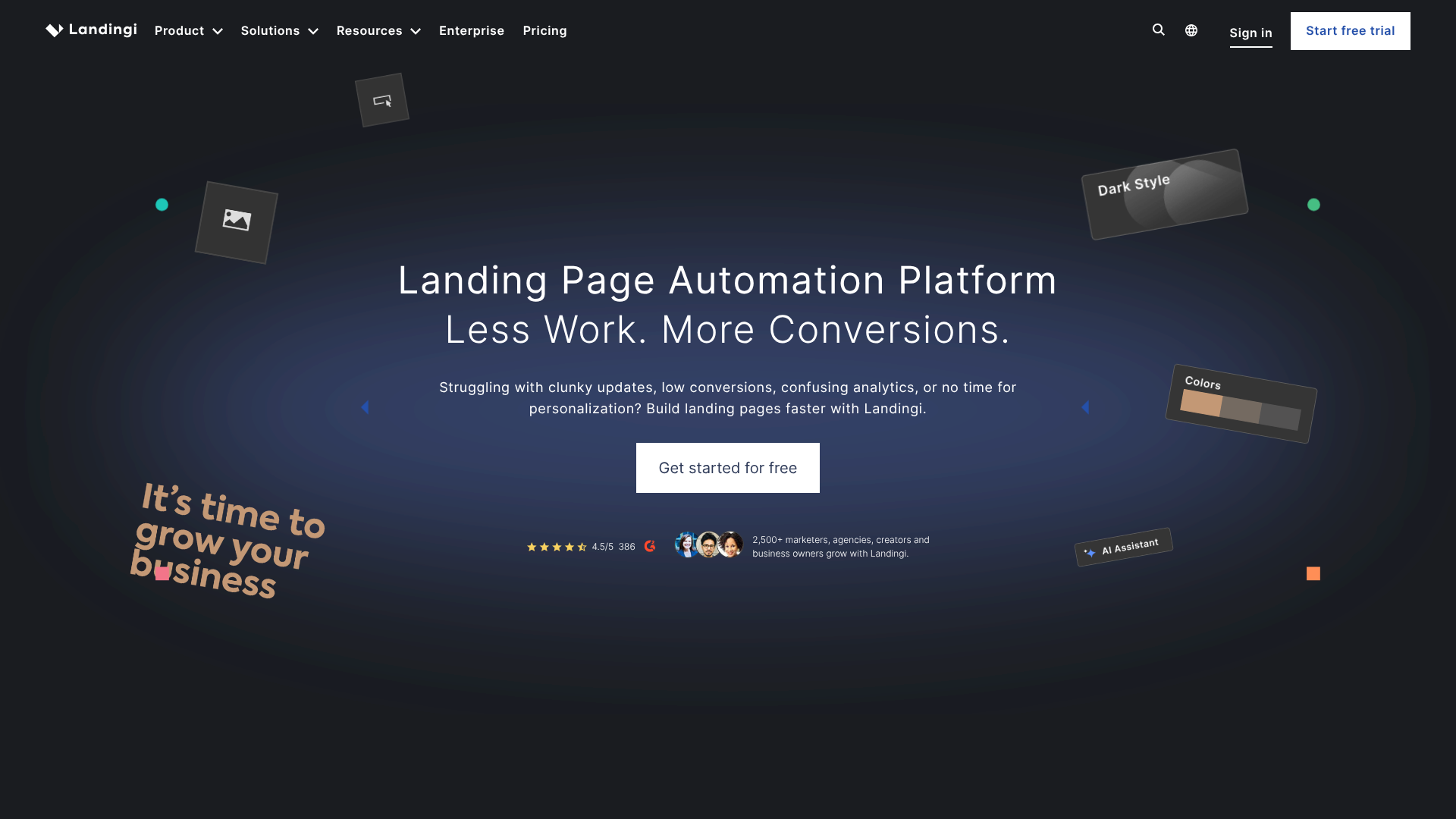
Directing paid traffic to a generic homepage is one of the most common mistakes made by novice advertisers. A successful ad campaign needs a dedicated landing page designed to convert. Landingi is the tool that lets you create these pages without writing a single line of code.
Landingi is a drag-and-drop landing page builder. The platform offers more than 300 templates designed for various purposes (lead generation, direct sales, event registration, content downloads, etc.). Every element is customizable, and the pages can be integrated with the leading marketing tools on the market.
What sets Landingi apart from a basic website builder is its focus on conversion: the templates are designed to guide visitors toward a specific action, with social proof, optimized forms, and well-placed CTAs.
Landingi includes a built-in A/B testing tool to compare different versions of the same page. The platform also offers pop-ups and smart forms, a conversion tracking system, and native integrations with Google Analytics, the most popular CRMs, and email marketing tools. Pages created on the platform are responsive by default and optimized for fast loading speeds.
Freelancers and consultants:
who generate leads through online advertising need dedicated pages for each offer or customer segment. Landingi makes it possible to create these pages quickly and test them without technical assistance.
Small marketing teams:
without an available front-end developer can roll out complete campaigns on their own, from page creation to results analysis.
Trainers and coaches:
offering webinars, training courses or discovery sessions can create optimized registration pages in a few hours.
Before diving into the comparison chart, here’s a quick overview based on your situation:
You sell to businesses (B2B) and have a high average order value:
LinkedIn Ads is your natural starting point. The cost per click is higher, but the quality of the leads generally justifies the investment if your product or service sells for between €500 and several thousand euros.
Do you have a consumer product or an e-commerce product?:
You have a consumer or e-commerce product:
You’re starting with a small budget (less than €500 per month):
TikTok for Business offers the most competitive CPMs. Start by testing your creative content there before moving on to more expensive channels.
You don’t have a designer:
AdCreative.ai is a must-have tool for creating high-quality visuals without blowing your creative budget.
You don’t want to direct your paid traffic to your main site:
Landingi lets you create dedicated pages for each campaign, which automatically improves your conversion rates and return on investment.
Pricing information is for reference only and is subject to change. We recommend that you check prices directly on each platform before making a commitment.
| Criterion | Google Ads | LinkedIn Ads | TikTok for Business | AdCreative.ai | Landingi |
|---|---|---|---|---|---|
| Type | Ads platform | Ads platform | Ads platform | AI creative tool | Landing page builder |
| Primary target | General-purpose B2C / B2B | Professional B2B | B2C / ages 18–35 | All advertisers | All advertisers |
| Minimum budget | Flexible (€300/month recommended) | €10/day | €50/campaign | ~29 $/month | ~29 $/month |
| Average cost per click | €0.50 to €15 | €5 to €15 | €0.10 to €1.50 | N/A | N/A |
| Learning curve | Moderate | Moderate to high | Low to moderate | Low | Low |
| Ideal for beginners | ✅ Yes | ⚠️ High budget | ✅ Yes | ✅ Yes | ✅ Yes |
| B2B | ✅ | ✅✅ | ❌ | ✅ | ✅ |
| E-commerce | ✅✅ | ❌ | ✅✅ | ✅ | ✅ |
| Freelance Stack Deal | ✅ | ✅ | ✅ | ✅ | ✅ |
FAQ: online advertising for beginners.❓
There’s no one-size-fits-all budget, but a practical rule of thumb applies: set aside at least €300 to €500 per month to gather enough data to optimize your campaigns. Below that, the algorithms lack the data they need to learn. On TikTok for Business, you can test with a slightly lower budget thanks to lower CPMs. On LinkedIn Ads, you’ll need to be prepared to invest more to achieve scale.
It all depends on your goal. If you’re targeting people who are actively looking for your product or service (purchase intent), Google Ads is the right place to start. If you’re looking to build brand awareness or reach an audience that isn’t yet familiar with you, social media (TikTok, LinkedIn, depending on your target audience) is a better fit. Most experienced advertisers use both in tandem.
Yes, and the impact is often dramatic. A generic homepage leads to high bounce rates because it isn’t designed to address the specific intent of your ad. A dedicated landing page, created with a tool like Landingi, aligns the ad’s message with the landing page and can double or triple conversion rates in some cases.
The key metric is ROAS (Return on Ad Spend) for e-commerce, or cost per lead (CPL) for lead generation. Before launching, set a target customer acquisition cost (CAC) that you’re willing to pay for a customer. If your average order value is €200 and your margin is 40%, you can afford to spend up to €60–70 to acquire a customer. This figure guides all your optimization decisions.
To get started, it’s often best to understand the mechanics yourself, even if you later outsource the work. Today’s tools (Google Ads, TikTok Ads Manager) are well-documented, and there are excellent resources available to help you learn quickly. An agency adds value for significant budgets (starting at €3,000 to €5,000 per month), where advanced optimization justifies its fees.
E-commerce, SaaS software, online training, value-added B2B services, and real estate are among the sectors where return on advertising investment is generally the best documented. That said, almost any sector can benefit from online advertising, provided it clearly defines its target audience and message.
There are several ways to minimize waste: use negative keywords in Google Ads to exclude irrelevant searches, refine your demographic and geographic targeting, leverage lookalike audiences based on your best current customers, and optimize your bids based on the best-performing time slots and devices. On Google Ads in particular, the list of excluded keywords is often underutilized by beginners.
That is precisely the value offered by a tool like AdCreative.ai. The platform automatically generates visuals tailored to your formats and brand guidelines, complete with a predicted performance score. This allows you to quickly test multiple creatives without relying on an external vendor.
CPM (cost per thousand impressions) measures what you pay for every 1,000 times your ad is displayed. CPC (cost per click) is what you pay each time a user clicks on your ad. CPL (cost per lead) is what you pay for each qualified lead you receive. These three metrics complement each other: a low CPM is only useful if the click-through rate (CTR) is high enough to generate a significant volume of traffic.
Paid online advertising isn’t just for large companies with dedicated teams and substantial budgets. The tools available today allow a small business or an independent professional to launch serious campaigns with a few hundred euros a month, provided they choose the right channel for their target and don’t overlook the elements that make all the difference: the quality of the creative, the relevance of the landing page, and rigorous tracking of results.
The platforms featured in this guide (Google Ads, LinkedIn Ads, TikTok for Business) cover most use cases for entrepreneurs and freelancers. Complementary tools such as AdCreative.ai and Landingi help maximize the return on investment for every euro spent on advertising.
If you’re also looking to enhance your marketing stack with email and automation tools to support your campaigns, you can check out our recommendations on Brevo or explore SEO tools like SEMrush to refine your keyword strategy before launching your first ads.
Paid advertising works best when it’s part of a cohesive strategy. Start small, measure everything, and make adjustments quickly.