





Our selection of cybersecurity tools for small and medium-sized businesses.
This ranking reviews the best cybersecurity tools available to SMEs and entrepreneurs 2026…
Read more


In just a few years, cybersecurity has become one of the most critical issues for businesses of all sizes. And yet, many organizations—from startups to small and medium-sized businesses to freelancers who handle sensitive data—continue to devote insufficient resources to it, often because they lack visibility into the actual risks or because the subject seems too complex to tackle.
The figures speak for themselves: according to IBM’s annual report on the cost of data breaches, the average cost of a cyberattack reached $4.88 million in 2024 worldwide, an all-time high. In France, ANSSI (the national information systems security agency) recorded a 30% increase in reported incidents between 2022 and 2024. Micro-businesses and SMEs are now prime targets: more accessible than large groups, they often hold data valuable enough to interest attackers.
So it's no longer a matter of size or industry. The question isn't whether you'll be targeted, but when.
Fortunately, in this context there is an ecosystem of robust, accessible SaaS tools designed for teams that do not necessarily have a dedicated IT department. We have selected 10 complementary solutions to cover the most common attack vectors: access protection, network security, compliance, monitoring and password management.
Here is a structured overview to help you build a truly secure infrastructure in 2026.

1Password is undoubtedly the most mature password manager on the market for enterprise use. Founded in 2005, it has established itself as the go-to solution for teams that need to securely share login credentials while maintaining granular control over access.
The concept is simple: centralize all your passwords, SSH keys, API tokens, and credentials in an encrypted vault that’s accessible from any device. But 1Password goes far beyond simple storage. The solution lets you create team-shared vaults, finely control access rights, and enforce security policies across your entire organization.
The Watchtower feature monitors in real time whether your credentials have been compromised in known data breaches. The 1Password Business module includes native Single Sign-On (SSO) integration with providers such as Okta, Azure AD, and Google Workspace. Management of developer secrets (API keys, tokens, environment variables) is also integrated via 1Password Secrets Automation, making it a particularly popular tool among tech teams.
Secret management and CLI integration make it possible to automate the retrieval of credentials without exposing them in configuration files. This saves a considerable amount of time for teams that have to manage numerous API keys and service tokens.
Shared vaults let you grant or revoke access in just a few seconds, which is especially useful when employees join or leave the company. There’s no longer any need to send passwords via email or instant messaging.
1Password offers a way to organize access management from the moment new employees are hired, without having to manage a complex infrastructure. It's a great way to establish good habits before the situation becomes unmanageable.
✅ The interface is exceptionally well-designed and intuitive, which makes it easy for all employees to adopt without extensive training.
✅ Developer secret management is natively integrated, and data leak monitoring via Watchtower works in real time.
✅ SOC 2 Type 2 and GDPR compliance is documented and up to date, which facilitates communication with auditors.
⚠️ There is no free plan for teams—only a 14-day trial—which may limit the ability to evaluate the service over the long term.
⚠️ Pricing can also become significant for large teams if they add up the costs of advanced modules.

Keeper targets a slightly different market segment than 1Password: while 1Password focuses on user experience and developer integration, Keeper emphasizes regulatory compliance and audit capabilities. It is the solution of choice for companies that need to demonstrate compliance with standards such as SOC 2, HIPAA, ISO 27001, and the GDPR.
The solution is based on a zero-knowledge architecture: not even Keeper can access your data. Everything is encrypted locally using AES-256 before being sent to the servers.
The BreachWatch module monitors the dark web for compromised credentials associated with your organization. KeeperMSP is a version designed specifically for IT service providers who manage multiple clients. Detailed audit reports allow you to track every instance of access, modification, or sharing of credentials, which is essential for compliance purposes.
The solution also includes a remote connection manager (Keeper Connection Manager) for RDP, SSH, and MySQL access without having to expose a VPN.
The financial, healthcare and legal sectors particularly appreciate the audit capabilities and the built-in compliance reports. Every access and every change to a credential is tracked and exportable, which considerably simplifies audit preparation.
KeeperMSP is a dedicated version that allows you to manage access for multiple clients from a centralized interface. It organizes permissions and vaults by client, with strict data separation.
Keeper serves as the foundation for a PAM (Privileged Access Management) strategy to control access to critical systems. Its granular access rights and comprehensive audit trails make it a robust tool for environments with high security requirements.
✅ The audit trail is comprehensive and exportable, which is rare at this level of detail in this price range.
✅ The zero-knowledge architecture is thoroughly documented, and privileged access management is natively integrated.
✅ Compliance with major standards (SOC 2, HIPAA, ISO 27001) is a strong selling point for companies subject to these requirements.
⚠️ The interface is a bit more austere than some competitors', which may slow down adoption by non-technical users.
⚠️ Implementing enterprise features also requires a significant amount of setup time before they are fully operational.



NordVPN Teams (now part of NordLayer, the B2B division of Nord Security) is the best-known VPN solution on the consumer market that has successfully transitioned to the enterprise sector. For teams working remotely, from coworking spaces, or on public networks, a professional VPN remains one of the first lines of defense.
NordVPN encrypts all internet traffic and hides users' real IP addresses, making it virtually impossible to intercept data on unsecured networks.
The NordLynx protocol (based on WireGuard) offers significantly better performance than traditional VPNs, with minimal latency. The Threat Protection feature blocks trackers, malicious ads, and phishing attempts directly at the network traffic level. Meshnet allows you to create private networks between multiple devices on your team, which is useful for accessing internal resources without exposing a public server.
Logging in regularly from hotels, airports, or coworking spaces exposes your work data to real risks. NordVPN protects all your traffic transparently, without the need for complex setup every time you connect.
Consolidating traffic on a secure network simplifies access to geo-restricted resources and ensures a consistent level of protection for all team members, regardless of their location.
The fact that the apps are available on all devices (Windows, Mac, iOS, Android, Linux) and are easy to use makes them a viable option, even for non-technical users who want one-click protection.
✅ Performance is high thanks to the NordLynx protocol, with latency significantly lower than that of traditional VPNs.
✅ The network covers more than 6,500 servers in 111 countries, and the no-logs policy has been audited by independent third parties.
✅ The interface is user-friendly even for non-technical users, which promotes seamless adoption.
⚠️ The consumer version is not designed for centralized team management: for that purpose, NordLayer is a better fit, though it has a different pricing structure.
⚠️ There is also no fine-grained management of access policies at the organizational level, which may limit its use in more structured contexts.
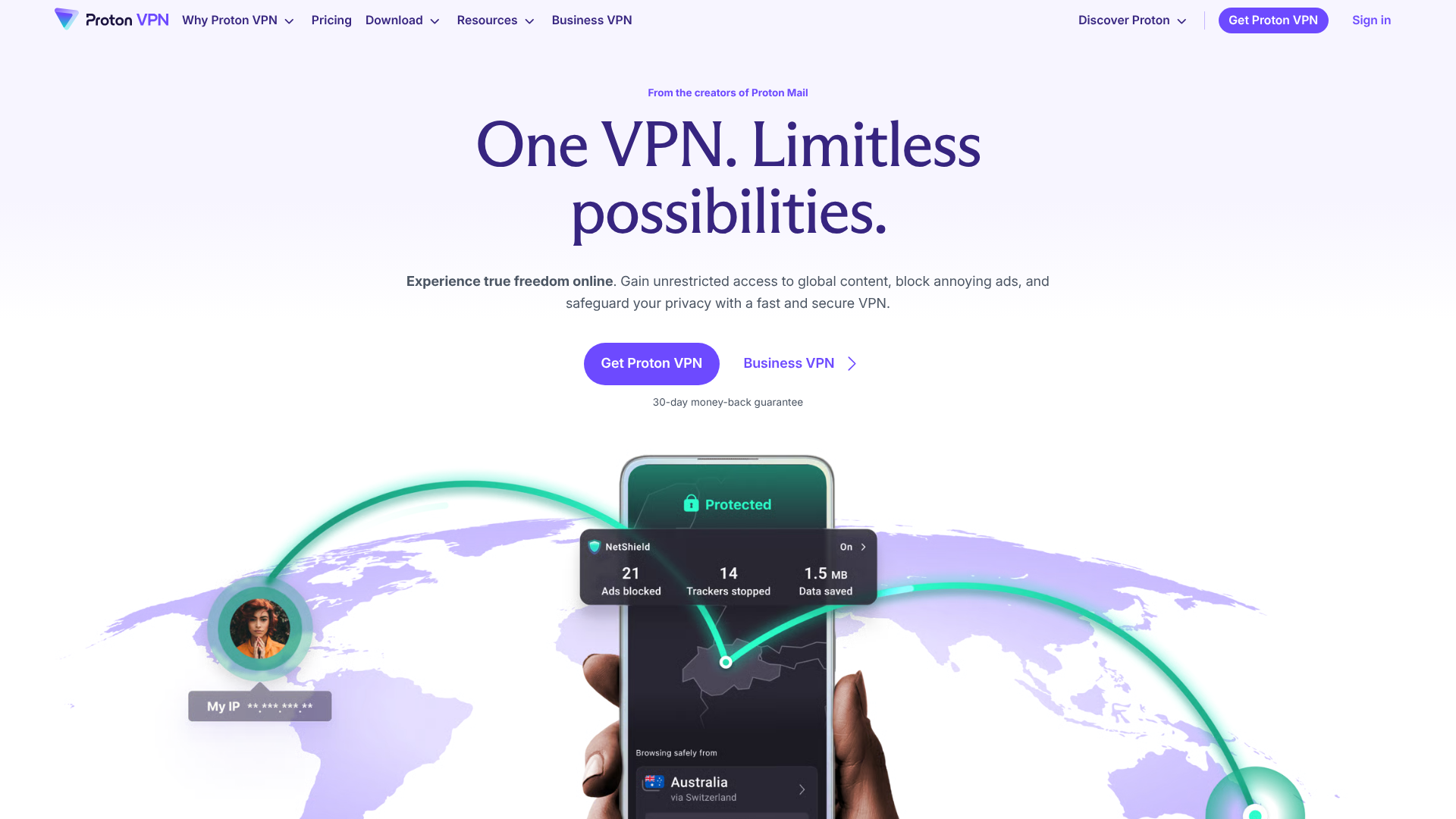
Proton VPN is the VPN solution developed by Proton AG, the same Swiss company that publishes ProtonMail. This is an important point: Proton is based in Switzerland, which has some of the most protective privacy laws in the world, and its source code is entirely open source and publicly audited.
For organizations that handle particularly sensitive data (medical data, confidential legal information, financial data), Proton VPN is a serious option that goes beyond a simple connection tool.
Secure Core routes traffic through servers located in countries with strong data protection laws (Switzerland, Iceland, Sweden) before redirecting it, providing additional protection against interception at the network infrastructure level. The NetShield feature blocks malware, trackers, and ads. Proton VPN also offers access to Tor over VPN for extreme use cases.
Note: Proton offers a comprehensive ecosystem that includes Proton Mail, Proton Drive, Proton Pass, and Proton Calendar, allowing you to build a fully encrypted and private work stack.
Healthcare, law, and finance: these sectors have specific data privacy requirements. Proton’s Swiss-based operations and the transparency of its open-source code facilitate compliance efforts and provide verifiable safeguards—not just contractual ones.
The Proton ecosystem makes it possible to build an entire encrypted communications infrastructure (email, cloud storage, calendar, password manager) on a single platform. This consistency is particularly valuable for teams seeking a comprehensive approach to privacy.
The ability to audit the source code directly and to verify privacy claims without depending on a marketing promise is a strong argument for technical profiles who do not want to take vendors’ statements at face value.
✅ The open-source code is publicly audited, which allows for independent verification of privacy claims.
✅ Swiss jurisdiction and a verifiable no-logs policy provide strong legal safeguards.
✅ The comprehensive suite of features (email, cloud storage, calendar, password manager) and a free plan with unlimited data nicely round out the offering.
⚠️ Performance is slightly slower than NordVPN on some servers, particularly those outside Europe.
⚠️ The team administration interface is still being refined compared to more established solutions in this segment.

ESET is a Slovak vendor founded in 1992 and one of the most serious players in endpoint protection (workstations, servers, mobile devices) worldwide. ESET PROTECT Advanced is their offering designed for SMEs and mid-sized companies, with a centralized management console to deploy and manage protection across the whole IT estate.
While many consumer antivirus products rely solely on signature-based detection (less effective against previously unseen threats), ESET adds a layer of machine learning and behavioral analysis that detects zero-day threats before they have been cataloged.
LiveGuard Advanced protection analyzes suspicious files in a cloud-based sandbox environment before they are executed on end-user devices. The Full Disk Encryption module allows you to encrypt the hard drives of managed devices from the central console, protecting data in the event of device theft. Vulnerability detection identifies out-of-date software across the entire fleet, one of the main entry points for attackers.
Windows, Mac, Linux, and Android within the same organization: ESET manages them all from a single console, eliminating the need to switch between multiple solutions depending on the operating system. This saves a significant amount of time for IT managers overseeing mixed environments.
Accounting firms, law firms, and HR departments: these organizations cannot afford to have their workstations compromised. The level of sandbox protection that ESET provides—including the analysis of suspicious files before they are executed—meets this need precisely.
ESET is subject to the European regulatory framework, unlike some U.S. or Asian companies. For organizations concerned about digital sovereignty or subject to data localization requirements, this is a key factor in their decision-making.
✅ ESET has a long-standing reputation for reliability as a European software vendor, offering cross-platform protection that can be managed from a centralized console.
✅ The impact on machine performance is particularly low, which is rare for such a comprehensive solution.
✅ Cloud-based sandbox analysis for zero-day threats provides a layer of protection that traditional antivirus software cannot offer.
⚠️ The administration interface may seem overwhelming to non-specialists, and there is a learning curve to expect.
⚠️ The full EDR functionality is available only with the PROTECT Elite plan, the highest tier, which may come as a surprise to those who thought it was included in the PROTECT Advanced plan.


In just a few years, Cloudflare has become one of the Internet's most critical network infrastructures. Initially known for its CDN (Content Delivery Network), Cloudflare now offers a comprehensive security suite that goes far beyond simple content acceleration.
For companies that host applications or websites, Cloudflare serves as the first line of defense: it filters incoming traffic before it even reaches your servers, absorbing DDoS attacks, blocking malicious bots, and protecting against SQL injections and XSS attacks.
Cloudflare's WAF (Web Application Firewall) relies on rules updated in real time based on threats detected across the global network. Unlimited DDoS protection is included in all plans, including free plans. Cloudflare Zero Trust (formerly Cloudflare Access) secures access to your internal applications without a traditional VPN by enforcing identity-based access policies. The Bot Management module analyzes each request to distinguish human visitors from bots—whether legitimate or malicious.
Exposing a mission-critical web application without WAF and DDoS protection poses a significant risk to availability. Cloudflare absorbs volumetric attacks and blocks exploitation attempts before they reach the infrastructure, ensuring service continuity.
The Cloudflare API and the Workers ecosystem make it possible to deploy security logic directly at the network level, without going through the application server. This approach is popular with teams that want to integrate security into their development pipeline.
Cloudflare Access enables organizations to gradually replace traditional VPNs with identity- and context-based conditional access. It is one of the most accessible entry points into a Zero Trust architecture for teams without a dedicated IT department.
✅ The high-performance global network spans more than 330 data centers, with DDoS protection included even in the free plan—a rarity at this level of quality.
✅ The Zero Trust solution is accessible to small and medium-sized businesses, and its technical documentation is among the most comprehensive in the industry.
✅ The platform covers everything from CDN to application security and identity management, making it a standout in its segment.
⚠️ Advanced configuration (custom WAF rules, full Zero Trust) requires genuine technical expertise and may be daunting for teams without a dedicated security role.
⚠️ Some key features are still limited to Enterprise plans, and pricing can quickly rise for more advanced needs.
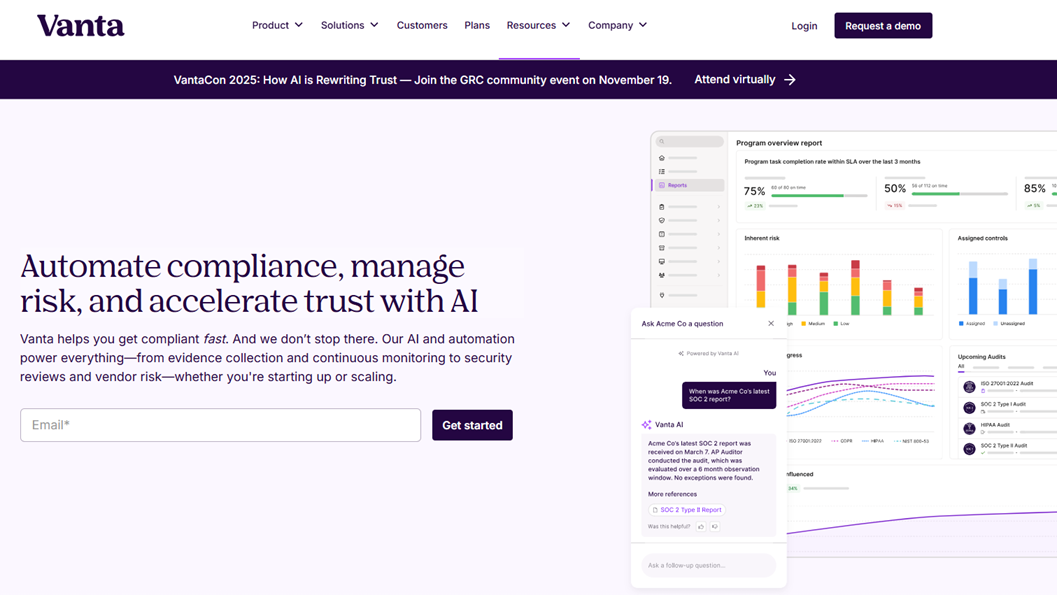
Vanta tackles one of the most time-consuming challenges for tech companies: compliance with security standards. Obtaining SOC 2 Type II certification, for example, traditionally takes several months of work and requires dedicated resources. Vanta automates much of this process by connecting directly to your tech stack to continuously collect evidence of compliance.
It is a particularly strategic solution for B2B startups selling to large accounts or to US customers, for whom SOC 2 is often an essential prerequisite to signing.
Vanta connects to over 300 integrations (AWS, GCP, Azure, GitHub, Okta, Slack, Jira, etc.) to automatically monitor your infrastructure’s compliance. The public Trust Center lets you share your security posture with prospects and customers, accelerating due diligence processes. The risk management module identifies compliance gaps and prioritizes corrective actions. The platform supports SOC 2, ISO 27001, HIPAA, GDPR, PCI DSS, and several other frameworks.
Vanta's pricing is available upon request and depends on the number of checks, integrations, and frameworks. Plans typically start at around $500 to $800 per month for small organizations.
Filling out security questionnaires for key account prospects can take weeks without the right tools. Vanta automates the collection of supporting documentation and generates standard responses, allowing you to handle these requests without dedicating a full-time resource to them.
Demonstrating an organization's security maturity without a dedicated compliance team is one of the most common challenges facing tech SMEs. Vanta provides the structure and documentation needed to fulfill this role with limited resources.
SOC 2 is often the first contractual requirement for selling to U.S. companies. Without this certification, many business opportunities are lost before the first meeting even takes place. Vanta significantly speeds up this process.
✅ The reduction in audit preparation time is the most immediately measurable benefit: months of manual work can be brought down to a few weeks.
✅ Automatic collection of compliance evidence and the public Trust Center to reassure prospective customers are two key features.
✅ Multi-framework coverage (SOC 2, ISO 27001, HIPAA, GDPR) allows you to pursue multiple certifications from a single platform.
⚠️ The investment is significant and difficult to justify in the very early stages, before compliance issues become a real barrier to business growth.
⚠️ Some integrations require extensive initial configuration to function properly and collect the correct evidence.

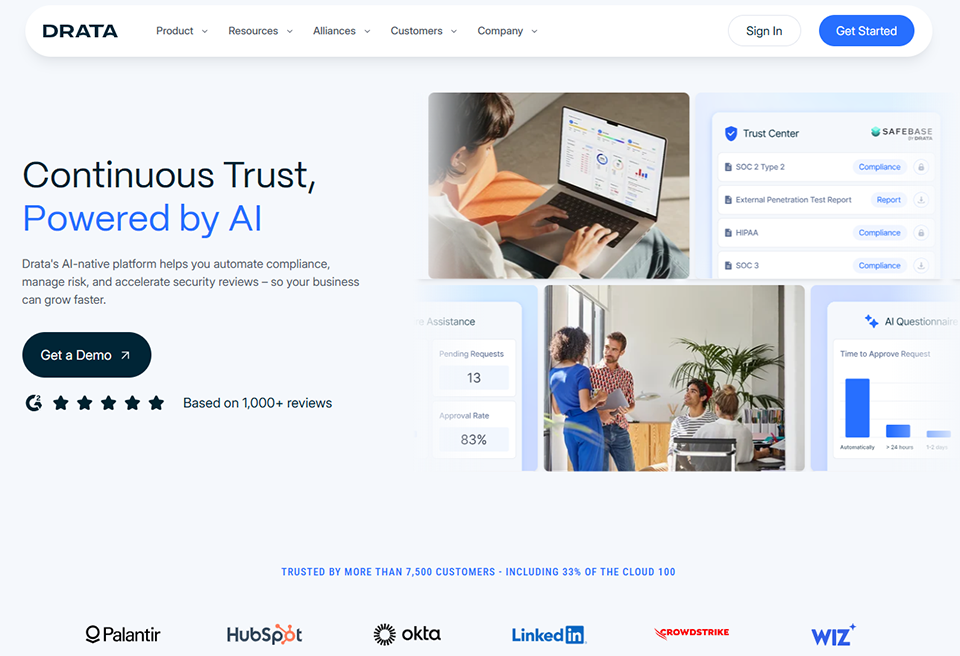
Drata is Vanta’s direct competitor in the compliance automation market. Founded in 2020, it has grown rapidly to become one of the most popular solutions among security teams thanks to its continuous compliance-focused approach: rather than preparing one-off audits, Drata continuously monitors the status of your infrastructure to ensure compliance at all times.
The difference between Vanta and Drata often comes down to a matter of interface preference and support for integrations specific to your tech stack. Both solutions are of very high quality; Drata is often seen as slightly more flexible when it comes to customizing controls.
The real-time monitoring engine automatically monitors more than 120 security controls. The employee management module tracks security training, policy reviews, and access rights for each employee—all of which are essential for audits. Vendor Risk Management assesses the security posture of your service providers and subcontractors, an often-overlooked but crucial aspect of GDPR compliance. The platform automatically generates audit reports and documentation packages for auditors.
Pricing is based on a quote, similar to Vanta. Special plans for early-stage startups are available.
The depth of its integrations and the flexibility to customize compliance controls make Drata a natural choice for teams with a multi-cloud infrastructure or numerous tools to monitor. The granularity of the settings is a real advantage in advanced technical environments.
Agencies, freelance service providers, technical partners: The Vendor Risk Management module helps you map your exposure to third parties and ensure that they, too, maintain an acceptable level of security. This is a crucial consideration that is often overlooked until the first incident occurs.
Executive dashboards and automated progress reports make it possible to communicate compliance status to non-technical stakeholders in a clear and structured way, without spending hours preparing slides.
✅ Compliance monitoring is truly ongoing and is not limited to the period leading up to audits, which changes the very nature of the process.
✅ Built-in vendor risk management is a rare feature at this level of accessibility, as is the tracking of training and policies per employee.
✅ Automatically generated audit reports significantly reduce the workload during formal evaluations.
⚠️ The price remains high for very small organizations, and the value is only fully apparent once there is a certain volume of assets to monitor.
⚠️ There is a real learning curve involved in taking full advantage of all the advanced features, and it requires an investment of time right from the onboarding phase.

Okta is the global leader in IAM (Identity and Access Management) for enterprises. Its value proposition is clear: a single, secure identity for accessing all of your organization’s applications, whether they’re your CRM, communication tools, cloud environments, or internal applications.
In an environment where the attack surface has expanded significantly (due to the proliferation of SaaS, remote work, and third-party service providers), controlling who accesses what, from where, and using which devices has become essential. That is exactly what Okta does.
SSO (Single Sign-On) allows your employees to log in to all their applications from a single portal by authenticating just once. The Adaptive MFA module dynamically adjusts the required authentication level based on context: a user logging in from their usual workstation will experience fewer friction points than a user attempting to log in from an unusual country at 3 a.m. Lifecycle Management automates the granting and revocation of access during onboarding and offboarding. Okta Verify is the mobile app that manages multi-factor authentication.
Once you exceed a certain threshold of SaaS applications and employees, managing access manually becomes a risk in itself. Okta centralizes everything and ensures that when an employee leaves, all of their access is revoked—which isn't always the case in organizations that manage this manually.
Automating the provisioning and deprovisioning of access saves a considerable amount of time during employee onboarding and offboarding and reduces the risk of forgetting to revoke access. This is a common scenario involving human error that can have serious consequences.
Okta Customer Identity allows you to manage authentication for an external user base with the same level of control as for internal employees. This consistency is particularly valuable for SaaS providers and B2B platforms.
✅ Okta is the industry leader in IAM, with integrations available for more than 7,000 applications, covering virtually all SaaS stacks used in enterprises.
✅ Adaptive MFA reduces friction for legitimate users while maintaining a high level of security.
✅ Full automation of the access lifecycle is one of the most impactful features for HR and IT teams.
⚠️ Pricing can quickly rise with advanced modules, particularly Lifecycle Management and audit reports.
⚠️ The initial setup requires a significant amount of time for configuration, particularly for custom integrations with in-house applications.

Penetration tests (“pentests”) are traditionally expensive, one-time events reserved for large companies. Astra makes this approach more accessible by offering an automated and managed pentest platform that combines automatic scans with the expertise of certified human pentesters.
Astra's positioning is particularly relevant for startups and SMEs that have contractual or regulatory obligations regarding security testing but cannot afford to hire a consulting firm at a rate of €20,000 per assignment.
Astra also offers Astra API Security to specifically secure APIs, which are an increasingly targeted attack vector.
The automated vulnerability scanner detects more than 8,000 known vulnerabilities and performs continuous testing on your web applications and APIs. Manual penetration tests conducted by certified experts (OSCP, CEH) help identify logical vulnerabilities and complex flaws that an automated scanner cannot detect. The vulnerability management dashboard centralizes all detected vulnerabilities, ranks them by severity, and tracks their remediation. The generated reports can be used directly for SOC 2 or ISO 27001 certification processes.
Integrating Astra into a CI/CD pipeline allows you to detect vulnerabilities with every deployment, before they reach production. This “shift left” approach to security prevents the need to urgently patch vulnerabilities after an incident.
SOC 2, ISO 27001: These certification processes require penetration test reports prepared by qualified third parties. Astra provides these reports in a format that auditors can use directly, eliminating the need to go through a traditional consulting firm.
Handling payment or personal data requires constant vigilance regarding application vulnerabilities. Astra's automated scans enable continuous monitoring without the need for a dedicated security team.
✅ The combination of automated scans and certified human testing is Astra's key strength: the two approaches complement each other and cover very different types of vulnerabilities.
✅ The remediation dashboard is clear and actionable, with issues prioritized by severity to help you know where to start.
✅ The reports can be used directly for certification purposes, which greatly simplifies the audit process.
⚠️ Manual penetration tests are, by default, one-time engagements and do not constitute continuous monitoring in the strict sense.
⚠️ A certain level of technical expertise is required to take full advantage of the recommendations and implement the suggested fixes.
Here is a summary overview of the 10 tools presented to help you make a decision based on your priorities.
| Tool | Category | Starting at | Ideal for | Level of complexity |
|---|---|---|---|---|
| 1Password | Password management | 4,99 $/user/month | Tech Teams and Startups | ⭐⭐ |
| Keeper Password | Privileged Access Management | 4 $/user/month | Compliance & Audit | ⭐⭐⭐ |
| NordVPN | VPN | 3,09 €/month | Nomads & Remote Workers | ⭐ |
| Proton VPN | VPN + Private Suite | €4.99/user/month | Sensitive Data & Open Source | ⭐⭐ |
| ESET PROTECT Advanced | Endpoint Protection | €8/device/year | SMEs with an IT infrastructure | ⭐⭐⭐ |
| Cloudflare | Network Security & WAF | Free / $ 20 /month | Web Apps & Zero Trust | ⭐⭐⭐ |
| Vanta | Automated Compliance | ~500 $/month | B2B Startups & Certification | ⭐⭐ |
| Drata | Continuous Compliance | Upon request | Advanced Compliance Teams | ⭐⭐⭐ |
| Okta | Identity Management (IAM) | 2 $/user/month | 20+ employees | ⭐⭐⭐ |
| Astra Pentest | Penetration Testing | 99 $/month | Tech Startups & Certification | ⭐⭐ |
The prices shown are indicative; we recommend checking them directly with the vendors, as pricing conditions may change.
Here are the questions that come up most often when teams begin to structure their security approach.
If you're starting from scratch, there are three essential components: a team password manager (1Password or Keeper), a VPN for unsecured connections (NordVPN or Proton VPN), and desktop protection (ESET PROTECT Advanced). These three layers cover the most common attack vectors at a reasonable cost.
Yes, and it’s often a misconception to think that these tools are reserved for large companies. Most of the solutions mentioned in this article offer plans starting at just a few euros per month per user. A freelancer who handles sensitive customer data needs a secure password manager and a VPN just as much as an IT manager at an SME with 50 employees.
The answer often depends on your technology stack and your specific needs. Vanta is generally seen as more accessible for startups just beginning their compliance journey, with a more intuitive interface. Drata is often preferred by teams that need to fine-tune their controls or manage a large number of third-party vendors. Both offer free demos: try them both before making a decision.
No. A VPN protects network traffic, but it does not address password management, endpoint security, application access, regulatory compliance, or application vulnerabilities. Effective cybersecurity relies on a layered approach (defense in depth), where each tool addresses a specific attack surface. A VPN is just one component among many—not a complete solution.
The Zero Trust model rests on a simple principle: never trust by default, always verify. Unlike traditional network architectures where everything “inside” the network is considered safe, Zero Trust verifies each access individually (identity, device, context) whatever the location. With the rise of remote work and SaaS, it has become the benchmark for modern security architecture. Cloudflare Zero Trust and Okta are two of the best entry points into this model for SMEs.
The most effective approach is to have a recognized certification (SOC 2 Type II, ISO 27001) or, failing that, a public Trust Center that documents your security posture. Platforms like Vanta or Drata facilitate this process by automating the collection of evidence and generating shareable Trust Centers. For startups that sell to large enterprises, this is often a decisive factor in securing contracts.
The two are complementary. An automated scanner like Astra’s detects known vulnerabilities and misconfigurations quickly and continuously. A manual penetration test, performed by a human expert, goes much further: it identifies logical flaws, chains of vulnerabilities (privilege escalation, lateral movement), and design issues that automated tools cannot detect. For SOC 2 or ISO 27001 certification, both are generally required.
Cloud security operates on a shared responsibility model. The provider (AWS, Azure, GCP, etc.) is responsible for the security of the infrastructure; you are responsible for security within the infrastructure (configurations, access, data encryption). Most cloud incidents are related to client-side configuration errors: open S3 buckets, exposed credentials, and overly permissive permissions. Tools like Vanta, Drata, and Cloudflare help continuously monitor and correct these issues.