





A Comprehensive Comparison of No-Code Video Editing Tools
In this guide, we review six leading no-code solutions: Descript, Veed.io, InVideo AI, Pictory, OpusClip, and Lumen5.…
Read more


Launching an online ad campaign has never been easier. Just a few clicks on Google Ads, TikTok for Business, or LinkedIn Ads, and your ads are reaching thousands of potential customers. The real challenge isn’t getting started—it’s what comes next: managing your budgets effectively, creating ads that perform well, identifying what actually drives conversions, and automating tedious adjustments.
This is precisely where native interfaces show their limitations. Google Ads remains a powerful tool, but it wasn’t designed to centralize your cross-platform data, generate visuals at scale, or automate complex bidding rules without spending hours in the dashboards. For marketing teams managing multiple channels simultaneously, scattered information quickly becomes a barrier to performance.
The market for third-party tools designed for ad campaigns has grown significantly in recent years. There are now specialized solutions for every challenge: creating ad visuals,automating campaign management,multi-source analysis, and evencreative intelligence. But with so many tools available, it can be hard to know where to start.
In this article, we’ve selected four solutions, each with a distinct approach: AdCreative.ai, Birch (formerly Revealbot), Atria, and Metadata.io. These four tools address real and complementary needs, and they all come with an discount on Freelance Stack. The goal here is simple: to help you understand what each one does best, who it’s best suited for, and when it’s worth investing in.

AdCreative.ai is a platform for the automated generation of advertising visuals. The basic idea is quite simple: you enter your brand details (logo, colors, text), specify the type of campaign and the target channel, and the AI generates creative variations ready for use on Google, Facebook, Instagram, TikTok, or LinkedIn.
What sets AdCreative.ai apart from traditional image generators is its focus on advertising performance. The tool isn’t designed to create art; it’s designed to produce creatives that convert. Each visual is assigned a predictive performance score based on data from millions of ads analyzed by the system. So you know, even before you launch, which formats are most likely to work for your audience.
The platform also offers a module for generating advertising copy (headlines, descriptions, calls to action), features for creating short videos, and access to competitive data to analyze creative trends in your industry.
AdCreative.ai is primarily aimed at freelancers and digital marketing consultants who need to produce a large volume of creative assets without the support of a full-time designer. It’s also a very useful solution for e-commerce businesses that manage large product catalogs and need to quickly create variations of ad formats. Agencies also benefit from it, particularly when managing multiple client accounts with different brand identities.
On the other hand, if your business relies on a highly refined visual identity or on unconventional designs that are difficult to template, you may run into the limitations of automatic generation.


Birch, formerly known as Revealbot, is an advertising campaign automation tool focused primarily on Meta Ads (Facebook and Instagram) and Google Ads. Its purpose is clear: to allow you to delegate all the repetitive tasks involved in the day-to-day management of your campaigns to automated rules.
In practical terms, Birch lets you create conditional rules such as "if the CPA exceeds X€ and the ROAS is less than Y, pause the ad and alert me via Slack." These automations can be highly granular: they apply at the campaign, ad set, or creative level, and can trigger actions such as pausing an ad, increasing or discount budget, duplicating a high-performing campaign, or sending a notification.
The tool also offers an automated reporting system that aggregates data from your various campaigns and sends it to your clients or your team according to a set schedule.
Birch is particularly well-suited for freelance media buyers who manage multiple client accounts and can’t be logged in 24/7 to monitor performance. It’s also a robust solution for in-house marketing managers at small and medium-sized businesses looking to keep their advertising spending under control and avoid budget overruns.
Performance agencies find this to be a significant operational benefit, especially during the optimization phases, where manual fine-tuning is very time-consuming. For an entrepreneur starting out with Meta Ads on a limited budget, however, the complexity of the setup may outweigh the immediate benefits.


Atria takes a different approach from the two previous tools. It doesn't generate creative content or automate your campaigns; instead, it helps you understand what works in your industry by giving you access to a massive library of active, high-performing ads that have been sorted and analyzed.
The tool aggregates millions of ads—primarily from the Meta Ads Library and other sources—so you can search for creative assets by industry, format, message type, performance, or brand. The idea is to provide you with a shortcut between creative intuition and data: rather than starting with a blank page, you start with an analysis of what has already performed well in your industry.
Atria also offers features for saving and organizing inspiring ads, collaborative annotations, and an alert system to keep track of your competitors' new ads.
Atria is particularly valuable for art directors and creative directors working on advertising campaigns who want to ground their work in the realities of industry performance. Growth marketers and media buyers who want to quickly understand the creative norms of a new market or a new client account will also benefit immediately from it.
It's also a useful tool for startup founders who are managing their first campaigns on their own and want to draw inspiration from what established players in their industry are doing, without having to manually search through the Meta library.
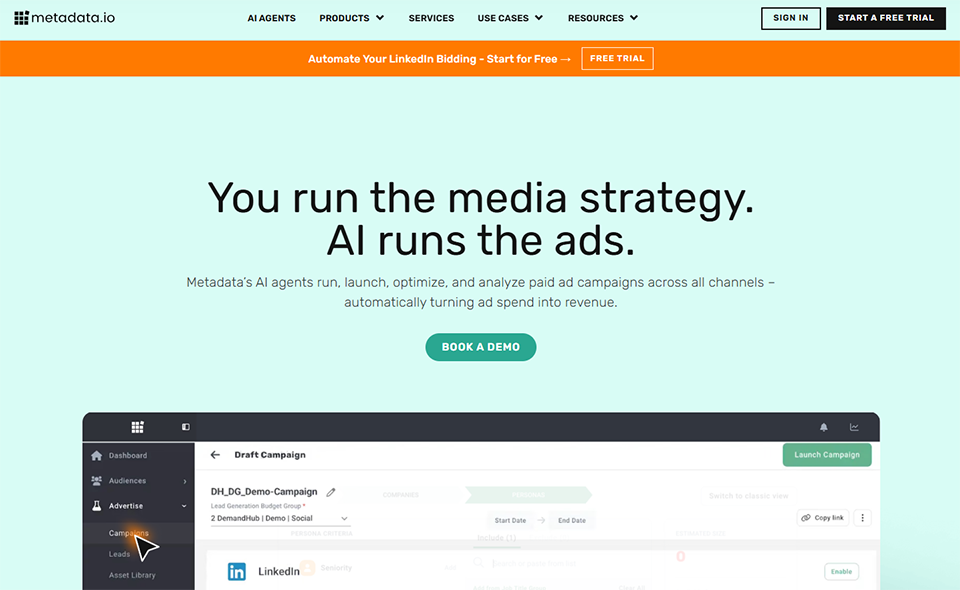
Metadata.io is a tool that’s quite different from the ones mentioned above. It has a specific target audience: B2B companies that use LinkedIn Ads and Facebook/Instagram to generate demand among professional audiences. The platform automates the entire ad testing process, from creating ad variations to optimizing your budget, including synchronization with your CRM.
What sets Metadata.io apart is its approach tolarge-scale experimentation. The tool can automatically launch and test hundreds of creative/audience/offer combinations simultaneously, measure results in terms of the sales pipeline and revenue generated (not just clicks or leads), and then reallocate budgets to the best-performing combinations without manual intervention.
Native integration with CRMs like Salesforce or HubSpot lets you go far beyond traditional advertising metrics: you can attribute an MQL, an SQL, or a deal directly to a specific creative/audience combination.
Metadata.io is clearly aimed at B2B marketing teams with strong growth ambitions and ad budgets exceeding $10,000 per month. The platform’s core target audience consists of lead generation managers at scale-ups and fast-growing small and medium-sized businesses. It is much less relevant for an entrepreneur a very small business with limited budgets: the cost-benefit ratio simply doesn’t make sense in those cases.
On the other hand, for a team that spends significant amounts on LinkedIn and Meta to build a sales pipeline, Metadata.io can be a significant driver of performance—particularly by reducing experimentation time and improving attribution accuracy.

Before looking at this table, keep in mind that these four tools are not really interchangeable: they address different stages of the advertising value chain. Some are even complementary.
| Criterion | AdCreative.ai | Birch (formerly Revealbot) | Atria | Metadata.io |
|---|---|---|---|---|
| Primary function | Ad Creation | Rule Automation | Trend Watching & Creative Inspiration | B2B Automation |
| Platforms Covered | Meta, Google, TikTok, LinkedIn | Meta, Google | Mainly Meta | LinkedIn, Meta |
| Target audience | Freelancers, e-commerce, agencies | Media buyers, agencies | Creative professionals, growth marketers | B2B teams, scale-ups |
| Technical requirements | Low | Medium to high | Low | High |
| Recommended minimum budget | Any budget | $2,000/month+ in ad revenue | Any budget | $10,000/month+ in ad revenue |
| Admission price | ~$21/month | ~$49/month | ~$49/month | Based on a quote (~$2,000/month) |
| CRM Integration | No | Partial | No | Yes (native) |
| AI / Automation | ✅ Strong | ✅ Strong | ⚠️ Moderate | ✅ Strong |
| Freelance Stack Deal | ✅ | ✅ | ✅ | ✅ |
The prices listed are for reference only and are subject to change. Please check the official websites for the current terms and conditions.
The question isn't "which tool is best," but "which tool is right for where you are."
AdCreative.ai and Atria are a particularly effective combination for this use case. Atria provides the strategic vision and creative inspiration, while AdCreative.ai lets you produce content at scale without relying on a designer. Birch can be added if you manage multiple client accounts on Meta and Google with budgets that justify automation.
AdCreative.ai is probably your best starting point: producing creative content at scale is a structural challenge in e-commerce, and the ability to quickly generate variations is a real game-changer for Facebook and Google Shopping campaigns. Birch can then help you secure your budgets once you have campaigns up and running.
Metadata.io is the right choice for you, provided you have the budget for it. For smaller teams, Atria remains an excellent investment for improving the quality of creative briefs and market understanding. Birch can handle campaign optimization until you reach the critical mass required for Metadata.io.
Start by familiarizing yourself with the native platforms: Google Ads, TikTok for Business, and LinkedIn Ads. Once you’ve gained some initial experience, Atria is a good starting point for organizing your competitive intelligence efforts. You can also check out X Ads or Reddit Ads if your target audiences are active there.
Atria is probably the tool that will be most directly useful to you. The ability to document, sort, and analyze the ads that perform well in your target sectors transforms the process of preparing creative briefs and significantly reduces the risk of heading in the wrong creative direction.
Below are the most frequently asked questions about tools for managing and optimizing advertising campaigns. To explore the best discount these solutions and other marketing automation tools, visit Freelance Stack.
Native platforms are the official interfaces of ad networks. They allow you to create, run, and measure your campaigns on their own ad inventory. Third-party tools, such as those featured in this article, integrate with these platforms to provide features that ad networks do not offer: advanced automation, creative generation, competitive intelligence, CRM attribution, and multi-account management. The two are complementary.
Some tools enable centralized, cross-platform management. Birch primarily covers Meta and Google Ads. Metadata.io manages LinkedIn and Meta. AdCreative.ai can produce creative assets for most platforms. For truly unified management of all your channels, you’ll often need to combine several tools or turn to centralized reporting solutions such as data connectors.
The answer varies depending on the tool. AdCreative.ai and Atria are worthwhile even with a very small budget, since they focus on the quality of creative assets and strategy, not on volume. Birch starts to pay for itself with a monthly ad budget of a few thousand euros, when manual monitoring becomes time-consuming. Metadata.io is designed for budgets exceeding $10,000 per month.
Predictive scoring systems like AdCreative.ai’s are based on the analysis of millions of data points from past ad campaigns. They provide a useful indicator, not a guarantee. A high score means that the format or message resembles ads that have performed well in similar contexts, but your specific market, audience, and offer may yield different results. These tools are decision-making aids, not oracles.
Automation really comes into its own when you have campaigns running with enough data for the algorithms to learn effectively. Launching Birch on a campaign with a daily budget of 50 euros and only 3 days of historical data is counterproductive. On the other hand, on a well-established account with significant volume, automated rules allow for continuous optimization without tying up human resources on repetitive tasks.
Coverage varies by tool. AdCreative.ai offers formats tailored for TikTok. Birch and Metadata.io focus primarily on Meta and Google/LinkedIn. If TikTok for Business, X Ads, or Reddit Ads are your main channels, you’re better off using tools that natively support these platforms or using the official interfaces directly.
The required skill level varies considerably. Atria and AdCreative.ai are accessible to non-technical users. Birch requires a solid understanding of advertising mechanics to set up consistent rules. Metadata.io involves a thorough onboarding process and a solid grasp of B2B challenges (sales pipeline, attribution, CRM integration). There’s no one-size-fits-all answer: it’s best to start with the tool that suits your skill level and gradually expand your tech stack.
Absolutely, and it's actually often recommended. A common combination for a performance marketing agency: Atria for monitoring and inspiration, AdCreative.ai for high-volume creative production, and Birch for automation of campaign management. These three tools cover different phases of the advertising workflow and don’t overlap. Metadata.io, on the other hand, is designed to centralize everything for B2B teams with the necessary budgets.