Cloudflare vs. Microsoft Azure: Features, Differences, and Use Cases.
In this article, we compare Cloudflare and Microsoft Azure: their features, their key differences, their strengths and limitations, as well as the types of users each platform is primarily designed for.
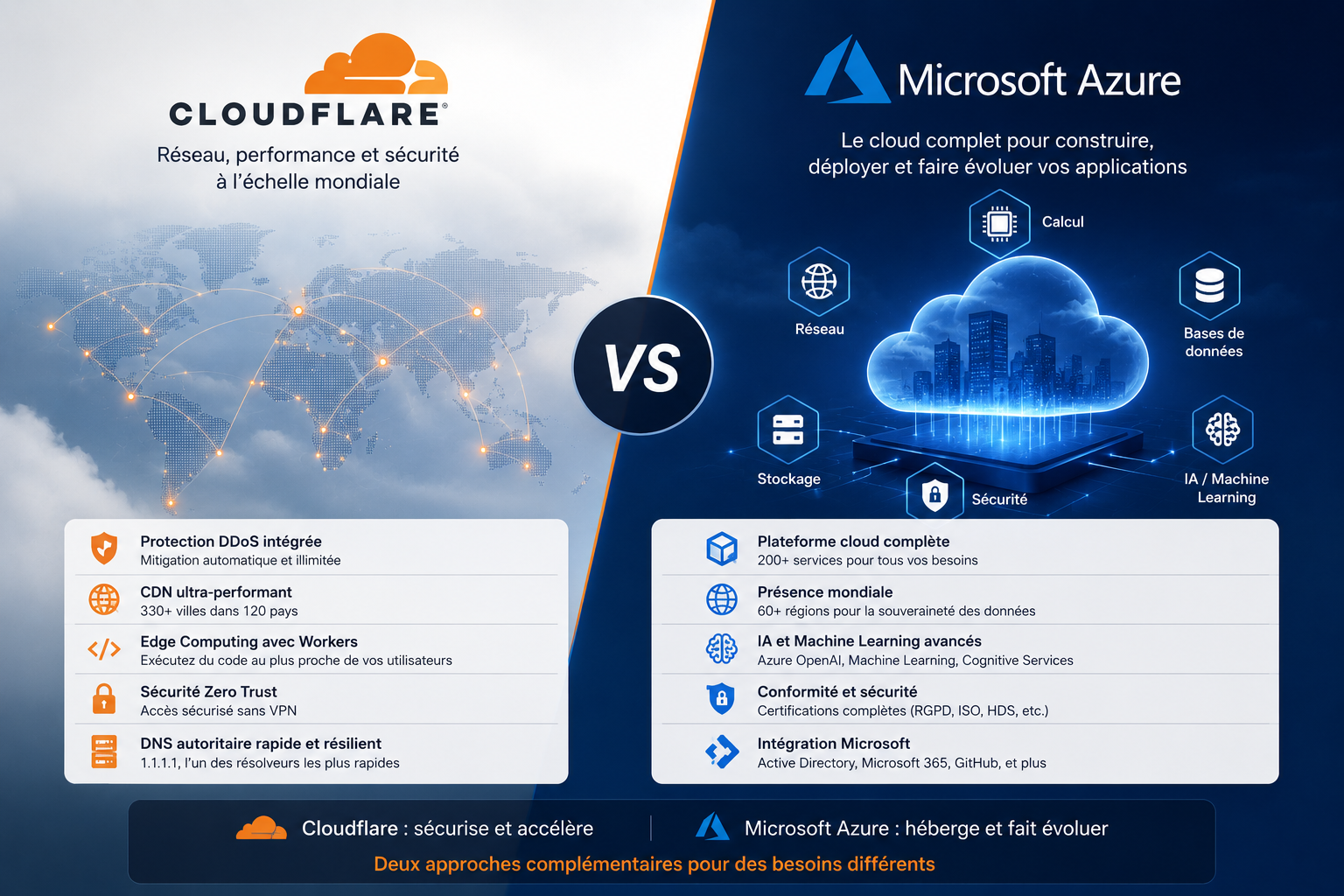
Cloudflare and Microsoft Azure regularly come up in the same conversations, often for the same reasons: security, performance, and infrastructure. However, these two tools aren’t quite in the same league. Cloudflare is built on network control and perimeter protection, whereas Azure is a general-purpose cloud platform capable of meeting a wide range of application needs. Comparing them, therefore, also means understanding why some teams end up using both at the same time. That’s what we’ll explore here, point by point, to help you identify what truly fits your situation.
#1 - Cloudflare: The global network that secures and accelerates your applications, without compromise.
Cloudflare, founded in 2009, is now one of the most influential players in global Internet infrastructure. Its network spans more than 330 cities in 120 countries, and according to its own data, more than 20% of global web traffic passes through its servers. This is no small feat: it enables the company to offer performance and network protection that are hard to match for certain very specific use cases.
Cloudflare was originally built on a CDN (Content Delivery Network) model: placing content as close as possible to the end user to reduce latency. Since then, the company has significantly expanded its scope to include web application firewalls (WAFs), DDoS protection, Zero Trust, reverse proxies, authoritative DNS, access to Workers (serverless code that runs at the edge), and even products like R2 (object storage) and Pages (static site deployment).
His philosophy remains consistent: everything related to networking, perimeter security, and content delivery performance.
💰 Cloudflare Pricing:
Prices are provided for informational purposes only. Check the current rates directly on the Cloudflare website.
Free Plan:€0/month. CDN, DNS, basic DDoS protection, automatic SSL/TLS. Ideal for testing or personal projects.
Pro Plan: About $20/month. Advanced WAF, image optimization, and priority support.
Business Plan: approximately $200/month. Custom WAF rules, 100% availability SLA, advanced logs.
Enterprise Plan: Pricing available upon request. Full access to all features, contractual SLA, dedicated support.
The complementary products (Workers, R2, Pages, Zero Trust) each have their own pricing structure, often with a generous free tier.
Benefit from a on Cloudflare .
$250,000 in credits during 12 months
Find our best discount right now with Cloudflare and save on your software subscriptions. We offer over 850 promo codes and discounts on the best software and SaaS on the market.
#2 - Microsoft Azure: Microsoft's enterprise cloud platform for building, deploying, and managing your applications at scale.
Microsoft Azure is a comprehensive cloud platform launched in 2010. Today, it offers more than 200 services covering computing (virtual machines, containers, Kubernetes), storage, databases, artificial intelligence, machine learning, security, networking, and much more. Azure is the world’s second-largest cloud provider behind AWS, with a market share of approximately 22% according to Statista.
What sets Azure apart from other cloud platforms is its deep integration with the Microsoft ecosystem: Windows Server, Active Directory, Microsoft 365, Teams, GitHub, and Visual Studio. For companies already using Microsoft products, choosing Azure is often a natural choice.
Azure is available in more than 60 geographic regions around the world, making it one of the cloud platforms with the broadest geographic coverage of physical data centers. This is an important consideration for organizations subject to data sovereignty requirements.
💰 Microsoft Azure Pricing:
Prices are provided for informational purposes only. Azure pricing is based on usage and varies significantly depending on services, regions, and configurations. Check current rates on the Azure portal or using the official cost calculator.
Pay-as-you-go Plan: Billed based on usage, with no commitment. This is the default plan to get started.
Reserved Instances Plan: a 1- to 3-year commitment to computing resources, with savings of up to 72% compared to the on-demand price.
Azure Hybrid Benefit plan: Allows you to reuse existing Windows Server or SQL Server licenses on Azure.
Azure for Students/Startups Plan: Free credits for eligible users ($100 in credits for students, and specific programs for startups).
Here are a few benchmarks: a B1s virtual machine (1 vCPU, 1 GB RAM) costs about 7 to 10 €/month, depending on the region. Basic blob storage is billed at around 0.018 $/GB/month. But Azure’s pricing structure is genuinely complex: costs can quickly spiral out of control without proper governance.
Benefit from a on Microsoft Azure .
Up to $5,000 in credits Azure
Find our best discount right now with Microsoft Azure and save on your software subscriptions. We offer over 850 promo codes and discounts on the best software and SaaS on the market.
Cloudflare has built its reputation on security. Its DDoS mitigation is recognized as one of the best on the market, capable of absorbing attacks exceeding 100 Tbps. The built-in WAF protects against SQL injections, XSS attacks, and OWASP Top 10 vulnerabilities without requiring complex configuration. This is often the main reason why companies adopt Cloudflare in the first place.
The Zero Trust model offered through Cloudflare Access provides fine-grained control over who can access what, without the need for a traditional VPN. For distributed or remote teams, this is a major selling point.
⚡ Global performance:
Thanks to its Anycast network, each request is automatically routed to the Cloudflare node closest to the user. The result: a often very significant discount latency, particularly for websites or applications with an international audience. Cloudflare also transparently optimizes protocols (HTTP/3, QUIC).
The Cloudflare Workers tool deserves special mention: it’s a platform for executing JavaScript (or WebAssembly) code directly at the edge, within Cloudflare’s data centers. In practice, your application logic runs as close as possible to the user, with virtually zero cold-start times. This is a radically different approach from traditional serverless functions.
🧩 Real-world use cases:
Cloudflare is particularly well-suited for:
Secure and accelerate a website or API exposed to the Internet: e-commerce, SaaS, media, fintech. Simply enabling Cloudflare in front of a website can immediately improve performance.
Replacing a VPN with a Zero Trust solution: less friction for users, better visibility for security teams.
Deploy edge applications using Workers, including for content customization, conditional routing, or HTTP response transformations.
Managing DNS Efficiently and Resiliently: Cloudflare operates one of the world's largest DNS resolvers (1.1.1.1).
🔄 Key differentiator:
What really sets Cloudflare apart is its position at the network layer. Unlike Azure or AWS, Cloudflare does not handle general-purpose computing or relational databases. Its scope is deliberately focused on the network, traffic, and perimeter security. This is both its strength and its limitation.
Why use Microsoft Azure?
🏗️ A comprehensive cloud platform:
Azure offers everything an organization needs to run production workloads: virtual machines, Kubernetes (AKS), relational and NoSQL databases (Azure SQL, Cosmos DB), object storage (Blob Storage), message queues (Service Bus), serverless functions (Azure Functions), and one of the most comprehensive AI/ML offerings on the market (Azure OpenAI Service, Azure Machine Learning).
The breadth of the catalog is an undeniable advantage: no matter what technology or architecture you want to implement, there's a good chance Azure has a service that fits your needs.
🔗 Integration with the Microsoft ecosystem:
This is the key selling point for companies already in the Microsoft ecosystem. Active Directory integrates natively with Azure AD (Microsoft Entra ID), enabling consistent single sign-on across cloud and on-premises applications. GitHub Actions integrates directly with Azure DevOps for CI/CD pipelines. Visual Studio Code offers native Azure extensions.
For an SME or mid-sized company that already uses Microsoft 365, migrating workloads to Azure delivers true operational consistency: a single management console, consolidated billing, and unified security policies.
🤖 AI and machine learning at the heart of our offering:
Azure has made artificial intelligence a strategic pillar. The Azure OpenAI Service provides access to OpenAI’s GPT-4, DALL·E, and Whisper models via a managed API on Microsoft’s infrastructure, with compliance guarantees (GDPR, ISO 27001, SOC 2). For companies that want to integrate generative AI into their applications without managing the underlying infrastructure, this is a significant advantage.
Azure Machine Learning provides a comprehensive environment for training, deploying, and monitoring models, along with MLOps tools for data science teams.
🌍 Data Compliance and Data Sovereignty:
Azure offers dedicated regions for sensitive data, including sovereign regions in Europe (Azure Germany, French regions). Compliance certifications include GDPR, HDS (Health Data Host), PCI-DSS, ISO 27001, and many others. For regulated industries (healthcare, finance, government), this is often a decisive factor.
🧩 Real-world use cases:
Azure is particularly well-suited for:
Migrate an on-premises infrastructure to the cloud using Azure Migrate, while retaining existing Windows Server and SQL Server environments.
Develop and deploy cloud-native web and mobile applications (containers, microservices, serverless).
Set up data pipelines using Azure Synapse Analytics, Azure Data Factory, or Azure Databricks.
Integrate AI capabilities into business applications using Azure AI Services or Azure OpenAI.
Manage security and compliance for a multi-cloud infrastructure using Microsoft Defender for Cloud and Microsoft Sentinel.
Strengths and Limitations of Cloudflare.
Highlights:
✅ An exceptional global network with very low latency for content delivery.
✅ Automatic DDoS protection, included even with the free plan.
✅ Robust application-level WAF, with rules updated in real time to address new threats.
✅ Cloudflare Workers: A Truly Unique Approach to Edge Computing.
✅ High-performance, resilient DNS.
✅ A very generous freemium model to get you started.
✅ A clear administration interface that is accessible to non-specialists.
Limitations:
⚠️ Does not replace a general-purpose cloud: no VMs, managed databases, or complex application services.
⚠️ The learning curve for Workers may come as a surprise to developers accustomed to traditional Node.js environments.
⚠️ The free plan can quickly reach its limits for growing projects (number of Workers requests, Argo bandwidth).
⚠️ Technical support for lower-end plans remains limited and can sometimes be slow.
⚠️ Some advanced features (Argo Smart Routing, Magic Transit) are available only on Enterprise plans, which have pricing that isn't very transparent.
Pros and Cons of Microsoft Azure.
Advantages:
✅ The most comprehensive service catalog on the market after AWS: computing, storage, networking, data, AI, and DevOps.
✅ Native integration with the entire Microsoft ecosystem (Active Directory, Microsoft 365, GitHub).
✅ Global coverage spanning more than 60 regions, ideal for addressing sovereignty requirements.
✅ One of the most advanced AI/ML offerings, particularly through the Azure OpenAI Service.
✅ Certification and compliance covering the most heavily regulated industries.
✅ Azure Hybrid Benefit: Maximizing the Value of Existing Microsoft Licenses.
Disadvantages:
⚠️ Pricing complexity: Usage-based billing can be unpredictable without proper cost management.
⚠️ Significant learning curve, especially for teams that aren't familiar with enterprise cloud environments.
⚠️ The Azure Portal interface is powerful but can be confusing at first, with navigation that is sometimes not very intuitive.
⚠️ Some services are at different stages of maturity compared to their AWS equivalents.
⚠️ The performance of the content delivery network (Azure CDN) remains below what Cloudflare offers in this specific area.
Summary: Cloudflare vs. Microsoft Azure at a Glance 📋
These two tools address fundamentally different needs. Comparing them directly across all aspects wouldn't make much sense, but here is a summary table highlighting the areas where they overlap (network, security, edge, performance).
Criterion
Cloudflare
Microsoft Azure
Platform Type
Network, CDN, Perimeter Security
Comprehensive General-Purpose Cloud
Entry point
A very comprehensive free plan
Pay-as-you-go, starter credits
CDN / Network Performance
⭐⭐⭐⭐⭐ Market Leader
⭐⭐⭐ Okay, but less specialized
DDoS Protection
⭐⭐⭐⭐⭐ Native and Automatic
⭐⭐⭐⭐ Azure DDoS Protection (paid)
Application-Level WAF
⭐⭐⭐⭐⭐ Included in paid plans
⭐⭐⭐⭐ Azure Application Gateway WAF
Edge computing
⭐⭐⭐⭐⭐ "Workers" is a must-read
⭐⭐⭐ Azure Edge Zones, less mature
General-purpose computing (VMs, K8s)
❌ Not available
⭐⭐⭐⭐⭐ The Heart of the Offer
Managed Databases
❌ Not available
⭐⭐⭐⭐⭐ Azure SQL, Cosmos DB, etc.
AI / Machine Learning
Basic Features (AI Gateway)
⭐⭐⭐⭐⭐ Azure OpenAI, Azure ML
Microsoft 365 / AD Integration
Limited
⭐⭐⭐⭐⭐ Native
Compliance & Sovereignty
Bonne (available EU regions)
⭐⭐⭐⭐⭐ Industry Benchmark
Easy to use
⭐⭐⭐⭐ Accessible
⭐⭐ Complex without training
Pricing Model
Transparent, predictable
Complex, when consumed
The rates listed are approximate and are subject to change. Please check the official rate schedules before making any decisions.
Who is each tool intended for?
🚀 Cloudflare—who exactly is it for?
Developers and technical teams who publish applications on the Internet:
Whether you're managing a SaaS, a public API, or an e-commerce site, Cloudflare provides a layer of protection and performance that you can enable in just a few minutes. You don't need advanced networking expertise to start benefiting from it right away.
Startups and small and medium-sized businesses that want to secure their infrastructure without hiring a security expert:
The free plan covers most basic needs, and the paid plans are still affordable. It's often the first security tool a startup implements, even before it has a dedicated team.
Teams transitioning to a Zero Trust model:
Cloudflare Access and Cloudflare Gateway make it possible to replace outdated VPNs with a Zero Trust architecture, without requiring a complete overhaul of the infrastructure.
Developers who want to experiment with edge computing:
Workers, Pages, and R2 form a cohesive stack for building globally distributed applications. If you know JavaScript and latency is a concern, this is a serious playground.
🏢 Microsoft Azure—who exactly is it for?
Companies already part of the Microsoft ecosystem:
This is undoubtedly the most obvious use case. If your organization uses Windows Server, Microsoft 365, Teams, and Active Directory, Azure offers operational and administrative consistency that’s hard to ignore.
CIOs and IT teams managing cloud migrations:
Azure Migrate and hybrid services (Azure Arc) are designed for phased transitions, with centralized governance and security tools. It's a platform built for large-scale migrations, not for weekend projects.
Data teams and data scientists:
Azure Synapse, integrated Databricks, Data Factory, and Azure Machine Learning cover data scenarios ranging from simple ETL pipelines to complex machine learning projects. Integration with Power BI further enhances this advantage for data-driven organizations.
Regulated sectors:
Healthcare, finance, public administration: Azure offers certifications and reference architectures to meet the most stringent compliance requirements, including HDS in France.
Developers who build cloud-native applications:
Azure Kubernetes Service, Azure Container Apps, Azure Functions: If you're building with microservices, Azure offers a robust platform with a good level of abstraction for teams that don't want to manage the Kubernetes infrastructure themselves.
See all the software of this category: Stockage & Cloud
Check out all the other software and discount we offer in this category. Explore other tools and choose the perfect solution to grow your business.
FAQ: Your Questions About Cloudflare and Microsoft Azure ❓
Here are the questions that come up most often when people start comparing these two tools. Here are some straightforward answers to clear up the most common points of confusion.
1️⃣ Are Cloudflare and Azure direct competitors?
Not really. The confusion stems from the fact that both offer network, security, and cloud services. But their market positions are very different: Cloudflare focuses on the network layer and perimeter security, while Azure is a general-purpose cloud platform. In practice, many organizations use both at the same time: Azure to host their applications, and Cloudflare in front of them for CDN and DDoS protection.
2️⃣ Can Cloudflare be used in front of resources hosted on Azure?
Yes, and this is actually a very common setup. Cloudflare can act as a proxy in front of a web application hosted on Azure App Service or behind an Azure Load Balancer. In this case, the two tools complement each other: Azure handles hosting and execution, while Cloudflare handles delivery and protection.
3️⃣ Which one is easier for a freelancer or a small business to get started with?
Cloudflare, without a doubt. The interface is more user-friendly, the free plan is generous, and the initial setup (DNS, proxy activation, SSL) takes less than 30 minutes. Azure requires more time to understand the fundamental concepts (resource groups, subscriptions, regions, etc.) and get a handle on pricing.
4️⃣ Does Azure offer a CDN equivalent to Cloudflare?
Azure CDN exists, and it works. However, most technical comparisons rank it behind Cloudflare in terms of global delivery performance, built-in DDoS protection, and the breadth of networking features. For pure CDN use, Cloudflare remains the gold standard.
5️⃣ Cloudflare Workers vs. Azure Functions: What’s the Difference?
These are two approaches to serverless computing, but with distinct philosophies. Azure Functions is a traditional serverless computing service that runs in Azure data centers (with variable cold starts). Cloudflare Workers runs directly at the edge, across Cloudflare’s 330+ data centers, with near-zero cold starts and an execution model based on V8 isolates rather than containers. For processing close to the end user, Workers clearly has the advantage. For complex business logic involving access to databases or native Azure services, Functions integrates better.
6️⃣ What are the cost risks associated with Azure?
That’s a valid question. Azure’s pay-as-you-go pricing can lead to unexpected costs if you don’t properly configure budget alerts and governance policies. We strongly recommend using Azure Cost Management, setting budgets by resource or resource group, and enabling over-budget alerts as soon as you set up the service. Resources left active by mistake (VMs, unattached disks) can result in significant costs.
7️⃣ Is Cloudflare GDPR-compliant?
Cloudflare offers GDPR compliance options, including the ability to select regions for data processing and Data Processing Agreements (DPAs) available to all customers, including on plan . That said, the default configuration routes data through servers in the United States: you must enable specific options and sign the appropriate agreements to ensure strict GDPR compliance.
8️⃣ For a SaaS startup, which tool should be prioritized?
The answer depends on the stage of development. In the early stages, Cloudflare’s Free or Pro plans cover most networking and security needs at a very low cost. For application hosting, platforms like Vercel, Railway, or Render are often better suited than Azure at this stage. Azure becomes a viable option when needs become more complex: team management, compliance, integration with enterprise tools, and advanced data requirements.