






Lindy AI vs. DevRev: Features, Differences, and Use Cases in 2026
In this article, we compare Lindy AI and DevRev: two tools that use artificial intelligence to automate workflows…
Read more


Setting up an online store isn't what it used to be five years ago. E-commerce website builders have long been associated with hours spent dragging and dropping blocks, adjusting margins, and tearing your hair out over mobile layout. Today, artificial intelligence is at the heart of these platforms, and it significantly speeds up the setup process.
According to Statista, the global e-commerce market is expected to exceed $8 trillion by 2027. In this context, entrepreneurs, freelancers, and small businesses would be well advised to choose tools that allow them to quickly launch a fully functional online store without necessarily having to hire a full-time developer.
What exactly does AI bring to these tools? It can generate a page structure from a simple text brief, write SEO-optimized product descriptions, customize the display based on visitor behavior, or suggest proven conversion sections-all in just a few minutes.
This guide reviews the best AI-powered e-commerce page builders in 2026: their features, strengths, limitations, and the types of users they’re best suited for. All the tools featured here come with a special offer or discount, available through our discount catalog.


Shopify is the must-have platform must-have market. With over 4.4 million active stores worldwide, the platform has firmly established itself as a one-stop solution for creating, managing, and scaling an online store without requiring advanced technical skills.
In 2024–2025, Shopify made significant investments in AI through Shopify Magic, its built-in AI engine, and through Sidekick, a conversational assistant capable of answering questions about your store, generating campaigns, and providing insights into your sales performance.
Shopify's AI works on several levels. Generating product descriptions from just a few keywords is one of the most immediate time-savers. Shopify Magic can also create background images for your product photos, draft marketing emails, and analyze your sales data to suggest corrective actions.
Beyond AI, Shopify remains a highly comprehensive platform: inventory management, payment integration (Shopify Payments, Stripe, PayPal, etc.), over 8,000 apps available in its App Store, and multi-channel management that lets you sell on Instagram, TikTok, or Amazon from a single interface.
The built-in page builder (formerly section-based, now powered by AI) lets you create product pages and landing pages without coding.
🚀 The serious e-commerce entrepreneur: Shopify is the natural choice for anyone looking to build a real store with high order volumes, logistics management, and multi-channel capabilities. If you sell physical products and aim to scale your business, few alternatives offer this level of infrastructure.
🎨 Creators and artisans looking for an easy way to sell: AI features make it possible even for non-technical users to quickly set up a professional-looking store. Shopify Magic eliminates some of the hassle involved in writing content and creating visuals.
🏢 E-commerce agencies or freelancers: The Shopify Partner Program is one of the most comprehensive on the market. If you manage stores on behalf of clients, Shopify is almost the obvious choice.

Wix has long been viewed as a tool for showcase or portfolio websites. That reputation is now partly outdated. The platform has developed Wix ADI (Artificial Design Intelligence), which can automatically create an e-commerce site based on a questionnaire, and more recently, its generative AI, which produces custom layouts in just a few seconds.
With Wix eCommerce, the platform offers a comprehensive e-commerce suite: product management, payments, subscription management, integrated dropshipping through partners like Modalyst, and built-in marketing tools.
The Wix AI Site Generator is undoubtedly the most impressive feature of 2025: you describe your business in plain language, and the AI generates a complete website structure-including pages, content, and a color scheme-which you can then customize as you like.
Wix's drag-and-drop editor remains one of the most flexible on the market, offering virtually complete freedom to position elements. AI is also used to generate page content, product descriptions, and layout suggestions.
E-commerce features: inventory management, abandoned cart recovery, coupons, loyalty programs, and integration with major payment solutions.
🎯 For solopreneurs or freelancers who want a professional website up and running quickly: Wix ADI is probably the fastest way to get a visually polished site in under an hour, with no technical skills required.
🖼️ Creative types looking for a custom-designed store: The Wix Editor’s flexibility is its biggest selling point. If you have specific visual requirements and don’t want to be limited by rigid templates, Wix is hard to beat.
🛒 The small business with limited needs: For 10 to 50 products and basic sales requirements, Wix is the perfect solution without having to pay extra for advanced features.


Squarespace is the platform for creatives, photographers, designers, and brands that use visuals as a key selling point. Its templates are widely regarded as some of the most beautiful in the industry, and the platform has steadily enhanced its e-commerce features to meet the needs of small, high-end retailers.
Blueprint AI, its AI-powered content creation tool launched in 2024, allows users to generate a website structure based on a few prompts. The AI can also write product descriptions, generate page content, and suggest color palettes that align with your brand identity.
Squarespace's e-commerce module covers all the essentials: product management, payments (Stripe, PayPal), subscription management, digital product sales, gift cards, and abandoned cart recovery.
AI is primarily used through the text content generator and layout assistance. Squarespace also offers Squarespace Domains AI to help you find a domain name relevant to your business, as well as AI-powered SEO tools to optimize your product pages.
🏺 Whether you're a creator, artisan, or lifestyle brand: Squarespace is perfect for brands that sell an image first and foremost. From jewelry and home decor to photography and artisanal fashion, the templates' aesthetic naturally enhances the perceived value of your products.
📸 Photographers or designers who sell their work online: Squarespace offers a particularly well-designed solution for managing digital products and e-commerce portfolios.
🧑💼 entrepreneur a professional online presence without a major technical investment: AI cuts down on initial setup time, and the platform is easy to use even without prior e-commerce experience.


Webflow is a platform that stands apart from the others. It is designed for more technically inclined users or designers who want to go beyond the limitations of traditional website builders. Its model is based on a visual CSS/HTML approach: you build like a developer, but without writing a single line of code.
Webflow Commerce lets you build online stores using this platform, with virtually unlimited customization options for every aspect of the product page-from checkout to animations.
AI has made its way into Webflow through Webflow AI, a suite of generative tools that allow users to create page sections, text content, and-soon-entire page layouts based on prompts.
Webflow's greatest strength in terms of AI lies in the combination of an extremely precise visual editor and AI assistants that generate clean code in the background. It allows you to create complex animations, scroll-based interactions, and custom element grids-features that other builders simply don't support without custom development.
When it comes to e-commerce, Webflow supports both physical and digital products, product variants, and categories, and integrates with Stripe. The options for customizing the shopping cart and checkout pages are far more extensive than elsewhere.
🎨 Web designer or digital agency: Webflow is the tool of choice for agencies that want to deliver customized e-commerce sites to their clients without resorting to custom development. AI speeds up the prototyping and content creation phases.
💡 Startups with high visual standards: If your store is also a key vehicle for your brand image and you need a highly polished user experience, Webflow offers a level of flexibility that few other platforms can match.
🧑💻 The no-code developer looking for flexibility: For someone who already has a technical background but doesn’t want to start from scratch with code, Webflow offers an excellent balance between power and speed of development.



Dorik AI is one of the newest tools in this selection, and likely the one that takes the AI-first approach the furthest. The concept is simple: describe your business in a few sentences, and Dorik generates a complete website-including structure, text, images, and color scheme-in less than a minute.
For e-commerce, Dorik includes a merchant module that allows you to add product pages, connect a payment system, and launch a fully functional store with no initial hassle.
The Dorik AI Site Builder is the heart of the platform. It uses language models to interpret your business description, select an appropriate structure, and generate context-specific content. The result isn’t a generic template, but a page tailored to your industry.
In addition to the initial generation, Dorik offers a visual editor that allows you to edit all generated elements. The AI can be called upon again to regenerate specific sections, rephrase text, or test different layout options.
The e-commerce module supports both physical and digital products, with integration with Stripe for payments.
🏃 For the busy entrepreneur who needs a website up and running today: Dorik AI is probably the fastest way to go from scratch to a fully functional online store. If you need an e-commerce presence quickly without compromising on design, this is a solid choice.
🧑🎨 Freelancers who build websites for their clients: With its Agency and White Label plans, Dorik is a great tool for web freelancers who want to quickly build client websites, customize the platform to reflect their brand, and deliver projects fast.
📦 Digital product or service sellers: Whether you’re selling files, courses, or online services, Dorik meets your needs without any unnecessary complexity.
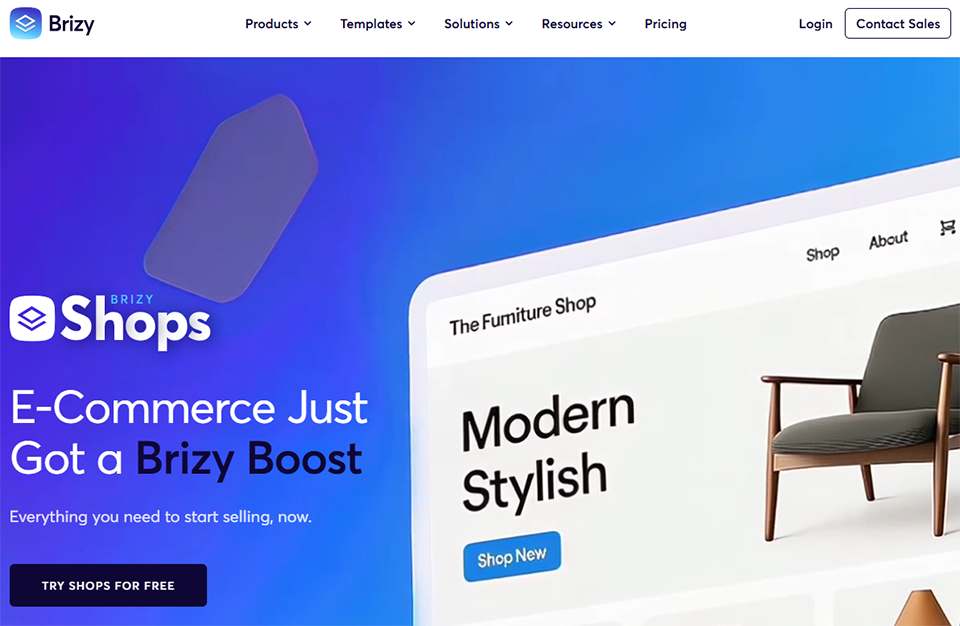
Brizy is a page builder that doesn’t get as much attention as the industry giants, but it has carved out a niche for itself thanks to a dual offering: a WordPress plugin (Brizy for WordPress) and a standalone cloud version (Brizy Cloud). This flexibility makes it appealing to users already in the WordPress ecosystem as well as those who want to break free from it.
The integration of AI into Brizy includes tools for generating text content, layout suggestions, and-soon-the ability to generate entire page sections. On the e-commerce side, Brizy Cloud offers a shopping module that allows users to create product pages and connect payment systems such as Stripe.
Brizy's editor is known for its fluidity and ease of use: there's no cluttered interface-options appear contextually when you select an element. The library of pre-designed blocks is extensive and covers most common e-commerce needs: product pages, CTAs, testimonials, and order forms.
Brizy's AI is primarily used for writing text and suggesting blocks tailored to the context of your page. The AI Content Generation feature allows you to write or rewrite any text block directly in the editor.
🧩 WordPress users looking for a page builder that’s smoother than Elementor: Brizy for WordPress is often cited as a lighter, faster-to-learn alternative to Elementor. If you’re already using WordPress with WooCommerce or Elementor, Brizy integrates seamlessly into that ecosystem.
🏗️ Freelance web designers managing multiple client projects: Brizy’s Agency plan and workflow are designed to manage multiple websites from a centralized interface, with a system for replicating blocks across projects.
💼 The solopreneur with a small product catalog: For a few products to sell online with a well-designed page, Brizy more than meets your needs without requiring a Shopify subscription costing tens of euros.

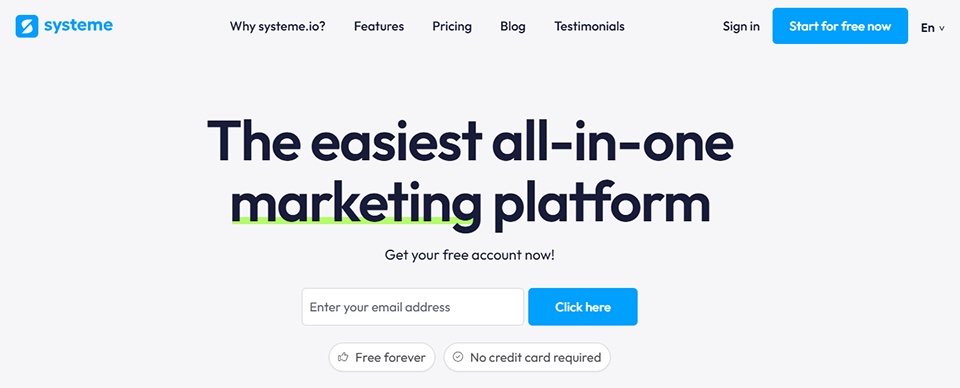
Systeme.io is a major French platform that has built its reputation a simple promise: to replace a dozen separate SaaS tools with a single, unified interface. Sales funnels, lead capture pages, email marketing, online course management, affiliate programs, and e-commerce stores-it’s all included in the subscription.
AI is integrated into Systeme.io primarily through content generation tools for sales pages and marketing emails. The page builder uses a block-based editor with pre-built, conversion-focused templates that the AI can enhance and optimize.
Systeme.io’s key strength is its ability to cover the entire sales funnel from a single interface: landing page → sign-up form → automated email sequence → sales page → upsell → member area. It’s a well-established funnel process that’s particularly effective for digital products and courses.
Systeme.io's AI generates copy for your sales pages based on a few details about your offer: headlines, bullet points highlighting benefits, and calls to action. The platform also offers a library of conversion-optimized content templates.
📚 The go-to platform for online courses and digital products: Systeme.io is hard to beat for anyone selling online courses, ebooks, or coaching services. Managing member areas, email sequences, and sales pages all within a single interface saves a significant amount of time and money.
💰 For entrepreneurs looking to keep their SaaS subscription costs down: Systeme.io’s free plan is one of the most generous on the market. If you want to get started without any upfront costs, it’s hard to find a better option.
📣 Affiliate marketers or digital product sellers: With built-in affiliate program management and conversion-focused funnel logic, Systeme.io is a tool that’s perfectly suited for traditional digital marketing.
These seven tools address a wide range of needs depending on your stage of development, your technical background, and the type of products you sell. Here’s a quick overview to help you figure out which one is right for you.
| Tool | Admission price (approx.) | Built-in AI | E-commerce type | Ideal Profile | Deal |
|---|---|---|---|---|---|
| Shopify | 29 $/month | ✅ Strong (Magic + Sidekick) | Physical products, multi-channel | Reputable online retailer | Yes |
| Wix | 17 $/month | ✅ Strong (ADI + AI generator) | Physical + digital products | Creative solopreneur | Yes |
| Squarespace | 16 $/month | ✅ Intermediate (Blueprint AI) | Physical + digital products | Lifestyle brands, creative professionals | Yes |
| Webflow | 29 $/month | ✅ Currently being rolled out | Physical + digital products | Designers, agencies | Yes |
| Dorik AI | 18 $/month | ✅ Very strong (full generation) | Digital products, services | Busy entrepreneurs, freelancers | Yes |
| Brizy | 10 $/month | ✅ Average (AI content) | Physical + digital products | WordPress users, freelance web designers | Yes |
| Systeme.io | 0 $/month | ✅ Average (AI copywriting) | Digital products, training | Content creators, infopreneurs | Yes |
Before you get started, here are the most frequently asked questions on this topic.
Not quite, and it’s best to know that from the start. Tools like Dorik AI or Wix ADI can generate a highly advanced site structure in just a few seconds, but the result still requires a review and refinement phase. The generated text serves as a starting point, not a final version. AI significantly speeds up production, but it doesn’t replace human judgment regarding the relevance of the content or its alignment with the brand identity.
For a complete beginner, Wix or Systeme.io are probably the easiest options to get started with. Wix, thanks to its generative AI and virtually flat learning curve; Systeme.io, for its free plan that lets you test the platform before committing. Shopify remains the go-to choice if you already know you’ll be handling high order volumes.
A page builder lets you create visual interfaces (product pages, landing pages, homepages) using a visual editor. A comprehensive e-commerce platform like Shopify also includes inventory management, logistics, payments, sales reports, and customer relationship management. Some tools, such as Webflow or Wix, offer both, with varying levels of depth depending on the tool.
Indirectly, yes. AI-generated templates are generally based on proven conversion patterns. Additionally, AI tools like Shopify Magic enable the creation of richer product descriptions and content that’s better optimized for SEO, which improves both organic traffic and the relevance perceived by visitors. But there’s no magic: a good tool can’t make up for a poorly positioned offering or inconsistent pricing.
Technically, yes, but migration is rarely straightforward, especially if you have a large product catalog and order history. Shopify and Wix offer import/export tools, but the work involved in reformatting data is often underestimated. It’s better to choose a tool from the start that aligns with your growth trajectory rather than your immediate needs.
Most offer a French interface and French-speaking support. Systeme.io was founded in France and its support team is native French-speaking. Shopify, Wix, and Squarespace have localized interfaces, but their most detailed documentation is still in English. Dorik AI is primarily in English.
All the tools mentioned in this article come with a special deal available through Freelance Stack. The platform offers over 850 discounts on the best SaaS software, making it ideal for testing these tools at a lower cost before committing to a long-term subscription.