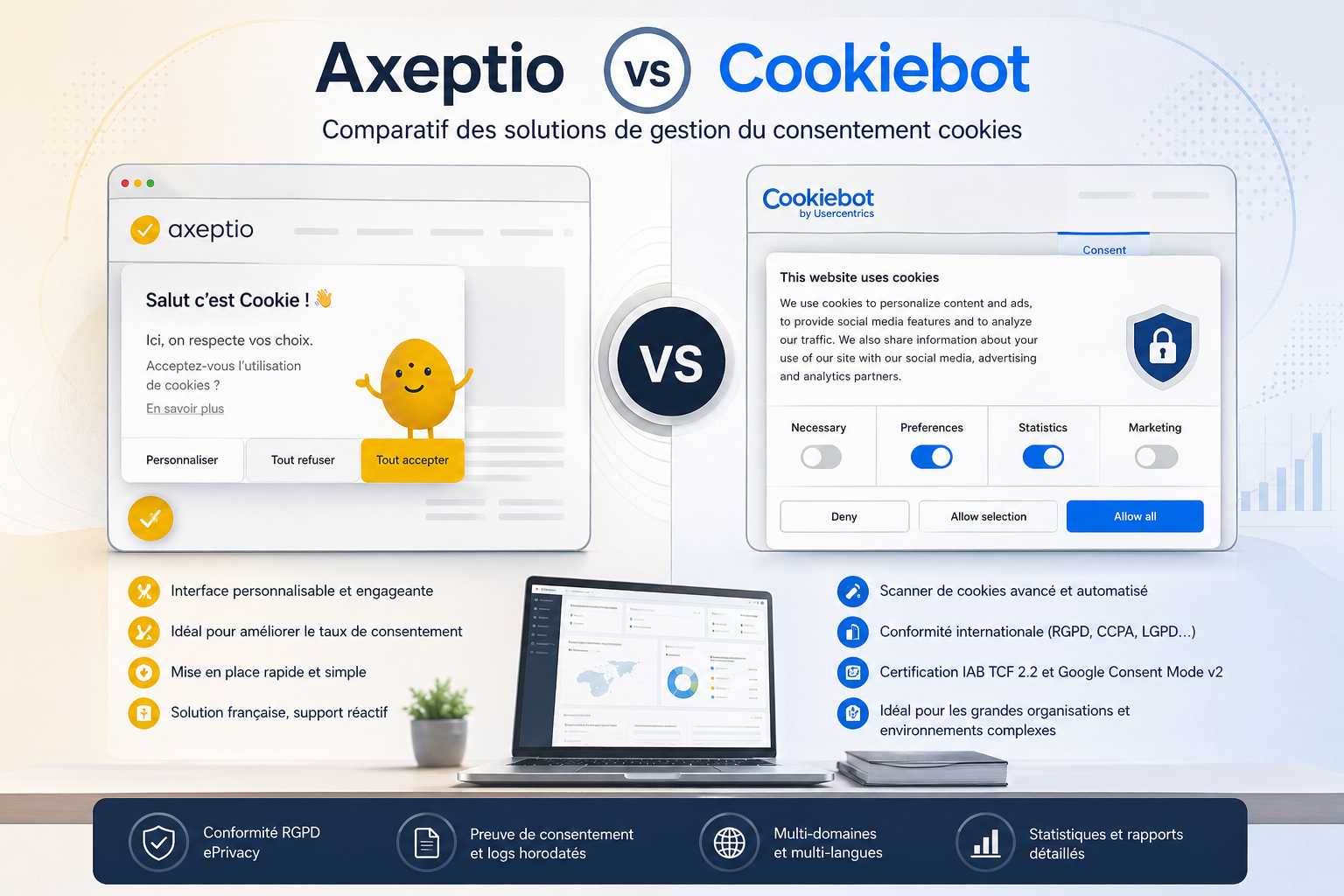
Axeptio vs Cookiebot: Features, Differences and Use Cases.
This article reviews the features, pricing, real-world use cases and limitations of Cookiebot & Axeptio to help you make the choice that best suits your situation.
Cookie compliance—a topic we can no longer ignore!
Since the GDPR took effect in 2018 and following the CNIL’s subsequent recommendations, simply displaying a cookie banner is no longer sufficient. Consent must be freely given and informed, and users must be able to withdraw it just as easily as they gave it. Fines are being imposed, penalties are on the rise, and even small organizations are no longer immune to audits.
The result: choosing a consent management solution (known as a CMP, or Consent Management Platform) has become a decision that must be taken seriously. It’s not just a matter of checking a box, but of finding the tool that truly aligns with your organization’s structure, audience, and available resources.
Two names come up time and again in this market: Axeptio and Cookiebot. The first is French and designed for teams that want a polished user experience. The second is Danish and has historically been rooted in large organizations and multi-site environments. Two philosophies, two market positions, two approaches to compliance.
This article reviews the features, pricing, real-world use cases, and limitations of each option to help you make the choice that best suits your situation.
#1 - Axeptio: The French CMP that focuses entirely on the user experience.
Axeptio was founded in France in 2019, at a time when cookie banners were still perceived as intrusive obstacles, often designed to discourage users from opting out. The initial idea was simple: why should legal compliance mean a poor user experience? The platform was therefore built around a consent interface designed to be clear, engaging, and even friendly.
Today, Axeptio is used by thousands of websites in Europe, with a particularly strong presence in France. The solution is designed for entrepreneurs s and small businesses as well as agencies that manage multiple clients.
Concept and positioning:
Axeptio is based on the idea that consent must be obtained in a context of trust, not under duress. Specifically, the cookie banner is visually customizable (colors, fonts, optional mascot), written in clear language, and designed so that users understand what they are consenting to. This approach stands in stark contrast to the dry, legalistic pop-ups that are still all too common.
The platform automatically generates a consent widget that complies with GDPR and ePrivacy requirements. It also includes a cookie scanner that detects trackers on the website and classifies them according to standard c Categories s (functional, analytical, marketing, etc.).
Main features :
Axeptio meets the essential needs of a modern CMP:
Automatic detection of cookies on the website using a built-in scanner.
Native multilingual support, including for French-speaking and European markets.
Stored and accessible proof of consent (timestamped logs).
Native integrations with Google Tag Manager, WordPress, Shopify, PrestaShop, and other CMS platforms.
API available for custom technical integrations.
Centralized dashboard for agencies managing multiple locations (multi-site mode).
One point often highlighted by users is how easy it is to set up. The script to be integrated is minimal, and the initial configuration takes just a few dozen minutes without requiring any special technical skills.
Axeptio Rates:
Free Plan: Up to 10,000 monthly sessions, basic features, 1 domain.
Start Plan: Starting at €9/month per domain, unlimited sessions, advanced customization.
Enterprise Plan: Available upon request, for large organizations with specific needs.
Benefit from a on Axeptio .
3 months free
Find our best discount right now with Axeptio and save on your software subscriptions. We offer over 850 promo codes and discounts on the best software and SaaS on the market.
#2 - Cookiebot: The European leader for demanding environments.
Cookiebot is published by the Danish company Usercentrics, one of the long-standing players in the European CMP market. The solution originated in a Nordic context where a culture of personal data protection is deeply rooted, and it was designed from the outset to meet the needs of organizations subject to strict regulatory frameworks.
Cookiebot is now used in more than 180 countries and counts hundreds of thousands of websites among its users. It is particularly widespread in the healthcare, education, and public sectors, as well as among international companies.
Concept and positioning:
While Axeptio focuses on user experience and simplicity, Cookiebot places greater emphasis on technical rigor and regulatory compliance. The platform is designed for teams that face strict legal requirements, operate in multiple countries, or must undergo regular compliance audits.
Its cookie scanner is recognized as one of the most comprehensive on the market: it performs an in-depth analysis of the entire website, detects third-party cookies hidden in iframes or loaded dynamically, and generates detailed reports that can be used directly as part of a documented compliance process.
Main features :
Cookiebot offers a wide range of features, with a particular focus on documentation and traceability:
Automatic scanning of the website on a weekly basis (detection of cookies, pixels, and trackers).
Automatically generated and updated cookie policy.
Supports more than 40 languages.
Consent management by category, with fine-grained control.
Multi-domain management from a centralized dashboard.
Robust API and SDK for developers.
ISO 27001 certifications and compliance with the Digital Markets Act.
Cookiebot Pricing:
Free Plan: Up to 1 domain with fewer than 100 subpages.
Essential Plan: starting at 9 €/month per domain.
Business Plan: Starting at €19/month per domain, statistics, advanced integrations.
Enterprise Plan: Available upon request, for large-scale, multi-site deployments.
Benefit from a on Cookiebot .
40% off during 3 years
Find our best discount right now with Cookiebot and save on your software subscriptions. We offer over 850 promo codes and discounts on the best software and SaaS on the market.
Axeptio’s key differentiator is its UX-first approach to compliance. Most CMPs treat the cookie banner as a legal issue to be resolved, minimizing user interaction as much as possible. Axeptio takes the opposite approach: if the banner is clear, well-designed, and respectful, users are more willing to respond to it, and the consent rate improves.
This is a concrete argument for marketing teams and e-commerce site managers, for whom every percentage point in the consent rate has a direct impact on the data available for their advertising campaigns.
Key Features:
The customizable mascot is a prime example of this philosophy: although optional, it helps give the banner an identity and align it with the site’s brand image. Internal studies at Axeptio show that this customization improves the interaction rate.
Conditional scripts are also handled effectively: it is possible to define specific behaviors for each category of cookies (blocking a script until consent is given, loading it dynamically after acceptance, etc.) without having to modify the source code.
The management interface for agencies deserves special mention. Digital agencies and freelancers managing multiple client sites can manage all their domains from a single dashboard, with a centralized view of statistics and settings.
Typical use cases:
Axeptio is particularly well-suited for:
E-commerce sites (Shopify, PrestaShop, WooCommerce) that want to maximize their consent rate without compromising the shopping experience.
French startups and small and medium-sized businesses that want to ensure GDPR compliance without having to hire a lawyer or a developer.
Web agencies and freelancers who manage multiple client websites and want a unified solution that is easy to bill and configure.
Websites with a strong brand identity, where a generic banner would be seen as out of place.
The fact that Axeptio is a French-developed solution is also seen as an advantage by some customers: the documentation, support, and communication with the team are all in French, and the platform is tailored to meet CNIL requirements.
Why choose Cookiebot?
What really sets Cookiebot apart:
Cookiebot stands out primarily for the depth of its scanner and the robustness of its regulatory coverage. For an organization that needs to be able to document its compliance, provide evidence during an audit, or manage legal requirements in multiple countries simultaneously, it is the better-equipped of the two tools.
The solution is also one of the first to have obtained IAB TCF 2.2 certification, the technical standard used by the European advertising industry for consent management in programmatic environments. For websites that monetize through display advertising, this is an important factor.
Key Features:
The automatic weekly scan is one of the most popular features among Cookiebot users. Unlike some solutions where the scan must be triggered manually, Cookiebot re-analyzes the site every week and automatically updates the cookie policy. If a new third-party script is integrated by a service provider without the team’s knowledge, it is detected and flagged.
Compatibility with Google Consent Mode v2 is also a notable strength in 2025: this Google protocol allows certain features of Google Analytics and Google Ads to remain available even in the absence of explicit consent, by using modeled data. Cookiebot supports this compatibility natively.
Finally, large-scale, multi-domain capabilities are particularly well-suited for groups, media publishers, or retail chains with multiple sites: centralized management, consolidated reports, and cascading configurations make it possible to quickly deploy a consistent consent policy.
Typical use cases:
Cookiebot is particularly well-suited for:
Companies with an international presence that must comply with different regulatory requirements in different countries (GDPR, CCPA, LGPD, etc.).
Sensitive sectors (health care, education, finance, the public sector) where documented compliance is non-negotiable.
Publishers and online media outlets that use ad networks and require IAB TCF certification.
Groups and holding companies with multiple entities or dozens of locations that need to be managed centrally.
Technical teams looking for a robust API and deep integrations with their own systems.
The platform's maturity and the availability of extensive technical documentation also make it a preferred choice for IT teams that want to retain control over the system's fine-tuning.
Advantages and Limitations of Axeptio.
✅ A polished, customizable user interface that fosters engagement and improves consent rates.
✅ Suitable for multi-site organizations and large enterprises.
✅ Security certifications (ISO 27001), a mark of trust for sensitive industries.
⚠️ The consent widget interface is more standard and less visually customizable than Axeptio.
⚠️ The learning curve may be longer for non-technical users.
⚠️ Support in French is not as readily available, as the main documentation is in English.
⚠️ For very small websites, functional depth can present a disproportionate level of complexity.
⚠️ The free plan is limited to sites with fewer than 100 subpages, which can quickly rule out growing sites.
Comparative Summary 📋
Before reviewing this comparison, keep in mind that both tools meet the fundamental legal requirements of the GDPR. The difference lies in the depth of functionality, user experience, and suitability for your organization’s size and industry.
Criterion
Axeptio
Cookiebot
🎨 Customizing the widget
⭐⭐⭐⭐⭐ Very in-depth
⭐⭐⭐ Standard
🔍 Quality of the cookie scanner
⭐⭐⭐ Correct
⭐⭐⭐⭐⭐ Excellent
🌍 International Coverage
⭐⭐⭐ Europe
⭐⭐⭐⭐⭐ Worldwide
⚡ Easy to set up
⭐⭐⭐⭐⭐ Very fast
⭐⭐⭐⭐ Good
💰 Value for money (microbusinesses and small businesses)
⭐⭐⭐⭐⭐ Excellent
⭐⭐⭐⭐ Good
📋 Documentation and Audits
⭐⭐⭐ Correct
⭐⭐⭐⭐⭐ Very comprehensive
🔗 CMS Integrations
⭐⭐⭐⭐⭐ Excellent
⭐⭐⭐⭐ Good
📢 IAB TCF 2.2 Compliance
✅ Partial
✅ Certified
🇫🇷 French-language support
⭐⭐⭐⭐⭐ Native
⭐⭐⭐ Fair
🏢 Suitable for large accounts
⭐⭐⭐ Possible
⭐⭐⭐⭐⭐ Perfect
The prices mentioned in this article are for informational purposes only. They may vary depending on current pricing terms, billing frequency (monthly or annual), and changes to the offerings. We recommend that you check the current rates directly on the providers’ official websites.
Who is each tool primarily intended for? 🎯
The question isn't which of the two is "better" in an absolute sense. Both are reliable, compliant, and well-maintained solutions. The real question is which one best suits your specific situation.
👩💻 Axeptio is for you if...
You manage one or more websites in France or French-speaking Europe, and you're looking for a solution that's quick to deploy without needing to involve a developer. Your priority is to achieve a decent consent rate while providing a good experience for your visitors. Visual customization is important to you because your website has a brand identity that you want to maintain even in its functional elements.
This is typically the right choice for:
A freelancer or consultant entrepreneur who wants to quickly bring their business into compliance without a large budget.
A French startup or small-to-medium-sized business that wants to manage its compliance internally, without dedicated legal expertise.
A digital agency that wants to offer GDPR compliance as a packaged service to its clients.
An e-commerce site that wants to maximize its cookie acceptance rate to power its analytics and advertising tools.
🏢 Cookiebot is right for you if...
You have stricter compliance requirements, a presence in multiple countries, or regular audits that need to be documented. Your priority is technical rigor and the ability to comprehensively demonstrate your compliance. The visual experience of the banner takes a back seat to the robustness of the system.
This is typically the right choice for:
A company that operates in several countries and must comply with different regulations simultaneously.
An organization in a sensitive sector (health care, finance, education) where the traceability of consent is criticized during audits.
A publisher or media company that monetizes through programmatic advertising and requires IAB TCF certification.
A group or holding company that manages a large number of sites and wants a consistent, centralized consent policy.
An IT team that wants to integrate the CMP into an existing technical architecture via an API.
See all the software of this category: Conformité & RGPD
Check out all the other software and discount we offer in this category. Explore other tools and choose the perfect solution to grow your business.
Questions on this topic come up often, whether they concern legal requirements, technical operations, or choosing between different tools. Here are the answers to the most frequently asked questions to help you better understand the subject.
1️⃣ Are Axeptio and Cookiebot GDPR-compliant?
Yes, both solutions are designed to meet the requirements of the GDPR and the guidelines of European data protection authorities, including the CNIL in France. They allow you to obtain free, informed, and revocable consent and to retain proof of that consent. That said, compliance does not depend solely on the tool: the configuration, the declared cookie Categories , and the site’s privacy policy also play an important role.
2️⃣ Is the cookie banner required for all websites?
Technically, the banner is required whenever your site uses cookies that are not strictly necessary for the service to function, particularly analytics cookies (such as Google Analytics) and marketing or advertising cookies. A simple showcase site with no third-party trackers could theoretically do without it, but in practice, this has become rare.
3️⃣ What is the difference between a functional cookie and a marketing cookie?
Functional cookies are those that enable the website to function properly: remembering language preferences, keeping a session open, and managing a shopping cart. They do not require consent. Analytical cookies (audience measurement) and marketing cookies (ad retargeting, cross-site tracking) are subject to the user’s prior consent.
4️⃣ Does the consent rate really have an impact on marketing performance?
Yes, and this is often underestimated. A low consent rate means that your analytics tools receive only a fraction of the actual data, which skews your analyses and makes your ad campaigns less accurate. For an e-commerce site that runs paid ads (Google Ads, Meta Ads), maximizing the consent rate has a direct impact on return on ad spend.
5️⃣ Can you use Google Analytics without a cookie banner?
Not in the standard configuration. Google Analytics 4 uses cookies that require prior consent under the GDPR. It is possible to configure GA4 in cookie-less mode or with minimal data collection, but this significantly reduces the accuracy of the data. The most common solution is still to use a CMP that is compatible with Google Consent Mode v2.
6️⃣ Do Axeptio and Cookiebot work with WordPress?
Yes, both offer official WordPress plugins that make integration easy. Axeptio also has very well-documented compatibility with WooCommerce, making it a particularly good choice for WordPress-based online stores.
7️⃣ Are there any comparable solutions on the market?
Yes, the CMP market has grown significantly. Among the available alternatives are CookieChimp and CookieHub, two solutions that offer different approaches in terms of pricing and positioning. For broader legal needs (drafting legal notices, terms of service, etc.), tools like LegalPlace or Legalstart can complement your compliance framework.
8️⃣ How can you migrate from one CMP to another without losing existing consents?
Migration is rarely seamless in terms of consent history: each CMP stores data in its own format, and past consents are generally not transferable from one system to another. In practice, this means that when switching to a new solution, visitors will have to re-select their preferences. This is something to anticipate, especially if you have a large user base.