10 Good Reasons to Add a Chatbot to Your Website in 2026
In 2026, not having a chatbot on your website often means leaving money on the table-and, more importantly, missing out on conversion opportunities at the very moment your visitors have a question. Here are 10 concrete reasons to integrate a chatbot into your website this year, followed by a selection of the best tools on the market, along with their advantages, limitations, and the types of users each is best suited for.
Just five years ago, chatbots were often seen as a gimmick reserved for large companies with substantial budgets. A floating button in the bottom right corner of the screen, a cold, automated response, and often a lot of frustration on the part of users. Those days are long gone.
Today, chatbot solutions have come a long way. Artificial intelligence has changed everything: conversations are more natural, integrations are smoother, and pricing is affordable even for freelancers or startups just getting started. In 2026, not having a chatbot on your website often means leaving money on the table- and, more importantly, missing out on conversion opportunities at the very moment your visitors have a question.
But why now, specifically? Because your competitors have already gotten started. Because online users’ behavior has changed: people no longer want to wait 24 hours for an email response, and they no longer want to wade through endless FAQs. They want an immediate, context-sensitive, and-if possible-helpful response.
Here are 10 practical reasons to add a chatbot to your website this year, followed by a selection of the best tools on the market, along with their advantages, limitations, and the types of users each is best suited for.
10 good reasons to take the plunge in 2026.
Here’s what this means in practice for your website, your team, and your customers.
1. 🕐 Available 24/7, at no extra cost:
Your visitors don’t just visit your site between 9 a.m. and 6 p.m. A chatbot answers questions at midnight, during weekends, during . For a small business or freelancer who can’t afford round-the-clock customer service, this is a real added value. While you sleep, your site keeps working.
2. 🎯 Automatically qualify your leads:
A good chatbot doesn’t just respond-it also asks questions. Within a few exchanges, it can determine whether a visitor is a hot lead or simply in the discovery phase, what their budget is, and what their primary need is. This information is fed directly into your CRM, without any human intervention. You get better-qualified leads, and your sales teams waste less time.
3. 💬 Reduce the volume of repetitive support tickets:
A significant portion of customer service inquiries always revolve around the same issues: delivery times, refund policies, how to create an account, and how to reset a password. A properly configured chatbot can handle 60 to 80% of these inquiries without human intervention. As a result, your teams can focus on complex cases and your most important customers.
4. 📈 Increase your conversion rates:
A visitor who is hesitating on a product or pricing page often just needs a little nudge. A simple question or a quick clarification can tip the scales. The chatbot can trigger a proactive message at the right moment (“Do you have any questions about this offer?”), offer a demo, or point them toward the right deal. In some industries, adding a chatbot has increased conversion rates by 10 to 30%.
5. 🌍 Effortlessly reach an international audience:
If your website attracts visitors from various countries, a multilingual chatbot allows you to respond to them in their own language without hiring additional staff. Tools like Intercom or Crisp Chat offer this feature natively, with automatic detection of the visitor’s language.
6. 🔗 Integrate with your existing stack:
Modern chatbots integrate with your email marketing software, your CRM, your marketing automation tools, Slack, and Notion. They fit seamlessly into your existing workflow rather than disrupting it. When a lead is qualified, it can be automatically added to an email sequence or assigned to a sales representative. The chatbot becomes a link in your conversion funnel, not a standalone tool.
7. 🤖 Leveraging AI for truly useful conversations:
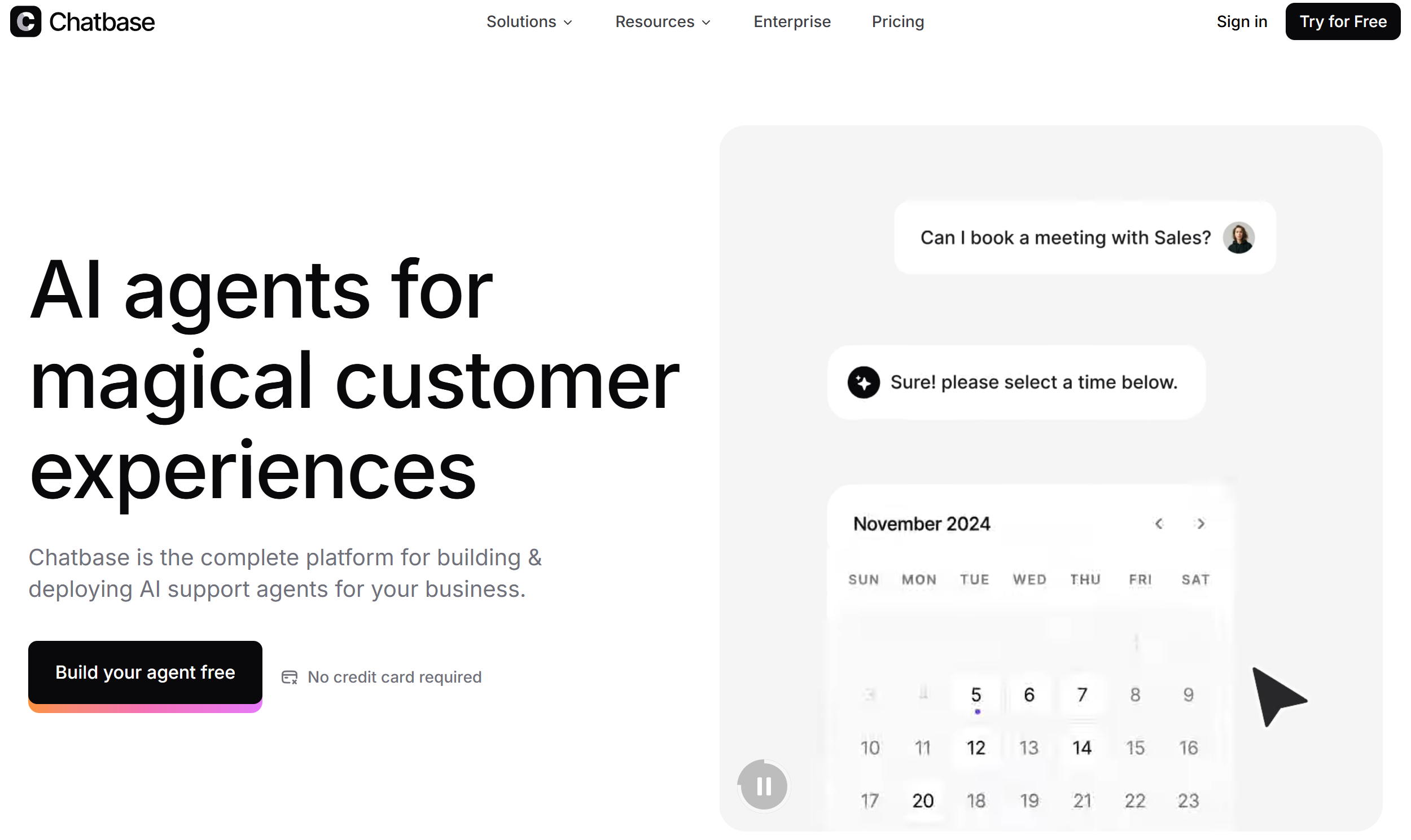
The previous generation of chatbots relied on rigid decision trees. If the user didn’t phrase their question exactly as expected, the conversation would stall. Today, language models enable much more fluid interactions: the chatbot understands the user’s intent, rephrases if necessary, and provides context-aware responses based on your documentation, product pages, and FAQs. Tools like Chatbase let you create an AI agent trained on your own content in just a few minutes.
8. 📊 Collect valuable data about your users:
Every interaction is a source of information. What are the most frequently discussed topics? What obstacles are preventing conversions? Which features generate the most questions? This data, collected passively, provides insights you can’t get from Google Analytics. It informs your product strategy, content, and customer service.
9. 🧩 Customize the experience without coding:
Most current solutions require no technical expertise. They feature drag-and-drop interfaces, ready-to-use templates, and triggers based on user behavior (time spent on a page, URL visited, number of visits). A solo founder or a small team can deploy a fully functional chatbot in just a few hours.
10. 💰 A quickly measurable return on investment:
Unlike many marketing investments, chatbots deliver visible results fairly quickly: the number of conversations handled, leads captured, and support tickets diverted. These metrics make it easy to justify the tool internally and adjust its settings to optimize performance. For those on a tight budget, several solutions offer a free plan or a generous trial period, allowing you to test the tool before committing.
The best chatbot tools available in 2026.
The chatbot category now encompasses a wide variety of options: all-in-one platforms, specialized AI tools, marketing-focused no-code solutions, and alternatives designed for small teams. Here is a selection of the most relevant tools currently available.
#1 - Tidio: The e-commerce chatbot that turns visitors into buyers.
Benefit from our free deal on Tidio.
20% off on any plan
Find over 300 free deals as well as over 850 Premium deals right now with Tidio and save on your software subscriptions. Whether you're an entrepreneur, a startup or a solo freelancer, save hundreds of euros thanks to our discounts and promo codes.
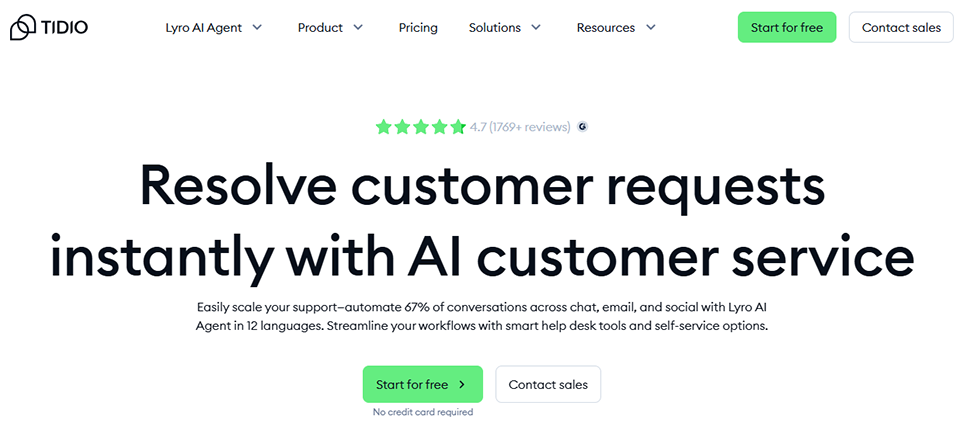
Tidio is a leading choice for small and medium-sized businesses looking to combine live chat and chatbots into a single tool. It is clearly geared toward e-commerce and online stores, with native integrations for Shopify, WordPress, and WooCommerce.
Tidio’s core concept is simple: to provide a unified inbox that brings together conversations from chat, email, and social media, with a layer of automation built on top. Its AI agent, named Lyro, is capable of handling complex conversations in natural language, retrieving order information, and answering product questions without human intervention.
Key features :
Chat with a customizable widget.
Lyro AI agent (based on Anthropic's Claude).
Automation using visual workflows.
Integration with Shopify, WooCommerce, and PrestaShop.
Analytics and conversation tracking.
Mobile app for managing conversations on the go.
Pricing:
Free plan: up to 50 conversations per month with Lyro, a basic live chat service.
Starter Plan: starting at $29/month.
Growth Plan: starting at $59/month.
Tidio+ Plan: Custom pricing for large teams.
Who is this for:
E-commerce businesses and online stores: Tidio is likely the best tool for this type of business. Its native e-commerce integrations allow you to automatically retrieve order information, manage returns, and drastically reduce the volume of support tickets.
Freelancers and consultants: The free plan is all you need to get started. The chat widget lets you capture leads directly on your portfolio site or services page, with simple automations.
Small businesses and SMEs with a website: The combination of live chat and a chatbot allows you to cover times when your team is unavailable while maintaining a personal touch during business hours.
The benefits:
✅ Very easy to get started.
✅ Lyro is one of the top-performing AI agents in its category.
✅ A generous free plan to get you started.
✅ Multilingual support.
Limitations:
❌ Advanced plans can become expensive if the volume of conversations increases.
❌ Some complex automations require an upgrade.
❌ Less suitable for complex B2B use cases.
Benefit from a on Tidio .
Additional 2 months free
Find our best discount right now with Tidio and save on your software subscriptions. We offer over 850 promo codes and discounts on the best software and SaaS on the market.
#2 - Crisp Chat: The omnichannel tool designed for startups just getting started.
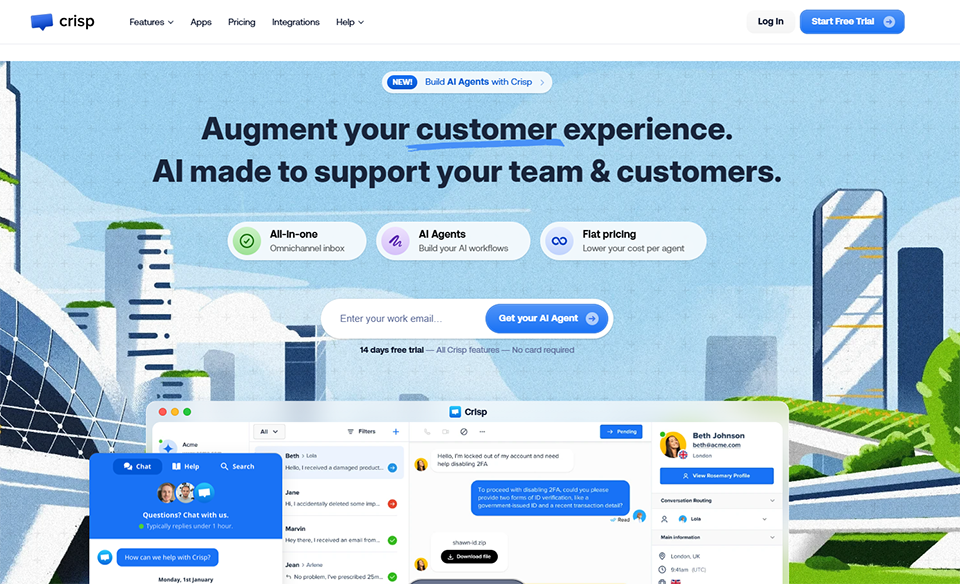
Crisp is a customer messaging platform founded in France that is now used by more than 600,000 businesses worldwide. It stands out for its user-friendly interface, its broad appeal, and its very affordable pricing for small teams.
Crisp acts as a centralized inbox for all customer communications: chat, email, WhatsApp, Instagram, Twitter, and Telegram. The built-in chatbot, called Crisp Bot, allows you to build conversational flows without writing code, and the platform also offers a knowledge base to power automated responses.
Key features :
Omnichannel inbox (chat, email, social media).
Visual chatbot builder.
Integrated knowledge base.
Lightweight CRM with contact profiles.
Co-browsing (browsing together with the visitor).
Proactive message automation.
Integrations with Slack, HubSpot, Zapier, and Segment.
Pricing:
Free plan: 2 agents, basic features.
Pro Plan: $25/month per workspace (includes 4 agents).
Early-stage startups: Crisp’s free plan is one of the most generous on the market. For a startup just getting started, it’s an excellent way to get started with no commitment.
Product and SaaS teams: Co-browsing and screen-sharing features are particularly useful for assisting users during onboarding or when technical issues arise.
Agencies and freelancers managing multiple clients: The architecture, which features separate workspaces, allows projects to be kept clearly separate.
The benefits:
✅ A very comprehensive free plan.
✅ A smooth and user-friendly interface.
✅ French-based with French-language support.
✅ Omnichannel from the start.
✅ GDPR-compliant data policy.
Limitations:
❌ The AI is less advanced than some competitors'.
❌ The built-in CRM remains limited for complex use cases.
❌ There are some gaps in the reporting features for teams that need detailed analytics.
Benefit from a on Crisp Chat .
20% off on any plan "Essentials" and "Plus" on any plan
Find our best discount right now with Crisp Chat and save on your software subscriptions. We offer over 850 promo codes and discounts on the best software and SaaS on the market.
#3 - Intercom: The go-to AI customer support solution for growing teams.
Intercom is the industry leader for growing businesses. The platform has invested heavily in AI over the past two years with its Fin agent, which is considered one of the most effective AI agents available in the chatbot market.
Beyond just a chatbot, Intercom is a comprehensive customer engagement platform that includes messaging, support, a knowledge base, email marketing, and in-app campaigns. The Fin agent can resolve complex inquiries by drawing on your entire help content library and can transfer the conversation to a human agent whenever the situation calls for it.
Key features :
Advanced AI Agent (GPT-4-based, capable of handling complex requests).
Shared inbox for support teams.
Advanced workflow automation.
Public and private knowledge base.
Email and in-app campaigns.
Analytics and detailed reports.
Integrations with Salesforce, HubSpot, Stripe, and Zendesk.
Pricing:
Essential Plan: starting at $39/month per agent.
Advanced Plan: Starting at $99/month per agent.
Expert Plan: Custom pricing.
AI Plan: Billed per resolution (approximately $0.99 per resolution).
Who is this for:
Scale-ups and SMEs with a significant support workload: This is Intercom’s natural habitat. As soon as a team grows beyond 3 or 4 support agents, Intercom’s collaboration, routing, and reporting features make a real difference.
SaaS Companies: In-app campaigns and integration with product data enable the personalization of messages based on user behavior within the app.
Growing B2B startups: Agent Fin can handle a large portion of incoming support, allowing you to stay lean even as your customer base grows rapidly.
The benefits:
✅ Fin is one of the best AI agents on the market.
✅ A comprehensive platform that covers support, marketing, and engagement.
✅ Excellent integration capabilities.
✅ Robust analytics.
Limitations:
❌ Pricing that can become expensive as usage increases.
❌ A steeper initial configuration curve.
❌ Less accessible for very small organizations.
Benefit from a on Intercom .
$100 in credits
Find our best discount right now with Intercom and save on your software subscriptions. We offer over 850 promo codes and discounts on the best software and SaaS on the market.
#4 - Landbot: Forms turned into conversations, for better-qualified leads.
Benefit from our free deal on Landbot.
20% off on annual plan
Find over 300 free deals as well as over 850 Premium deals right now with Landbot and save on your software subscriptions. Whether you're an entrepreneur, a startup or a solo freelancer, save hundreds of euros thanks to our discounts and promo codes.
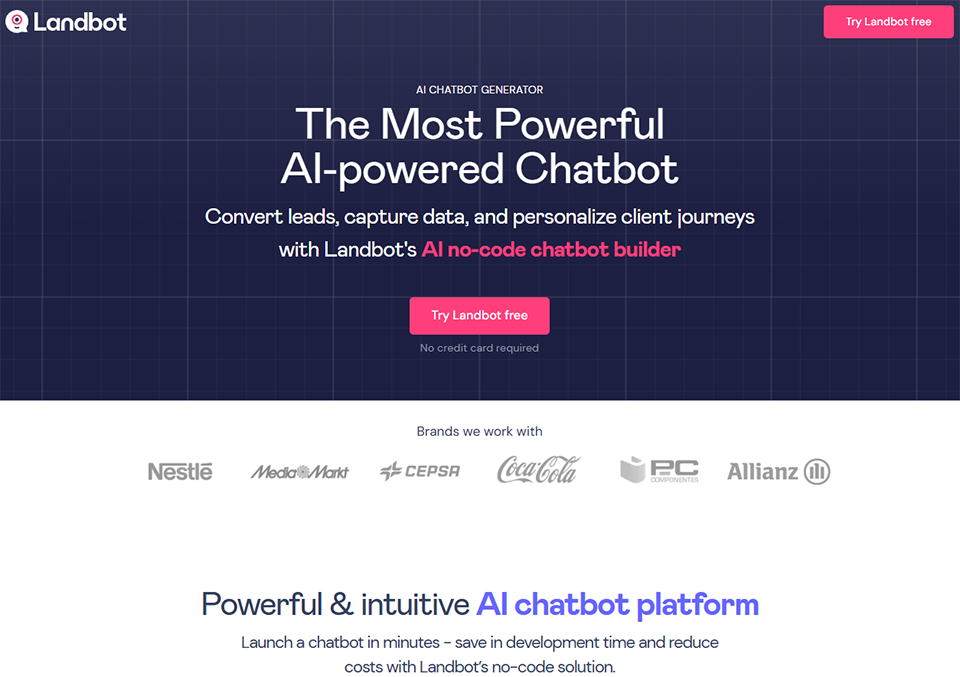
Landbot takes a different approach from the other tools in this selection. Rather than positioning itself as a support tool, it is designed as a builder of conversational chatbots for marketing and lead generation.
The idea behind Landbot is to replace static forms with dynamic conversations. Instead of a contact form with 10 fields to fill out, you create a chatbot that asks the same questions in a natural, step-by-step manner. The completion rate is significantly higher, and the data collected is more reliable.
Key features :
Visual chatbot builder (no-code).
Available on the web, WhatsApp, and as a widget.
Advanced conditional logic.
Built-in calculations and formulas.
Integrations with Zapier, Make, HubSpot, Slack, and Airtable.
Ready-to-use templates by industry.
API for advanced use cases.
Pricing:
Sandbox Plan: Free (up to 100 chats per month).
Starter Plan: $45/month.
Pro Plan: $110/month.
Business Plan: Custom pricing.
Who is this for:
Marketing teams: Landbot is designed with them in mind. Lead generation campaigns, lead qualification, surveys, event registration-anything that involves collecting data in an engaging way.
Digital agencies: The ability to create chatbots for multiple clients using reusable templates makes this a valuable tool for agencies.
entrepreneurs consultants: To replace a generic contact form with a more engaging experience that better filters incoming inquiries.
The benefits:
✅ A very intuitive design interface.
✅ Highly effective for data collection and lead qualification.
✅ Robust WhatsApp integration.
✅ Extensive library of templates.
Limitations:
❌ Less suitable for responsive customer support.
❌ No built-in inbox for human conversations.
❌ Costs that rise quickly as the volume of chats increases.
Benefit from a on Landbot .
Additional 20% off on annual plan
Find our best discount right now with Landbot and save on your software subscriptions. We offer over 850 promo codes and discounts on the best software and SaaS on the market.
#5 - Botnation: The French solution for a GDPR-compliant chatbot.
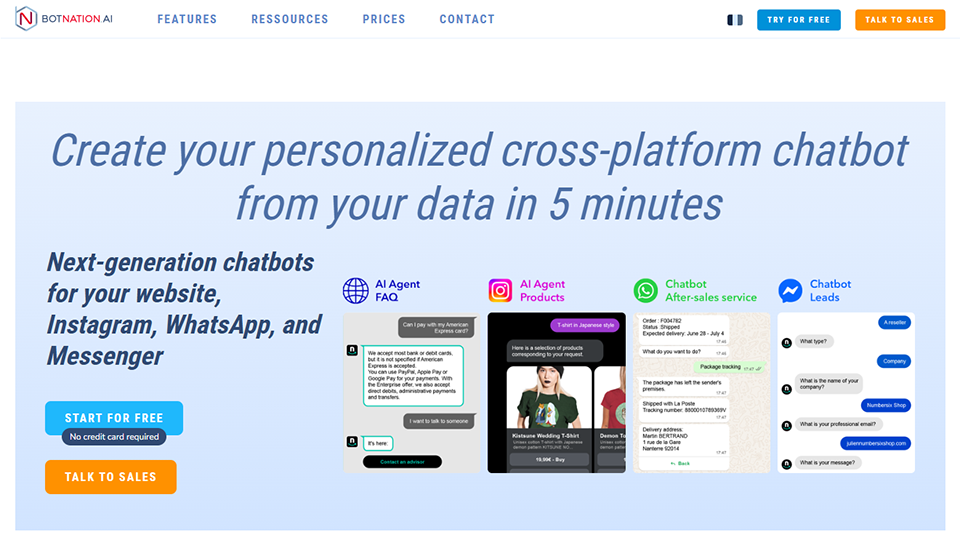
Botnation is a French solution and one of the few chatbot platforms developed and hosted entirely in Europe. It supports chatbots for websites, Facebook Messenger, and WhatsApp.
Botnation positions itself as an affordable, GDPR-compliant alternative to the industry’s American giants. The platform offers a visual builder, AI features, and a French-speaking support team. For companies concerned about where their data is stored, this is a significant selling point.
Key features :
Visual chatbot builder.
Deployment on websites, Messenger, and WhatsApp.
Integration of AI (GPT) for natural language responses.
Analytics and conversation tracking.
Integrations via Zapier and API.
Hosting in Europe (GDPR compliance).
Pricing:
Free plan: limited features.
Starter Plan: starting at €49/month.
Pro Plan: starting at €99/month.
Enterprise Plan: Price upon request.
Who is this for:
French SMEs and microbusinesses: Botnation’s main advantage is its French-language support and its European data infrastructure. For an SME that lacks technical resources and wants support in French, it’s a logical choice.
E-commerce businesses on Facebook/Instagram: Botnation effectively manages Messenger workflows and can support "click-to-Messenger" campaigns.
Healthcare, legal, and finance sectors: Regulated professions that must be vigilant about data location will appreciate European hosting.
The benefits:
✅ Interface in French.
✅ GDPR compliance and EU hosting.
✅ Support available in French.
✅ Good value for money.
Limitations:
❌ Fewer native integrations than its U.S. competitors.
❌ The AI is less advanced than Fin (Intercom) or Lyro (Tidio).
❌ A less robust online community and fewer resources.
Benefit from a on Botnation .
50% off on annual plan
Find our best discount with Botnation and save on your software subscriptions. We offer over 850 promo codes and discounts on the best software and SaaS on the market.
#6 - Chatbase: Turn your documentation into an AI agent in less than an hour.
Benefit from our free deal on Chatbase.
20% off on annual plan
Find over 300 free deals as well as over 850 Premium deals right now with Chatbase and save on your software subscriptions. Whether you're an entrepreneur, a startup or a solo freelancer, save hundreds of euros thanks to our discounts and promo codes.
Chatbase represents a new generation of chatbot tools: personalized AI agents trained on your own content, which can be deployed in minutes without any technical expertise.
The concept behind Chatbase is remarkably simple: you upload your documents (PDFs, web pages, text files, Notion databases), and Chatbase creates an AI agent capable of answering any question based on that content. It can be integrated into your website with just a few lines of code or via a simple link.
Key features :
Creating AI agents from documents, URLs, Notion, and YouTube.
Customization of the agent's personality and tone.
Integration via widget or iframe.
API available for advanced use.
Conversation history and analytics.
Zapier, Make, Slack, and WhatsApp connectors.
Pricing:
Free Plan: 1 chatbot, 20 messages per month.
Hobby Plan: $19/month.
Standard Plan: $99/month.
Unlimited Plan: $399/month.
Who is this for:
Content creators and instructors: Do you have a large volume of content (courses, guides, articles)? Chatbase lets your users "talk" to your content library.
SaaS startups with comprehensive documentation: Instead of asking your users to search through your documentation, a Chatbase agent answers their questions directly.
Entrepreneurs and consultants: If you want to quickly set up an FAQ chatbot on your website without any coding, Chatbase is likely the most user-friendly tool on the market today.
The benefits:
✅ Super-fast setup.
✅ Very high-quality responses (powered by GPT-4).
✅ No technical skills required.
✅ Great value for money on small jobs
Limitations:
❌ Less suitable for real-time customer support.
❌ No live chat features.
❌ Free plans have very limited message quotas.
Benefit from a on Chatbase .
Additional 20% off on any plan
Find our best discount right now with Chatbase and save on your software subscriptions. We offer over 850 promo codes and discounts on the best software and SaaS on the market.
Note: The prices listed are those provided by the publishers at the time this article was written and are subject to change. Please check the current terms and conditions directly on the official websites.
Tool
Free map
Admission price
Built-in AI
Live chat
Ideal for
Tidio
✅ Yes
~$29/month
✅ Lyro (Claude)
✅ Yes
E-commerce, Small Businesses
Crisp Chat
✅ Yes
$25/month
⚠️ Basic
✅ Yes
Startups, SaaS
Intercom
❌ No
$39 per agent per month
✅ End (GPT-4)
✅ Yes
Scale-ups, B2B
Landbot
✅ Limited
$45/month
✅ Conversational AI
❌ No
Marketing, leads
Botnation
✅ Limited
€49/month
✅ Built-in GPT
✅ Yes
French SMEs
Chatbase
✅ Very limited
$19/month
✅ GPT-4
❌ No
Docs, FAQ, SaaS
See all the software of this category: Chatbot
Check out all the other software and discount we offer in this category. Explore other tools and choose the perfect solution to grow your business.
Here are some answers to frequently asked questions to help you better understand the situation before making your decision.
1️⃣ Can a chatbot really replace a human agent?
Partially. Today’s chatbots handle repetitive requests and standard questions very well, which often account for 60 to 70 percent of incoming volume. For complex situations, emotionally charged interactions, or scenarios that require actual decision-making, handing the conversation over to a human is still preferable. The best tools handle this transition seamlessly.
2️⃣ How long does it take to set up a chatbot?
It depends on the tool and the level of complexity you want. With Chatbase, you can have a fully functional agent up and running in less than an hour. With Intercom or Tidio, expect it to take a few days to properly configure workflows, integrate third-party tools, and build the knowledge base.
3️⃣ Do these tools comply with the GDPR?
Most reputable providers offer GDPR-compliant configurations: hosting in Europe is available, user consent is required, and data retention periods can be customized. Botnation and Crisp are particularly well-positioned in this regard. Always review the data processing terms before deploying, especially if you operate in a regulated industry.
4️⃣ Do you need technical skills to set up a chatbot?
No, in the vast majority of cases. All the tools presented here offer a widget that can be integrated simply by copying and pasting a snippet of JavaScript code. For WordPress, native plugins are available (notably for Tidio and Crisp). If you’re using a no-code builder, direct integrations are often available.
5️⃣ What is the difference between a chatbot and an AI agent?
A traditional chatbot follows a decision tree: it responds based on preconfigured rules. An AI agent understands natural language, infers the user’s intent, and formulates an appropriate response even if the question isn’t exactly what was expected. Today, the line between the two is becoming increasingly blurred: most modern tools combine both approaches.
6️⃣ Can you use a chatbot on WhatsApp or Instagram?
Yes. Landbot, Manychat, Botnation, and Tidio all offer WhatsApp integrations. Crisp and others support Instagram Messenger. These multi-channel solutions allow you to centralize conversations in a single inbox, regardless of the original platform.
7️⃣ How much should you budget to get started?
With a budget of €0 to €30 per month, you can already deploy a fully functional chatbot using the free plans from Crisp or Tidio, or the entry-level plans from Chatbase. For an organization looking to scale up with advanced automations and a significant volume of conversations, expect to spend between €50 and €150 per month, depending on the tool.
8️⃣ Is a chatbot suitable for all industries?
Generally speaking, yes, though the degree of adoption varies. E-commerce, SaaS, professional services, real estate, online education, and healthcare (with regulatory considerations) are among the sectors where chatbots generate the best return on investment. In sectors where human interaction is key (luxury goods, strategic consulting), chatbots are used more to screen and guide customers than to replace human interaction.
This guide brings together the 12 must-have e-commerce tools must-have 2026, selected for how well they complement each other: platforms to create your…