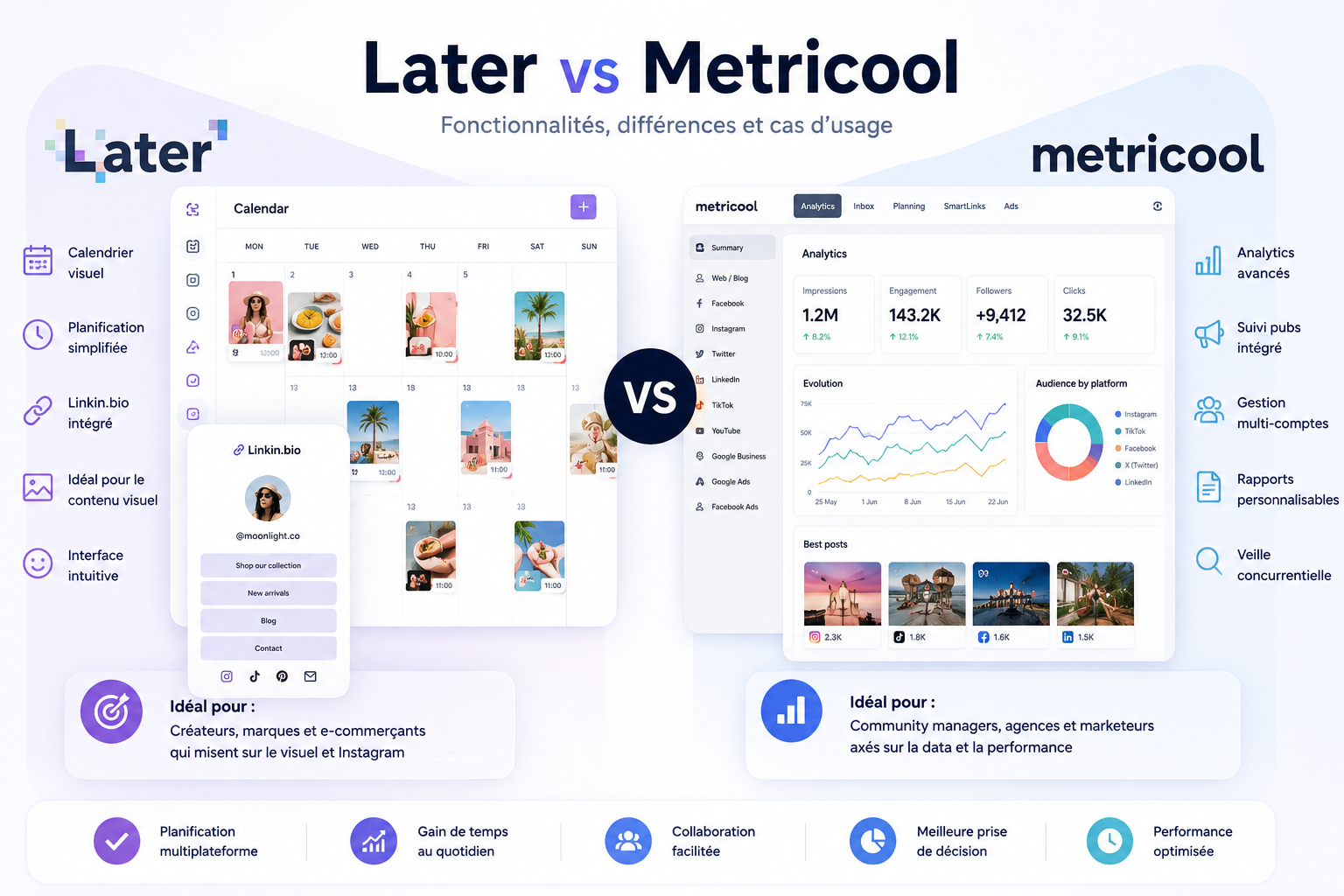
Later vs. Metricool: Features, Differences, and Use Cases.
In this article, we compare these two tools in detail: their features, value for money, respective strengths, and the use cases where each one excels. The goal: to help you make the right choice based on your situation.
Managing Social Media: It's All About Having the Right Tools.
Social media management has become a profession in its own right. Whether you’re a freelancer, a community manager, a startup, or an SME, posting at the right time, on the right platform, with the right content… that’s not something you can wing. And doing all that without a dedicated tool means wasting a considerable amount of time every week.
Two solutions stand out in particular in this segment: Later and Metricool. At first glance, one might think they do the same thing. In reality, they are based on quite different approaches, with strengths and limitations that make them suited for very distinct user profiles.
In this article, we compare these two tools in detail: their features, value for money, respective strengths, and the use cases where each one excels. The goal: to help you make the right choice based on your situation.
#1 - Later: The tool designed for visual content and Instagram scheduling.
Benefit from our free deal on Later.
Find over 300 free deals as well as over 850 Premium deals right now with Later and save on your software subscriptions. Whether you're an entrepreneur, a startup or a solo freelancer, save hundreds of euros thanks to our discounts and promo codes.
Later was launched in 2014 under the name Latergramme, with a simple promise: to let users schedule their Instagram posts from a computer. Since then, the platform has evolved significantly to cover a wider range of social media platforms, but it remains fundamentally geared toward visual content creators and brands that prioritize visuals.
How much it costs:
Later offers several plans, including a free plan limited to one social media profile per network and 30 posts per month. To learn more:
Starter Plan: approximately $18/month (1 user, 1 profile per network, unlimited posts).
Growth Plan: approximately $40/month (3 users, 3 profiles per network, advanced analytics).
Advanced Plan: approximately $80/month (6 users, 6 profiles per network, full features).
Later places a strong emphasis on its integration with Instagram, to the point of having built an entire interface around the visual calendar. You can literally see what your feed will look like before you post. This is a tangible benefit for brands whose Instagram aesthetic is at the heart of their strategy.
Benefit from a on Later .
30% off on any plan
Find our best discount right now with Later and save on your software subscriptions. We offer over 850 promo codes and discounts on the best software and SaaS on the market.
#2 - Metricool: The all-in-one tool for managing your digital presence with data.
Benefit from our free deal on Metricool.
24% off on annual plan
Find over 300 free deals as well as over 850 Premium deals right now with Metricool and save on your software subscriptions. Whether you're an entrepreneur, a startup or a solo freelancer, save hundreds of euros thanks to our discounts and promo codes.
Metricool is a Spanish company founded in 2016 that has quickly gained a following among agencies, marketers, and freelancers looking for a single dashboard to manage planning, performance analysis, and even the tracking of advertising campaigns.
While Later focuses on the visual experience and simplicity, Metricool emphasizes information density and versatility. It’s a tool that’s particularly well-suited for analytical professionals and those who manage multiple accounts for multiple clients.
How much it costs:
Metricool offers a fairly generous free plan, limited to one account per social media platform and 50 scheduled posts per month. Paid plans:
Starter Plan: starting at $18/month (1 brand, extended basic features).
Advanced Plan: starting at $45/month (multiple brands, detailed analytics, reports).
Plan Agency: Pricing is based on a quote depending on the number of accounts.
What immediately sets Metricool apart is its ability to centralize data from a wide variety of sources: Instagram, TikTok, LinkedIn, X, Facebook, YouTube, Pinterest, Google Business Profile, and even Google Ads and Facebook Ads. For anyone who wants a consolidated view without having to open multiple tabs, this is a significant advantage.
Benefit from a on Metricool .
30% off on any plan
Find our best discount right now with Metricool and save on your software subscriptions. We offer over 850 promo codes and discounts on the best software and SaaS on the market.
Why Choose Later: When Visuals Matter More Than Anything Else.
Later has established itself as the go-to platform for brands and creators whose identity is rooted in aesthetics, by placing the visual "feed" at the center of their entire planning strategy.
🖼️ A one-of-a-kind visual calendar:
Later's interface is designed for creators whose content is image-based. The grid-style calendar lets you see exactly how your upcoming posts will look in your Instagram feed before you even hit "post." You can rearrange posts with a simple drag-and-drop.
This feature may seem trivial, but for a lifestyle brand, a photographer, an e-commerce business, or a creative studio, the visual consistency of the feed is a real strategic challenge. Later is one of the few tools that has taken this seriously.
📸 Linkin.bio: Turn Instagram into a traffic driver:
Later has developed Linkin.bio, a customizable landing page that lets you turn every Instagram post into a clickable link to a product, an article, or a landing page. For e-commerce businesses and content creators looking to convert their Instagram audience into web traffic, it’s a valuable tool.
📅 Simplified cross-platform planning:
Later supports Instagram, TikTok, Facebook, X (Twitter), Pinterest, LinkedIn, and YouTube. Scheduling is simple and fast, and the interface doesn't try to do too much. For anyone who just needs to post visual content on a regular and organized basis, it's more than enough.
🤝 Collaboration with creators:
Later has developed features for managing partnerships and collaborations with influencers, which are useful for brands that work with content creators.
Who is Later primarily intended for?
Later is particularly well-suited for solo content creators, small marketing teams, visually-driven brands (fashion, beauty, food, lifestyle, e-commerce), and creative agencies that manage a few accounts with high aesthetic standards.
If your strategy relies mainly on Instagram or TikTok, you produce a lot of visual content, and feed consistency is important to you, Later is probably the right tool for you.
Why Choose Metricool: When Data Becomes a Competitive Advantage.
Metricool has established itself as the essential strategic dashboard for those who place data analysis and profitability at the heart of their social media management.
📊 Some of the most comprehensive analytics on the market:
This is undoubtedly Metricool’s most distinctive strength. While Later offers decent statistics, Metricool goes much further: it tracks engagement trends over time, analyzes the best times to post, compares performance across different periods, and monitors audience growth on a network-by-network basis.
For a freelance social media manager or an agency that needs to report to its clients, this level of analytical depth is invaluable. The reports can be exported, which makes it much easier to prepare monthly reports.
📈 Built-in advertising campaign tracking:
Metricool lets you track your Google Ads and Meta Ads campaigns directly from the platform, without having to switch between multiple dashboards. This is a rare feature at this price point, and it makes a real difference for users who manage both organic and paid traffic.
🔄 Multi-account and multi-client management:
Metricool's architecture is designed for multi-account management from the ground up. You can easily switch between clients, customize access, and generate reports branded for each client. For agencies or freelancers juggling multiple client portfolios, it's a real lifesaver.
🕒 Best suggested posting time:
Metricool analyzes your accounts' engagement data and automatically suggests the times when your audience is most receptive. This isn't a unique feature, but Metricool's implementation is particularly reliable because it's based on actual historical data.
🔍 Competitive Intelligence:
Metricool offers a feature that lets you track competitors' accounts across multiple social media platforms, allowing you to analyze your competitors' strategies, posting frequency, and top posts. This is useful for benchmarking your own strategy.
Who is Metricool primarily intended for?
Metricool is designed for professional community managers, digital agencies, marketers who manage both content and advertising, and freelancers who handle multiple clients. It’s also a great option for businesses looking for a single tool that covers virtually their entire online presence, from YouTube to Google Business Profile.
If your day-to-day routine involves juggling multiple accounts, generating regular reports, and making data-driven decisions, Metricool is likely a better fit than Later.
Strengths and Limitations of Later.
Later prioritizes the creative experience and visual harmony, establishing itself as the must-have partner must-have brands whose image is their primary sales driver.
✅ Key strengths:
A particularly well-designed and intuitive interface that's easy to learn.
A visual grid calendar, perfect for managing your Instagram aesthetic.
Linkin.bio, a unique feature for monetizing Instagram traffic.
Good support for Reels, Stories, and TikTok.
A free plan that lets you thoroughly test the tool.
👎 The downsides:
Analytics that are less comprehensive than Metricool, particularly when it comes to exportable reports.
Not well suited for large-scale multi-client management.
Lack of monitoring of advertising campaigns.
Advanced features (analytics, collaboration) are available only on higher-tier plans.
Less versatile for roles that cover a broad digital ecosystem (YouTube, Google Ads, etc.).
Strengths and Limitations of Metricool.
Metricool leverages analytical power and centralized management, establishing itself as the essential control tower for performance professionals.
✅ Key features:
Extensive coverage of networks and platforms (including YouTube, TikTok, and Google Business).
Built-in tracking for Google Ads and Meta Ads campaigns.
In-depth analytics and customizable, exportable reports.
A practical multi-client architecture for agencies and freelancers.
Native competitive intelligence feature.
A generous free plan to get you started.
👎 Limitations:
A more complex interface, with a slightly steeper learning curve.
Less focus on the visual experience of the content (no feed previews like Later).
The price can rise quickly as soon as you add additional brands.
Some advanced AI features are still under development.
Comparative Summary.
Here is a summary table to give you a quick overview:
Criterion
Later
Metricool
Cross-platform planning
✅
✅
Visual calendar / feed preview
✅ Excellent
⚠️ Basic
Depth of Analytics
⚠️ Correct
✅ Excellent
Ad Campaign Tracking
❌
✅
Multi-client management
⚠️ Limited
✅
Exportable Reports
⚠️ Midterm
✅
Competitive Intelligence
❌
✅
Linkin.bio
✅
❌
Getting Started
✅ Fast
⚠️ Moderate
Free map
✅
✅
Admission fee (paid)
~$18/month
~$18/month
These are approximate rates; please check directly with each service provider.
Which tool is best for which profile?
The choice between Later and Metricool often comes down to one priority: Do you want to focus on your brand image or on managing your performance?
🎨 The solo content creator or small lifestyle brand:
Later is clearly the best choice. Its visual interface, feed preview, Linkin.bio, and overall simplicity make it a natural fit for anyone who produces a lot of visual content and uses Instagram or TikTok as their main channel. There’s no need for an ultra-analytical dashboard: Later does what it does well, without overwhelming you.
📊 Freelance Social Media Management:
Metricool comes out on top in most cases. Its multi-account management, exportable client reports, ad tracking, and competitive intelligence features are exactly what a freelancer needs to manage multiple client portfolios and demonstrate the value of their work with concrete data.
🏢 The digital agency:
The same logic applies as for freelancers: Metricool is designed for this use case. Its "brand"-based architecture, customizable access rights, and rich analytical data meet the needs of an agency that manages dozens of client accounts.
🛒 The e-retailer or DTC brand:
Later is definitely worth considering thanks to its Linkin.bio feature and its expertise in Instagram visual content. If your strategy focuses on Instagram and TikTok and driving traffic to your website is a top priority, it’s a good choice. If, on the other hand, your company also invests in advertising and wants to centralize everything, Metricool will offer a more comprehensive solution.
🚀 Startups or small and medium-sized businesses looking for an all-in-one tool:
Metricool is often the preferred choice, especially if the team is also managing ad campaigns and wants to avoid using too many different tools. For a team that’s new to social media and prioritizes simplicity above all else, Later can be a good place to start.
There are other solid alternatives in this segment if neither of these is a perfect fit for you: Buffer, Hootsuite, Publer, SocialBee, and Iconosquare each offer a different approach and are worth exploring depending on your specific situation.
See all the software of this category: Marketing
Check out all the other software and discount we offer in this category. Explore other tools and choose the perfect solution to grow your business.
FAQ: Later, Metricool, and Social Media Management.
These frequently asked questions round out the overview of two tools with opposing philosophies but both essential depending on your profile: pure aesthetics for Later, statistical power for Metricool.
1️⃣ Are Later and Metricool compatible with Instagram?
Both tools fully support Instagram, including Reels, Stories, and standard posts. Later has traditionally been stronger on plan user experience and previews, while Metricool offers more in-depth analytics for this platform.
2️⃣ Can you manage TikTok with these tools?
Yes, both platforms integrate with TikTok and allow you to schedule posts directly. Managing short videos has become standard for these tools.
3️⃣ Is Metricool suitable for beginners?
The tool is user-friendly but offers enough depth to keep users engaged. It takes a little longer to get the hang of than Later, but Metricool provides helpful tutorials and clear documentation. A motivated beginner will have no trouble mastering it in a few weeks.
4️⃣ Is Later really useful if you're not on Instagram?
Honestly, a significant part of Later's value comes from its Instagram integration. If your strategy relies primarily on LinkedIn or YouTube, Later loses some of its competitive edge. In that case, Metricool or SproutSocial would likely be a better fit.
5️⃣ Can you manage ads with Later or Metricool?
Later does not offer ad tracking functionality. Metricool, on the other hand, includes tracking for Google Ads and Meta Ads campaigns, making it a more comprehensive solution for users who manage both organic and paid traffic.
6️⃣ Do these tools offer AI features?
Both are gradually incorporating AI features, particularly for generating captions and suggesting the best times to post. Metricool is slightly more advanced in this regard at the moment, but the industry is evolving rapidly.
7️⃣ Do these tools replace a community manager?
No. These tools make planning and analysis easier, but strategy, content creation, and community management remain human skills. Above all, they allow you to work in a more organized way and save time on repetitive tasks.
8️⃣ Are there any other similar tools available on Freelance Stack
Yes: Buffer for its simplicity, Hootsuite for its robustness in corporate environments, Publer for its excellent value for money, SocialBee for managing evergreen content, and Iconosquare for advanced Instagram and Facebook analytics.
Further Reading: What We're Seeing in the Field!
Beyond the basic features, there are a few practical considerations that often make the difference when choosing between these two tools.
The issue of workflow:
Later is designed to make publishing easier. Everything about it is geared toward helping you spend as little time as possible on setup and as much time as possible on creating content. Metricool, on the other hand, is designed for management. You spend more time analyzing, adjusting, and comparing. These aren’t quite the same approaches to work.
A content creator who posts five times a week and wants their content to look good and be consistent doesn't have the same needs as a consultant who needs to show a client how engagement has changed over three months. The tool adapts to the workflow, not the other way around.
The issue of scalability:
If you currently manage just one account and plan to manage five in a year, it’s best to plan ahead. Later can quickly become cumbersome as your client base grows. Metricool is designed from the ground up to scale with you in this regard.
On the other hand, if you have just one very active Instagram account and place a high priority on aesthetics, switching to Metricool probably won't offer you much in the way of tangible benefits.
The issue of integration into the stack:
Both tools integrate with third-party solutions, but in different ways. Later integrates well with content creation tools like Canva and cloud storage solutions. Metricool integrates better with broader marketing environments.
If you're already using automation tools like Make, it might be a good idea to check the available connectors for each tool before making your choice. Platforms like SproutSocial and Hootsuite are also known for their wide range of integrations.
What users actually remember:
The feedback we regularly see on Later tends to focus on two points: the interface is user-friendly, and Linkin.bio is a great idea for e-commerce businesses. Criticism mainly centers on the limitations of the analytics and the price of the premium plans.
According to Metricool, users overwhelmingly appreciate the wealth of information and the value for money, especially with the entry-level plans. The most common complaint concerns the interface, which is considered less intuitive than that of some competitors when users first start using it.
Neither of these two tools is "the best" in an absolute sense. What matters is how well they fit your work style, your goals, and the size of your organization.
A quick note about the free plans.
If you're still on the fence and don't want to commit financially until you've tried it out, here's some good news: Both Later and Metricool offer a free plan that's actually usable.
With Later, the free plan includes one profile per social media platform and 30 posts per month. That's enough to see if the interface fits your workflow.
With Metricool, the free plan allows for up to 50 scheduled posts per month and provides access to some analytics. It’s also a good starting point for evaluating the dashboard’s features.
The best way to decide is still to try both out for a few weeks and see which one fits best into your daily routine.