







Expensify vs. Navan: Features, Differences, and Use Cases.
Choosing between the two isn't just a matter of price. It's a matter of priorities: Are you looking to…
Read more

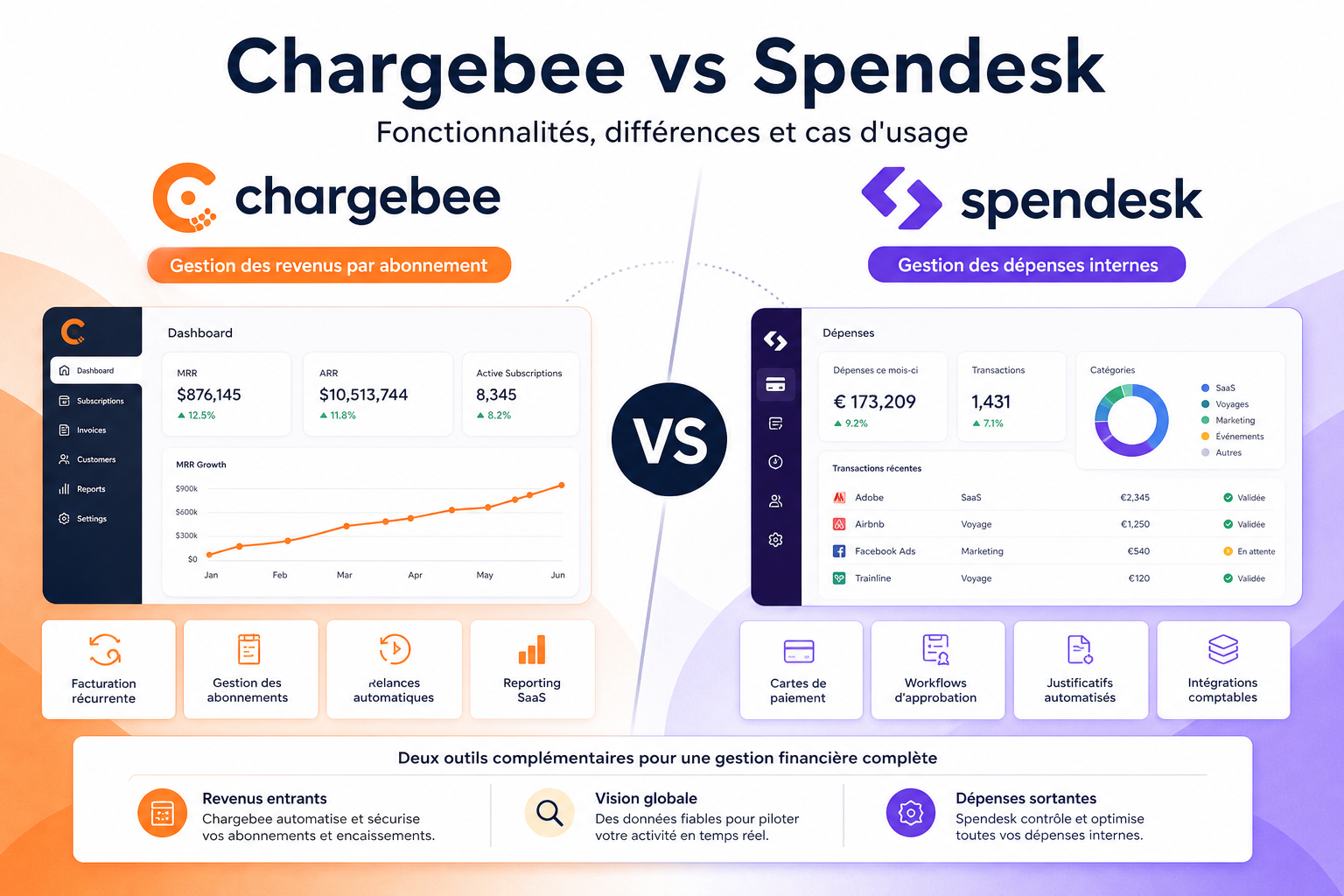
It’s not uncommon to see Chargebee and Spendesk mentioned in the same conversation about corporate financial management. However, these two platforms are fundamentally different, and confusing them can lead to a poor choice—or even to using both at the same time when one would suffice.
Chargebee was created to solve a very specific problem: managing recurring billing and subscriptions at scale. Spendesk, on the other hand, tackles another pain point familiar to finance teams and operations managers: monitoring internal expenses, expense reports, and employee purchases.
So it's not so much a head-to-head competition as it is a matter of positioning. This article is here to help you understand what each one really does, what it does better than the other, and—most importantly—in what context it makes sense for your organization.
Founded in 2011 in Chennai, India, Chargebee has established itself as one of the most comprehensive solutions for everything related to recurring billing and revenue management. The platform is now used by thousands of companies worldwide, ranging from SaaS startups to ambitious scale-ups, as well as subscription-based e-commerce businesses and B2B software providers.
The core idea: to automate everything in a subscription model that could become an operational nightmare if managed manually. Creating and modifying pricing plans, managing free trials, sending payment reminders when payments fail, calculating SaaS metrics (MRR, ARR, churn)... Chargebee centralizes all of this in a unified interface.
Chargebee itself operates on a subscription model, with pricing tiers tailored to the company's size and revenue:
Get the discountBenefit from a on Chargebee .40% off on "Performance" plan for 12 monthsFind our best discount right now with Chargebee and save on your software subscriptions. We offer over 850 promo codes and discounts on the best software and SaaS on the market.
Spendesk is a French fintech company founded in 2016, and it is one of the few French startups to have made a name for itself on the European market for corporate expense management. Its promise: to give finance teams complete visibility into what each employee spends, while making life easier for employees.
Specifically, Spendesk allows you to issue payment cards (physical and virtual) for teams, manage expense reimbursements, automate the collection of receipts, and control budgets by department or project. All of this comes with customizable approval levels and direct integration with the leading accounting software on the market.
Spendesk targets mid-sized companies that have outgrown the stage where the CEO manages everything himself, but that do not yet have the resources of a large corporation with a well-staffed finance department.
Spendesk uses a quote-based pricing model, which means that the price depends on the number of users, the activated modules, and the size of the organization:
Get the discountBenefit from a on Spendesk .20% off to 30% off during 6 monthsFind our best discount right now with Spendesk and save on your software subscriptions. We offer over 850 promo codes and discounts on the best software and SaaS on the market.
Chargebee isn't just a billing tool. It's a revenue lifecycle management platform. In practice, this covers several areas.
This is the heart of the system. You can create complex pricing plans (based on usage, tiered, consumption-based, or hybrid), schedule automatic upgrades or downgrades based on customer behavior, and manage monthly, annual, or custom billing cycles without having to intervene manually each time.
This is often underestimated. Chargebee includes a module called Dunning that automates follow-ups in the event of a failed payment (multiple staggered attempts, with customizable emails), which helps recover a significant portion of revenue that would otherwise be lost.
Particular attention is paid to: MRR, ARR, LTV, churn rate, revenue by segment or pricing plan... All of this data is accessible in real time without having to export it to Excel. For teams that regularly pitch to investors or track their financial OKRs, this is invaluable.
Another key strength is that Salesforce, HubSpot, Slack, QuickBooks, Xero, NetSuite, and many others can be integrated natively or via well-documented APIs.
Chargebee is designed for businesses that generate revenue through subscriptions: B2B or B2C SaaS, streaming platforms, physical devices, and membership-based services. If your revenue model involves recurring payments, multiple plans, free trials, or limited-time promotions, Chargebee significantly simplifies operational management.
It is particularly aimed at startups in the growth phase that are beginning to feel the limitations of makeshift solutions (Stripe alone, or manual exports), and at teams that need a tool that integrates seamlessly with their CRM and accounting systems.
Spendesk starts with a simple observation: in most companies, managing employee expenses is organized chaos. Lost expense reports, salary advances, purchases made with personal cards while waiting for reimbursement, no visibility for the finance team until the end of the month... Spendesk built its platform to eliminate these friction points.
This is just the beginning. Each employee can be assigned a physical or virtual card with spending limits set according to their role. There’s no need to go through the CEO to approve a subscription to a SaaS tool or pay for a business trip. Employees have autonomy within the limits set for them.
These features allow you to configure approval workflows based on the amount or type of expense. An expense of €50 can be approved by the direct manager, while an expense of €5,000 can be approved by the CFO. These rules are applied automatically and create an auditable trail for each decision.
Significantly reduces administrative workload. Using the mobile app, employees take a photo of the receipt immediately after the expense, and Spendesk automatically links it to the corresponding transaction using OCR. No more missing receipts at the end of the month.
Enable automated data export to accounting, with pre-configured cost center codes. What used to take several days at month-end can now be done with just a few clicks.
Spendesk is ideal for growing companies with structured teams where spending is decentralized and where the finance department seeks to regain control without creating operational bottlenecks.
It's particularly well-suited to the needs of sales and marketing teams who travel, purchase supplies, and organize events. And to finance managers who are tired of spending the end of every month chasing down receipts.
Chargebee's main strength lies in its pricing flexibility. Few tools allow you to build such complex pricing structures without coding. Edge cases (partial refunds, credits, plan migrations) are handled natively, which helps avoid many awkward situations with customers.
The dunning module is particularly popular with teams that manage a significant volume of subscriptions. The automatic recovery of failed payments can account for several percentage points of additional revenue over the course of a year—a highly measurable ROI.
The quality of the APIs and documentation is another recognized strength: technical teams generally find the integration to be well-documented and the webhooks to be reliable.
Chargebee can be difficult for teams without technical resources to get up and running. Its rich feature set is a strength, but it involves a significant learning curve and an initial setup process that takes time.
Pricing can become a significant factor as revenue increases—which is paradoxical: the more successful you are, the more you pay. For organizations with very high volumes, the return on investment should be calculated carefully.
Finally, Chargebee isn't for everyone: if you don't sell using a recurring model, the platform isn't very useful. It remains, at its core, a tool for subscription-based businesses.
Spendesk’s user experience is often cited as a key strength, both for employees (the mobile app is clear and intuitive) and for the finance team (the dashboard provides a real-time overview of all current expenses). This is no small matter: an expense management tool that isn’t used by teams is useless.
discount ing the time it takes to close the books is a tangible benefit that most finance teams quickly notice. Less time spent reconciling statements, fewer errors, and less stress at the end of the period.
Compliance and traceability are well thought out: each expense is documented with its supporting documentation, approval workflow, and analytical metadata. This is a strong selling point for internal or external audits.
Spendesk requires a certain level of structure to reach its full potential. For a team of 5 or 10 people, the ROI isn't necessarily clear, and the cost may seem disproportionate.
Workflow customization can have its limitations in complex configurations, particularly for organizations with highly specific validation rules or advanced multi-entity requirements.
And as is often the case with enterprise tools, the relationship with sales teams and pricing transparency could be improved; it often takes a series of demos and discussions before you get a clear picture of the actual cost.
Here is a summary table that provides a quick overview of the main differences between the two tools.
| Criterion | Chargebee | Spendesk |
|---|---|---|
| Primary use | Billing and Subscriptions | Internal Expense Management |
| Primary target | SaaS, subscription-based e-commerce | SMEs and mid-sized companies with structured teams |
| Ideal size | Startups to Scale-ups | 30 to 500+ employees |
| Key strengths | Pricing flexibility, dunning, reporting | UX, traceability, accounting integration |
| Limitations | Learning curve, cost per unit | Less suitable for small organizations |
| Pricing Model | Freemium, then subscription | Upon request |
| Integrations | CRM, ERP, Accounting | Accounting, ERP, HR |
| Available APIs | Yes, well-researched | Yes |
| Mobile | Yes | Yes (strength) |
| Compliance / Audit | Solid | Very sturdy |
In fact, the two tools aren't necessarily in direct competition. Some companies use Chargebee to manage their incoming revenue and Spendesk to manage their outgoing expenses—two sides of the same financial coin.
This is an absolute must. If your customers make recurring payments, Chargebee will save you a considerable amount of time and reduce billing errors.
Free trial, monthly plan, annual plan, usage-based plan... Chargebee excels at managing these hybrid setups, which quickly become unmanageable when handled manually or with general-purpose tools.
Whether you want to track your MRR or churn, or prepare for a fundraising round, Chargebee's dashboards are ready to use right away.
The automatic reminder module is one of the best on the market in this segment.
Travel, SaaS subscriptions, supplies, events... Spendesk organizes and monitors these expenses without hindering teams.
While closing the books can be a painful process due to missing supporting documents or tedious reconciliations, Spendesk tackles these issues head-on.
Approval workflows allow teams to work independently while maintaining full visibility.
That's really where Spendesk offers the best value for the money.
In this case, it’s a no-brainer: Chargebee manages your recurring revenue, and Spendesk manages your operational expenses. These are two complementary building blocks of a structured finance stack. Other tools, such as Pennylane or Qonto, can round out the suite on the accounting and business banking side.
Here are the most frequently asked questions about these two tools, along with some straightforward answers to save you time.
Yes, absolutely. They serve different purposes: one manages your income, and the other manages your expenses. Using them together is a logical approach for an SME or a scale-up that wants to organize its overall financial management.
Not really: they complement each other. Chargebee integrates with Stripe (among other payment processors) and adds a layer of subscription management, reporting, and automation that Stripe alone does not natively offer. Most Chargebee users continue to use Stripe as their underlying payment gateway.
Honestly, no. Spendesk is designed for teams of at least 30 people. For smaller teams, the cost and complexity of implementation generally aren't worth it. For freelancers or very small businesses, solutions like Qonto or Pennylane are a better fit.
A standard corporate card provides you with a payment method. Spendesk provides you with a management system: who can spend, how much, on what, with what approvals, and how all of that is automatically reported to accounting. This is a fundamental difference in terms of control and traceability.
Yes, that’s one of the platform’s strengths. Chargebee incorporates country-specific VAT management, market-specific tax rules (particularly for SaaS), and adapts to e-invoicing requirements. For companies that sell internationally, this is a major selling point.
Not necessarily, but you need to be comfortable with the configuration logic. The no-code interface covers many use cases, but if you want to harness the full power of the APIs or create custom integrations, you’ll need technical support. Small and medium-sized businesses without an in-house developer usually manage by working with an integrator or by limiting their use to standard features.
If you're just starting out and your revenue is still low, begin with Chargebee's free plan—it works very well for the early stages. Spendesk, on the other hand, only makes sense once you have a team. Focus on your revenue management tool first, and look into expense management once your team starts to grow.