


TypeDream
10% off on any plan








✅ Information about this deal:
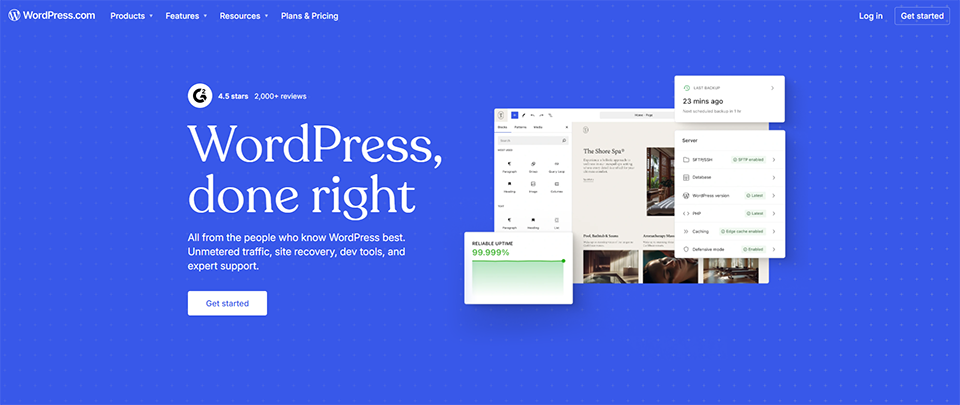
WordPress is an open source content management system (CMS) that makes it easy to create websites, blogs or online stores, without advanced technical knowledge. Flexible and customizable, it offers thousands of themes and extensions to adapt your site to your needs.
Whether you're a beginner or an experienced developer, WordPress offers an intuitive interface and a host of advanced features. It's also optimized for Search Engine Optimization (SEO), making it easier for search engines to find your site. Its large, active community guarantees constant support and continuous evolution of the platform. WordPress is used by over 40% of the world's websites, making it a reliable, proven and scalable solution. Thanks to its compatibility with numerous third-party tools, it integrates seamlessly into your digital ecosystem.
The main features of WordPress :
Easily create, modify and organize your pages, articles, images and files thanks to a clear, accessible user interface.
Access thousands of free or premium themes and add functionality via plugins to tailor your site to your needs.
WordPress is designed to be compatible with SEO best practices, with extensions like Yoast SEO to take things a step further.
The majority of themes are adapted to all screen types (computer, tablet, mobile), guaranteeing an optimal user experience.
Assign different roles (administrator, editor, author, etc.) to better manage rights and security on your site.
WordPress can be used in dozens of languages, and allows the creation of multilingual sites thanks to extensions such as WPML or Polylang.
Turn your site into a full-featured online store with the WooCommerce plugin, featuring product management, payments, shipping and promotions.
Regular updates, security extensions and best practices ensure effective protection against online threats.
WordPress is compatible with third-party tools such as Google Analytics, Mailchimp, Stripe and social networks.
An extensive community of developers, users and contributors provides ongoing support, tutorials, forums and online resources.
WordPress has established itself as the world’s most popular content management system (CMS), powering more than 40% of all websites. This open-source platform offers exceptional flexibility that appeals to everyone from novice bloggers to experienced developers working on complex enterprise projects. Its philosophy is based on democratizing web publishing, allowing anyone to create and manage a professional website without requiring in-depth technical skills.
What sets WordPress apart from its competitors is its dual nature: it’s available as a hosted service (WordPress.com) for maximum simplicity, and as a self-hosted platform (WordPress.org) for total control. This modular approach extends across the entire ecosystem, with a system of themes and plugins that transforms a basic installation into a custom solution. Whether you want to create a personal blog, an online store, a showcase website, or a community platform, WordPress adapts to your specific needs.
The platform’s ongoing evolution-particularly with the introduction ofthe Gutenberg editor-modernizes the user experience while maintaining the robustness for which it is renowned. This capacity for innovation, combined with an active global community of developers and contributors, ensures a sustainable solution that keeps pace with current web standards.
This wealth of features, accessible through an intuitive interface, explains why WordPress remains the go-to choice for creating a professional, scalable website that is perfectly suited to today’s digital landscape.
WordPress offers two distinct approaches: WordPress.com provides a turnkey hosted solution, while WordPress.org offers the free software that you must host yourself.
Here are the official WordPress.com pricing plans, which include hosting and various features depending on the plan you choose:
| Plan | Rates | Included |
|---|---|---|
| Free | Free | 1 GB of storage, WordPress.com subdomain, basic themes |
| Personal | 4€/month | Free domain name, 6 GB of storage, email support |
| Premium | 8€/month | 13 GB of storage, premium themes, ad monetization |
| Business | 25€/month | 200 GB of storage, plugins, unlimited themes, e-commerce tools |
| e-commerce | 45€/month | 200 GB of storage, advanced e-commerce features, integrations |
1️⃣ If you are a freelancer or consultant:
Webflow offers a modern alternative for creating websites without in-depth technical knowledge. Its no-code philosophy lets you visually design your site while generating clean code. Hosting is included and performance is excellent, making it perfect for portfolios or showcase sites. Ghost is also a great choice if you’re focused on content creation and blogging. This platform stands out for its ease of use, elegant themes, and built-in SEO features. The writing interface is particularly well-designed, making it ideal for regularly publishing professional content. For an even simpler approach, Carrd lets you quickly create effective landing pages or one-page sites. Its intuitive interface and responsive templates are perfect for presenting your services in a concise and professional manner, without getting bogged down in technical complexity.
2️⃣ If you are a startup:
Framer has established itself as an innovative solution for startups looking to create interactive web experiences. This platform combines design and development, enabling users to quickly prototype and publish modern websites with advanced animations. Its collaborative approach facilitates teamwork, which is essential during the growth phase. Notion can also serve as an alternative CMS for creating simple websites directly from your workspace. This unified approach is particularly well-suited for tech startups that already use Notion for their internal organization. Bubble offers a more ambitious alternative if you’re planning to develop a full-fledged web application. Its no-code platform allows you to create complex user interfaces and integrate databases, making it perfect for quickly testing an MVP before investing in custom development. These solutions save you valuable time during the seed stage.
3️⃣ If you are a small business or an SME:
Shopify is must-have your business has a significant e-commerce component. This all-in-one platform handles hosting, payments, and inventory management, and offers a wide range of professional themes. Its robustness and scalability make it ideal for growing businesses. Wix offers a user-friendly alternative with its intuitive drag-and-drop editor and numerous industry-specific templates. The built-in business features (booking, basic CRM, analytics) simplify the day-to-day management of your online presence. HubSpot CMS is worth considering if you’re looking to integrate your website into a broader marketing strategy. This solution combines website creation, marketing automation, and CRM into a cohesive ecosystem. Although more complex, it offers a compelling ROI for businesses that are seriously investing in their digital transformation and want to centralize their marketing tools.
Otherwise, these other software programs may also be a good alternative to WordPress.