


Replo
Additional 20% off on any plan








✅ Information about this deal:
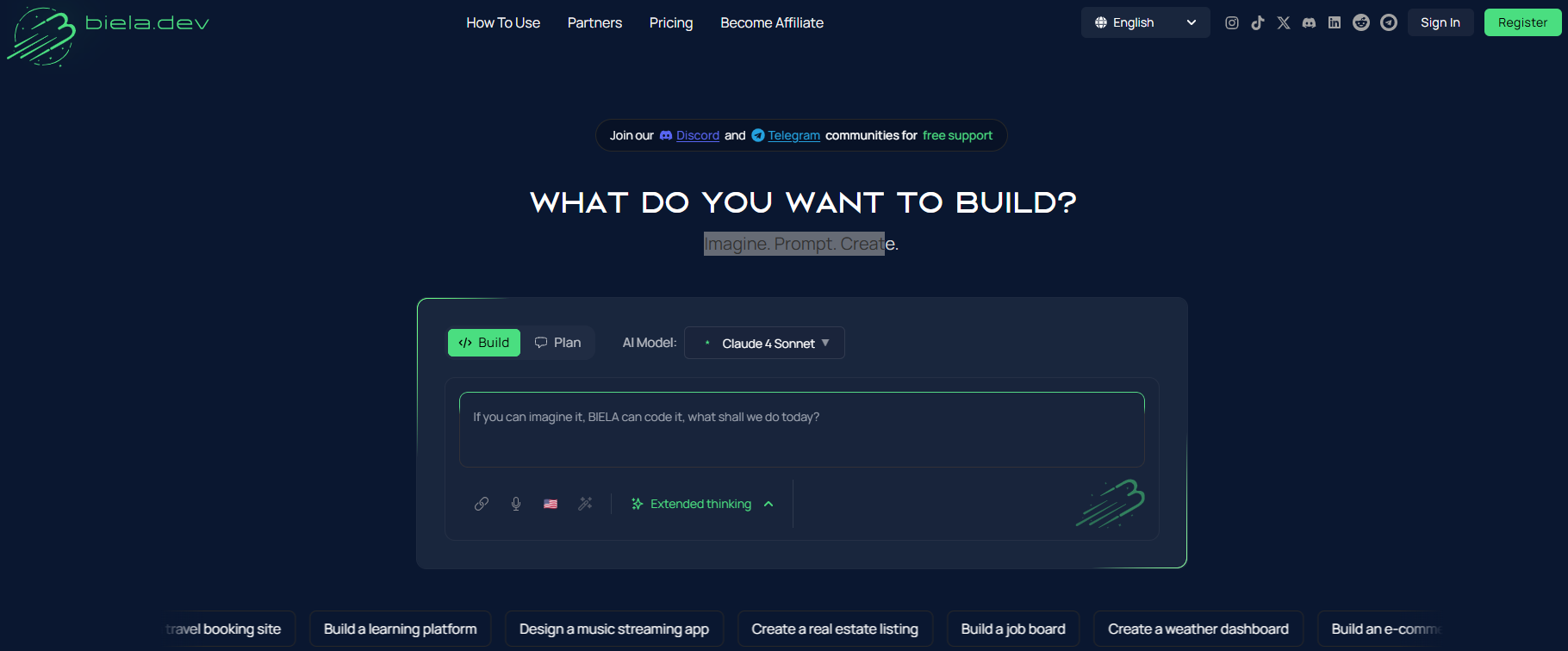
Biela.dev is an AI-powered build space where creative people, freelancers, and early-stage founders turn ideas into real digital products just by prompting. Instead of juggling multiple tools, biela.dev handles coding, debugging, design generation, and even deployment, all in one smooth flow.
With features like built-in Getty Images, an AI Image Editor, large-context understanding, and smarter token usage, it helps you build faster, experiment freely, and bring your ideas (and your customers' ideas) to life.
Key Features :
Practical Use Cases and Benefits :
Strategic Value and Productivity :
Biela.dev is an AI-powered full-stack builder that transforms plain-language prompts into functional, production-ready web applications and websites. The platform is built around the concept of "vibe-coding": you describe what you want to create in natural language, and the AI generates the corresponding code, sets up the backend and database, and deploys a live preview-all without requiring you to write a single line of code.
At the heart of the product is its conversational AI interface, powered by Claude Sonnet. You describe your project in plain English, and the platform builds it in real time. If you want to change a color, add a feature, or restructure the navigation, you simply ask. The live preview updates instantly, allowing you to iterate seamlessly between your idea and the final result.
What sets Biela.dev apart from many competitors is that it generates real, exportable code rather than proprietary components locked within the platform. The underlying files can be inspected, edited, and exported to GitHub. This gives technical users full control and ensures that the product you build is truly yours: no platform lock-in, and no reliance on Biela for future maintenance if you decide to hand the project over to a developer.
Full-stack generation covers frontend, backend, authentication, and database integration in a single workflow. The platform connects to Supabase for PostgreSQL-based databases, handles user authentication flows, and manages file storage, all of which can be configured via prompts. This means you can build applications that require user login, stored data, and real backend logic without touching a configuration file.
Biela also supports AI-powered image generation, AI-powered video generation, and a community-driven Biela Library where users can browse and reuse AI-generated assets created by others on the platform. These features are ideal for teams that want to populate their applications with visual content during the development process rather than sourcing assets separately.
Responsive design is built into every output: the platform generates previews for desktop, tablet, and mobile views simultaneously, allowing users to verify the layout across different screen sizes before deploying. With one-click deployment and custom domain support, projects can go live directly from the platform with minimal configuration.
Voice input is also supported, allowing users to describe what they want to build without typing, which improves accessibility for non-technical users who think better out loud.
Biela.dev uses a token-based pricing model. Tokens are used for every AI action on the platform, from generating code to processing files and running the web container. The free plan resets daily, while paid plans offer larger monthly allocations. Annual billing provides a significant discount compared to monthly rates.
| Plan | Price | Tokens included |
|---|---|---|
| Free | $0/month | 200,000 tokens per day (resets daily); up to 10 full generations per month for verified users |
| LaunchPad | Starting at ~$26/month (billed annually) / ~$29/month (billed monthly) | 10 million tokens per month ($2.61 million annually, $2.90 million monthly) |
| Creator Plus | Starting at ~$53/month (billed annually) | 24 million tokens per month ($2.21 million annually, $2.46 million monthly) |
| Enterprise | Custom pricing | Unlimited tokens, dedicated support, advanced team and security features |
1️⃣ If you are a freelancer or consultant:
For independent professionals who need to launch a working product quickly without managing a development environment, Lovable is one of the most straightforward options. It focuses on creating polished, production-ready frontends connected to Supabase, and the quality of its UI output is consistently high. For those whose primary need is a professional website or landing page rather than a full web application, Framer offers significantly more design control and visual quality for that specific use case. Replit is worth considering for freelancers with some technical background who want a cloud development environment where AI assists rather than takes over entirely, with the benefit of more granular control over the generated output.
2️⃣ If you are a startup:
Startups validating an MVP need rapid iteration and real functionality, not static mockups. Base44 is a close competitor in the AI-native builder space, with a strong emphasis on business logic and integrations. Bolt.new is a popular choice for rapid prototyping on modern frameworks, particularly among founders who want to go from concept to a deployable prototype in a single session. For startups that require more complex data management and are comfortable with a more structured, visual environment, Bubble remains the most capable no-code option for intricate, data-driven web applications, thanks to its extensive plugin ecosystem and established community. Xano handles the backend layer for teams seeking a scalable, structured API and database environment to pair with a front-end builder.
3️⃣ If you are a small or medium-sized business:
At this scale, the Focus on shifts toward reliability, integration with existing systems, and team workflows. Webflow is the gold standard for professionally designed websites, offering robust CMS capabilities and design precision, though it requires separate solutions for any complex backend logic. For businesses building internal tools or operations dashboards, Softr or Glide allow non-technical teams to create functional interfaces on top of existing data in Airtable or Google Sheets, without the complexity of full-stack development. FlutterFlow is worth considering for SMBs with a mobile-first product requirement, as it generates Flutter-based applications for both iOS and Android using a visual editor that balances speed and output quality.
Otherwise, these other software programs may also be a good alternative to Biela.dev.No resources currently available.