
DuploCloud
2 months free

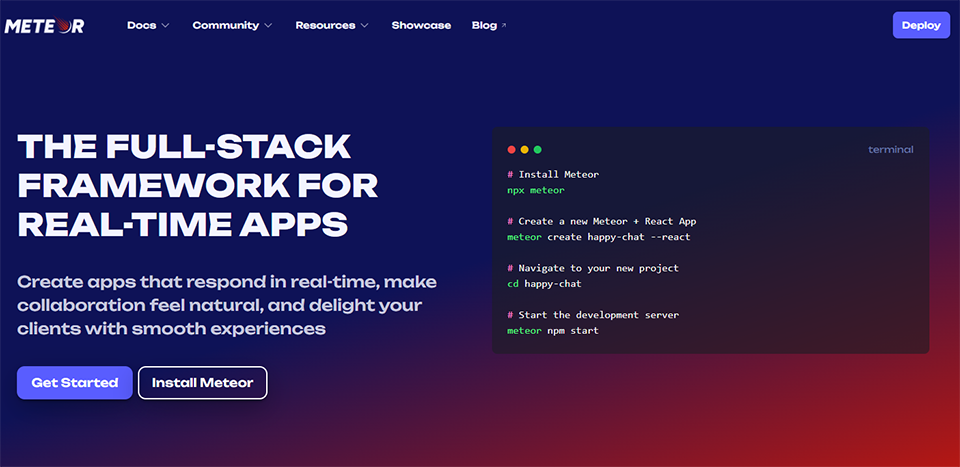







Meteor.js is an open-source JavaScript framework that enables rapid and efficient development of real-time web applications. It simplifies the creation of full-stack applications by integrating both client-side and server-side development. Meteor offers a reactive architecture, meaning that data is automatically synchronized between the client and server, providing a smooth and interactive user experience.
The framework also includes tools for managing databases, user sessions, and deployments. Due to its simplicity and flexibility, Meteor.js is ideal for developers looking to build modern and dynamic applications without excessive complexity.
Meteor.js is an open source platform for seamlessly building and deploying Web, Mobile, and Desktop applications in Javascript or TypeScript.
Why Meteor.js?:
Meteor Cloud:
Open Source:
Build great applications faster than ever using Meteor.js. Join the community of developers from all over the world that rely on Meteor.js.
Meteor.js is a comprehensive full-stack JavaScript platform that revolutionizes how developers build modern web and mobile applications. Unlike traditional frameworks that require you to piece together multiple technologies, Meteor provides an integrated development ecosystem where you can use JavaScript across your entire application stack, from the database layer to the user interface. This unified approach eliminates the complexity of managing separate front-end and back-end codebases while maintaining the flexibility to scale your applications effectively.
What sets Meteor apart in the crowded landscape of web development frameworks is its " real-time by default " philosophy and data synchronization capabilities. The platform automatically handles the complex process of keeping data consistent between your server and all connected clients, making it exceptionally well-suited for applications that require live updates, collaborative features, or interactive user experiences. Whether you're building a chat application, a project management tool, or an e-commerce platform, Meteor's architecture ensures that changes propagate instantly across all user sessions without requiring complex WebSocket implementations or manual state management.
The framework's opinionated yet flexible structure is well-suited for both rapid prototyping and production-grade applications. Meteor comes with sensible defaults and built-in solutions for common development challenges, allowing you to Focus on your application's unique business logic rather than infrastructure concerns. At the same time, it provides workarounds and customization options for teams that need to integrate specific technologies or adapt to particular architectural requirements.
These capabilities combine to create a development environment where you can quickly prototype ideas, iterate on features, and scale applications without the overhead typically associated with full-stack development. Meteor's strength lies in its ability to abstract away infrastructure complexity while preserving the flexibility needed for sophisticated applications.
Meteor.js offers a flexible approach to hosting and deploying applications, with both free and paid options available depending on your needs. The framework itself remains open-source and free to use, while Galaxy hosting services offer plans tailored to different stages of development.
Pricing for Galaxy, Meteor's official hosting platform, is designed to support your growth, from prototyping to production applications that require high availability and optimal performance.
| Plan | Pricing | Includes |
|---|---|---|
| Meteor Open Source | Free | Full-featured framework, development tools, community |
| Galaxy Hobby | $7/month | 512 MB RAM, free SSL, custom domain, basic monitoring |
| Galaxy Essentials | $25/month | 1 GB of RAM, priority support, advanced metrics, auto-scaling |
| Galaxy Professional | $90/month | 2.5 GB RAM, high availability, automatic backup, premium support |
The main advantage of Meteor's pricing model is that it allows you to get startedwith the open-source framework completely free of charge. You can develop, test, and even deploy your applications on other platforms without any upfront costs. This approach lets you experiment with Meteor and validate your project before investing in Galaxy hosting.
The Galaxy Hobby plan, priced at $7 per month, is an excellent starting point for personal projects and advanced prototypes. With 512MB of RAM and SSL included, it provides sufficient resources for light to moderate applications. The included custom domain allows you to present your application professionally right from the start.
For growing applications, the Galaxy Essentials plan, priced at $25 per month, doubles the resources to 1GB of RAM and introduces essential features such as auto-scaling and advanced metrics. Priority support becomes particularly valuable once your application starts generating revenue or serving a significant user base.
The Galaxy Professional plan, priced at $90 per month, is designed for mission-critical applications that require maximum uptime. With 2.5GB of RAM, high availability, and automatic backups, this plan is ideal for businesses whose operations rely on their Meteor application. Premium support ensures that technical issues are resolved quickly.
Please note that these Galaxy rates apply only to hosting and related services. Development with Meteor remains entirely free, including access to all packages, development tools, and framework features. This distinction between free development and paid hosting gives you maximum flexibility in choosing your infrastructure.
Compared to other full-stack solutions like Firebase or AWS Amplify, Meteor offers a significant cost advantagefor small projects. While some platforms charge from the very first user, Galaxy Hobby lets you serve thousands of users for just $7 a month, which is particularly appealing for startups in the validation phase.
The pricing structure remains logical and predictable, making it easier to plan long-term budgets. With no hidden fees or unpredictable usage-based billing, you can keep your infrastructure costs under control. Businesses appreciate this pricing transparency, which simplifies budgeting for technical projects.
For teams requiring significant resources, Galaxy also offers Enterprise plans through custom quotes, featuring personalized configurations, dedicated support, and guaranteed SLAs. These solutions are tailored to the specific needs of large organizations with unique security and performance requirements.
1️⃣ If you are a freelancer or consultant:
For your client projects, Next.js is an excellent alternative to Meteor.js, thanks to its mature React ecosystem and optimized performance. If you’re already proficient in React, you’ll find the learning curve much smoother, while still being able to offer modern solutions to your clients. Nuxt.js is also a solid choice if you work with Vue.js, providing a well-defined structure for your web applications with excellent server-side rendering (SSR) support. For simpler projects or rapid prototypes, Firebase combined with a frontend framework allows you to quickly deliver functional applications without managing backend infrastructure. This approach saves you valuable configuration time and keeps you focused on adding value for your clients, while offering scalable and professional solutions.
2️⃣ If you are a startup:
Vercel with Next.js offers a comprehensive solution for quickly developing and deploying your MVP, with an infrastructure that scales automatically to meet your needs. You save on initial infrastructure costs while enjoying excellent performance. Supabase is a modern alternative to Firebase, particularly appealing for its open-source approach and full PostgreSQL features. You retain greater control over your data while benefiting from rapid development. The T3 Stack (Next.js, TypeScript, Tailwind, tRPC) provides a modern, type-safe tech stack that accelerates development while maintaining a robust codebase. This approach makes it easier to recruit developers familiar with these popular technologies and ensures better long-term maintainability.
3️⃣ If you are a small or medium-sized business (SMB):
Django, with its mature Python framework, offers a robust solution for your business applications, backed by an established community and a large pool of developers available on the market. You benefit from a stable ecosystem and numerous third-party libraries to extend your features. Ruby on Rails remains an excellent choice for rapidly developing complex web applications, particularly well-suited if you need advanced administrative features. Laravel for PHP also offers a solid alternative with its rich ecosystem and integrated tools like Forge for deployment. These frameworks all provide better separation between frontend and backend, allowing you to more easily adapt your architecture as your business needs evolve and to recruit specialized developers based on your technical priorities.
Otherwise, these other software programs may also be a good alternative to Meteor.js.No resources currently available.