

logo anime freelance stack white
Logo de l'outil Databricks sur Freelance Stack
All deals (850+)
Freelance Stack > Data > Data - Analytics & Management >

Databricks Promo Code

Logo de l'outil Databricks sur Freelance Stack

Databricks

Premium Deal
1 deal available
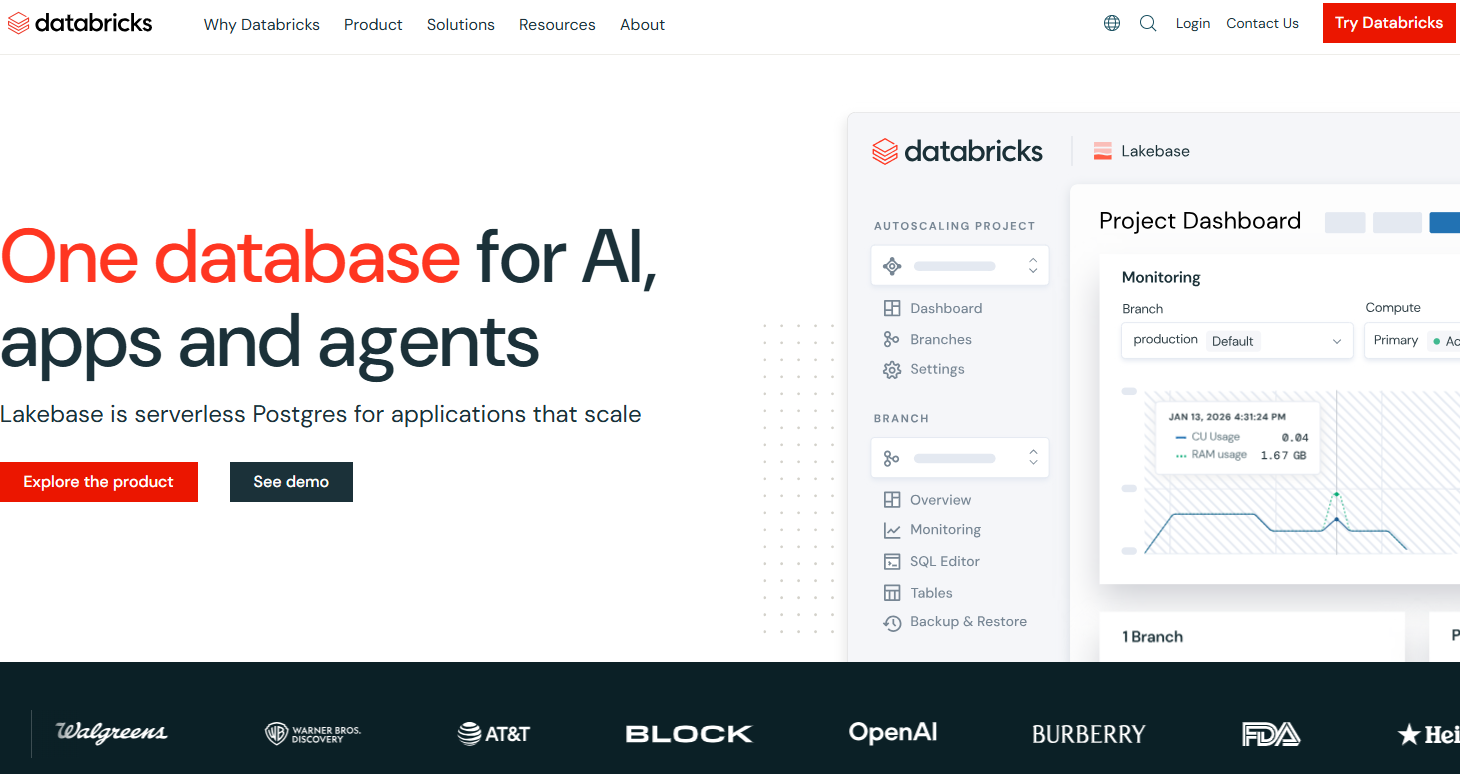
The most powerful platform for data and AI
The Databricks Data Intelligence Platform allows your entire organization to use data and AI. It's built on a lakehouse to provide an open, unified foundation for all data and governance, and is powered by a Data Intelligence Engine that understands the uniqueness of your data.
Save big with 850+ deals 💶
Explore all deals
Illustration of Databricks on Freelance Stack's deal page
1 deal available
Premium Deal #1

$21,000 in credits

All our deals are negotiated by our team to give you the best discount and are updated regularly.
This deal is available to new customers or customers on a free plan of the tool.
Save Money !
Logo Freelance Stack blanc
Freelance Stack 
Premium
Access our 850+ exclusive promo code for $55/year.
and over 850 other deals.
and +850...
general information
ALTERNATIVES
YOU MAY ALSO LIKE...

📅 May 2026 -

 Our promo code verified with the software 

Databricks

Benefit from $21,000 in credits on Databricks.

Save $21,000 in credits on Databricks thanks to our exclusive partnership.

Freelance Stack is the first deals platform to access best discounts, coupon codes and credits on 650+ software, SaaS and online services for entrepreneurs and startups. We offer exclusive and validated discounts that we negotiate directly with partners to help you to grow and save money. Our promotional codes enable thousands of entrepreneurs, startups, freelancers and consultants to save thousands of euros on best software.

Don't wait any longer and save $21,000 in credits on Databricks.

📄 Information about 

Databricks

Databricks is a unified data processing and artificial intelligence platform that enables companies to manage and analyse large quantities of data. It combines data processing with analysis and machine learning tools, facilitating collaboration between data science and engineering teams. Databricks offers environments based on Apache Spark, enabling fast and scalable data processing.

With advanced visualisation and integration capabilities, the platform helps businesses to extract meaningful insights from their data. In short, Databricks is a powerful tool for companies looking to optimize their data management and accelerate their AI projects.

Smart. Simple. Private.

The Databricks Data Intelligence Platform allows your entire organization to use data and AI. It's built on a lakehouse to provide an open, unified foundation for all data and governance, and is powered by a Data Intelligence Engine that understands the uniqueness of your data. The winners in every industry will be data and AI companies. From ETL to data warehousing to generative AI, Databricks helps you simplify and accelerate your data and AI goals.

Smart:

Databricks combines generative AI with the unification benefits of a lakehouse to power a Data Intelligence Engine that understands the unique semantics of your data. This allows the Databricks Platform to automatically optimize performance and manage infrastructure in ways unique to your business.

Simple:

Natural language substantially simplifies the user experience on Databricks. The Data Intelligence Engine understands your organization's language, so search and discovery of new data is as easy as asking a question like you would to a coworker. Additionally, developing new data and applications is accelerated through natural language assistance to write code, remediate errors and find answers.

Private:

Data and AI applications require strong governance and security, especially with the advent of generative AI. Databricks provides an end-to-end MLOps and AI development solution that's built upon our unified approach to governance and security. You're able to pursue all your AI initiatives - from using APIs like OpenAI to custom-built models - without compromising data privacy and IP control.

AI - Build better AI with a data-centric approach:

Great models are built with great data. With Databricks, lineage, quality, control and data privacy are maintained across the entire AI workflow, powering a complete set of tools to deliver any AI use case.

  • Create, tune and deploy your own generative AI models
  • Automate experiment tracking and governance
  • Deploy and monitor models at scale

Governance - Unify governance for data, analytics and AI:

Maintain a compliant, end-to-end view of your data estate with a single model of data governance for all your structured and unstructured data. Discover insights rooted in the characteristics, people and priorities of your business.

  • Context-aware natural language search and discovery
  • AI-powered monitoring and observability
  • Single permission model for data + AI

Warehousing - The best data warehouse is a lakehouse:

Achieve 12x better price/performance for SQL and BI workloads by moving from legacy cloud data warehouses to a lakehouse.

  • Serverless for simplified management
  • AI-optimized query execution
  • Open formats and APIs to avoid lock-in

ETL - Intelligent data processing for batch and real time:

Implement a single solution for all of your ETL use cases that automatically adapts to help ensure data quality.

  • Simple workflow authoring for batch and streaming
  • End-to-end pipeline monitoring
  • Hands-off reliability and optimization at scale

Data Sharing - Open data sharing:

The first open approach to secure data sharing means you can easily share live data sets, models, dashboards and notebooks to collaborate with anyone on any platform.

  • No proprietary formats or expensive replication
  • No complicated ETL
  • Monetize sharing with the Databricks Marketplace

Orchestration - Manage pipelines to business requirements:

Optimize data pipeline execution to deadlines and budget requirements.

  • Intelligent selection of compute type
  • Workload-specific autoscaling
  • Automatic remediation of errors

📋 Databricks features:

In this section, you will find our opinion the main features of Databricks. All of these features are subject to regular updates. We recommend that you check that they are available before purchasing any software.

Databricks is the leading unified analytics platform that bridges the gap between data engineering, data science, and business analytics within a collaborative cloud environment. Built on Apache Spark, this comprehensive platform enables organizations to process massive datasets, build machine learning models, and derive actionable insights from their data at an unprecedented scale. What sets Databricks apart is its ability to eliminate the traditional silos between different data teams by providing a single workspace where data engineers, data scientists, and analysts can collaborate seamlessly on the same projects.

The platform's architecture is designed around the concept of a lakehouse, combining the best features of data lakes and data warehouses to provide both flexibility and performance. This approach allows organizations to store all their data in an open format while maintaining the governance, reliability, and query performance typically associated with traditional data warehouses. Databricks Runtime, the platform’s optimized Apache Spark engine, delivers significant performance improvements over standard Spark deployments, making it possible to handle complex analytical workloads with remarkable efficiency.

For teams working on machine learning and AI initiatives, Databricks provides an end-to-end MLOps platform that streamlines the entire machine learning lifecycle, from experimentation to production deployment. The platform's collaborative notebooks, automated infrastructure management, and integrated version control make it an ideal choice for organizations looking to scale their data science operations while maintaining reproducibility and governance standards.

  • Collaborative Notebooks: provide an interactive environment where multiple team members can work together in real time using Python, R, Scala, or SQL. These notebooks support rich visualizations, Markdown documentation, and seamless integration with version control systems, making them perfect for exploratory data analysis, model development, and sharing insights across teams.
  • Delta Lake: serves as an open-source storage layer that brings reliability and performance optimizations to data lakes. It provides ACID transactions, scalable metadata handling, and time travel capabilities, allowing you to query historical versions of your data and maintain data quality at petabyte scale with automatic schema enforcement and evolution.
  • MLflow Integration: offers comprehensive machine learning lifecycle management with experiment tracking, model registry, and deployment capabilities. You can compare different model runs, package models for reproducible deployment, and manage model versions across development, staging, and production environments with built-in governance controls.
  • Auto Scaling Clusters: automatically adjust compute resources based on workload demands, optimizing both performance and costs. The platform intelligently provisions and terminates instances as needed, ensuring you only pay for the resources you actually use while maintaining optimal performance for your data processing tasks.
  • Unity Catalog: provides centralized governance and security for all your data assets across clouds and platforms. This comprehensive data governance solution offers fine-grained access controls, data lineage tracking, and unified metadata management, ensuring compliance and enabling secure data sharing across your organization.
  • SQL Analytics: provides a dedicated workspace for business analysts and SQL users to query data, create dashboards, and generate reports without requiring deep technical expertise. The built-in visualization tools and performance optimizations make it easy to derive insights from large datasets using familiar SQL syntax.
  • Structured Streaming: enables real-time data processing with exactly-once semantics and automatic fault tolerance. You can build streaming applications that process data as it arrives, making it possible to implement real-time analytics, monitoring systems, and reactive applications with minimal complexity.
  • Repos Integration: connects directly with Git providers such as GitHub, GitLab, and Azure DevOps, enabling proper version control workflows for your data science and analytics projects. This integration supports branching strategies, code reviews, and collaborative development practices essential for professional data teams.

The platform's multi-cloud capabilities ensure that you can deploy Databricks on AWS, Microsoft Azure, or Google Cloud Platform while maintaining consistent functionality and performance across environments. This flexibility, combined with enterprise-grade security features and comprehensive API access, makes Databricks a powerful foundation for organizations committed to scaling their data and analytics capabilities in the modern cloud era.

📊 Databricks Pros and Cons:

This section provides a summary of the advantages and limitations of using Databricks on a daily basis. We are not paid or influenced by brands, and this content is solely our own. These features, their advantages and disadvantages are likely to change regularly, both positively and negatively. If you have complex needs, we invite you to contact the software publisher directly for more information about your requirements. 

👍 Pros with Databricks:

  • Unified Data and AI Workspace: Databricks brings data engineering, data science, and SQL analytics together into a single collaborative environment. By using a Lakehouse architecture, your team can work on the same data source for different purposes without moving files between tools. This consolidation simplifies your company’s architectural landscape, making it easier for senior engineers to oversee the entire pipeline and ensuring that data flows smoothly from ingestion to production-ready AI models.
  • High-Performance Serverless and Auto-scaling: Databricks offers serverless compute options that eliminate the need for manual cluster configuration, allowing you to run SQL queries and machine learning workloads instantly. For traditional clusters, its intelligent auto-scaling adjusts resources based on real-time demand. Combined with the Photon engine and Delta Lake optimizations, the platform handles massive data volumes with minimal latency, ensuring you get high performance without needing a dedicated engineer to monitor every compute resource.
  • Enterprise-Grade Security and Governance: Databricks provides comprehensive security features, including end-to-end encryption, role-based access controls, and integration with enterprise identity providers such as Active Directory and SAML. The platform offers detailed audit trails and data lineage tracking, which is crucial for regulatory compliance in industries such as finance and healthcare. Unity Catalog, Databricks' unified governance solution, enables centralized metadata management and fine-grained access controls across all your data assets, ensuring that data privacy and compliance requirements are consistently met throughout your organization.
  • Collaborative Development Environment: The notebook-based interface supports multiple programming languages (Python, R, Scala, SQL) within the same workspace, enabling data scientists, engineers, and analysts to work together effectively regardless of their preferred tools. Real-time collaboration features allow team members to share insights, comment on code, and work simultaneously on projects, similar to Google Docs but for data science. The platform also integrates seamlessly with popular development tools and version control systems, making it easy to incorporate Databricks workflows into existing DevOps practices and maintain code quality standards.
  • Advanced MLOps Capabilities: Databricks MLflow provides end-to-end machine learning lifecycle management, from experiment tracking and model versioning to automated deployment and monitoring. The platform simplifies the transition from prototype to production with features such as automated model serving, A/B testing capabilities, and drift detection. This comprehensive MLOps approach reduces the time between model development and deployment from months to days, while ensuring models remain accurate and reliable in production environments through continuous monitoring and automated retraining workflows.
  • Cost-Effective Lakehouse Architecture: By combining the flexibility of data lakes with the performance and reliability of data warehouses, Databricks eliminates the need for costly data duplication between systems. Delta Lake technology provides ACID transactions and time travel capabilities on object storage, which is significantly more cost-effective than traditional data warehouse storage. This architecture allows you to store structured and unstructured data in open formats, reducing vendor lock-in while maintaining high query performance, ultimately delivering substantial cost savings compared to maintaining separate data lake and warehouse infrastructures.

👎 Cons with Databricks:

  • Steep Learning Curve and Complexity: Databricks requires significant technical expertise to use effectively, particularly for teams without a strong background in Apache Spark, machine learning, or distributed computing. The platform’s extensive feature set can overwhelm newcomers, and mastering its collaborative notebooks, cluster management, and MLOps capabilities often requires weeks or months of training. Organizations may need to invest heavily in upskilling their teams or hiring specialized talent, which can delay project timelines and increase implementation costs.
  • High Costs for Smaller Organizations: The pricing model can become prohibitively expensive, especially for smaller teams or organizations with limited budgets. Costs add up quickly due to compute hours, storage, and premium features, making it difficult to accurately predict monthly expenses. The pay-as-you-go model, while flexible, can lead to unexpectedly high bills if clusters aren’t properly managed or if workloads scale unexpectedly. For companies just starting their data journey, the investment may not justify the ROI compared to simpler, more cost-effective alternatives.
  • Evolving Open Standards vs. Managed Services: While Databricks is built on open-source foundations like Spark and Delta Lake, the most powerful performance features and UI elements are proprietary to their managed service. Migrating your entire workflow to another provider would still require significant effort to reconfigure your security policies and MLOps pipelines. You own your data in open formats, but the specific technology that makes Databricks fast is tied to their platform, creating a functional dependency that you need to factor into your long-term strategy.

  • Resource Management Complexity: Managing clusters, compute resources, and workloads requires constant attention and expertise in optimization. Auto-scaling features don't always work perfectly, leading to either over-provisioning (wasting money) or under-provisioning (causing performance issues). The platform offers numerous configuration options for different cluster types, instance sizes, and runtime versions, but making the right choices requires a deep understanding of both your workloads and Databricks’ architecture. Poor resource management can quickly cause costs to spiral out of control.
  • Limited Control Over Infrastructure: While Databricks’ managed nature reduces operational overhead, it also limits your control over the underlying infrastructure and security configurations. Some organizations with strict compliance requirements or specific networking needs may find the platform’s constraints incompatible with their policies. You are also dependent on Databricks’ uptime and performance, with limited ability to troubleshoot issues at the infrastructure level when problems arise, potentially creating bottlenecks in critical data workflows.

💰 Databricks pricing:

All prices listed are taken from the Databricks software website. However, these prices are subject to change regularly. We recommend that you check them directly on each software's website to be sure. 

Databricks offers usage-based pricing using compute units called Databricks Units (DBUs), which are billed hourly based on the instance type and workload.

The platform offers different service tiers to meet the needs of data science, engineering, and analytics teams, ranging from individual projects to enterprise-wide deployments.


Plan Pricing Includes
Community Edition Free 15 GB of storage, shared clusters, Databricks notebooks, Apache Spark
Standard Starting at $0.15 per DBU per hour Dedicated clusters, team collaboration, cloud integrations, standard support
Premium Starting at $0.30 per DBU per hour Role-based access control, audit logs, MLflow, priority support
Enterprise Custom quote Advanced security, compliance, single sign-on (SSO), dedicated support, custom service level agreements (SLAs)

💬 Frequently asked questions about Databricks's promo:

In this section, you will find all the main questions you may have about accessing this discount. We wanted to provide you with as much information as possible to help you save as much as possible on your software subscriptions. 

1️⃣ How to access to the deal with Databricks?

This promo code allows you to save money and enjoy premium features on Databricks paid plans and subscriptions. Check the eligibility criteria on this page to see if you can benefit from this discount. Don't miss out on the opportunity to pay less for your subscription to one of the best tools on the market.

2️⃣ Why Freelance Stack can help you to access to Databricks discount?

As a partner of Databricks, you can easily save on your subscription to this software. Without us or another affiliate partner, you will have difficulties to activate the discount. We are the largest discount promo code platform for software and SaaS in the world.

3️⃣ How to use Databricks deal?

To use the discount with Databricks, you need to click on the various buttons that may be available on the right side of the deal page and follow the instructions to unlock this promotion.

4️⃣ What are Databricks's promo requirements?

We specify all the terms and conditions on each deal page. You must click on the various buttons on the deal page to view all the terms and conditions. This deal is available to new customers or customers on a free plan with Databricks.

🔄 Alternatives to Databricks software:

Find the right software with our suggestions for alternative solutions.

When growing a business, comparing the right tools is essential. With thousands of options available, these solutions are strong alternatives to Databricks 
Indeed, Databricks is a solution that can adapt according to your needs:

1️⃣ If you are a freelancer or consultant:

For freelancers and consultants working in data analytics, Jupyter Notebooks offers an excellent starting point with its interactive development environment, which is perfect for prototyping and presenting results to clients. You can combine code, visualizations, and documentation in a single interface, making it ideal for client reports and proof-of-concepts. Google Colab is another compelling option, offering free access to GPU resources and seamless collaboration features without the need for any infrastructure setup. Its integration with Google Drive makes sharing work with clients straightforward. For more advanced analytics needs, Anaconda provides a comprehensive data science platform with package management and deployment capabilities. These tools allow you to Focus on value to your clients rather than managing complex infrastructure, while still providing professional-grade analytics capabilities that can scale with your consulting practice.

2️⃣ If you are a startup:

Startups looking for powerful analytics without the complexity of enterprise-level solutions should consider Snowflake, which offers a cloud-native data warehouse that scales automatically and charges only for actual usage. Its separation of storage and compute makes it a cost-effective choice for growing companies with fluctuating workloads. BigQuery from Google Cloud provides serverless analytics with impressive performance and pay-per-query pricing that fits well within startup budgets. The platform excels at handling large datasets without the overhead of infrastructure management. Palantir Foundry offers a more comprehensive alternative for startups facing complex data integration challenges, providing robust data governance and operational analytics capabilities. For startups focused on machine learning, Dataiku offers an accessible platform that bridges the gap between technical and business teams, enabling faster time-to-value for data science initiatives while maintaining the flexibility to scale as your startup grows.

3️⃣ If you are an SMB:

Small and medium-sized businesses looking for practical analytics solutions should consider Tableau, which excels at transforming raw data into actionable insights through intuitive visualizations that non-technical team members can easily understand and create. Its drag-and-drop interface makes data analysis accessible to everyone in your organization. Microsoft Power BI offers exceptional value for businesses already using Microsoft products, providing seamless integration with Excel, Office 365, and Azure services at competitive prices. The platform scales with your business while maintaining familiar interfaces. Looker (now part of Google Cloud) delivers a modern business intelligence platform that emphasizes self-service analytics and data governance, making it suitable for companies seeking to establish data-driven decision-making processes. For businesses with specific industry needs, Sisense provides powerful analytics with simplified deployment and maintenance requirements, allowing smaller IT teams to deliver enterprise-grade insights without extensive technical expertise or dedicated data engineering resources.

Otherwise, these other software programs may also be a good alternative to Databricks

🆕 Our new Premium deals:

We offer discounts on 650+ different software. We regularly add new discounts on the best software for freelancers, consultants and entrepreneurs.

Discover these new software in addition to the deal we offer with Databricks.

👤 Our members have just used these other deals:

We offer on 850+ different software. That's both a lot and a little compared to all the software that exists and that could help you in your business as entrepreneur or business owner.

Discover new software and discounts to complement the deal we offer on Databricks