Convertigo
-30% sur l'abo.

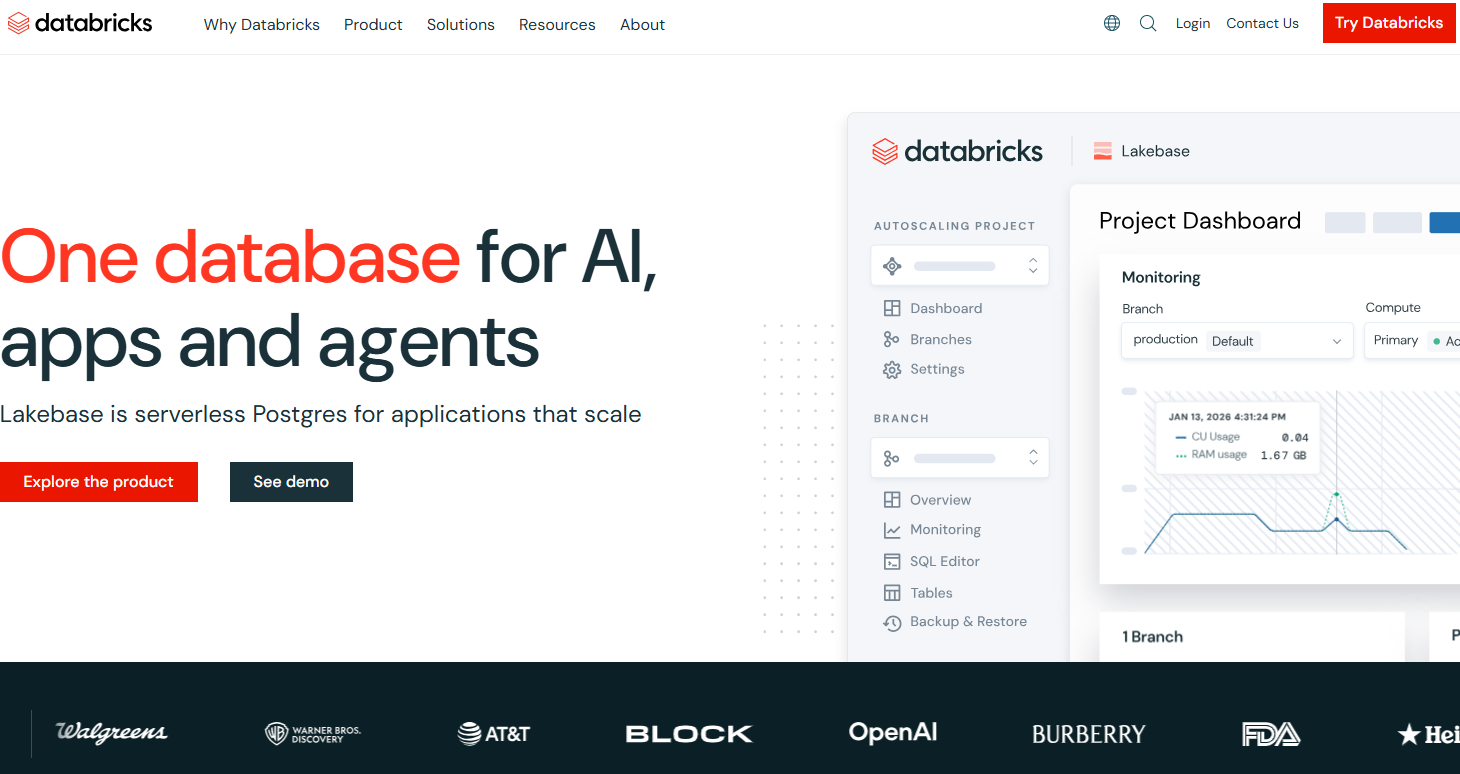







Databricks is a unified data processing and artificial intelligence platform that enables companies to manage and analyse large quantities of data. It combines data processing with analysis and machine learning tools, facilitating collaboration between data science and engineering teams. Databricks offers environments based on Apache Spark, enabling fast and scalable data processing.
With advanced visualisation and integration capabilities, the platform helps businesses to extract meaningful insights from their data. In short, Databricks is a powerful tool for companies looking to optimise their data management and accelerate their AI projects.
Intelligent. Simple. Private.
The Databricks Data Intelligence Platform allows your entire organization to use data and AI. It’s built on a lakehouse to provide an open, unified foundation for all data and governance, and is powered by a Data Intelligence Engine that understands the uniqueness of your data. The winners in every industry will be data and AI companies. From ETL to data warehousing to generative AI, Databricks helps you simplify and accelerate your data and AI goals.
Intelligent:
Databricks combines generative AI with the unification benefits of a lakehouse to power a Data Intelligence Engine that understands the unique semantics of your data. This allows the Databricks Platform to automatically optimize performance and manage infrastructure in ways unique to your business.
Simple:
Natural language substantially simplifies the user experience on Databricks. The Data Intelligence Engine understands your organization’s language, so search and discovery of new data is as easy as asking a question like you would to a coworker. Additionally, developing new data and applications is accelerated through natural language assistance to write code, remediate errors and find answers.
Private:
Data and AI applications require strong governance and security, especially with the advent of generative AI. Databricks provides an end-to-end MLOps and AI development solution that’s built upon our unified approach to governance and security. You’re able to pursue all your AI initiatives — from using APIs like OpenAI to custom-built models — without compromising data privacy and IP control.
AI - Build better AI with a data-centric approach:
Great models are built with great data. With Databricks, lineage, quality, control and data privacy are maintained across the entire AI workflow, powering a complete set of tools to deliver any AI use case.
Governance - Unify governance for data, analytics and AI:
Maintain a compliant, end-to-end view of your data estate with a single model of data governance for all your structured and unstructured data. Discover insights rooted in the characteristics, people and priorities of your business.
Warehousing - The best data warehouse is a lakehouse:
Achieve 12x better price/performance for SQL and BI workloads by moving from legacy cloud data warehouses to a lakehouse.
ETL - Intelligent data processing for batch and real time:
Implement a single solution for all of your ETL use cases that automatically adapts to help ensure data quality.
Data Sharing - Open data sharing:
The first open approach to secure data sharing means you can easily share live data sets, models, dashboards and notebooks to collaborate with anyone on any platform.
Orchestration - Manage pipelines to business requirements:
Optimize data pipeline execution to deadlines and budget requirements.
Databricks stands as the leading unified analytics platform that bridges the gap between data engineering, data science, and business analytics within a collaborative cloud environment. Built on top of Apache Spark, this comprehensive platform enables organizations to process massive datasets, build machine learning models, and derive actionable insights from their data at unprecedented scale. What sets Databricks apart is its ability to eliminate the traditional silos between different data teams by providing a single workspace where data engineers, data scientists, and analysts can collaborate seamlessly on the same projects.
The platform's architecture is designed around the concept of a lakehouse, combining the best aspects of data lakes and data warehouses to provide both flexibility and performance. This approach allows organizations to store all their data in an open format while maintaining the governance, reliability, and query performance typically associated with traditional data warehouses. Databricks Runtime, the platform's optimized Apache Spark engine, delivers significant performance improvements over standard Spark deployments, making it possible to handle complex analytical workloads with remarkable efficiency.
For teams working with machine learning and AI initiatives, Databricks provides an end-to-end MLOps platform that streamlines the entire machine learning lifecycle from experimentation to production deployment. The platform's collaborative notebooks, automated infrastructure management, and integrated version control make it an ideal choice for organizations looking to scale their data science operations while maintaining reproducibility and governance standards.
The platform's multi-cloud capabilities ensure you can deploy Databricks on AWS, Microsoft Azure, or Google Cloud Platform while maintaining consistent functionality and performance across environments. This flexibility, combined with enterprise-grade security features and comprehensive API access, makes Databricks a powerful foundation for organizations serious about scaling their data and analytics capabilities in the modern cloud era.
Evolving Open Standards vs. Managed Services: While Databricks is built on open-source foundations like Spark and Delta Lake, the most powerful performance features and UI elements are proprietary to their managed service. Migrating your entire workflow to another provider would still require significant effort in reconfiguring your security policies and MLOps pipelines. You own your data in open formats, but the specific magic that makes Databricks fast is tied to their platform, creating a functional dependency that you need to factor into your long-term strategy.
Databricks offers usage-based pricing with compute units called Databricks Units (DBUs), billed hourly depending on the instance type and workload.
The platform provides different service levels to suit the needs of data science, engineering, and analytics teams, from individual projects to enterprise deployments.
| Plan | Pricing | Includes |
|---|---|---|
| Community Edition | Free | 15 GB storage, shared clusters, Databricks notebooks, Apache Spark |
| Standard | Starting at $0.15/DBU/hour | Dedicated clusters, team collaboration, cloud integrations, standard support |
| Premium | Starting at $0.30/DBU/hour | Role-based access control, audit logs, MLflow, priority support |
| Enterprise | Custom quote | Advanced security, compliance, SSO, dedicated support, custom SLA |
1️⃣ If you are a freelancer or consultant:
For freelancers and consultants working with data analytics, Jupyter Notebooks offers an excellent starting point with its interactive development environment that's perfect for prototyping and presenting results to clients. You can combine code, visualizations, and documentation in a single interface, making it ideal for client reports and proof-of-concepts. Google Colab represents another compelling option, providing free access to GPU resources and seamless collaboration features without any infrastructure setup. Its integration with Google Drive makes sharing work with clients straightforward. For more advanced analytics needs, Anaconda delivers a comprehensive data science platform with package management and deployment capabilities. These tools allow you to focus on delivering value to your clients rather than managing complex infrastructure, while still providing professional-grade analytics capabilities that can scale with your consulting practice.
2️⃣ If you are a startup:
Startups seeking powerful analytics without enterprise complexity should consider Snowflake, which offers a cloud-native data warehouse that scales automatically and charges only for usage. Its separation of storage and compute makes it cost-effective for growing companies with variable workloads. BigQuery from Google Cloud provides serverless analytics with impressive performance and pay-per-query pricing that aligns well with startup budgets. The platform excels at handling large datasets without infrastructure management overhead. Palantir Foundry presents a more comprehensive alternative for startups dealing with complex data integration challenges, offering robust data governance and operational analytics capabilities. For machine learning focused startups, Dataiku provides an accessible platform that bridges the gap between technical and business teams, enabling faster time-to-value for data science initiatives while maintaining the flexibility to scale as your startup grows.
3️⃣ If you are a SMB:
Small and medium businesses looking for practical analytics solutions should explore Tableau, which excels at transforming raw data into actionable insights through intuitive visualizations that non-technical team members can easily understand and create. Its drag-and-drop interface democratizes data analysis across your organization. Microsoft Power BI offers exceptional value for businesses already using Microsoft products, providing seamless integration with Excel, Office 365, and Azure services at competitive pricing. The platform grows with your business while maintaining familiar interfaces. Looker (now part of Google Cloud) delivers a modern business intelligence platform that emphasizes self-service analytics and data governance, making it suitable for companies wanting to establish data-driven decision making processes. For businesses with specific industry needs, Sisense provides powerful analytics with simplified deployment and maintenance requirements, allowing smaller IT teams to deliver enterprise-grade insights without extensive technical expertise or dedicated data engineering resources.
Sinon, ces autres logiciels peuvent également être une alternative intéressante à Databricks.Aucune ressource actuellement disponible.