
Thunderbit
Additional 20% off on any plan







✅ Deal details:
✅ Deal details:
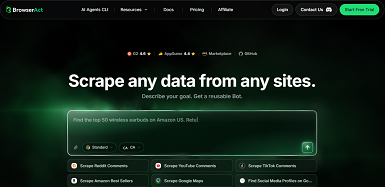
BrowserAct turns a plain-English instruction into a reusable web scraper. You describe the data you want, and the platform explores the target site, builds what it calls a Bot, and then verifies it before you run it again, so there are no CSS selectors to write or maintain. The output is returned as structured data and source files, which can be downloaded in CSV or JSON format or pushed directly into your stack via Make, n8n, Zapier, APIs, and webhooks.
The feature that saves the most time is at the core of the platform: BrowserAct runs everything in real Chromium browsers hosted in the cloud, using residential proxies for country-level targeting, automatic handling of reCAPTCHA, Turnstile, and DataDome, and offering a choice between fresh private sessions or a stable identity for logged-in workflows. Bots can run on demand or on a schedule, and when a page layout changes, the platform attempts to detect the change and fix the broken path on its own. Teams typically use it for price and supplier monitoring, competitor and review tracking, and lead lists built from public business data. There is also a CLI that hands a browser off to a local agent such as Claude Code or Cursor, which will appeal to more technically inclined users.
Easy, reliable web scraping at any scale:
From a single prompt to a verified, reusable bot:
Managed web scraping infrastructure:
Built for the data your team needs:
BrowserAct is a cloud based web scraping and browser automation platform that turns almost any website into a structured data source, without asking you to write a single line of code. The idea is simple: you describe the data or the task you need in plain language, and the tool builds a reusable "Bot" that navigates the site, collects the information, and hands it back to you in a clean, ready to use format. Once a Bot is built, you can run it again as the site evolves, with far less upkeep than a traditional selector based scraper would demand.
Most of the value comes from what happens behind the scenes. Rather than running scrapers on your own machine, BrowserAct executes everything in real Chromium browsers hosted in the cloud, and it quietly manages the parts that usually break a scraping project. Residential proxies with country level targeting let you collect from the regions you care about, automatic handling of reCAPTCHA, Turnstile and DataDome clears the challenges that block ordinary bots, and low noise fingerprints combined with full session isolation keep logged in workflows stable. When a page layout changes, the tool detects it and attempts to repair the broken path on its own, which spares you the constant script rewriting that comes with classic scraping.
On the output side, results arrive as clean tables you can export to CSV or JSON, complete with source URLs, and the tool can also retrieve source files such as images when a workflow requires them. That data does not have to stay inside the platform: native connectors push it into Make, n8n and Zapier, while an API and webhooks let you wire it into your own systems. Bots run on demand or on a round the clock schedule, so a monitoring task can keep collecting prices or listings while you focus on something else.
Finally, BrowserAct gives you two ways to work depending on your setup. You can run everything inside BrowserAct Cloud with nothing to install, or you can give a local agent such as Claude Code, Codex CLI or Cursor a managed browser through the AI Agents CLI. In day to day use, teams rely on it to monitor products, prices and competitors, to build B2B prospect lists from public directories, to keep an eye on reviews and social content, and to track job postings or product launches on a repeatable basis.
BrowserAct operates on a credit-based model rather than fixed feature tiers: each standard action (navigating, clicking, entering text, extracting data) costs 5 credits, and every plan draws from a single shared credit pool. A seven-day free trial with trial credits is included with any plan, and a daily login bonus of 100 free credits allows light users to continue testing at no cost. In addition to monthly and annual subscriptions (annual billing saves 20 percent), BrowserAct is also available through an AppSumo lifetime deal, a one-time payment that grants a monthly credit allowance for life. The table below summarizes the features that are publicly documented.
| Service | Price |
|---|---|
| Free trial | 7 days, with trial credits included with any plan |
| Daily Login Bonus | 100 free credits per day |
| Workflow step | 5 credits per step, as low as $0.0032 per step |
| Cloud browser | Free for a limited time |
| Local Fingerprint Browser | 100 credits, as low as $0.064 per browser |
| Dynamic residential proxy | 5,000 credits per GB, as low as $3.2 per GB |
| Static proxy | Priced by location and tier |
| AppSumo Lifetime, Tier 1 | $69 one-time fee, 20,000 credits per month |
| AppSumo Lifetime, Tier 3 | $219 one-time payment, 90,000 credits per month |
Since credit usage depends heavily on the number of pages and actions per run, a short test run remains the safest way to estimate your actual monthly cost.
1️⃣ If you are a freelancer or consultant:
For solo work, the priority is usually a tool you can point at a site and get results from quickly. Browse AI and Octoparse (along with Octoparse AI) sit closest to BrowserAct, with no-code capture and monitoring that suit occasional to regular scraping. When your needs lean towards prospecting on social platforms rather than generic sites, PhantomBuster is built precisely for that kind of lead extraction and enrichment. And if a single project only calls for pulling clean content from a set of pages, Scrapingbee offers a straightforward scraping service without the overhead of a full platform.
2️⃣ If you are a startup:
Fast growing teams tend to need volume, integrations and data that feeds directly into outbound or product work. Apify is the natural pick when you have some technical resource in house and want a scalable platform with a large library of ready made actors. Clay goes further on the enrichment side, combining scraped data with dozens of sources to build qualified lead lists, while Firecrawl is designed to feed clean web content into AI and LLM pipelines, which fits product driven startups well. To orchestrate all of this across your stack, n8n connects the collected data to the rest of your tools with flexible, self hostable automation.
3️⃣ If you are a small or medium-sized business:
Here the emphasis is on reliability and on slotting into tools your team already uses. Browse AI and Octoparse remain strong choices for recurring, hands off monitoring of prices, competitors or listings. When the volume climbs and blocking becomes an issue, Bright Data provides enterprise grade proxy and data collection infrastructure, better suited to heavier or more sensitive projects. To keep everything connected without adding technical debt, pairing a scraper with Make or Zapier lets the extracted data trigger the rest of your business processes automatically.
Otherwise, these other software programs may also be a good alternative to BrowserAct.No resources currently available.