logo anime freelance stack blanc
Logo de l'outil Databricks sur Freelance Stack
Tous les deals (850+)
Logo de l'outil Databricks sur Freelance Stack

Databricks

Deal Premium
1 deal disponible
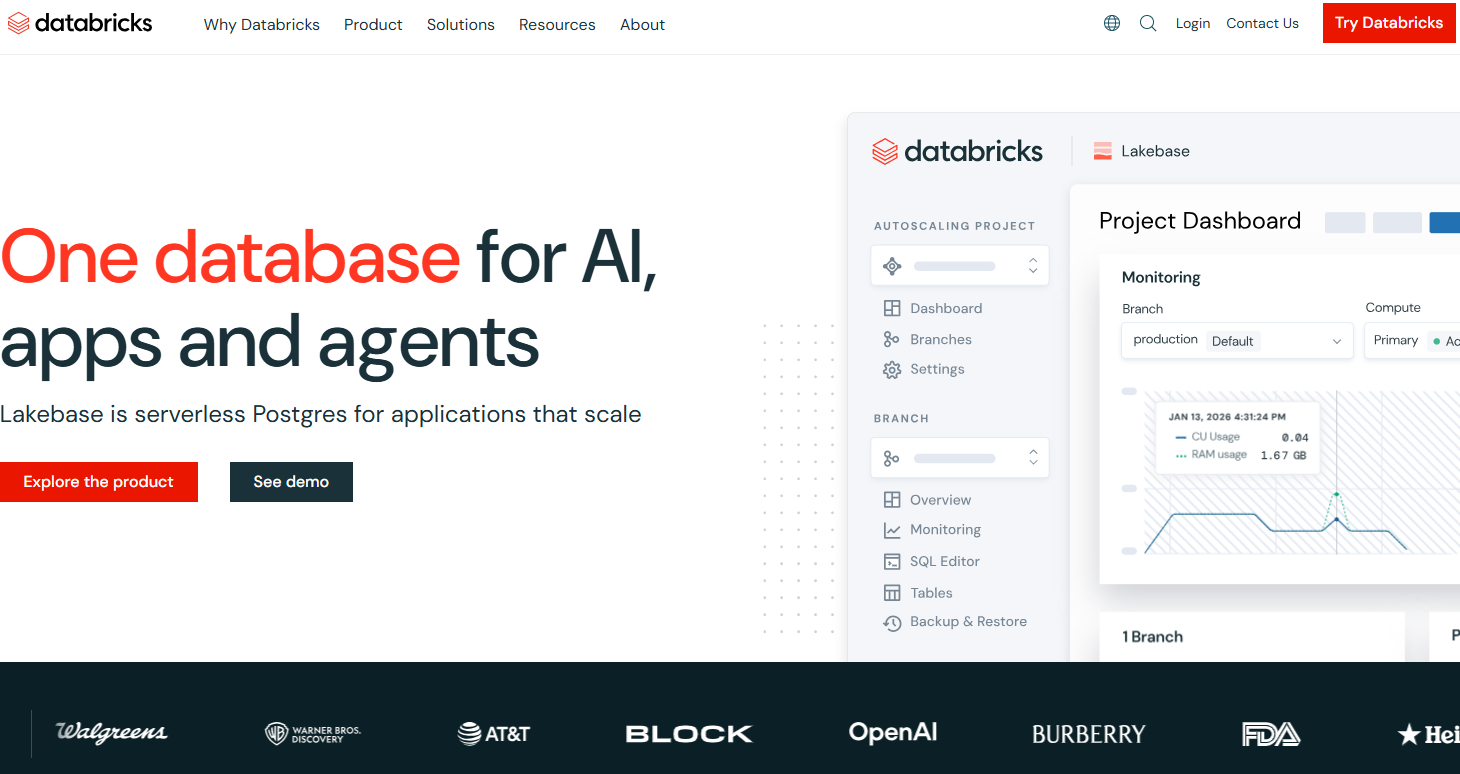
The most powerful platform for data and AI
The Databricks Data Intelligence Platform allows your entire organization to use data and AI. It’s built on a lakehouse to provide an open, unified foundation for all data and governance, and is powered by a Data Intelligence Engine that understands the uniqueness of your data.
Faites le plein d’économies avec +850 deals 💶
Explorer tous des deals
Illustration de Databricks sur la page du deal de Freelance Stack
1 deal disponible
Deal Premium #1

21 000$ de crédits

Tous nos les deals sont négociés par notre équipe pour vous permettre de bénéficier de la meilleure réduction et sont mis à jour régulièrement.
Ce deal est disponible pour les nouveaux clients ou client sur un plan gratuit de l'outil.
Save Money !
Logo Freelance Stack blanc
Freelance Stack 
Premium
Accédez à nos 850+ codes promo exclusifs pour 55€ / an 💶.
et plus de 850 autres deals.
et +850...
INFORMATION Générale
ALTERNATIVES
VOUS AIMEREZ AUSSI...

📅 avril 2026 -

 Notre code promo vérifié avec le logiciel 

Databricks

Profitez d’une réduction de 21 000$ de crédits sur les services proposées par Databricks

Economisez 21 000$ de crédits sur l’adhésion à une offre chez Databricks grâce à notre partenariat exclusif. 

Freelance Stack est la première plateforme de deal à vous proposer des réductions, codes promos et crédits sur 650+ logiciels, SaaS et service en ligne pour les entrepreneurs et startups. Nous proposons des réductions exclusives validées que nous négocions directement avec les éditeurs afin de vous permettre de faire des économies. Nos codes promos permettent à des milliers d'entrepreneurs, de startups, d'indépendants, freelances ou encore consultants d'économiser des milliers d'euros lors de la souscription de ces logiciels.

N’attendez plus et économisez 21 000$ de crédits sur les services proposés par Databricks.

📄 Information sur le logiciel 

Databricks

Databricks is a unified data processing and artificial intelligence platform that enables companies to manage and analyse large quantities of data. It combines data processing with analysis and machine learning tools, facilitating collaboration between data science and engineering teams. Databricks offers environments based on Apache Spark, enabling fast and scalable data processing.

With advanced visualisation and integration capabilities, the platform helps businesses to extract meaningful insights from their data. In short, Databricks is a powerful tool for companies looking to optimise their data management and accelerate their AI projects.

Intelligent. Simple. Private.

The Databricks Data Intelligence Platform allows your entire organization to use data and AI. It’s built on a lakehouse to provide an open, unified foundation for all data and governance, and is powered by a Data Intelligence Engine that understands the uniqueness of your data. The winners in every industry will be data and AI companies. From ETL to data warehousing to generative AI, Databricks helps you simplify and accelerate your data and AI goals.

Intelligent:

Databricks combines generative AI with the unification benefits of a lakehouse to power a Data Intelligence Engine that understands the unique semantics of your data. This allows the Databricks Platform to automatically optimize performance and manage infrastructure in ways unique to your business.

Simple:

Natural language substantially simplifies the user experience on Databricks. The Data Intelligence Engine understands your organization’s language, so search and discovery of new data is as easy as asking a question like you would to a coworker. Additionally, developing new data and applications is accelerated through natural language assistance to write code, remediate errors and find answers.

Private:

Data and AI applications require strong governance and security, especially with the advent of generative AI. Databricks provides an end-to-end MLOps and AI development solution that’s built upon our unified approach to governance and security. You’re able to pursue all your AI initiatives — from using APIs like OpenAI to custom-built models — without compromising data privacy and IP control.

AI - Build better AI with a data-centric approach:

Great models are built with great data. With Databricks, lineage, quality, control and data privacy are maintained across the entire AI workflow, powering a complete set of tools to deliver any AI use case.

  • Create, tune and deploy your own generative AI models
  • Automate experiment tracking and governance
  • Deploy and monitor models at scale

Governance - Unify governance for data, analytics and AI:

Maintain a compliant, end-to-end view of your data estate with a single model of data governance for all your structured and unstructured data. Discover insights rooted in the characteristics, people and priorities of your business.

  • Context-aware natural language search and discovery
  • AI-powered monitoring and observability
  • Single permission model for data + AI

Warehousing - The best data warehouse is a lakehouse:

Achieve 12x better price/performance for SQL and BI workloads by moving from legacy cloud data warehouses to a lakehouse.

  • Serverless for simplified management
  • AI-optimized query execution
  • Open formats and APIs to avoid lock-in

ETL - Intelligent data processing for batch and real time:

Implement a single solution for all of your ETL use cases that automatically adapts to help ensure data quality.

  • Simple workflow authoring for batch and streaming
  • End-to-end pipeline monitoring
  • Hands-off reliability and optimization at scale

Data Sharing - Open data sharing:

The first open approach to secure data sharing means you can easily share live data sets, models, dashboards and notebooks to collaborate with anyone on any platform.

  • No proprietary formats or expensive replication
  • No complicated ETL
  • Monetize sharing with the Databricks Marketplace

Orchestration - Manage pipelines to business requirements:

Optimize data pipeline execution to deadlines and budget requirements.

  • Intelligent selection of compute type
  • Workload-specific autoscaling
  • Automatic remediation of errors

📋 Les principales fonctionnalités de Databricks :

Retrouvez dans cette section notre avis sur les principales fonctionnalités de Databricks. L'ensemble de ces fonctionnalités sont amenées à évoluer régulièrement. Nous vous conseillons de bien vérifier l'existance de celle-ci avant de souscrire à chaque logiciel.

Databricks stands as the leading unified analytics platform that bridges the gap between data engineering, data science, and business analytics within a collaborative cloud environment. Built on top of Apache Spark, this comprehensive platform enables organizations to process massive datasets, build machine learning models, and derive actionable insights from their data at unprecedented scale. What sets Databricks apart is its ability to eliminate the traditional silos between different data teams by providing a single workspace where data engineers, data scientists, and analysts can collaborate seamlessly on the same projects.

The platform's architecture is designed around the concept of a lakehouse, combining the best aspects of data lakes and data warehouses to provide both flexibility and performance. This approach allows organizations to store all their data in an open format while maintaining the governance, reliability, and query performance typically associated with traditional data warehouses. Databricks Runtime, the platform's optimized Apache Spark engine, delivers significant performance improvements over standard Spark deployments, making it possible to handle complex analytical workloads with remarkable efficiency.

For teams working with machine learning and AI initiatives, Databricks provides an end-to-end MLOps platform that streamlines the entire machine learning lifecycle from experimentation to production deployment. The platform's collaborative notebooks, automated infrastructure management, and integrated version control make it an ideal choice for organizations looking to scale their data science operations while maintaining reproducibility and governance standards.

  • Collaborative Notebooks: provide an interactive environment where multiple team members can work together in real-time using Python, R, Scala, or SQL. These notebooks support rich visualizations, markdown documentation, and seamless integration with version control systems, making them perfect for exploratory data analysis, model development, and sharing insights across teams.
  • Delta Lake: serves as an open-source storage layer that brings reliability and performance optimizations to data lakes. It provides ACID transactions, scalable metadata handling, and time travel capabilities, allowing you to query historical versions of your data and maintain data quality at petabyte scale with automatic schema enforcement and evolution.
  • MLflow Integration: offers comprehensive machine learning lifecycle management with experiment tracking, model registry, and deployment capabilities. You can compare different model runs, package models for reproducible deployment, and manage model versions across development, staging, and production environments with built-in governance controls.
  • Auto Scaling Clusters: automatically adjust compute resources based on workload demands, optimizing both performance and costs. The platform intelligently provisions and terminates instances as needed, ensuring you only pay for the resources you actually use while maintaining optimal performance for your data processing tasks.
  • Unity Catalog: provides centralized governance and security for all your data assets across clouds and platforms. This comprehensive data governance solution offers fine-grained access controls, data lineage tracking, and unified metadata management, ensuring compliance and enabling secure data sharing across your organization.
  • SQL Analytics: delivers a dedicated workspace for business analysts and SQL users to query data, create dashboards, and generate reports without requiring deep technical expertise. The built-in visualization tools and performance optimizations make it easy to derive insights from large datasets using familiar SQL syntax.
  • Structured Streaming: enables real-time data processing with exactly-once semantics and automatic fault tolerance. You can build streaming applications that process data as it arrives, making it possible to implement real-time analytics, monitoring systems, and reactive applications with minimal complexity.
  • Repos Integration: connects directly with Git providers like GitHub, GitLab, and Azure DevOps, enabling proper version control workflows for your data science and analytics projects. This integration supports branching strategies, code reviews, and collaborative development practices essential for professional data teams.

The platform's multi-cloud capabilities ensure you can deploy Databricks on AWS, Microsoft Azure, or Google Cloud Platform while maintaining consistent functionality and performance across environments. This flexibility, combined with enterprise-grade security features and comprehensive API access, makes Databricks a powerful foundation for organizations serious about scaling their data and analytics capabilities in the modern cloud era.

📊 Avantages et inconvénients de Databricks :

Cette section vous permet de retrouver une synthèse des avantages et limites que peut représenter l'usage de Databricks au quotidien. Nous ne sommes pas rémunéré ou influencé par les marques et ce contenu n'engage que nous. Ces fonctionnalités, leurs avantages et inconvénients sont susceptibles d'évoluer très régulièrement positivement comme négativement. En cas de besoin complexe, nous vous invitons à contacter directement l'éditeur de logiciel afin d'obtenir plus d'informations sur votre besoin. 

👍 Ce que l'on aime avec Databricks :

  • Unified Data and AI Workspace: Databricks brings data engineering, data science, and SQL analytics into a single collaborative environment. By using a Lakehouse architecture, your team can work on the same data source for different purposes without moving files between tools. This consolidation simplifies the architectural landscape of your company, making it easier for senior engineers to oversee the entire pipeline and ensuring that data flows smoothly from ingestion to production-ready AI models.
  • High-Performance Serverless and Auto-scaling: Databricks offers serverless compute options that remove the need for manual cluster configuration, allowing you to run SQL queries and machine learning workloads instantly. For traditional clusters, its intelligent auto-scaling adjusts resources based on real-time demand. Combined with the Photon engine and Delta Lake optimizations, the platform handles massive data volumes with minimal latency, ensuring you get high performance without needing a dedicated engineer to babysit every compute resource.
  • Enterprise-Grade Security and Governance: Databricks provides comprehensive security features including end-to-end encryption, role-based access controls, and integration with enterprise identity providers like Active Directory and SAML. The platform offers detailed audit trails and data lineage tracking, which is crucial for regulatory compliance in industries like finance and healthcare. Unity Catalog, Databricks' unified governance solution, enables centralized metadata management and fine-grained access controls across all your data assets, ensuring data privacy and compliance requirements are met consistently across your organization.
  • Collaborative Development Environment: The notebook-based interface supports multiple programming languages (Python, R, Scala, SQL) within the same workspace, enabling data scientists, engineers, and analysts to work together effectively regardless of their preferred tools. Real-time collaboration features allow team members to share insights, comment on code, and work simultaneously on projects, similar to Google Docs but for data science. The platform also integrates seamlessly with popular development tools and version control systems, making it easy to incorporate Databricks workflows into existing DevOps practices and maintain code quality standards.
  • Advanced MLOps Capabilities: Databricks MLflow provides end-to-end machine learning lifecycle management, from experiment tracking and model versioning to automated deployment and monitoring. The platform simplifies the transition from prototype to production with features like automated model serving, A/B testing capabilities, and drift detection. This comprehensive MLOps approach reduces the time between model development and deployment from months to days, while ensuring models remain accurate and reliable in production environments through continuous monitoring and automated retraining workflows.
  • Cost-Effective Lakehouse Architecture: By combining the flexibility of data lakes with the performance and reliability of data warehouses, Databricks eliminates the need for costly data duplication between systems. The Delta Lake technology provides ACID transactions and time travel capabilities on object storage, which is significantly more cost-effective than traditional data warehouse storage. This architecture allows you to store structured and unstructured data in open formats, reducing vendor lock-in while maintaining high query performance, ultimately delivering substantial cost savings compared to maintaining separate data lake and warehouse infrastructures.

👎 Ce qu'on aime moins avec Databricks :

  • Steep Learning Curve and Complexity: Databricks requires significant technical expertise to use effectively, particularly for teams without strong backgrounds in Apache Spark, machine learning, or distributed computing. The platform's extensive feature set can overwhelm newcomers, and mastering its collaborative notebooks, cluster management, and MLOps capabilities often requires weeks or months of training. Organizations may need to invest heavily in upskilling their teams or hiring specialized talent, which can delay project timelines and increase implementation costs.
  • High Cost Structure for Smaller Organizations: The pricing model can become prohibitively expensive, especially for smaller teams or organizations with limited budgets. Costs accumulate quickly through compute hours, storage, and premium features, making it challenging to predict monthly expenses accurately. The pay-as-you-go model, while flexible, can lead to bill shock if clusters aren't properly managed or if workloads scale unexpectedly. For companies just starting their data journey, the investment may not justify the ROI compared to simpler, more cost-effective alternatives.
  • Evolving Open Standards vs. Managed Services: While Databricks is built on open-source foundations like Spark and Delta Lake, the most powerful performance features and UI elements are proprietary to their managed service. Migrating your entire workflow to another provider would still require significant effort in reconfiguring your security policies and MLOps pipelines. You own your data in open formats, but the specific magic that makes Databricks fast is tied to their platform, creating a functional dependency that you need to factor into your long-term strategy.

  • Resource Management Complexity: Managing clusters, compute resources, and workloads requires constant attention and optimization expertise. Auto-scaling features don't always work perfectly, leading to either over-provisioning (wasting money) or under-provisioning (causing performance issues). The platform offers numerous configuration options for different cluster types, instance sizes, and runtime versions, but making the right choices requires deep understanding of both your workloads and Databricks' architecture. Poor resource management can quickly spiral costs out of control.
  • Limited Control Over Infrastructure: While the managed nature of Databricks reduces operational overhead, it also limits your control over the underlying infrastructure and security configurations. Some organizations with strict compliance requirements or specific networking needs may find the platform's constraints incompatible with their policies. You're also dependent on Databricks' uptime and performance, with limited ability to troubleshoot issues at the infrastructure level when problems arise, potentially creating bottlenecks in critical data workflows.

💰 Les tarifs de Databricks :

L'ensemble des tarifs indiqués proviennent du site du logiciel Databricks. Cependant, ces tarifs sont susceptibles d'évoluer réguilèrement. Nous vous conseillons de les vérifier directement sur le site de chaque logiciel pour vous en assurer. 

Databricks offers usage-based pricing with compute units called Databricks Units (DBUs), billed hourly depending on the instance type and workload.

The platform provides different service levels to suit the needs of data science, engineering, and analytics teams, from individual projects to enterprise deployments.


Plan Pricing Includes
Community Edition Free 15 GB storage, shared clusters, Databricks notebooks, Apache Spark
Standard Starting at $0.15/DBU/hour Dedicated clusters, team collaboration, cloud integrations, standard support
Premium Starting at $0.30/DBU/hour Role-based access control, audit logs, MLflow, priority support
Enterprise Custom quote Advanced security, compliance, SSO, dedicated support, custom SLA

💬 Questions fréquentes autour de cette promo avec Databricks :

Retrouvez dans cette section l'ensemble des principales questions que vous pourriez vous poser concernant l'accès à cette réduction. Nous avons voulu vous apporter un maximum d'informations pour vous permettre de faire un maximum d'économies sur vos abonnements logiciels. 

1️⃣ Comment accéder au deal avec Databricks ?

Ce code promo vous permet d’économiser ainsi que de profiter des fonctionnalités premium disponibles sur les formules et abonnement payants de Databricks. Consultez les critères d’éligibilité sur cette page pour vérifier si vous pouvez bénéficier de cette réduction. Ne ratez pas l’occasion de payer moins cher votre abonnement à cet outil grâce l'un des meilleurs outils du marché.

2️⃣ Pourquoi profiter de cette réduction avec Databricks en passant par Freelance Stack ?

En tant que partenaire de Databricks, vous pouvez économiser facilement sur votre adhésion à ce logiciel. Sans nous ou un autre partenaire affilié, vous n’aurez pas accès à cette réduction ni aux économies importantes qu’elle propose. Nous sommes la plus grosse plateforme de réductions et de codes promo sur les logiciels et SaaS dans le monde.

3️⃣ Comment utiliser ce deal Databricks ?

Pour utiliser ce deal Databricks, cliquez sur les différents boutons qui peuvent être disponibles à droite de la page du deal et suivez les instructions pour débloquer cette promo.

4️⃣ Qui peut profiter de la réduction avec Databricks ?

Nous précisons l'ensemble des conditions sur la page de chaque deal. Il faut alors cliquer sur les différents boutons sur la page du deal pour connaitre l'ensemble des conditions. Ce deal est disponible pour les nouveaux clients ou client sur un plan gratuit de l'outil Databricks.

🔄 Alternatives au logiciel Databricks :

Trouvez le bon logiciel grâce à nos propositions de solutions alternatives.

Quand on développe son activité, il est important de comparer les outils qui peuvent vous aider à développer votre activité. Il existe des milliers d'outils et logiciels différents. Ces outils sont des alternatives intéressantes à Databricks
En effet, Databricks est une solution qui peut s'adapter en fonction de vos besoins :

1️⃣ If you are a freelancer or consultant:

For freelancers and consultants working with data analytics, Jupyter Notebooks offers an excellent starting point with its interactive development environment that's perfect for prototyping and presenting results to clients. You can combine code, visualizations, and documentation in a single interface, making it ideal for client reports and proof-of-concepts. Google Colab represents another compelling option, providing free access to GPU resources and seamless collaboration features without any infrastructure setup. Its integration with Google Drive makes sharing work with clients straightforward. For more advanced analytics needs, Anaconda delivers a comprehensive data science platform with package management and deployment capabilities. These tools allow you to focus on delivering value to your clients rather than managing complex infrastructure, while still providing professional-grade analytics capabilities that can scale with your consulting practice.

2️⃣ If you are a startup:

Startups seeking powerful analytics without enterprise complexity should consider Snowflake, which offers a cloud-native data warehouse that scales automatically and charges only for usage. Its separation of storage and compute makes it cost-effective for growing companies with variable workloads. BigQuery from Google Cloud provides serverless analytics with impressive performance and pay-per-query pricing that aligns well with startup budgets. The platform excels at handling large datasets without infrastructure management overhead. Palantir Foundry presents a more comprehensive alternative for startups dealing with complex data integration challenges, offering robust data governance and operational analytics capabilities. For machine learning focused startups, Dataiku provides an accessible platform that bridges the gap between technical and business teams, enabling faster time-to-value for data science initiatives while maintaining the flexibility to scale as your startup grows.

3️⃣ If you are a SMB:

Small and medium businesses looking for practical analytics solutions should explore Tableau, which excels at transforming raw data into actionable insights through intuitive visualizations that non-technical team members can easily understand and create. Its drag-and-drop interface democratizes data analysis across your organization. Microsoft Power BI offers exceptional value for businesses already using Microsoft products, providing seamless integration with Excel, Office 365, and Azure services at competitive pricing. The platform grows with your business while maintaining familiar interfaces. Looker (now part of Google Cloud) delivers a modern business intelligence platform that emphasizes self-service analytics and data governance, making it suitable for companies wanting to establish data-driven decision making processes. For businesses with specific industry needs, Sisense provides powerful analytics with simplified deployment and maintenance requirements, allowing smaller IT teams to deliver enterprise-grade insights without extensive technical expertise or dedicated data engineering resources.

Sinon, ces autres logiciels peuvent également être une alternative intéressante à Databricks

🆕 Nos nouveaux deals Premium :

On vous propose des réductions sur plus de 650 logiciels différents. Nous ajoutons régulièrement de nouvelles réductions sur les meilleurs logiciels dédiés aux freelances, consultants et entrepreneurs.

Découvrez ces nouveaux logiciels en complément du deal que nous vous proposons avec Databricks.

👤 Nos membres viennent d'utiliser ces différents deals :

On vous propose des réductions sur plus de 850 logiciels différents. C'est à la fois beaucoup et peu par rapport à tous les logiciels qui peuvent exister et qui pourront vous aider dans votre activité en tant qu'indépendant ou entrepreneur.

Découvrez de nouvelles solutions et de nouveaux logiciels en complément du deal que nous vous proposons sur Databricks.