

UptimeRobot
Additional 20% off on any plan








✅ Information to access to the deal :
✅ Information to access to the deal :
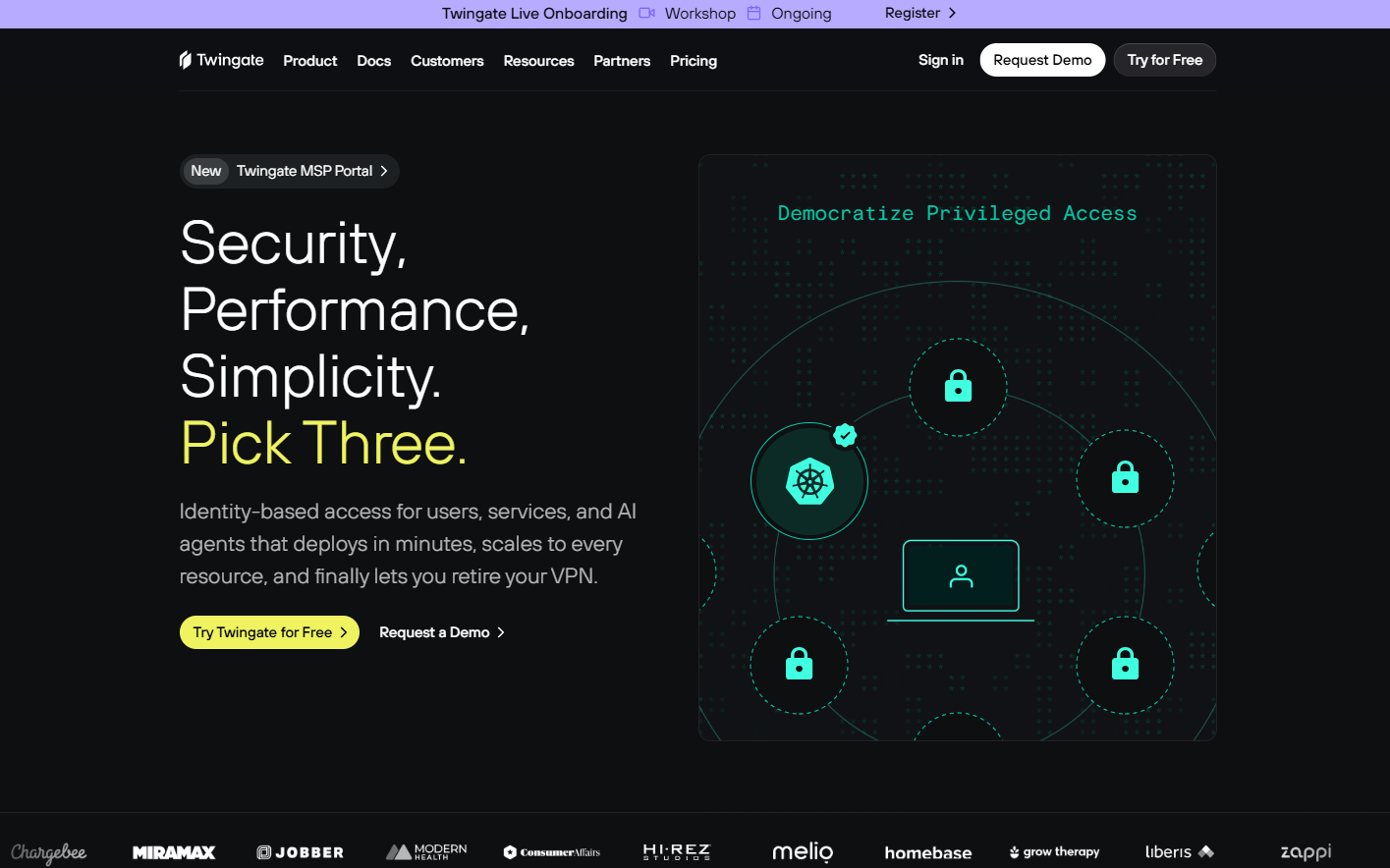
Twingate is a modern Zero Trust Network Access (ZTNA) platform designed to replace legacy VPNs with a faster, more secure, and easier-to-manage solution for granting remote access to corporate resources. Rather than granting users broad network access once authenticated as traditional VPNs do Twingate enforces the principle of least privilege by creating direct, encrypted point-to-point tunnels between each user and only the specific resources they are authorized to access, without requiring any changes to existing IP addresses, firewall rules, or network architecture. The platform can be deployed in as little as 15 to 30 minutes, works across cloud, on-premises, and hybrid environments, and supports all major operating systems and devices including macOS, Windows, Linux, iOS, Android, and Chromebooks.
Twingate integrates natively with major identity providers (IdPs), MDM and EDR tools, SIEM platforms like Splunk, and CI/CD pipelines, enabling IT and DevOps teams to automate provisioning and access management at scale with full support for Infrastructure as Code via Terraform. Its split tunneling feature, active by default, routes only sensitive traffic through encrypted tunnels while letting general internet traffic flow normally, reducing latency and eliminating the bandwidth bottlenecks typical of VPNs. With granular access policies configurable down to the port and protocol level, detailed activity logging, and real-time anomaly detection, Twingate is particularly well suited for organizations in regulated industries such as finance, legal, and healthcare that need enterprise-grade security without the complexity.
The Zero Trust Platform, Ditch Your VPN:
Zero Trust Network Access (ZTNA):
Internet Security:
Identity Firewall, Comprehensive Privileged Access:
Device Security:
Zero Trust as Code:
Twingate is a Zero Trust Network Access (ZTNA) solution designed to replace traditional corporate VPNs with a more secure, more flexible, and significantly simpler-to-manage architecture. The core premise: rather than granting blanket access to an entire network once a user is connected, Twingate applies granular, resource-by-resource access policies based on verified identity, device posture, and contextual signals.
The platform revolves around a three-layer architecture that separates the control plane (who gets access to what), the data plane (actual traffic between users and resources), and the identity plane (authentication). This separation is what makes Twingate fundamentally different from a VPN, which collapses all three into a single tunnel that, once opened, offers few internal controls.
Peer-to-peer encrypted connections are established directly between users and the resources they need, using Twingate's globally distributed relay network as a fallback. This architecture keeps latency low and avoids routing all traffic through a central server, which is one of the biggest performance complaints with traditional VPNs.
The Connector component sits inside your infrastructure (on-premise, AWS, Azure, GCP, or any other environment) and serves as the bridge between Twingate's cloud control layer and your private resources. Connectors support high-availability clustering with automatic load balancing and failover, which is a meaningful operational advantage for teams that need uptime guarantees.
Device posture checks are central to Twingate's security model. Before granting access to a resource, the platform can verify that the connecting device meets defined security criteria: OS version, antivirus status, firewall configuration, disk encryption, and more. Access can be automatically blocked or limited for devices that fall outside policy, without any manual intervention from an admin.
Single Sign-On (SSO) integration works with Google Workspace, Okta, Microsoft Entra ID, JumpCloud, and other major identity providers, enabling organizations to plug Twingate directly into their existing user management workflows. On higher-tier plans, this extends to automated user provisioning and de-provisioning via SCIM, which reduces the operational overhead of onboarding and offboarding employees.
Split tunneling gives administrators fine-grained control over which traffic flows through Twingate and which goes directly to the internet. This is particularly useful for teams who want to secure access to internal resources without degrading the performance of unrelated internet traffic.
Beyond these core capabilities, Twingate includes activity logging and analytics, DNS-based resource routing, SaaS application gating (for controlling access to cloud-hosted tools based on device posture), and secure service accounts for machine-to-machine communication in CI/CD pipelines and automated workflows. On enterprise-tier deployments, geoblocking, DNS filtering, and advanced SIEM integrations round out the security stack.
The client applications are available for macOS, Windows, Linux, iOS, Android, and ChromeOS, and are consistently praised by end users for their simplicity. Connecting to the network is typically a one-click operation, which matters a great deal for adoption in organizations where users are not technically sophisticated.
Twingate structures its pricing across five plans, covering everything from solo developers and homelab enthusiasts to large enterprises with complex security requirements. The Teams and Business plans are billed per user per month, with a 15% discount available when paying annually.
| Plan | Price | Key limits |
|---|---|---|
| Starter | Free | Up to 5 users, 50 resources, 10 remote networks |
| Home | $15/month (flat rate) | Up to 7 users, device posture checks, exit networks, non-commercial use only |
| Teams | $5 / user / month (yearly: $4.25) | Up to 100 users, SSO via Google Workspace, SaaS application gating, native device posture checks |
| Business | $10 / user / month (yearly: $8.50) | Up to 500 users, Okta / Entra ID / JumpCloud SSO + SCIM provisioning, DNS filtering, secure service accounts, exit networks |
| Enterprise | Custom (on request) | Unlimited users, geoblocking, custom SLAs, priority support, pay by invoice |
The Teams and Business plans include a 14-day free trial. The Enterprise plan requires contacting the sales team directly and is the only plan that offers payment by invoice.
1️⃣ If you are a freelancer or consultant:
The free Starter plan from Twingate itself covers most solo use cases, but if you are looking at alternatives, NordVPN and PureVPN are solid options for basic secure connectivity needs. They are traditional VPN solutions with simple client apps, wide server coverage, and accessible pricing, which makes them practical for individual professionals who need to secure their connection on public networks or access a client's private resources occasionally. Proton VPN is worth considering if privacy is a primary concern, as it is operated by the Swiss-based Proton organization with a strong no-logs track record. Hide.me VPN rounds out this category as a transparent, independently audited option with a functional free tier. None of these offer the granular resource-level access control that Twingate provides, but for a freelance context where you are managing your own security posture rather than administering a team's, they cover the essentials at a lower operational cost.
2️⃣ If you are a startup:
Cloudflare is the most relevant alternative to evaluate seriously. Its Zero Trust suite (Cloudflare Access) provides ZTNA capabilities with competitive per-user pricing, and for organizations already using Cloudflare for DNS or CDN, the integration story is compelling. The platform is particularly strong for protecting web-based applications and has a generous free tier. Auth0 sits in adjacent territory: rather than securing network access, it focuses on identity and authentication infrastructure. For startups building products that require robust user authentication alongside internal access control, Auth0 and Twingate can complement each other rather than directly compete. If your team is primarily technical, Tailscale (not currently on Freelance Stack but worth knowing about) offers a mesh VPN architecture built on WireGuard that is exceptionally easy to set up and free for small teams.
3️⃣ If you are an SMB (microbusiness/SME):
Okta is the enterprise standard for identity and access management, and while it solves a somewhat different problem than Twingate (identity provider vs. network access layer), it is frequently deployed in conjunction with or instead of dedicated ZTNA tools in organizations that already have a mature identity stack. For SMBs with a strong security posture and compliance requirements, the combination of Okta for identity and Cloudflare for network access control can cover similar ground to Twingate at potentially different cost structures depending on user count. 1Password and Keeper Password are not direct network security alternatives, but for SMBs whose primary exposure point is credential management rather than network segmentation, investing first in a team password manager with access control features is a pragmatic starting point before adopting a full ZTNA solution.
Otherwise, these other software programs may also be a good alternative to Twingate.No resources currently available.