
logo anime freelance stack white
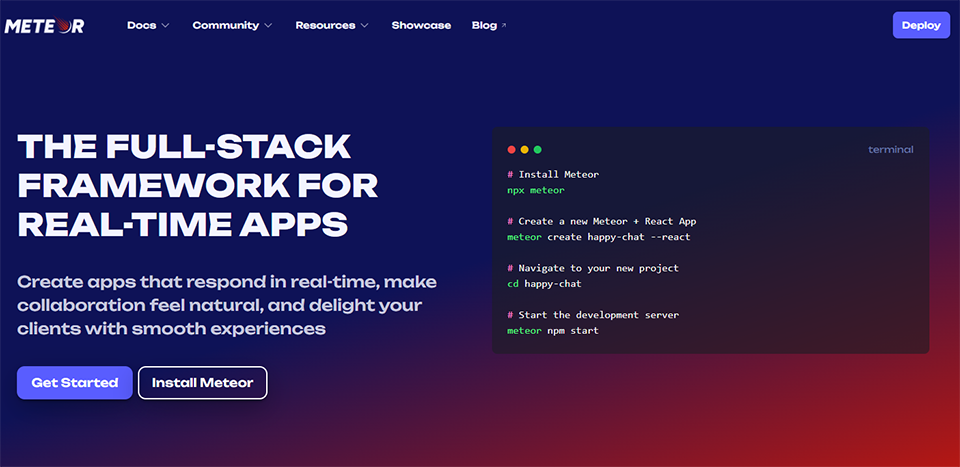
Logo de l’outil Meteor JS sur le deal de Freelance Stack
All deals (850+)
Logo de l’outil Meteor JS sur le deal de Freelance Stack

Meteor.js

Premium Deal
1 deal available
Build Full-Stack Javascript Apps
Meteor.js is an open source platform for seamlessly building and deploying Web, Mobile, and Desktop applications in Javascript or TypeScript.
Save big with 850+ deals 💶
Explore all deals
Illustration of Meteor.js on Freelance Stack's deal page
1 deal available
Premium Deal #1

$600 in credits

All our deals are negotiated by our team to give you the best discount and are updated regularly.
This deal is available to new customers or customers on a free plan of the tool.
Save Money !
Logo Freelance Stack blanc
Freelance Stack 
Premium
Access our 850+ exclusive promo code for $55/year.
and over 850 other deals.
and +850...
general information
ALTERNATIVES
YOU MAY ALSO LIKE...

📅 April 2026 -

 Our promo code verified with the software 

Meteor.js

Benefit from of $600 in credits on Meteor.js.

Save $600 in credits on Meteor.js on to our exclusive partnership.

Freelance Stack is the first deals platform to access best discounts, coupon codes and credits on 650+ software, SaaS and online services for entrepreneurs and startups. We offer exclusive and validated discounts that we negotiate directly with partners to help you to grow and save money. Our coupon codes enable thousands of entrepreneurs, startups, freelancers and consultants to save thousands of euros on best software.

Don't wait any longer and save $600 in credits on Meteor.js.

📄 Information about 

Meteor.js


Meteor.js is an open-source JavaScript framework that enables rapid and efficient development of real-time web applications. It simplifies the creation of full-stack applications by integrating both client-side and server-side development. Meteor offers a reactive architecture, meaning that data is automatically synchronized between the client and server, providing a smooth and interactive user experience.

The framework also includes tools for managing databases, user sessions, and deployments. Due to its simplicity and flexibility, Meteor.js is ideal for developers looking to build modern and dynamic applications without excessive complexity.

Meteor.js is an open source platform for seamlessly building and deploying Web, Mobile, and Desktop applications in Javascript or TypeScript.

Why Meteor.js?:

  • Integrate technologies you already use
    Use popular frameworks and tools right out-of-the-box. focus on building features instead of configuring disparate components yourself.
  • Build apps for any device
    Use the same code whether you're developing for web, iOS, Android, or desktop for a seamless update experience for your users.
  • 43,400+ Stars on GitHub and 508,000+ unique installs
    Developed for over a decade and trusted by industry giants. Meteor.js is a mature open source platform that allows you to build and scale efficiently so you can serve millions of users.

Meteor Cloud:

  • Meteor APM: Visibility into your apps performance. See real time metrics so you can monitor how your application is running.
  • Galaxy Hosting: Spend less time on DevOps and more time building. The most efficient way for you to host & scale your Meteor app.
  • Atmosphere: Browse our extensive library of open source packages, free for you to download and use with your Cloud Account.

Open Source:
Build great applications faster than ever using Meteor.js. Join the community of developers from all over the world that rely on Meteor.js.

📋 Meteor.js features:

In this section, you will find our opinion the main features of Meteor.js. All of these features are subject to regular updates. We recommend that you check that they are available before purchasing any software.

Meteor.js is a comprehensive full-stack JavaScript platform that revolutionizes how developers build modern web and mobile applications. Unlike traditional frameworks that require you to piece together multiple technologies, Meteor provides an integrated development ecosystem where you can use JavaScript across your entire application stack, from the database layer to the user interface. This unified approach eliminates the complexity of managing separate front-end and back-end codebases while maintaining the flexibility to scale your applications effectively.

What sets Meteor apart in the crowded landscape of web development frameworks is its " real-time by default " philosophy and data synchronization capabilities. The platform automatically handles the complex process of keeping data consistent between your server and all connected clients, making it exceptionally well-suited for applications that require live updates, collaborative features, or interactive user experiences. Whether you're building a chat application, a project management tool, or an e-commerce platform, Meteor's architecture ensures that changes propagate instantly across all user sessions without requiring complex WebSocket implementations or manual state management.

The framework's opinionated yet flexible structure is well-suited for both rapid prototyping and production-grade applications. Meteor comes with sensible defaults and built-in solutions for common development challenges, allowing you to Focus on your application's unique business logic rather than infrastructure concerns. At the same time, it provides workarounds and customization options for teams that need to integrate specific technologies or adapt to particular architectural requirements.

  • Isomorphic JavaScript Development: Meteor enables you to write JavaScript code that runs seamlessly in both client-side and server-side environments, eliminating context switching and reducing the cognitive overhead of managing different programming languages. This approach significantly accelerates development speed and reduces the potential for inconsistencies between your frontend and backend logic.
  • Reactive Data System: The platform's reactive programming model automatically updates your user interface whenever underlying data changes, creating a responsive and dynamic user experience without manual DOM manipulation. This reactivity extends throughout the entire application stack, from database queries to template rendering, ensuring that your application always reflects the current state of your data.
  • Built-in Real-time Capabilities: Meteor includes DDP (Distributed Data Protocol) as its real-time communication layer, automatically synchronizing data between your server and all connected clients. This eliminates the need to manually implement complex WebSocket handling or server-sent events, making real-time features accessible even to developers new to live data applications.
  • Integrated Build System: The framework provides a sophisticated build pipeline that handles ES6+ transpilation, module bundling, and asset optimization out of the box. You can start coding immediately without configuring Webpack, Babel, or other build tools, while still maintaining the flexibility to customize the build process when necessary.
  • MongoDB Integration: Meteor offers seamless integration with MongoDB through Minimongo, a client-side database that mirrors your server-side MongoDB collections. This approach enables optimistic UI updates and offline functionality while maintaining data consistency through automatic synchronization mechanisms.
  • Package Ecosystem: The Atmosphere package manager provides access to thousands of community-contributed packages specifically designed for Meteor applications. These packages integrate deeply with Meteor's architecture, offering everything from authentication systems to UI components that work seamlessly with the platform's reactive data flow.
  • Mobile Development Support: Meteor can compile your web application into native iOS and Android apps using Apache Cordova, allowing you to maintain a single codebase while delivering native mobile experiences. The platform handles the complexities of mobile deployment and provides access to device-specific APIs through its plugin system.
  • Hot Code Reload: During development, Meteor automatically refreshes your application whenever you make code changes, preserving application state and user sessions. This feature dramatically improves developer productivity by eliminating the need for manual browser refreshes and reducing the time between making changes and seeing results.
  • Account Management System: The platform includes a comprehensive user authentication and account management system that supports multiple login methods, password reset functionality, and session management. This system integrates seamlessly with Meteor's reactive data layer and provides secure, scalable user management out of the box.

These capabilities combine to create a development environment where you can quickly prototype ideas, iterate on features, and scale applications without the overhead typically associated with full-stack development. Meteor's strength lies in its ability to abstract away infrastructure complexity while preserving the flexibility needed for sophisticated applications.

📊 Meteor.js Pros and Cons:

This section provides a summary of the advantages and limitations of using Meteor.js on a daily basis. We are not paid or influenced by brands, and this content is solely our own. These features, their advantages and disadvantages are likely to change regularly, both positively and negatively. If you have complex needs, we invite you to contact the software publisher directly for more information about your requirements. 

👍 Pros with Meteor.js:

  • Full-Stack JavaScript Development: Meteor.js allows you to build complete applications using JavaScript on both the client and server sides, eliminating the need to switch between different programming languages. This unified approach significantly reduces the learning curve and development complexity, enabling you to apply your existing JavaScript knowledge across the entire technology stack. The seamless integration between frontend and backend components means fewer context switches during development, leading to increased productivity and a more consistent code architecture throughout your application.
  • Real-Time Data Synchronization: The platform excels at creating reactive applications where data changes are instantly reflected across all connected clients without requiring manual refreshes. Meteor's built-in reactivity system automatically updates the user interface whenever underlying data changes, creating smooth and responsive user experiences that feel native. This real-time capability is particularly valuable for collaborative applications, live dashboards, or any scenario where multiple users need to see updates immediately, eliminating the complexity typically associated with implementing WebSocket connections and manual state synchronization.
  • Rapid Prototyping and Development Speed: Meteor's integrated ecosystem and "convention over configuration" approach allows you to build functional applications remarkably quickly, making it ideal for startups, MVPs, or rapid proof-of-concept development. The framework includes everything needed to get started immediately, from database integration to user authentication systems, without requiring extensive setup or configuration. Hot code reload functionality means you can see changes instantly during development, while smart packages handle common functionality automatically, allowing you to Focus on your application's unique business logic rather than boilerplate code.
  • Native npm Integration: In 2026, Atmosphere is considered legacy. Meteor 3.0 has fully embraced npm as the primary source for libraries. You should update both points to reflect that you no longer need Meteor-specific packages. The real strength now is that Meteor makes any standard npm package reactive by default. You have the entire JavaScript ecosystem at your disposal with added real-time capabilities, bridging the gap between standard tools and live data.
  • Simplified Database Operations: Meteor's integration with MongoDB provides an intuitive database experience that allows you to work with data using familiar JavaScript syntax and objects, eliminating the need for complex ORM configurations or SQL query management. The framework's publications and subscriptions system automatically handles data synchronization between the client and server, ensuring users always see the most up-to-date information while efficiently managing security and performance. This approach eliminates much of the traditional complexity associated with database connections, query optimization, and data caching, which typically requires significant backend expertise.
  • Cross-Platform Mobile Development: With Meteor's Cordova integration, you can deploy the same codebase to iOS and Android platforms as native mobile applications, dramatically reducing development time and maintenance overhead compared to building separate native apps. The hot code push feature allows you to update your mobile applications instantly without going through app store approval processes, providing unprecedented flexibility for bug fixes and feature updates. This unified approach means your web development skills directly translate to mobile app creation, eliminating the need to learn platform-specific development frameworks or maintain multiple codebases.

👎 Cons with Meteor.js:

  • The Complexity of Distributed Data Management: While writing JavaScript on both sides is simple, managing a distributed database in the browser (MiniMongo) is where teams actually struggle. The learning curve isn't about syntax, but about understanding how subscriptions filter data. If a team does not master this, they will face security leaks or browser performance issues caused by data over-saturation.
  • Infrastructure and Oplog Costs: Scaling is no longer a code-level bottleneck thanks to the introduction of native async support and improved Redis Oplog scaling in Meteor 3.0. The challenge has shifted from architectural limitations to financial costs. Because Meteor maintains a persistent state for every user to provide a real-time experience, your server costs and DevOps requirements (managing WebSocket connections and sticky sessions) will be significantly higher than those of a stateless app.
  • Deployment and DevOps Complexity: Although marketed as beginner-friendly, deploying Meteor applications in production environments presents unique challenges. The framework's full-stack nature means you're managing both client and server code in a single deployment, which can complicate scaling strategies and server management. Traditional hosting solutions and CDN configurations often require custom modifications to work optimally with Meteor's bundled approach. Additionally, implementing proper monitoring, logging, and debugging tools in production requires a deeper understanding of Meteor's internals.
  • Vendor Lock-in and Future Uncertainty: Building with Meteor creates a significant dependency on the framework's continued development and community support. While the project remains active, its popularity has declined compared to alternatives such as Next.js or Express.js combined with modern frontend frameworks. Migrating away from Meteor requires substantial refactoring since many of its features are tightly integrated. This risk of vendor lock-in becomes a serious consideration for long-term projects where technological flexibility and future-proofing are important factors.

💰 Meteor.js pricing:

All prices listed are taken from the Meteor.js software website. However, these prices are subject to change regularly. We recommend that you check them directly on each software's website to be sure. 

Meteor.js offers a flexible approach to hosting and deploying applications, with both free and paid options available depending on your needs. The framework itself remains open-source and free to use, while Galaxy hosting services offer plans tailored to different stages of development.

Pricing for Galaxy, Meteor's official hosting platform, is designed to support your growth, from prototyping to production applications that require high availability and optimal performance.


Plan Pricing Includes
Meteor Open Source Free Full-featured framework, development tools, community
Galaxy Hobby $7/month 512 MB RAM, free SSL, custom domain, basic monitoring
Galaxy Essentials $25/month 1 GB of RAM, priority support, advanced metrics, auto-scaling
Galaxy Professional $90/month 2.5 GB RAM, high availability, automatic backup, premium support


The main advantage of Meteor's pricing model is that it allows you to get startedwith the open-source framework completely free of charge. You can develop, test, and even deploy your applications on other platforms without any upfront costs. This approach lets you experiment with Meteor and validate your project before investing in Galaxy hosting.

The Galaxy Hobby plan, priced at $7 per month, is an excellent starting point for personal projects and advanced prototypes. With 512MB of RAM and SSL included, it provides sufficient resources for light to moderate applications. The included custom domain allows you to present your application professionally right from the start.

For growing applications, the Galaxy Essentials plan, priced at $25 per month, doubles the resources to 1GB of RAM and introduces essential features such as auto-scaling and advanced metrics. Priority support becomes particularly valuable once your application starts generating revenue or serving a significant user base.

The Galaxy Professional plan, priced at $90 per month, is designed for mission-critical applications that require maximum uptime. With 2.5GB of RAM, high availability, and automatic backups, this plan is ideal for businesses whose operations rely on their Meteor application. Premium support ensures that technical issues are resolved quickly.

Please note that these Galaxy rates apply only to hosting and related services. Development with Meteor remains entirely free, including access to all packages, development tools, and framework features. This distinction between free development and paid hosting gives you maximum flexibility in choosing your infrastructure.

Compared to other full-stack solutions like Firebase or AWS Amplify, Meteor offers a significant cost advantagefor small projects. While some platforms charge from the very first user, Galaxy Hobby lets you serve thousands of users for just $7 a month, which is particularly appealing for startups in the validation phase.

The pricing structure remains logical and predictable, making it easier to plan long-term budgets. With no hidden fees or unpredictable usage-based billing, you can keep your infrastructure costs under control. Businesses appreciate this pricing transparency, which simplifies budgeting for technical projects.

For teams requiring significant resources, Galaxy also offers Enterprise plans through custom quotes, featuring personalized configurations, dedicated support, and guaranteed SLAs. These solutions are tailored to the specific needs of large organizations with unique security and performance requirements.

💬 Frequently asked questions about Meteor.js's promo:

In this section, you will find all the main questions you may have about accessing this discount. We wanted to provide you with as much information as possible to help you save as much as possible on your software subscriptions. 

1️⃣ How to access to the deal with Meteor.js?

This promo code allows you to save money and enjoy premium features on Meteor.js paid plans and subscriptions. Check the eligibility criteria on this page to see if you can benefit from this discount. Don't miss out on the opportunity to pay less for your subscription to one of the best tools on the market.

2️⃣ Why Freelance Stack can help you to access to Meteor.js discount?

As a partner of Meteor.js, you can easily save on your subscription to this software. Without us or another affiliate partner, you will have difficulties to activate the discount. We are the largest discount promo code platform for software and SaaS in the world.

3️⃣ How to use Meteor.js deal?

To use the discount with Meteor.js, you need to click on the various buttons that may be available on the right side of the deal page and follow the instructions to unlock this promotion.

4️⃣ What are Meteor.js's promo requirements?

We specify all the terms and conditions on each deal page. You must click on the various buttons on the deal page to view all the terms and conditions. This deal is available to new customers or customers on a free plan with Meteor.js.

🔄 Alternatives to Meteor.js software:

Find the right software with our suggestions for alternative solutions.

When growing a business, comparing the right tools is essential. With thousands of options available, these solutions are strong alternatives to Meteor.js 
Indeed, Meteor.js is a solution that can adapt according to your needs:

1️⃣ If you are a freelancer or consultant:

For your client projects, Next.js is an excellent alternative to Meteor.js, thanks to its mature React ecosystem and optimized performance. If you’re already proficient in React, you’ll find the learning curve much smoother, while still being able to offer modern solutions to your clients. Nuxt.js is also a solid choice if you work with Vue.js, providing a well-defined structure for your web applications with excellent server-side rendering (SSR) support. For simpler projects or rapid prototypes, Firebase combined with a frontend framework allows you to quickly deliver functional applications without managing backend infrastructure. This approach saves you valuable configuration time and keeps you focused on adding value for your clients, while offering scalable and professional solutions.

2️⃣ If you are a startup:

Vercel with Next.js offers a comprehensive solution for quickly developing and deploying your MVP, with an infrastructure that scales automatically to meet your needs. You save on initial infrastructure costs while enjoying excellent performance. Supabase is a modern alternative to Firebase, particularly appealing for its open-source approach and full PostgreSQL features. You retain greater control over your data while benefiting from rapid development. The T3 Stack (Next.js, TypeScript, Tailwind, tRPC) provides a modern, type-safe tech stack that accelerates development while maintaining a robust codebase. This approach makes it easier to recruit developers familiar with these popular technologies and ensures better long-term maintainability.

3️⃣ If you are a small or medium-sized business (SMB):

Django, with its mature Python framework, offers a robust solution for your business applications, backed by an established community and a large pool of developers available on the market. You benefit from a stable ecosystem and numerous third-party libraries to extend your features. Ruby on Rails remains an excellent choice for rapidly developing complex web applications, particularly well-suited if you need advanced administrative features. Laravel for PHP also offers a solid alternative with its rich ecosystem and integrated tools like Forge for deployment. These frameworks all provide better separation between frontend and backend, allowing you to more easily adapt your architecture as your business needs evolve and to recruit specialized developers based on your technical priorities.

Otherwise, these other software programs may also be a good alternative to Meteor.js

🆕 Our new Premium deals:

We offer discounts on 650+ different software. We regularly add new discounts on the best software for freelancers, consultants and entrepreneurs.

Discover these new software in addition to the deal we offer with Meteor.js.

👤 Our members have just used these other deals:

We offer on 850+ different software. That's both a lot and a little compared to all the software that exists and that could help you in your business as entrepreneur or business owner.

Discover new software and discounts to complement the deal we offer on Meteor.js