


Prisma
20% off on any plan








✅ Requirements:
✅ Requirements:
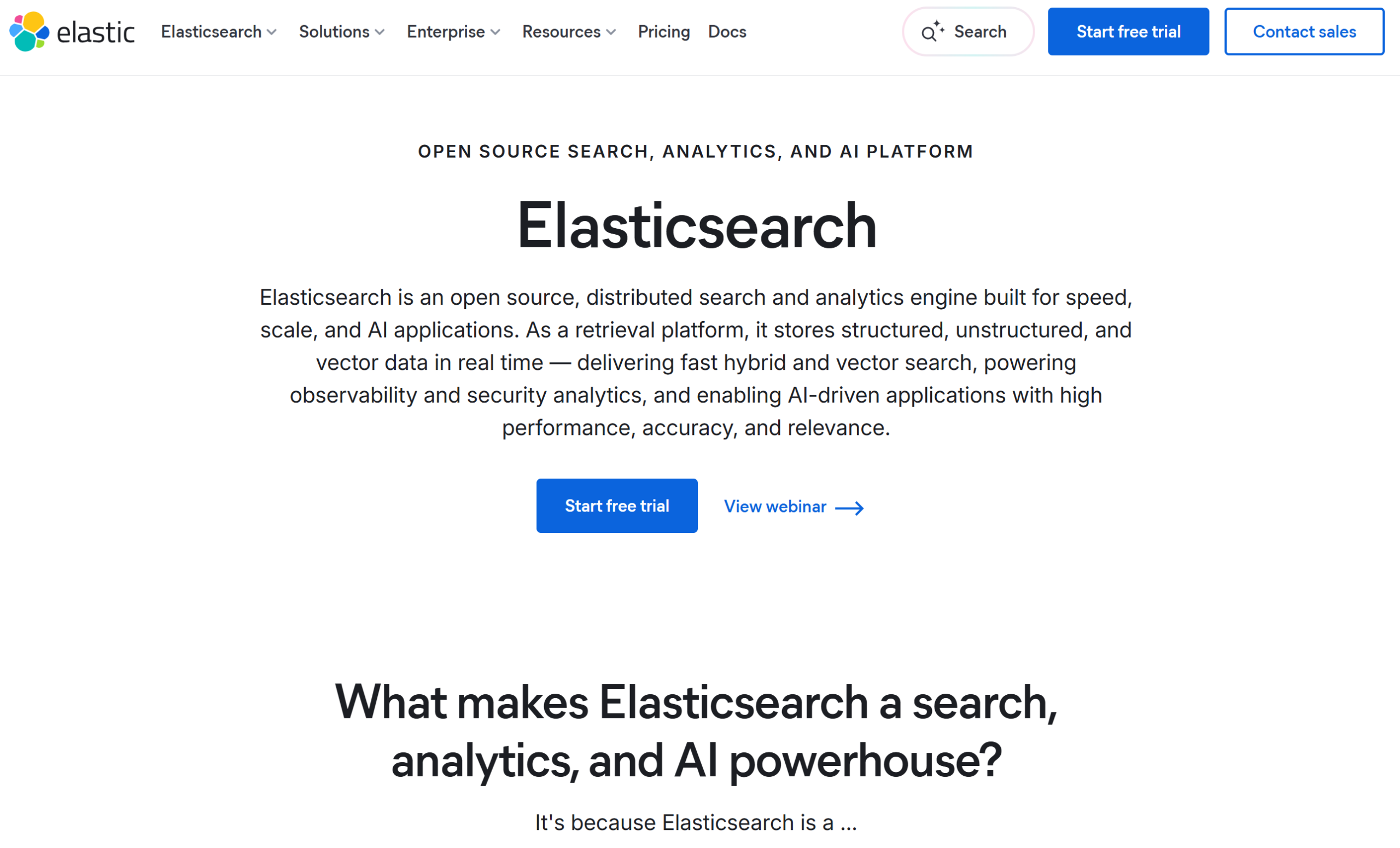
Elastic is a company specializing in data search and analysis solutions, best known for its flagship product, Elasticsearch. This platform enables data to be searched, analyzed and visualized in real time, facilitating informed decision-making. Elastic also offers complementary tools such as Kibana for visualization and Logstash for data ingestion, forming a complete suite for data management.
With robust scalability and security features, Elastic adapts to the needs of businesses, whether monitoring performance or optimizing user experiences. By adopting Elastic solutions, organizations can make the most of their data and improve their operational efficiency.
Elastic offers 3 solutions designed for enterprise search, observability, and security. They are backed by a single technology stack and can be deployed anywhere.
Elastic Cloud: On Elastic Cloud, the choice is yours!
Run your solutions wherever and however you want. You can deploy them on Google Cloud, Microsoft Azure or Amazon Web Services. Elastic Cloud means freedom. The real Elasticsearch experience and flexible pricing.
Elastic Enterprise Search: Search everything, everywhere!
Give your teams a search experience that's as innovative as it is powerful. Integrate a preset search function into your website, app or online store. Everything becomes searchable, and it's that simple.
Elastic Observability: Observe your entire ecosystem!
Unify logs, indicators, traces and more, in a free, open Suite designed for speed. Monitor every element of your infrastructure for rapid problem resolution, and consistently deliver a flawless digital experience.
Elastic Security: Keep security threats at bay!
Unify prevention, detection and response, and combat threats on a massive scale. Operate security-related use cases: SIEM, malware prevention, threat scanning, cloud monitoring, and more.
Elastic has established itself as an must-have tool must-have the world of real-time data search and analysis. This open-source technology suite is revolutionizing the way companies collect, store, search, and visualize their data-whether it’s application logs, performance metrics, or complex business data. Designed to meet the challenges of modern big data, Elastic offers a distributed architecture capable of processing terabytes of data with remarkable speed and accuracy.
Elastic's strength lies in its ELK Stack (Elasticsearch, Logstash, Kibana), which forms a comprehensive and cohesive ecosystem. This holistic approach enables organizations of all sizes to transform raw data into actionable insights, while maintaining optimal performance even when dealing with massive volumes. The tool stands out in particular for its full-text search capabilities and advanced analytics features, which open up new horizons for data exploration.
What makes Elastic particularly appealing to technical teams is its architectural flexibility and its ability to adapt to a wide variety of environments. Whether you’re managing a cloud-native infrastructure, on-premises systems, or hybrid architectures, Elastic integrates seamlessly into your existing ecosystem while delivering exceptional processing power.
The Elastic ecosystem continues to evolve to meet the growing needs of modern businesses, regularly incorporating new features such as time-series analysis, vector search, and generative AI capabilities that position the platform at the forefront of technological innovation.
Elasticsearch offers a flexible pricing structure tailored to the diverse needs of organizations, ranging from free solutions for getting started to enterprise plans for mission-critical deployments. Elastic's pricing is structured around different service tiers and advanced features.
Prices vary depending on the number of nodes, data volume, and required features, with both cloud and on-premises hosting options available.
| Plan | Rates | Included |
|---|---|---|
| Free | Free | Elasticsearch, Kibana, Beats, Logstash, 3 nodes, basic features |
| Basic | Free | Monitoring, alerting, LDAP/Active Directory, Canvas |
| Gold | Starting at $95/month | Machine learning, encryption, SAML, hot-warm architecture |
| Platinum | Starting at $125/month | Graph analytics, Advanced alerting, IP filtering, JDBC driver |
| Enterprise | Upon request | Searchable snapshots, Third-party data, 24/7 priority support |
| Elastic Cloud | Starting at $16/month | Managed cloud solution, automated deployment, automatic scaling |
The free versionof Elasticsearch already offers an impressive set of features to get started with data search and analysis. It includes full access to Elasticsearch, Kibana for visualization, Beats for data collection, and Logstash for pipeline processing. This version supports up to three nodes and serves as an excellent foundation for development projects, prototypes, or small applications.
The Basic plan, which is also free, adds essential monitoring capabilities to track the health of your cluster, alerting features to notify you of issues, integration with LDAP and Active Directory for user management, and Canvas for creating custom visual reports. These additional features make it an attractive choice for teams that need more in-depth monitoring of their deployments.
With the Gold plan, you gain access to advanced features that truly transform your Elasticsearch experience. Built-in machine learning automatically detects anomalies in your data, identifies trends, and predicts future behavior-all without requiring prior data science expertise. Encryption of data at rest and in transit ensures the security of your sensitive information, while SAML authentication facilitates integration with your existing identity systems. The hot-warm architecture optimizes storage costs by automatically moving older data to less expensive storage nodes.
The Platinumtier further enhances the offering with graphical analysis capabilities that allow you to explore complex relationships within your data, revealing connections that might go unnoticed using traditional methods. Advanced alerting offers more sophisticated conditions and automated actions, IP filtering enhances security by controlling access based on network addresses, and the JDBC driver facilitates integration with existing applications and analytics tools. These features are particularly valuable for use cases involving security, fraud detection, and behavioral analysis.
The Enterpriseplan offers the full range of Elasticsearch capabilities, including features such as searchable snapshots, which allow you to search directly within backups without restoring them, significantly saving storage space. Third-party data management tools automate the data lifecycle by automatically moving data between different storage tiers based on its age and access frequency. 24/7 priority support ensures immediate assistance for critical deployments, with guaranteed response times and direct access to Elastic engineers.
Elastic Cloudoffers an attractive alternative for organizations that prefer to outsource infrastructure management. This managed solution eliminates the complexity of deployment and maintenance, featuring automatic scaling that adapts to your workload needs, automatic backups, and built-in high availability. Pricing starts at $16 per month for small instances, with pay-as-you-go billing that allows you to optimize costs based on your actual needs.
Elastic Cloud pricing varies based on several factors: the deployment region, instance size (CPU, RAM, storage), the desired level of redundancy, and the enabled features. AWS, Google Cloud, and Azure regions are available, each with its own pricing structure. For large-scale deployments, Elastic offers volume discounts and annual contracts that can significantly reduce costs.
Support optionscomplement the pricing plans with different levels of assistance. The standard support included with paid licenses covers general technical questions with a response time of 48 hours. Priority support reduces this response time to 4 hours for critical issues, while premium support offers direct access to Elastic solution architects for personalized guidance on optimizing and scaling your architecture.
For organizations with specific needs, Elastic also offers custom licensing optionsthat may include tailored features, dedicated integrations, or contractual terms designed to meet specific regulatory requirements. These arrangements are negotiated directly with Elastic’s sales teams and may include consulting and training services.
It is important to note that the prices listed are base rates, which may vary depending on the configuration chosen and the volume of data processed. For on-premises deployments, licenses are generally billed per node per year, with volume discounts available for large-scale deployments. Migrating between different plans is possible and relatively straightforward, allowing you to start small and scale up as your project’s needs evolve.
Before choosing a plan, take the time to assess your actual needs in terms of data volume, required features, and the criticality of your use case. The free version already allows you to carry out substantial projects, while the paid versions provide the robustness and advanced features necessary for enterprise deployments.
1️⃣ If you are a freelancer or consultant:
For your data analysis and search needs as a freelancer, Algolia is an excellent, more affordable alternative to Elastic. This search-as-a-service solution lets you easily integrate advanced search features into client projects without having to manage complex infrastructure. The API is particularly well-documented, and you can get started quickly with transparent pricing. Meilisearch is also a smart choice if you’re working on open-source projects or for clients with tight budgets. This tool offers remarkable performance for text search with minimal setup, perfect when you need to deliver quickly without compromising on quality. Finally, Typesense deserves your attention for its ease of deployment and smart search features, making it ideal for e-commerce sites or content platforms you’re developing for your clients.
2️⃣ If you are a startup:
Startups need solutions that scale with their growth without eating up their entire tech budget. OpenSearch stands out as the most credible open-source alternative to Elastic, offering the same core features without the licensing restrictions. You Benefit from active community and can easily migrate from Elasticsearch if needed. ClickHouse is must-have your startup handles large volumes of analytical data, offering exceptional performance for OLAP queries and controlled costs. For a more modern approach, Vector combined with Grafana Loki offers a comprehensive and cost-effective observability stack. This combination allows you to manage logs, metrics, and traces in a unified manner-crucial for maintaining your product’s performance while controlling infrastructure costs during growth phase.
3️⃣ If you are a small business or an SME:
Established companies are looking for robust solutions with professional support. Splunk remains the gold standard for log analysis and security, particularly well-suited if you have strict compliance requirements or if your IT team prefers a packaged solution with commercial support. Datadog excels at monitoring modern applications and offers a superior user experience with intuitive dashboards that your teams will easily adopt. For internal search or website search needs, Azure Cognitive Search or Amazon CloudSearch are managed alternatives that eliminate maintenance burdens. These cloud services allow you to focus on your core business rather than the technical management of indexes and clusters, while benefiting from the reliability and scalability of major cloud providers.
Otherwise, these other software programs may also be a good alternative to Elastic.No resources currently available.