
Lark
6 mois offerts sur le plan "Pro"








✅ Informations sur le deal :
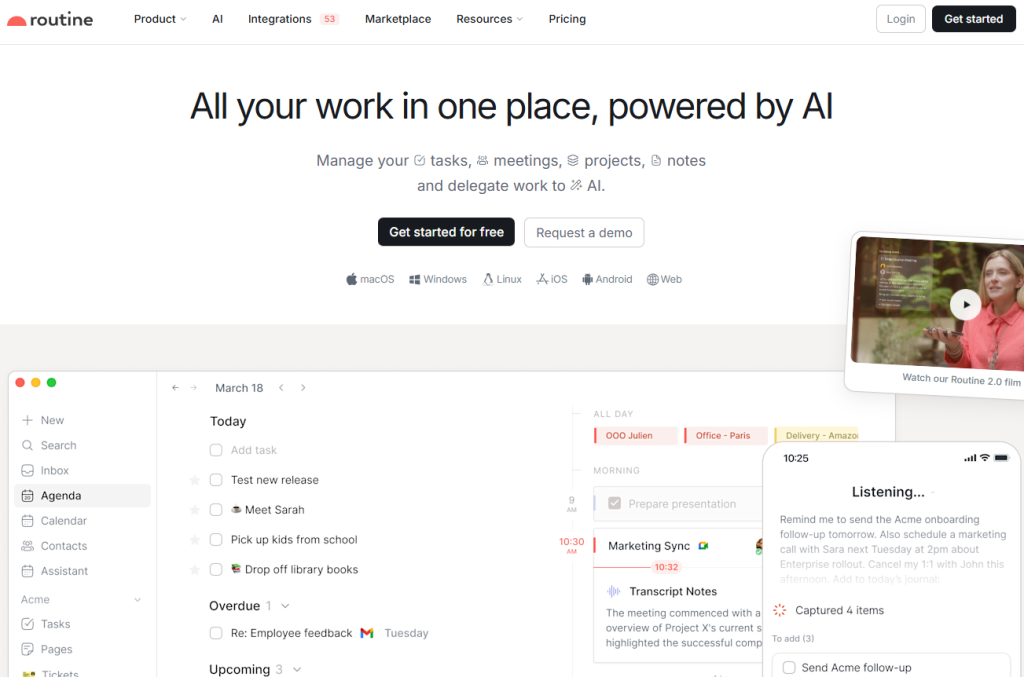
Routine brings your tasks, calendar and notes together in a single interface, built for people who spend their days switching between a calendar, a to-do list and a note-taking app. Its universal inbox pulls together tasks, messages and notifications from your other services, while time blocking lets you drag tasks straight into your calendar to reserve real working slots. Capture happens through a desktop hotkey, or by voice from mobile when you are away from your desk.
For independent professionals, the built-in time tracking makes client billing easier, since each task can be timed without reaching for a separate tool. The app connects to more than 50 integrations (Google Calendar, Slack, Outlook, Linear, Asana, Notion and others) with two-way syncing, and the AI meeting notes work across Meet, Zoom and Teams without inviting a bot into the call. Routine runs on macOS, Windows, Linux, iOS, Android and the browser, with an offline mode.
Capture everything:
Automate and delegate: Add specialized AI agents to your workforce, automate complex processes and focus on taking key decisions.
Organize and plan:
Data model:
Make Routine your own by defining the entities you manipulate every day: customers, projects, candidates, bug reports, marketing initiative etc.
Extend as you grow:
Built for every team:
Routine brings together three things most professionals juggle across separate apps: your tasks, your calendar, and your notes. Instead of hopping between a to-do list, a calendar, and a note-taking tool, you work from a single workspace where everything is connected and, increasingly, driven by AI.
The heart of the product is a universal inbox that centralizes your tasks, messages and notifications so you stop losing time switching between services. Around it sits a quick capture system: a desktop hotkey lets you jot down a task in a second, attach the context it came from, and get back to what you were doing. That capture layer also works through voice, which is handy when you're away from your desk and simply want to offload something before it slips your mind.
On the AI side, Routine leans into features that go beyond a chatbot. Its meeting notes feature transcribes and summarizes calls, then turns action items into tasks automatically. Worth noting for anyone wary of intrusive tools: it works across platforms without any meeting bot joining the call, and it plugs into Google Meet, Zoom, Teams, Discord, and Slack. Beyond that, you can build AI agents and automations to handle repetitive processes, delegating the busywork and keeping your attention on decisions that actually matter.
Planning is where the calendar and task sides meet. You lay out tasks and events on a single planner, then drag tasks directly onto your calendar to block time for the work that counts. Recurrences, labels, priorities, and projects keep everything organized without much ceremony, and recurring tasks stay on autopilot once set up.
For teams and power users, Routine gets deeper. A customizable data model lets you define the objects you deal with every day, whether that's clients, projects, candidates, or bug reports, and turn the app into something closer to an operating system for how you work. Custom databases, flexible views for dashboards and reports, and separate workspaces for access control round out the picture. It connects to 53 integrations with two-way sync, runs on macOS, Windows, Linux, iOS, Android, and the web, and keeps working offline.
Routine keeps its pricing simple with four paid tiers plus a free plan, and the gap between them is mostly about how much AI you use and whether you're working solo or with a team. Prices below are shown in US dollars, per month, as listed on Routine's official pricing page, so it's worth confirming the exact currency and billing cycle at checkout before publication.
| Plan | Price | What the plan unlocks |
|---|---|---|
| Free | Free forever | Tasks, calendars and notes, AI assistant, AI voice commands, offline mode, 3 integrations, 3 custom databases, 250 AI credits |
| Personal | $5 / month | Everything in Free, plus time blocking, event coloring, exporting, unlimited file uploads, 10 integrations and 500 AI credits |
| Professional | $10 / month | Everything in Personal, plus AI meeting notes, AI agents and automations, time tracking, contextual capture, unlimited integrations and 7,000 AI credits |
| Business | $15 / seat / month | Everything in Professional, plus organizations, workspaces, access control, versioning, consolidated billing, priority support and 10,000 AI credits per seat |
| Enterprise | Custom pricing | Everything in Business, plus unlimited history, compliance, audit logs, analytics, user provisioning and a dedicated success manager |
1️⃣ If you're a freelancer or consultant:
Your priority is usually a single, low-friction place to run your day and keep track of client work. Todoist is the natural pick if you want something lighter and faster to adopt, with excellent task capture and no learning curve. Sunsama takes the opposite approach, building a calm daily planning ritual that pulls your tasks and calendar into one intentional agenda, which suits anyone who wants to plan deliberately rather than react. If your friction is mostly around scheduling, Akiflow consolidates tasks and calendar events into one command-driven view, while Motion leans on AI to auto-schedule your work into open slots so you spend less time arranging your own calendar.
2️⃣ If you're a startup:
Here the goal is often to consolidate tools and move fast without paying for five overlapping subscriptions. Notion is the reference for an all-in-one workspace, combining docs, notes, and databases with enormous flexibility, though it asks for more setup. Coda sits in similar territory, blending documents and structured data into interactive tools your team can actually operate. For product and engineering teams that value speed and focus, Linear offers a fast, opinionated issue and project tracker, and Taskade brings AI-assisted task management and collaboration into a lighter package well suited to small, fast-moving teams.
3️⃣ If you're a small or medium business:
At this stage the emphasis shifts toward structured project management and keeping everyone aligned as operations scale. ClickUp is the most feature-dense option, covering tasks, docs, goals, and dashboards in one platform. Asana and Monday.com are strong choices when you want clear workflows, visual project views, and reporting that non-technical team members will actually use. Basecamp takes a deliberately simpler, calmer approach to team coordination, and Zoho Projects is worth a look if you're already invested in the broader Zoho suite and want project management that fits alongside your other business tools.
Sinon, ces autres logiciels peuvent également être une alternative intéressante à Routine.Aucune ressource actuellement disponible.