DigitalOcean
5 000$ de crédits







✅ Informations sur le deal :
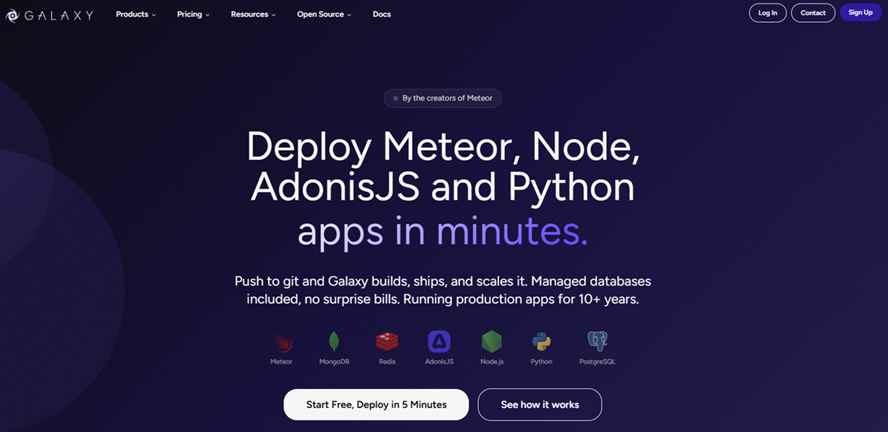
Galaxy Cloud is a full-stack Platform-as-a-Service (PaaS) built by the creators of Meteor.js, designed to let developers deploy, scale, and monitor their applications in minutes without dealing with complex infrastructure. The platform supports a wide range of stacks Meteor, AdonisJS, Node.js (Express, Fastify, NestJS, Next.js), Python (Django, FastAPI, Flask) and is the only PaaS on the market offering managed MongoDB clusters alongside PostgreSQL and Redis, all provisionable in one click with automatic backups, scaling, and security built in. With features like Git-based deployments from GitHub, GitLab, or Bitbucket, zero-downtime deployments, one-click scaling, instant rollbacks, automatic SSL certificates, and built-in DDoS protection, Galaxy positions itself as the developer-friendly alternative to AWS, Railway, Render, and Heroku without the surprise bandwidth bills.
What truly sets Galaxy apart is its pricing transparency and support quality: unlimited network bandwidth and domains are included on all plans, a free Sandbox plan is available forever with no expiration, and every customer gets access to real engineers not bots or forum threads for support. Backed by over 10 years of running production workloads since 2015, and trusted by companies like Planable, Ledgy, and WeAreDevelopers, Galaxy is particularly well suited for teams migrating from Heroku or MongoDB Atlas who want a simpler, more cost-effective cloud experience where infrastructure is handled for them so they can focus entirely on shipping their product.
Deploy, scale, and monitor with no costs surprises:
The cloud platform built for developers who want to code, not configure infrastructure.
Choose Your Stack. We Handle the Rest:
Managed Databases. Zero Maintenance:
Provision MongoDB, PostgreSQL, or Redis in one click. Automatic backups, scaling, and security, so you can focus on your app.
Why Teams Choose Galaxy Over Railway, Render, and Heroku:
Galaxy is a full-stack cloud platform built by the creators of Meteor, designed for developers who want to ship and scale applications without dealing with infrastructure complexity. Rather than positioning itself as a generic cloud provider, it focuses on a narrow set of stacks and handles the rest itself.
The platform supports Meteor, AdonisJS, Node.js, and Python applications, alongside managed databases including MongoDB, PostgreSQL, and Redis. That breadth matters less than the depth: each supported stack gets genuinely tailored treatment, not a one-size-fits-all container experience.
Galaxy's billing model is usage-based: you pay only for the containers you actually run, calculated by the minute. There are no fixed monthly seats or per-user charges. Pricing varies by plan tier and container size (measured in RAM and compute units). The figures below reflect Meteor app hosting on monthly billing; Web Apps hosting follows a similar structure.
| Plan | Price per hr / GB | Key inclusions |
|---|---|---|
| Free (Sandbox) | $0 | Push-to-deploy, automatic SSL, shared MongoDB, Meteor domains only |
| Essentials | $0.08 / hr / GB | Custom domains, Prerender SEO, instant rollback, DDoS mitigation, unlimited containers |
| Professional | $0.11 / hr / GB | Autoscaling (triggers), Monti APM, IP whitelisting, Galaxy API access, IPv6 support |
| Custom / Enterprise | On request | Private cluster, VPC peering, custom container sizes, scaling discounts, 24/7 premium support |
| Savings Plan (annual) | 30% discount on compute | One-year upfront commitment, non-refundable, auto-renewed annually |
By way of illustration, an Essentials container running on Standard specs (1 GB RAM / 1 ECU) 24/7 for a full month costs approximately $58/month. Upgrading the same container to Professional adds roughly $21/month for the autoscaling, APM, and API access. The billing cycle runs from the beginning to the end of each month, invoiced at the start of the following month.
1️⃣ If you are a freelancer or consultant:
If you're working solo or in a small team and need to ship client projects quickly, a few platforms stand out. Vercel is excellent for frontend-heavy projects and Next.js applications: deployment is near-instantaneous from a Git push, and the free tier is generous. Clever Cloud is a French PaaS with solid multi-language support (Java, Node.js, PHP, Python, Ruby) that works well for full-stack projects where you want European data residency and a pay-as-you-go model without heavy ops overhead. Cloudways is another option if your client projects tend to run on managed WordPress or PHP stacks: it abstracts infrastructure across multiple cloud providers and is particularly beginner-friendly on the server management side.
2️⃣ If you are a startup:
Startups that need to move fast but also want production-grade infrastructure have good options. DigitalOcean remains one of the clearest on pricing and offers an App Platform for containerized deployments that's straightforward to use alongside managed databases and object storage. Supabase is worth considering if your architecture leans toward PostgreSQL and you want an integrated backend (auth, storage, real-time, edge functions) without managing separate services. Appwrite takes a similar approach with a self-hostable backend-as-a-service that covers auth, databases, storage, and functions, particularly suited to startups that want full control over their data from day one. Bubble is relevant if your founding team is non-technical or building an MVP quickly on no-code principles, though it comes with trade-offs in performance and customization at scale.
3️⃣ If you are a SMB:
For established small and medium businesses running real production workloads, the priorities shift toward reliability, support quality, and cost at volume. Google Cloud and IBM Cloud both offer enterprise-grade infrastructure with extensive compliance certifications, support for complex architectures, and professional support tiers, though both come with steeper learning curves than developer-focused PaaS options. OVH Cloud and OVH Public Cloud are particularly relevant for European organizations that prioritize data sovereignty, competitive compute pricing, and GDPR compliance without managing everything in-house. DuploCloud takes a different angle: it's a DevOps automation layer that sits on top of AWS, GCP, or Azure, helping teams that already have cloud commitments reduce the engineering overhead of managing their infrastructure.
Sinon, ces autres logiciels peuvent également être une alternative intéressante à Galaxy (ex Meteor Cloud).Aucune ressource actuellement disponible.